- Category:
- Crimes and repression
- Front:
- Poland
- Date:
- 13 April 1943
- Author:
- Łukasz
- Tags:
- Katyn massacre, Poland, Soviet Union, propaganda
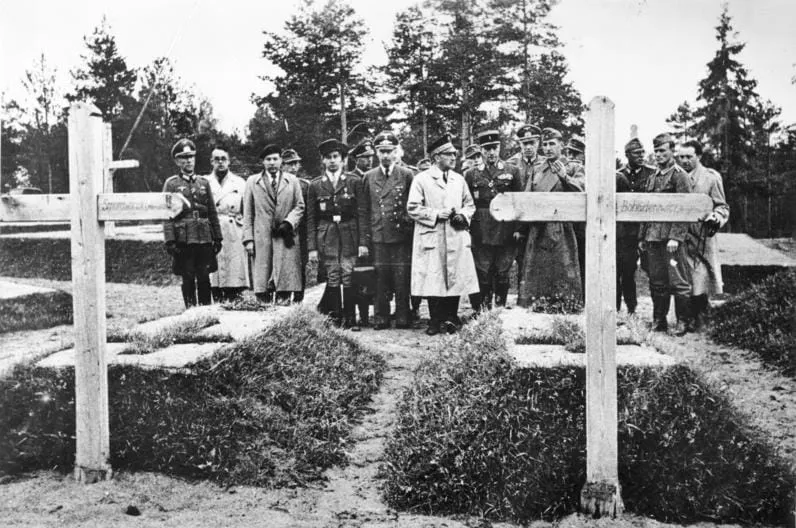
On 13 April 1943 Berlin radio announced that in a forest near Katyn, not far from Smolensk, the German army had found mass graves of Polish officers. According to the announcement they held some 10,000 men who had been taken prisoner by the Red Army in 1939 and shot by the Soviet political police. Two days earlier the German Transocean agency had put out a similar report, but it was the broadcast from Berlin, repeated by the press and radio stations of all occupied Europe, that brought the graves to the world’s attention.
Some war chronologies speak of the graves of Poles “allegedly” killed by the Soviets. That cautious word suited April 1943, when the news came from German propaganda, but today it is no longer needed. The crime was committed by the NKVD, carrying out a decision of the Soviet Politburo of 5 March 1940, and the Soviet Union itself admitted it on 13 April 1990 – exactly 47 years after the Berlin announcement. The figure given by the Germans, on the other hand, was inflated: the Katyn Forest held about 4,400 prisoners from the camp at Kozelsk, not 10,000–12,000.
The announcement and Goebbels’s campaign
The Germans had known of the graves at Goat Hill (Kozie Góry) since the winter, and had begun exhuming them at the end of March. The decision on when and how to make the matter public was taken by the propaganda minister, Joseph Goebbels. As early as 9 April he noted in his diary that Polish mass graves had been found near Smolensk, and he immediately grasped what use he could make of them. After the defeat at Stalingrad and the proclamation of “total war”, the Reich needed an argument that would frighten Europe with the spectre of Bolshevism and divide the Allies. The murder of thousands of Polish officers, committed by an ally of Britain and the United States against citizens of the very state for whose sake the British had gone to war, was exceptionally well suited to the purpose.
The campaign was launched on a grand scale. Newspapers in the Reich, in its allied states and in the occupied countries of Europe printed photographs of the exhumations, lists of names and descriptions of gunshot wounds to the back of the head. In the General Government, the German-controlled papers known to Poles as the “reptile press” (gadzinówki) published list after list of those identified. On 17 April the Ilustrowany Kurier Polski reported that Generals Mieczysław Smorawiński and Bronisław Bohaterewicz had been identified among the dead. Loudspeakers in the streets of Polish towns read out the names. On the same day Goebbels wrote that the Katyn affair was turning into a “gigantic political affair” that might have far-reaching consequences.
The Germans also wanted outside witnesses to confirm their reports. Even before the announcement, on 10 and 11 April, they brought to Katyn a group of Poles from the General Government that included the writer Ferdynand Goetel and the journalist Jan Emil Skiwski. Goetel went with the knowledge of the Polish underground; Skiwski, who collaborated with the occupier, without it. Over the following weeks the forest was visited by journalists from neutral countries and from states allied with the Reich, and later also by prisoners from German Oflags, among them Polish, British and American officers. In May the writer Józef Mackiewicz went there, also with the underground’s consent.
The Polish Red Cross Technical Commission
The occupiers also demanded that the Polish Red Cross go to the site. Its Executive Board in Warsaw found itself in a difficult position. Refusal would leave the exhumation entirely in German hands, while agreement risked the organisation’s name being used by German propaganda. After deliberation, and in agreement with the Home Army, the Red Cross secretary general, Kazimierz Skarżyński (PL), set up a strictly technical commission. Its task was to exhume and identify the bodies and notify the families, not to make political pronouncements. The commission flew from Warsaw to Smolensk in a German aircraft on 15 April, and by the next morning it was at Goat Hill.
The Poles worked at Katyn until 7 June, in small teams that relieved one another. The medical examinations and identification were directed by the Kraków forensic pathologist Marian Wodziński (PL). Members of the commission went through the documents, letters, notebooks and diaries found on the dead. None of the entries went beyond the spring of 1940. On this basis, as well as from the condition of the bodies and the age of the pine trees planted on the graves, they had no doubt when the murders had taken place. Skarżyński, however, avoided any public declarations. As early as 20 April the Executive Board sent his first report to the International Committee of the Red Cross in Geneva. The commission passed its conclusions about the perpetrators through secret channels to the Polish underground and to the government in London, and gave the Germans no statement that they could use for propaganda.
By the time work stopped, more than 4,200 bodies had been exhumed, of which about 2,700 were identified. The dead were reburied in mass graves, the two generals in separate graves. The last, eighth grave could not be fully exhumed: when the Germans halted the work on 7 June because of the summer heat, about 200 bodies remained in it.
The International Medical Commission
The second pillar of the German campaign was to be the opinion of foreign scientists. At the invitation of the Reich health minister, Leonardo Conti, an International Medical Commission was formed of twelve specialists, mostly in forensic medicine. The Germans failed to recruit doctors from Sweden, Spain, Portugal or Turkey. In the end only one member of the commission, François Naville of Geneva, came from a neutral country. The others came from states allied with or occupied by the Reich: Hungary, Bulgaria, Romania, Italy, Finland, Slovakia, Croatia, Denmark, the Netherlands, Belgium and the Protectorate of Bohemia and Moravia. Vichy France sent an observer.
The doctors were in Smolensk and the Katyn Forest from 28 to 30 April 1943. They elected the Hungarian Ferenc Orsós (PL) as their chairman. They chose the bodies for examination themselves, carried out several autopsies and spoke to local witnesses. Orsós examined under the microscope the trunks of the young pines used to camouflage the graves and concluded that they had been transplanted in 1940. The report signed on 30 April stated that the victims had been killed by shots to the back of the head and buried in the spring of 1940. It did not name the perpetrator outright, but in 1940 the Smolensk area had been in Soviet hands, so the conclusion was obvious.
The British and American governments ignored the report. The Foreign Office stressed that the commission had been assembled by the Germans and that its chairman had a reputation as a supporter of the Reich. After the war some of its members who found themselves in the Soviet zone were forced to retract their signatures: the Bulgarian Marko Markov and the Czech František Hájek did so under pressure from the new authorities. Naville, the Swiss member, upheld the 1943 findings to the end of his life.
Moscow’s response
The Kremlin responded quickly. On 15 April Moscow radio broadcast a statement by the Sovinformburo, printed the next day in Pravda. It called the German reports “monstrous fabrications” and claimed that in 1941 the Polish prisoners had been employed on construction work west of Smolensk and that in the summer of that year, after the Soviet withdrawal, they had fallen into the hands of the Germans, who had murdered them. The statement also suggested that the Germans had mistaken the Polish graves for the archaeological burial mounds at nearby Gnezdovo.
This version contradicted what Moscow had said earlier. When, after the Sikorski–Maisky agreement and the amnesty of 1941, the Poles were forming an army in the USSR and searching for thousands of missing officers, the Soviet authorities had never once mentioned that the prisoners had fallen into German hands. During a conversation in the Kremlin in December 1941, at the time of the Sikorski–Stalin declaration, Joseph Stalin had told General Władysław Sikorski and General Władysław Anders that perhaps the officers had escaped to Manchuria. Now it suddenly turned out that he knew where they had been in 1941.
The Polish government and the appeal to the Red Cross
For the government in London the announcement from Berlin confirmed its worst fears. For a year and a half the Poles had been gathering accounts of the camps at Kozelsk, Starobilsk and Ostashkov, and they knew well that in the spring of 1940 the prisoners’ letters to their families had suddenly stopped. On 16 April the Minister of National Defence, General Marian Kukiel, issued a statement describing the fruitless efforts to establish the fate of the missing men and announcing an approach to the International Red Cross. The next day, 17 April, the Polish government issued a declaration that condemned German propaganda and recalled German crimes against Poles, but at the same time asked the Committee in Geneva to investigate the matter on the spot.
The Polish step coincided with a German one: almost simultaneously, the Germans, through their own Red Cross, made the same request to Geneva. For Moscow this was a gift. From then on the Soviet press could write of collusion, and on 19 April Pravda published an article entitled “Hitler’s Polish Collaborators”. The Committee in Geneva replied that it could undertake the task only at the request of all the parties concerned, and so of the USSR as well. The Soviet Union, needless to say, made no such request, and the initiative collapsed.
Churchill and Roosevelt
The Western Allies did not want to risk a quarrel with Moscow at a time when the Red Army was bearing the main burden of the land war and Stalin was demanding a second front. On 15 April Winston Churchill had Sikorski to lunch at Downing Street. According to the Polish record, the Prime Minister did not rule out that the German reports were true, remarking that the Bolsheviks could be very cruel, but advised against raising the matter publicly. In conversations with the Soviet ambassador, Ivan Maisky, Churchill gave assurances that even if the German version proved true, it would not change British policy towards the USSR.
President Franklin Delano Roosevelt took a similar line. In his correspondence with Stalin he called the Polish request a mistake but asked him not to break off relations with the Poles over it. The British pressed Sikorski to withdraw his appeal to Geneva, and in May the ambassador to the Polish government, Owen O’Malley, produced a report that convincingly pointed to Soviet guilt. The British government received it with embarrassment and filed it away in the archives.
Place in the war
Stalin used the Polish request to achieve an aim he had been pursuing for months. On 21 April he wrote to Churchill and Roosevelt that Sikorski’s government was collaborating with Hitler and announced a break in relations. The pleas of the two leaders were of no avail. During the night of 25–26 April the People’s Commissar for Foreign Affairs, Vyacheslav Molotov, handed the Polish ambassador, Tadeusz Romer, a note in which the USSR “interrupted” relations with the Polish government, accusing it of taking part in a campaign of slander conducted by the Germans. Romer refused to accept the note, but that changed nothing. The break in relations, presented as a suspension, was never reversed.
The Katyn crisis deprived the government in London of its only channel of communication with Moscow just as the Red Army was approaching Poland’s pre-war borders. Stalin already had an alternative in hand. In March 1943 the communist Union of Polish Patriots, headed by Wanda Wasilewska, had been set up in Moscow, and in May the USSR agreed to the formation under its auspices of a Polish division named after Tadeusz Kościuszko. From these seeds grew the authorities that Stalin imposed on Poland in 1944. Sikorski was killed on 4 July 1943 in an air crash off Gibraltar, and his successors were unable to restore relations with the USSR.
The Katyn lie outlived the war. In the autumn of 1943, after Smolensk had been retaken, the NKVD fabricated evidence and witnesses, and in January 1944 the Burdenko commission (PL) announced that the Poles had been murdered by the Germans in the autumn of 1941. The USSR included Katyn in the indictment at Nuremberg, but the tribunal did not accept the charge and left it out of the judgment. In 1951–1952 the matter was investigated by a committee of the United States Congress, which found the NKVD guilty. In communist Poland the truth about Katyn could not be spoken.
The Soviet Union admitted the crime on 13 April 1990, in a TASS statement issued during a visit to Moscow by the Polish president, Wojciech Jaruzelski. In 1992 Russia handed Poland documents including the Politburo decision of 5 March 1940, under which nearly 22,000 Polish citizens were killed in the spring of 1940 – the full scale of the Katyn massacre. The Berlin radio announcement of 13 April 1943 told the truth about the perpetrator, but it was broadcast by a state that was itself waging a war of annihilation in the east and was at that very moment murdering the Jews of occupied Poland. This duality allowed Stalin for almost half a century to present the NKVD’s crime as a German one, and the Western Allies to remain silent for the sake of the coalition’s unity.
Places·Katyn
Sources
Meanwhile
(04)Elsewhere, within a week.
- 15 April 1943 · Western FrontThe raids on Stuttgart and PilsenOn the night of 14–15 April 1943 the RAF bombed Stuttgart. Two nights later a raid on the Škoda works at Pilsen missed its target, and 36 bombers were lost.
- 18 April 1943 · PacificThe death of Admiral YamamotoOn 18 April 1943 American P-38 fighters shot down Admiral Yamamoto’s aircraft over Bougainville. The ambush was made possible by breaking a Japanese code.
- 18 April 1943 · MediterraneanThe Palm Sunday massacreOn 18 April 1943 US P-40s and British Spitfires shattered a Ju 52 formation off Cape Bon. The Axis air bridge to Tunisia began to collapse.
- 7 April 1943 · DiplomacyBolivia declares war on the AxisOn 7 April 1943 President Enrique Peñaranda decreed that Bolivia was at war with Germany, Italy and Japan. The country supplied the Allies with tin.
Related events
(04)The same battle, people or subject.
- 25 April 1943 · PolandUSSR breaks relations with the Polish governmentOn the night of 25-26 April 1943 Molotov read Ambassador Romer a note breaking relations with the Polish government. The pretext was an appeal to the Red Cross.
- 16 March 1943 · PolandThe discovery of the Katyn gravesIn March 1943 the German Secret Field Police examined mass graves of Polish officers in the Katyn Forest. The world learned of them only in April.
- 4 July 1943 · PoliticsThe death of General SikorskiOn 4 July 1943 a Liberator carrying General Władysław Sikorski crashed into the sea just after take-off from Gibraltar. Sixteen died; only the pilot survived.
- 16 March 1943 · DiplomacyStalin demands a second frontIn March 1943 Congress extended Lend-Lease, and on 15–16 March Stalin warned Churchill and Roosevelt against further delay to an invasion of France.