Equipment
The North American B-25 Mitchell
The medium bomber of the Doolittle Raid, which became a flying battery of guns in the Pacific and also flew over Italy, Burma, the Netherlands and Russia.
- Role:
- medium bomber
- State:
- United States
- Maker:
- North American Aviation
- First flight:
- 19 August 1940
- Built:
- 9,816
- Author:
- Natalia
- Updated:
- 1 November 2026
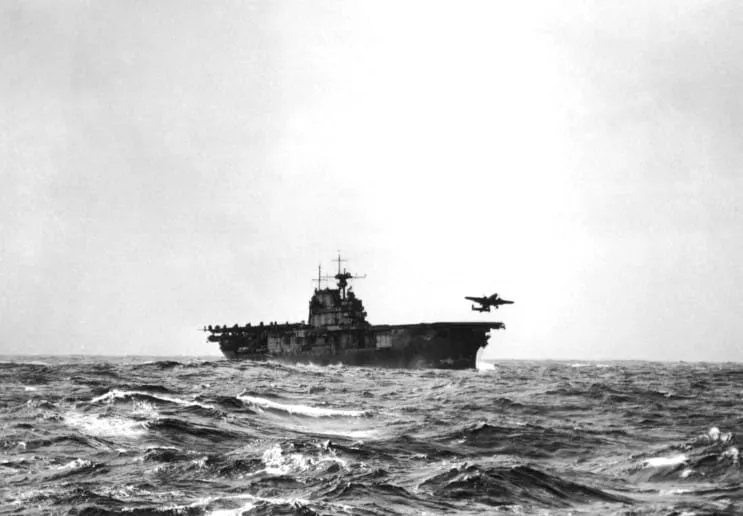
The North American B-25 Mitchell was a twin-engined medium bomber, one of those aircraft that worked on every front and seldom made the headlines. The exception was a single day: in April 1942 sixteen Mitchells took off from an aircraft carrier and bombed Tokyo, the first good news for Americans since Pearl Harbor. More important, though, was its later career in the Pacific, where the bomber was turned into a strafer with a battery of guns in the nose, deadly to Japanese ships and airfields. It also flew over Italy, Burma, the Netherlands and the Eastern Front, in the colours of at least seven countries.
From prototype to Mitchell
In 1938 the North American works at Inglewood, California, built a twin-engined prototype for an Army Air Corps competition for an attack bomber. Douglas won the competition, but the war in Europe meant that the army needed every modern bomber it could get. In September 1939 it ordered 184 aircraft of an enlarged version before any of them had flown. The first production B-25 flew on 19 August 1940. The aircraft was named after William “Billy” Mitchell, the general who after the First World War argued that bombers could sink any battleship and was court-martialled for it. It was sturdy, easy to fly and forgiving of mistakes, which mattered enormously when young crews were being trained in large numbers.
From the deck of the Hornet
When, after Pearl Harbor, the navy was looking for a way to strike Japan, James Doolittle chose the B-25B: it had enough load and range, and wings short enough for a dozen or more aircraft to fit on a carrier’s deck. On 2 February 1942 two Mitchells took off on trial from the Hornet off the Virginia coast. On 18 April sixteen bombers took off from its deck far from Japan, bombed Tokyo, Yokohama, Nagoya, Kobe and Osaka, and flew on to China. The Doolittle Raid did little serious damage, and none of the aircraft came back: fifteen crashed or were abandoned over China, the sixteenth landed near Vladivostok. Japan answered with the Zhejiang–Jiangxi campaign, in which many Chinese civilians died, and its naval staff brought forward the plan to attack Midway.
A battery in the nose
In New Guinea the Mitchells ran into the same problem as other bombers: from high altitude they could not hit manoeuvring ships. George Kenney, the air commander in Australia, looked for another way. Major Paul “Pappy” Gunn and the mechanics of the Townsville workshops cut off the B-25s’ glazed noses and put heavy machine guns in their place. Aircraft converted in this way attacked at mast height: first their fire swept the gun crews from the decks, then they dropped bombs that skipped off the water like stones and struck the ship’s side. In the Battle of the Bismarck Sea at the beginning of March 1943 they played the main part in destroying a Japanese convoy bound for Lae. That autumn dozens of Mitchells struck Rabaul at low level, its airfields and its harbour.
The factory took up the idea. The G and H versions were given a 75 mm cannon in the nose, and the most numerous, the J, could have more than a dozen forward-firing guns. Marine Corps airmen also flew Mitchells, in the PBJ version with radar and rockets, hunting ships at night around Iwo Jima. From the Aleutians the Mitchells of the Eleventh Air Force attacked the Japanese Kurils, in the worst weather of the war.
The Mediterranean and Burma
In southern Europe B-25s formed the core of the Twelfth Air Force’s medium bomber force. They bombed the ports of Tunisia, Sicily and Sardinia, and on 19 July 1943, in the first raid on Rome, they struck Ciampino airfield. On 15 February 1944, 47 Mitchells dropped bombs on the abbey of Monte Cassino, after the heavy bombers. Later, from Corsica, they attacked bridges and railways in northern Italy.
In Asia the first B-25s reached China in 1942, in a small bomber squadron attached to Claire Chennault’s fighters. The Mitchells of the 1st Air Commando Group supported the second Chindit expedition behind Japanese lines in Burma in 1944. In one of them, on 24 March 1944, Orde Wingate was killed, the creator of those forces. In March 1945 B-25s tried to break the walls of the fort at Mandalay with heavy bombs, knocking only a narrow breach in them.
Allies and the balance
The RAF received several hundred Mitchells, which flew in No. 2 Group and later in the tactical air forces over France and the Netherlands. In December 1942 their inexperienced crews were withdrawn from the raid on the Philips works, but later the same squadrons, with the Dutch No. 320 Squadron, flew regularly. On 3 March 1945 RAF Mitchells and Bostons, aiming at V-2 rocket sites, bombed the Bezuidenhout district of The Hague because of an error in their data, killing more than five hundred residents. The Polish No. 305 Squadron (PL) flew Mitchells for a few months in the autumn of 1943 before converting to the Mosquito. Dutch Mitchells from Australia fought the Japanese over the Netherlands East Indies.
Under Lend-Lease the Soviet Union received 862 Mitchells, many of them ferried along the route through Alaska and Siberia; in May 1945 Soviet long-range aviation had several hundred of them. According to most tallies 9,816 were built, the greater part at the new factory in Kansas City; some sources count slightly more. After the war Mitchells flew for decades as trainers and in the air forces of more than a dozen countries. They went down in history, though, thanks to sixteen crews who one April morning took off from a deck from which a bomber had no business taking off.
Sources
Battles
(03)- 4–16 September 1943Capture of LaeOn 4–16 September 1943 Australian sea and air landings took Lae, and Salamaua on the 11th; the Japanese 51st Division escaped over the Saruwaged Range.
- 11 May 1944 – 27 January 1945Salween offensiveFrom May 1944 to January 1945 China's Expeditionary Force in Yunnan crossed the Salween, took Song Shan, Tengchong and Longling and reopened the road to China.
- 14 January – 28 March 1945Battle of Meiktila and MandalayJanuary–March 1945. Slim's Fourteenth Army crossed the Irrawaddy, took Meiktila and Mandalay and shattered the Japanese armies in central Burma.
In the chronicle
(18)1943
1944
- 5 February 1944The bombardment of the Kuril Islands
- 15 February 1944The destruction of the Abbey of Monte Cassino
- 29 February 1944The landing on Los Negros
- 6 March 1944Operation Thursday – the second Chindit expedition
- 6 March 1944The alarm in Western Australia
- 24 March 1944The death of Orde Wingate
- 8 December 1944The bombardment of Iwo Jima