United States
Jimmy Doolittle
Leader of the raid on Japan (1942), commander of the US Twelfth, Fifteenth and Eighth Air Forces (1942–1945), general (1985)
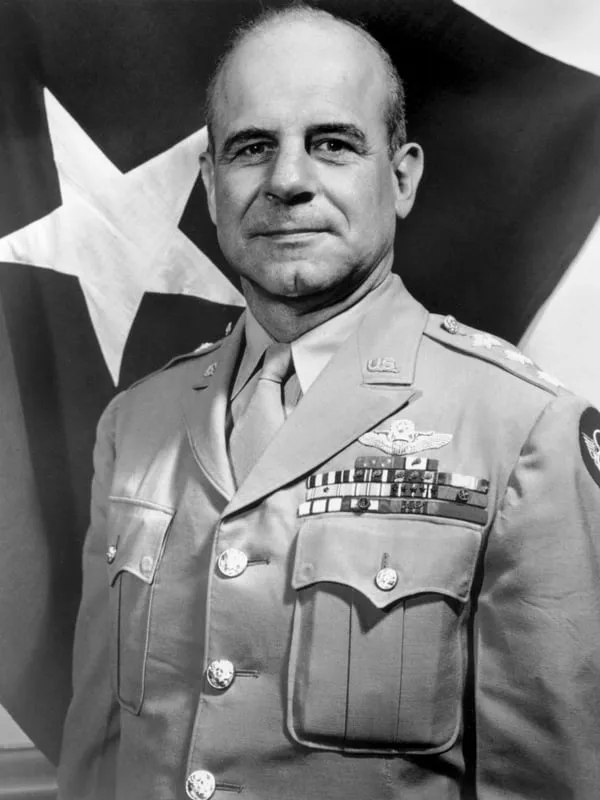
- Born:
- 14 December 1896, Alameda (California, United States)
- Died:
- 27 September 1993, Pebble Beach (California, United States)
- Author:
- Łukasz
- Photo:
- USAF, domena publiczna, Wikimedia Commons

James Harold Doolittle, known all his life simply as Jimmy, was one of those airmen who between the wars turned flying from a risky sport into a technology. The short, athletic son of a carpenter from Alaska earned a doctorate in aeronautical engineering, won the most important air races of the age and was the first to take off, fly a set course and land while looking at nothing but his instruments. In the history of the Second World War his name is linked above all with the raid of 18 April 1942, when sixteen bombers from the carrier Hornet bombed Tokyo and other Japanese cities. He went on to command large air formations in North Africa, Italy and England, and as commander of the Eighth Air Force he helped to destroy the German fighter arm before the invasion of Normandy.
Childhood in Alaska
He was born on 14 December 1896 in Alameda on San Francisco Bay, the only child of Frank Doolittle, a carpenter, and Rosa, née Shephard. His father went to Alaska during the gold rush, and his mother and the boy joined him in Nome. Slight and the smallest in his class, the boy quickly learned to fight; as a boxer he enjoyed considerable fame in the town. Before 1910 his mother moved with him to Los Angeles. In 1910, at the air meet at Dominguez Field, he saw an aeroplane for the first time. After high school he studied in Los Angeles and then at the School of Mines of the University of California, Berkeley.
Instructor and Army airman
In October 1917, six months after the United States entered the First World War, he broke off his studies and enlisted as a flying cadet in the Signal Corps Reserve. In March 1918 he was commissioned as a second lieutenant. He never reached France: the Army decided he would be more useful as an instructor, and for the rest of the war he trained pilots and gunners at airfields in California and Texas, later patrolling the Mexican border. Earlier, on 24 December 1917, he had married Josephine Daniels, with whom he spent exactly 71 years.
In 1920 he received a regular commission in the Army Air Service as a first lieutenant. On 4 September 1922 he flew a DH-4 from Pablo Beach in Florida to San Diego in 21 hours and 19 minutes with a single stop on the way – the first crossing of the American continent within one day. The same year he completed his degree at Berkeley, and the Army sent him on engineering courses and to the Massachusetts Institute of Technology. He took his master’s degree in 1924 for research into the accelerations acting on an aircraft in flight, and in June 1925 he already received his doctorate in aeronautics, one of the first in the United States. He liked to say that he wanted to combine pilot and engineer in one person, because the two did not understand each other.
In October 1925 he won the Schneider Trophy, the most prestigious air race in the world, in a Curtiss R3C seaplane. In 1926, during demonstrations for the Curtiss company in Chile, he broke both ankles, yet with his legs in plaster he still showed off the aircraft better than his competitors. In 1927 he became the first to fly an outside loop, a manoeuvre until then thought fatal to both pilot and machine.
Blind flying
Doolittle’s most important work in those years, however, was instrument flying. At the time fog, cloud and darkness killed more pilots than any enemy, because a man deprived of a view of the ground quickly loses his bearings and his sense of balance deceives him. Seconded in 1928 to a research programme funded by the Guggenheim Fund, Doolittle helped to develop, and was the first to test in flight, the artificial horizon and the gyroscopic directional gyro, as well as a precision altimeter and a radio guidance system. On 24 September 1929 at Mitchel Field on Long Island he took off in a hooded cockpit, flew a set course and landed, guided by his instruments alone. This experiment became the foundation of all-weather flying, without which there would have been neither regular airlines nor the night and winter bombing operations of the Second World War.
Shell and air racing
In February 1930 Doolittle left active service, retaining the rank of major in the reserve, and became head of the aviation department of the Shell oil company. He still flew in races: in 1931 he won the first transcontinental Bendix Trophy race, and in 1932 he set a speed record for landplanes and won the Thompson Trophy race in the Gee Bee R-1, an aircraft notoriously dangerous to fly. Having won the three greatest trophies of the age, he retired from racing, remarking that he had yet to hear of anyone in that line of work dying of old age.
Even more important for the coming war was that he persuaded Shell to invest in producing 100-octane aviation fuel, for which in the mid-1930s there were as yet no buyers, since no engines existed that could make use of it. Colleagues called the project “Doolittle’s million-dollar blunder”, but once the Army was won over to the new fuel its price fell to the level of ordinary aviation petrol. During the war high-octane fuel gave American and British aero engines a power that German engines could not match. In 1934 Doolittle sat on the Baker Board under Newton Baker, which examined the organisation of the Army Air Corps, and in 1940 he became president of the Institute of the Aeronautical Sciences.
Return to the Army and the Tokyo raid
On 1 July 1940, after the fall of France, he returned to active service as a major. He worked in Indianapolis and Detroit on converting car factories to aircraft production and went on a mission to Britain, from which he brought back information on the air forces of the warring states. In January 1942, after the attack on Pearl Harbor, he was promoted to lieutenant colonel and posted to the staff of General Henry H. Arnold, commander of the Army Air Forces.
Arnold entrusted him with preparing an operation to meet President Franklin Delano Roosevelt’s demand that Japan be bombed. Doolittle chose the B-25 bomber, supervised the conversion of the aircraft, directed the training of the volunteer crews in Florida, and then talked Arnold into letting him lead the attack himself. On 18 April 1942, after the force was spotted by a Japanese picket boat, the sixteen bombers took off from the deck of Hornet ten hours earlier and some 170 nautical miles farther out than planned. Doolittle took off first. The aircraft bombed targets in Tokyo, Yokohama, Yokosuka, Nagoya, Kobe and Osaka and flew on to China. Night fell, fuel was running out and the airfields had not been prepared; Doolittle’s crew baled out near Quzhou in Zhejiang province.
Doolittle was certain he had failed: he had lost all his aircraft, and the damage done in Japan was slight. He expected a court martial. Instead, the news that Tokyo had been bombed caused jubilation in the United States. Doolittle was promoted straight to brigadier general, skipping the rank of colonel, and in May Roosevelt presented him with the Medal of Honor at the White House. For the rest of his life he insisted that the credit belonged to all eighty men who took part, and he looked after their promotions and decorations. Others, too, bore the cost of the operation: the Japanese executed three of the captured airmen, and tens of thousands of Chinese were killed in the punitive campaign in Zhejiang and Jiangxi.
North Africa and Italy
General Douglas MacArthur, to whom Doolittle was proposed as air commander in Australia, chose George Kenney instead. Doolittle therefore went to Europe. In September 1942 he took command of the new Twelfth Air Force, which in November supported the Allied landings in North Africa; in the same month he became a major general. The beginnings were difficult: American air units in Tunisia suffered losses, and Doolittle himself did not immediately win the confidence of General Dwight Eisenhower. From March 1943 he commanded the North African Strategic Air Forces, in which American and British units operated together. In June 1943 his bombers forced the Italian garrison on the island of Pantelleria to surrender, and then supported the landings in Sicily and southern Italy. He flew combat missions himself many times, although he knew the secret that the German ciphers had been broken and risked being interrogated if he were captured. From November 1943 he commanded the Fifteenth Air Force, which from bases in Italy attacked targets in southern Germany, Austria and the Balkans.
The Eighth Air Force
In January 1944 Doolittle took command of the Eighth Air Force in England, the largest American air formation, whose first headquarters staff had arrived there in February 1942. In March 1944 he was promoted to lieutenant general, which was then exceptional for a reserve officer. His most important decision was to change the tactics of the escort fighters. Until then they had had to stay close to the bombers; Doolittle allowed them to range far ahead of the formations, hunting down German fighters before they could attack, and to strafe airfields and transport on the way home. The long-range P-51 Mustang fighters, introduced in the spring of 1944, were ideally suited to this. In February and March 1944, during “Big Week” – the attacks on the German aircraft industry – and the raids on Berlin, the Luftwaffe lost so many experienced pilots that in June it was unable to oppose the invasion of Normandy. The bomber crews, who had lost their close escort, did not always welcome the change.
Under his command the Eighth Air Force bombed Germany’s refineries, railway junctions and industrial plants. In February 1945 its bombers took part in the great raids on Berlin and in the bombing of Dresden; according to some studies, Doolittle had earlier raised objections to the raid on central Berlin, which he saw as an attack on the civilian population, but he carried out his orders. After Germany’s surrender he and his headquarters were transferred to Okinawa, from where he was to conduct B-29 raids on Japan. The war ended before his air force went into action. On 2 September 1945 Doolittle was present aboard the battleship Missouri at the signing of the Japanese surrender.
After the war
In 1946 he went into the reserve and returned to Shell as a vice-president and later a director. He chaired a board examining relations between officers and enlisted men in the Army, whose recommendations some professional soldiers considered damaging to discipline; he was the first president of the Air Force Association and scientific adviser to the chief of staff of the new United States Air Force. In 1948 he spoke in favour of ending racial segregation in the armed forces. At the request of President Harry Truman he chaired a commission on the safety of city airports in 1952, and in 1954, at President Eisenhower’s request, he prepared a secret report on the covert operations of the CIA, in which, in the spirit of the Cold War, he called for a ruthless struggle against Soviet intelligence.
In 1957–1958, amid the shock caused by the launch of the Soviet Sputnik, he was the last chairman of NACA, the committee out of which NASA grew; he declined the post of the new agency’s first administrator. In 1959 he ended his service in the Air Force Reserve. In 1985, under a special act of Congress, he was given the rank of general, presented to him by President Ronald Reagan, and in 1989 he received the Presidential Medal of Freedom. In 1991 he published his autobiography, I Could Never Be So Lucky Again.
His wife Josephine, who for decades collected the signatures of famous airmen on a tablecloth, died in 1988. Their elder son, James, a military pilot, took his own life in 1958; the younger, John, rose to the rank of colonel in the Air Force. Jimmy Doolittle died on 27 September 1993 at Pebble Beach, California, at the age of 96. He was buried in Arlington National Cemetery, and a B-25 bomber flew over his grave.
Significance
Doolittle belonged to the generation that built American air power: as an engineer and test pilot he prepared the techniques of blind flying and the fuel without which the air war would have looked different, and as a commander in Europe he helped the Allies win command of the air in 1944. In the collective memory, however, he remains above all the leader of the raid of April 1942. Militarily the raid was a minor episode, but at the moment of the greatest defeats it gave Americans the sense that they could strike back, it shook the Japanese high command and it prompted decisions that led to defeat at Midway. It also brought down a bloody reprisal on the people of China, which in the United States was long remembered far less than the courage of the airmen.
Sources
Mentioned in battles
(01)Often appears with
People who appear in the same events.