United States
George Kenney
Commander of the Allied Air Forces in the South West Pacific and the US Fifth Air Force (1942–1944), of the Far East Air Forces (1944–1945), first commander of Strategic Air Command (1946–1948)
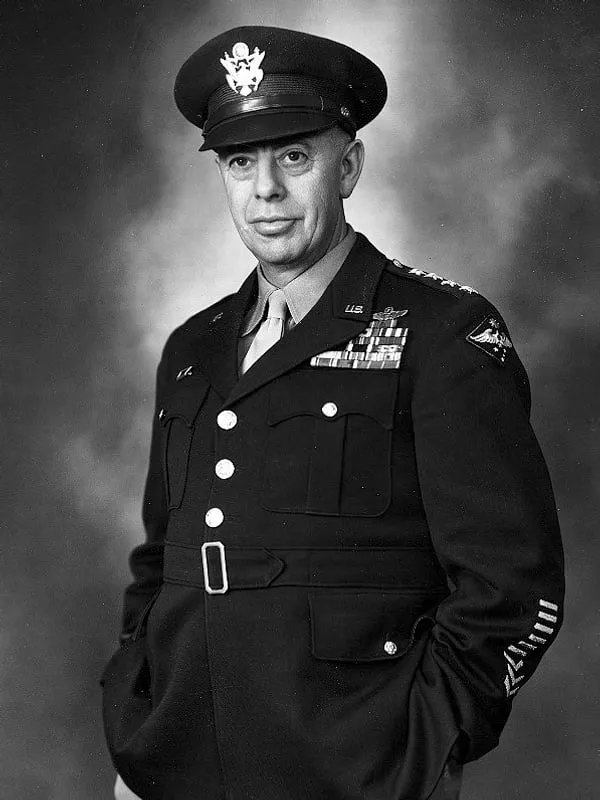
- Born:
- 6 August 1889, Yarmouth (Nova Scotia, Canada)
- Died:
- 9 August 1977, Bay Harbor Islands (Florida, United States)
- Author:
- Łukasz
- Photo:
- US Air Force, domena publiczna, Wikimedia Commons

George Kenney was General Douglas MacArthur’s air commander from July 1942 to the end of the war and one of the most inventive air commanders of the conflict. When he arrived in Australia he found a demoralised, poorly supplied air force that MacArthur did not trust. He replaced the commanders, introduced mast-height attacks and skip bombing, turned medium bombers into flying batteries of machine guns and convinced MacArthur that the transport aircraft could replace the roads that did not exist in the jungle of New Guinea. His aircraft destroyed a convoy in the Bismarck Sea in March 1943, wiped out the Japanese air force on the ground at Wewak and Hollandia and neutralised Rabaul. MacArthur’s strategy of “leaps” along the coast of New Guinea rested on the fact that the next targets usually lay within reach of Kenney’s aircraft.
Engineer and reconnaissance flyer
He was born on 6 August 1889 in Yarmouth, Nova Scotia, in Canada, where his parents had come for the summer, and grew up in Brookline near Boston. He studied civil engineering at the Massachusetts Institute of Technology, but after three years had to break off his studies when his father deserted the family. He worked as a surveyor on railway construction in Quebec, then for construction firms, until he set up his own business with a classmate.
In June 1917, after the United States entered the war, he enlisted as a flying cadet. From February 1918 he flew in France with the 91st Aero Squadron, a long-range reconnaissance unit, and after a crash on take-off his comrades called him “Bust ’em up George”. Together with his observers he shot down two German aircraft: on 15 September 1918 during the fighting at Saint-Mihiel and on 9 October during the Meuse-Argonne offensive. For the second of these flights he received the Distinguished Service Cross, for the first the Silver Star.
A maverick in the Air Corps
After the war he stayed in the army. He commanded a squadron patrolling the Mexican border, at the aircraft engineering works he devised a way of mounting machine guns in the wings, and for years he taught attack aviation tactics. He belonged to a minority: most American airmen believed in heavy bombers flying high, while he championed low-level attacks on the enemy’s troops and airfields. In 1932–1933 he attended the Army War College, where he got to know, among others, Richard Sutherland, MacArthur’s future chief of staff. He translated the writings of the Italian air power theorist Giulio Douhet and worked on the staff of General Frank Andrews’s GHQ Air Force, the Army’s striking air arm, but because of sharp quarrels with his superiors he was sent in 1936 to teach at the infantry school at Fort Benning.
At the beginning of 1940, as assistant air attaché in Paris, he watched the first months of the war in Europe. His reports, comparing the Luftwaffe with the American air arm to the latter’s disadvantage, offended many in Washington, but his recommendations to switch to .50-calibre machine guns and self-sealing fuel tanks were adopted. In 1941, as a brigadier general, he ran the air arm’s experimental centre at Wright Field, and in March 1942, by then a major general, he took over the Fourth Air Force in San Francisco.
To Australia
In July 1942 MacArthur, dissatisfied with his air commander, General George Brett, passed over James Doolittle and accepted Kenney. On 28 July Kenney reported in Brisbane. He concluded that MacArthur did not understand air power, but that without his trust he could achieve nothing, and he won it within a few weeks. He sent home several generals and dozens of colonels whom he regarded as useless. To Sutherland, who until then had been issuing detailed orders to the airmen, he reportedly drew a dot on a blank sheet of paper: that much, he said, the chief of staff knew about air power, and the rest of the sheet was what Kenney knew. In New Guinea the forward headquarters was taken over by General Ennis Whitehead, and the bomber command by General Kenneth Walker. At the beginning of September the American units were formed into the Fifth Air Force, with Kenney as its commander, while he also kept command of all the Allied air forces, including the Australian.
The first weeks were a struggle for the survival of Port Moresby. In August his airmen bombed the airfields near Buna and helped the Australians hold Milne Bay. In September, as the Japanese advanced along the Kokoda Track, Kenney proposed flying in reinforcements, and on 15 September the first company of the American 32nd Division landed at Port Moresby. Afterwards the transport aircraft supplied the troops fighting at Buna and Gona. In October Kenney was promoted to lieutenant general. He had few heavy bombers, and the occasional raids on Rabaul achieved little; in January 1943 Walker personally led a daylight raid on Rabaul, against Kenney’s orders, and did not return.
The Bismarck Sea
Kenney was looking for a weapon against ships. Bombers releasing their bombs from high altitude rarely hit manoeuvring vessels, so his airmen practised skip bombing and mast-height attacks, and Major Paul “Pappy” Gunn converted A-20 and B-25 bombers into attack aircraft with a battery of guns in the nose, meant to silence the ships’ anti-aircraft artillery. At the end of February 1943 intelligence warned Kenney of a convoy that was to carry the main body of the Japanese 51st Division from Rabaul to Lae. From 2 to 4 March American and Australian aircraft sank all eight transports and four of the eight destroyers; nearly 3,000 Japanese were killed. It was Kenney’s greatest success and proof that the new tactics worked.
The battle also has a dark side. For three days after the engagement aircraft and torpedo boats strafed survivors in boats and in the water; some accounts say this was done on Kenney’s orders. MacArthur’s communiqué spoke of 22 vessels sunk and nearly 13,000 soldiers killed, and when Washington established that the convoy had numbered only 16 warships and merchant ships, MacArthur’s staff stuck to the original version.
Wewak, Nadzab and Rabaul
Kenney convinced MacArthur that air power could prepare every leap forward: win command of the air, cut the enemy off from supplies, cover the landing and then move onto the captured airfields. In the summer of 1943 his men built a secret airstrip in the mountains at Tsili Tsili, and on 17 August his aircraft struck the Japanese airfields at Wewak, destroying some hundred aircraft on the ground. On 5 September, during the operation against Lae, 1,700 American paratroopers jumped onto Nadzab; Kenney set the date according to the forecasts of two teams of meteorologists, and MacArthur watched the drop from one of three B-17s. The Australian 7th Division was flown in to the captured airstrip and soon took Lae.
On 12 October 1943 Kenney sent 349 aircraft against Rabaul, “everything that was in commission and could fly that far”. So began the massed raids which, together with carrier strikes and aircraft from the Solomon Islands, paralysed Japan’s main base in the South Pacific. His airmen’s reports were heavily exaggerated, as the official histories stress, but Rabaul ceased to be an offensive base and could be bypassed. Kenney did, however, oppose the landing at Cape Gloucester, believing that airfields in western New Britain were not needed. In February 1944 it was his crews, after circling for an hour and a half over an apparently empty Los Negros, who gave MacArthur the idea of an immediate landing in the Admiralty Islands.
His most sophisticated blow was Hollandia. The Japanese believed the airfields there lay beyond the reach of Allied fighters and crowded several hundred aircraft onto them. Kenney, meanwhile, had received P-38s with drop tanks, but deliberately kept them away from the area. From 30 March to 3 April 1944 his bombers, escorted by Lightnings, destroyed several hundred aircraft on the ground and in the air according to American estimates, and the Japanese air force in New Guinea ceased to count. Three weeks later the Americans landed at Hollandia and Aitape with almost no opposition.
The Philippines and the end of the war
In June 1944 Kenney took over the Far East Air Forces, which comprised the Fifth and Thirteenth Air Forces and later the Seventh as well. His bombers attacked the refineries at Balikpapan in Borneo. In the Philippines land-based air power could not keep pace with MacArthur: on Leyte rain and boggy ground delayed the building of airfields, and for a long time Kenney’s aircraft did not control the sky over the island. In March 1945 Kenney became a full general, and his aircraft supported the fighting on Luzon, the landings in Borneo and the battle for Okinawa. On 2 September 1945 he watched Japan’s surrender from the deck of the battleship “Missouri”.
After the war and assessment
In 1946 Kenney became the first commander of Strategic Air Command, the strategic air force intended to deliver atomic bombs. He proved a poor peacetime commander: he devoted more time to speeches in favour of an independent air force and to work on the United Nations Military Staff Committee than to his command, and his crew cross-training programme lowered their efficiency. An inspection in which Charles Lindbergh and Paul Tibbets took part went disastrously, and in 1948, during the Berlin blockade, Kenney was replaced by Curtis LeMay. Until his retirement in 1951 he headed the air force’s university, Air University. He wrote the memoir “General Kenney Reports”, a book about MacArthur and a biography of his best pilot, the ace Richard Bong. He died on 9 August 1977 at Bay Harbor Islands, Florida.
Historians rate him highly as a wartime commander. Kenney was faithful to no doctrine: he adapted weapons and tactics to the conditions of New Guinea, where what counted were airfields, supply ships and transport, not factories. His low-level attacks, attack aircraft and airlift gave MacArthur an advantage without which the New Guinea campaign would have lasted much longer. His critics point to his exaggeration of successes, his indulgence of his airmen’s inflated reports and the disputed attacks on survivors in March 1943.
Sources
Commanded in battles
(01)Mentioned in battles
(06)Often appears with
People who appear in the same events.