1944–1945: The fighting for Burma and India
Battle of Meiktila and Mandalay
- Dates:
- 14 January – 28 March 1945
- Front:
- Pacific
- Location:
- Central Burma: the bend of the Irrawaddy from Thabeikkyin and Kyaukmyaung north of Mandalay to Myinmu, Ngazun, Nyaung-U and Pagan (Bagan) in the west; Mandalay with Mandalay Hill and Fort Dufferin; the road and rail junction and airfields of Meiktila between the lakes; Taungtha, Myingyan and the Popa massifOn the battle map →
- Sides:
- United Kingdom and IndiaWilliam Slim, Frank Messervy, Montagu Stopford, David Cowan, Thomas ReesJapanHeitarō Kimura, Masaki Honda, Shihachi Katamura
- Result:
- A decisive British and Indian victory. The 17th Indian Division took Meiktila on 3 March and held it throughout a month-long Japanese siege; the 19th Indian Division captured Fort Dufferin in Mandalay on 20 March. On 28 March the Japanese command called off the counter-offensive at Meiktila. The Japanese 15th and 33rd Armies, stripped of most of their guns and of their cohesion, fell back south and into the Shan Hills, opening the road to Rangoon for the Fourteenth Army.
- Author:
- Natalia
Name and dates
The Battle of Meiktila and Mandalay is the name given to two parallel and closely linked operations by General William Slim’s British Fourteenth Army in central Burma in the first quarter of 1945: the fighting for Mandalay, the former royal capital of the Burmese kings and the country’s second city, and for Meiktila, a small town set among lakes which was nonetheless the most important communications and supply hub of the Japanese forces in Burma. English-language literature often treats the two battles together as the Battle of Central Burma. The whole formed part of an operation that the Allies first named Capital and then, once its aim came to include a pursuit to Rangoon, Extended Capital.
The opening date is taken to be 14 January 1945. That night the first units of Major General Thomas Rees’s 19th Indian Division crossed the Irrawaddy at Thabeikkyin, some 100 kilometres north of Mandalay, and the following day at Kyaukmyaung as well. From then on the fighting was no longer about the approaches to the great river but about its eastern bank – and thus about the very heart of central Burma. The closing date is 28 March 1945: on that day the chief of staff of the Japanese Burma Area Army, General Shin’ichi Tanaka, after consulting the commander of the 33rd Army, Masaki Honda, ordered the counter-offensive against Meiktila to be called off. Mandalay had by then been in British hands for eight days, and the Japanese units around both towns were beginning to withdraw south.
Both dates are to some extent conventional. The fighting for the Irrawaddy bridgeheads began in the second half of January and went on until the end of February, and isolated Japanese units were still holding out in early April east and south of Meiktila. But the outcome was settled in those ten weeks – and it was the outcome of the whole war in Burma.
Background
The Japanese occupied Burma in the spring of 1942. After the capture of Mandalay, which was preceded by a devastating air raid on the city, and the end of the fighting, the British, Indian and Chinese forces defeated in the Burma campaign of 1942 withdrew to India and China. For the next two years the front stood still on the Indo-Burmese frontier. The Allies tried to operate through the jungle with Chindit expeditions and an offensive in the Arakan, but the course of the war in Burma was decided only by the Japanese offensive against India in 1944.
The Battle of Imphal and Kohima ended in catastrophe for the Japanese. Lieutenant General Renya Mutaguchi’s 15th Army lost most of its men in combat, to starvation and to disease, and after the siege of Imphal was lifted its remnants retreated during the monsoon behind the Chindwin. Tokyo changed the command. In September 1944 Lieutenant General Heitarō Kimura, previously Vice-Minister of War in Hideki Tōjō’s government, took over the Burma Area Army; the 15th Army passed to Lieutenant General Shihachi Katamura. The replacements reaching Burma were few and poorly trained. According to British studies, Japanese divisions usually numbered less than half of their already reduced establishment of 10,000 men; they lacked anti-tank weapons, transport and fuel, and the Japanese air force in Burma had only a few dozen aircraft against more than a thousand Allied ones.
On the Allied side, Admiral Louis Mountbatten’s South East Asia Command (SEAC), created in 1943 when Mountbatten took command, weighed three options in the summer of 1944: confining itself to northern Burma in order to complete the Ledo Road to China, a seaborne landing at Rangoon, or an overland offensive by the Fourteenth Army through central Burma. The first option was judged too modest, and the second was impracticable without landing craft, which could not reach the Indian Ocean before the end of the war in Europe. That left the overland offensive. In northern Burma, meanwhile, Chinese and American forces continued the fighting that had brought the capture of Myitkyina in the summer of 1944; on 11 January 1945 the first convoy set off along the Ledo Road towards China. On the Arakan coast XV Corps was taking islands and airfields from which transport aircraft would later supply the troops in the interior.
When the monsoon ended, the Fourteenth Army crossed the Chindwin on Bailey bridges and advanced onto the Shwebo plain. This stage – from the first bridgeheads to the arrival on the Irrawaddy – was the pursuit to the Irrawaddy. By early January 1945 British and Indian divisions already stood on the western and northern banks of the great river. The Japanese, however, unlike in 1944, had no intention of giving battle in front of it.
Plans and forces
Kimura concluded that his worn-down divisions would not withstand a clash with British armour on the open Shwebo plain. He therefore decided to give up the area between the Chindwin and the Irrawaddy and to defend behind the river. Katamura’s 15th Army, with the 15th, 31st and 33rd Divisions, occupied the east bank of the Irrawaddy from around Mandalay to Pakokku; Lieutenant General Shōzō Sakurai’s 28th Army defended the Arakan and the lower Irrawaddy valley with its oilfields; and Lieutenant General Masaki Honda’s 33rd Army was fighting in the north against the Chinese and American forces of Lieutenant General Daniel Sultan and the Chinese advancing from Yunnan. Kimura reckoned that the broad river would stop the enemy and stretch his supply lines over hundreds of kilometres of poor roads, and that at a favourable moment it might even allow a counter-stroke against the bridgeheads.
Slim discovered this change in December 1944, when the 19th Division was advancing across the Shwebo plain almost unopposed. He then recast his entire plan. Lieutenant General Montagu Stopford’s XXXIII Corps, reinforced by the 19th Division, was to cross the Irrawaddy north and west of Mandalay and tie down the main Japanese forces in a battle for the city. Lieutenant General Frank Messervy’s IV Corps was secretly shifted from the army’s left flank to its right: it was to move south through the Gangaw valley west of the Chindwin, cross the Irrawaddy near Pakokku and seize Meiktila with a swift armoured thrust. Meiktila, some 130 kilometres south of Mandalay, lay on the railway and the roads from Rangoon to Mandalay; it held airfields, hospitals and the main depots of the Japanese forces fighting in the north. The loss of this hub would cut the supplies of both Japanese armies on the Irrawaddy.
Success depended on surprise. A dummy IV Corps headquarters was left at Sittaung on the Chindwin, through which all radio traffic with the 19th Division passed, and in the Gangaw valley light units – the 28th East African Brigade and the improvised Lushai Brigade – led the columns, so that the Japanese would take the movement for a subsidiary operation. IV Corps’s heavy equipment moved along a road that the engineers first had to make passable for tanks and lorries; at one point, according to British accounts, the column of vehicles stretched from Pauk all the way back to Kohima. Japanese intelligence, deprived of air reconnaissance and receiving less and less information from a disaffected Burmese population, failed to recognise the scale of the threat until the end of February.
The forces were unequal. The Fourteenth Army had six infantry divisions (the British 2nd Division and the Indian 5th, 7th, 17th, 19th and 20th Divisions), two armoured brigades and command of the air. It was short, however, of river-crossing equipment and above all of transport: every ton of supplies had to travel hundreds of kilometres from the bases in Assam or be flown in from the Arakan and India.
The course of the battle: crossing the Irrawaddy
The 19th Indian Division was the first across. On the night of 13–14 January its units crossed the river at Thabeikkyin, and a day later at Kyaukmyaung, where the Irrawaddy flows in a narrow channel between hills. The Japanese 15th Division, reinforced with artillery, attacked both bridgeheads for several weeks but failed to eliminate them. By the end of January Rees had moved his entire division onto the east bank. For Kimura this was proof that the main British blow would fall on Mandalay from the north, and it was there that he sent his reserves.
Meanwhile XXXIII Corps was clearing the Shwebo plain of Japanese rearguards. The British 2nd Division and the 19th Division took Shwebo, and Major General Douglas Gracey’s 20th Indian Division captured the river port of Monywa on the Chindwin after heavy fighting. The Japanese still held the Sagaing hills on the north bank of the Irrawaddy opposite Mandalay.
The crossings downstream, where the Irrawaddy is between one and several kilometres wide, required more preparation. There were too few assault boats, pontoons and outboard motors, and some of the equipment had already been through campaigns in other theatres and often broke down. Slim wanted the 20th Division and IV Corps’s 7th Division to cross almost simultaneously, so that the Japanese would be unable to judge which was the main thrust. The 20th Division crossed the river on the night of 12–13 February at Myinmu, some 30 kilometres west of Mandalay. For almost two weeks its bridgeheads were attacked every night by the Japanese 31st Division; fighter-bombers circling over the river destroyed Japanese tanks and guns, and in the end the division joined its positions into a single strong bridgehead.
The decisive crossing was that of Major General Geoffrey Evans’s 7th Indian Division at Nyaung-U, on the boundary between the Japanese 15th and 28th Armies – something the Allies did not know, but which delayed the Japanese response. Postponed by a day because boats needed repair, it began on 14 February and at first came close to disaster: at Nyaung-U the boats of a battalion of the South Lancashire Regiment broke down under machine-gun fire, while at Pagan, the ancient royal capital with its famous temples, the crossing by Sikh troops collapsed under fire. The bank here was defended by battalions of the Indian National Army, raised with Japanese support by Subhas Chandra Bose. Only fire from tanks and artillery on the west bank made it possible to consolidate the bridgehead at Nyaung-U, and the defenders of Pagan hoisted a white flag and surrendered. Slim later called this operation the longest opposed river crossing of the entire Second World War, referring to the width of the river.
From 17 February the motorised brigades of the 17th Division and the 255th Indian Tank Brigade passed into the bridgehead. To distract the Japanese still further, the British 2nd Division crossed from 23 February at Ngazun, barely a dozen or so kilometres west of Mandalay; here too boats leaked and engines died, but one brigade managed to gain a foothold on the bank and the rest of the division followed it.
The course of the battle: the thrust on Meiktila
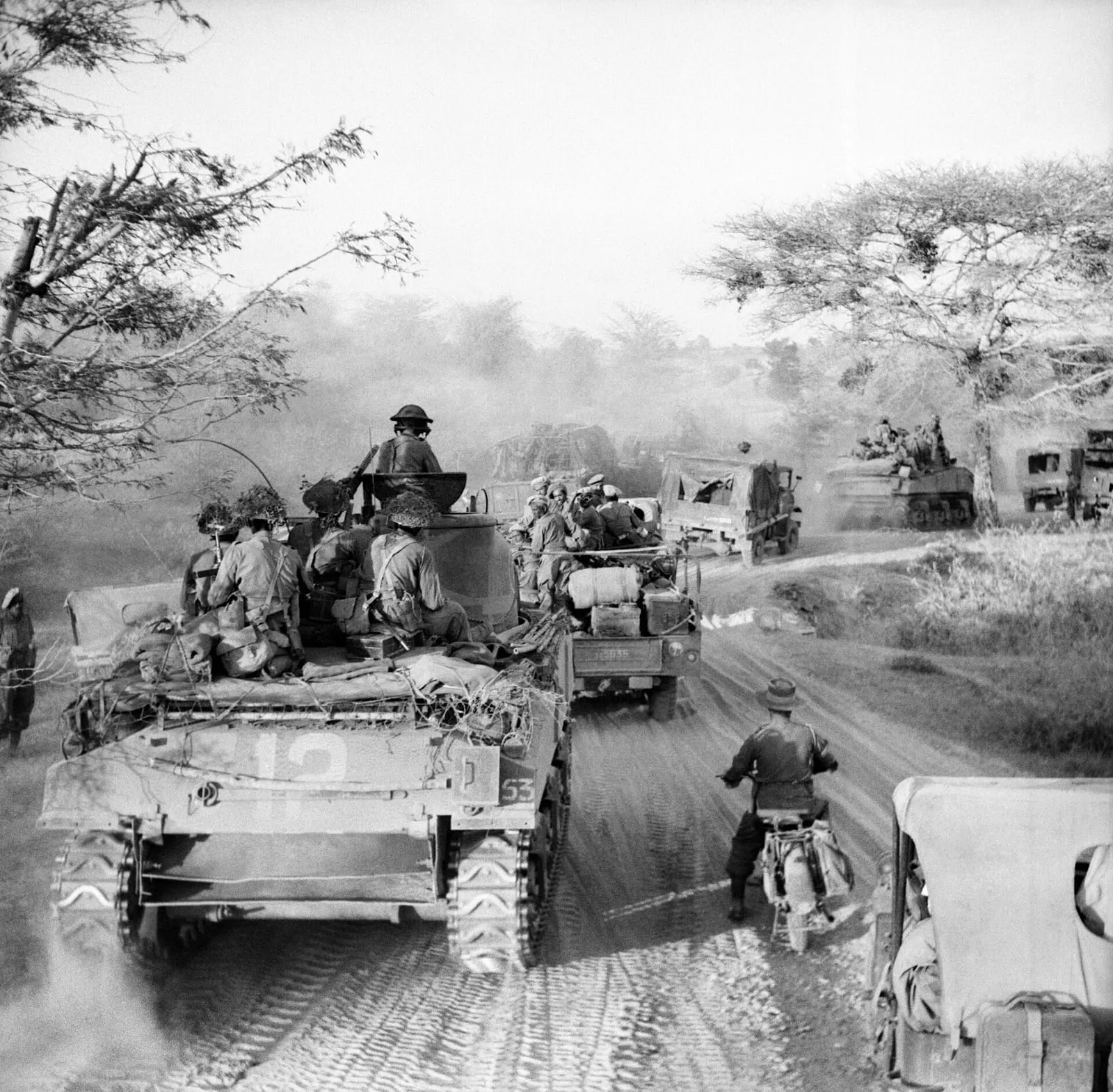
Major General David Cowan’s 17th Indian Division – two fully motorised infantry brigades (the 48th and 63rd) and the 255th Indian Tank Brigade with M4 Sherman tanks – broke out of the Nyaung-U bridgehead on 20 February and reached Taungtha, halfway to Meiktila, on 24 February. That same day a conference of Japanese staffs met in Meiktila to consider a counter-offensive against the Irrawaddy bridgeheads. The Japanese were taken completely by surprise. According to accounts cited by British historians, an observer’s report from the Popa massif of 2,000 vehicles heading for Meiktila was dismissed at a higher headquarters as a mistake, and one zero was struck out in the belief that it concerned a raid. Only on 26 February did the Japanese grasp what was happening and begin feverishly preparing the town for defence.
Meiktila lies between two lakes, to the north and south of the town, which narrowed the front of attack. It was to be defended by some 4,000 men: most of the 168th Regiment of the 49th Division, together with anti-aircraft gunners, rear-echelon and hospital personnel, including wounded men still able to hold a weapon. On 26 February Cowan’s division seized the landing strip at Thabutkon, some 30 kilometres north-west of the town; the air-transportable 99th Brigade was flown in there, and fuel for the tanks was dropped by parachute.
On 28 February the 17th Division attacked Meiktila from all sides. The 63rd Brigade cut the roads to the south-west and attacked from the west; the 48th Brigade advanced from the north along the main road, halting at a fortified monastery on the edge of the town; and the 255th Tank Brigade, with two infantry battalions and self-propelled artillery, swung round the town in a wide arc, seized the airfields to the east and attacked from the south-east. At night Cowan withdrew his tanks from the streets, leaving the infantry on the ground it had taken. On 1 March Messervy and Slim watched the fighting from his headquarters, fearing that the Japanese might hold out for weeks.
The defence collapsed, however, in less than four days. The Japanese had plenty of artillery but were unable to concentrate its fire on any one of the attacking brigades, and their lack of anti-tank weapons left them helpless against the tanks. In his memoirs Slim described how two platoons of Gurkhas supported by a single tank took a whole line of bunkers in a few minutes. Japanese soldiers crouched in trenches with 250-kilogram aircraft bombs, intending to detonate them with a blow when a tank passed over the trench; most were shot before they could do so. The defenders fought almost to the last man. By 3 March the town was in the hands of the 17th Division, and over the following days the British cleared scattered groups from the surrounding area. According to British figures the garrison was almost entirely wiped out, and only a handful of men were taken prisoner.
The course of the battle: the siege of Meiktila
The loss of Meiktila forced Kimura to change all his plans. Units that had been meant to reinforce the garrison now had to retake the town. Lieutenant General Eitarō Naka’s 18th Division, brought down from the northern front, the 49th Division from the south, regiments detached from the 33rd and 53rd Divisions, an artillery group and a raiding detachment intended for attacks on the airfields were all sent against Meiktila. According to British estimates this amounted in all to some 12,000 men and 70 guns, but these units arrived from different directions, without communications with one another, accurate maps or information about the enemy. The 17th Division had some 15,000 men in Meiktila, nearly a hundred tanks and 70 guns, and received reinforcements during the fighting.
Cowan did not wait passively to be attacked. Every day motorised columns of infantry and tanks sallied out of the town to strike the Japanese concentrations in the surrounding villages before they could prepare an attack, returning to the defensive perimeter at night. The first attacks by the 18th Division from the north and west broke down with heavy losses. An attempt to open an overland route to Nyaung-U failed, so the garrison remained dependent on air supply.
From 12 March the Japanese concentrated on the airfields east of the town, through which ammunition, fuel and food were flown in and the wounded flown out. Despite the shelling, the 9th Brigade of the 5th Indian Division landed there with its equipment from 15 March; only two aircraft were destroyed. The Japanese were nevertheless edging ever closer to the runways, and from 18 March Cowan halted landings by transport aircraft – supplies were dropped by parachute from then on, while the wounded were taken out by light aircraft from a smaller strip. On 18 March Lieutenant Karamjeet Singh Judge of the 15th Punjab Regiment was killed while leading tanks and infantry against Japanese bunkers; he was posthumously awarded the Victoria Cross.
On 12 March Kimura entrusted command of the fighting for Meiktila to Masaki Honda and the 33rd Army staff, which took over on 18 March but, lacking signals units of its own, was unable to coordinate the attacks. The Japanese artillery, pushed forward into the front line for want of anti-tank weapons, destroyed tanks but itself suffered heavy losses. In a major attack on 22 March the Japanese sent a captured British tank into action; it was destroyed and the assault repulsed.
Meanwhile the 7th Division was defending the Nyaung-U bridgehead against the 72nd Independent Mixed Brigade and Indian National Army units, and in mid-March a motorised brigade of the 5th Division began clearing the area of the Popa massif in order to open the road to Meiktila. After making contact with the garrison, the 7th Division captured the river port of Myingyan on 18–22 March; the port and the railway to Meiktila were quickly brought back into use. On 28 March Tanaka, after talking to Honda, ordered the siege to be abandoned. The 33rd Army staff reported that about 50 tanks had been destroyed at a cost of 2,500 men and 50 guns; it had 20 guns left.
The course of the battle: Mandalay
By mid-February the Japanese 15th Division facing the 19th Division’s bridgeheads was already weak and stretched over a wide front. Rees struck south along the east bank of the Irrawaddy, and on 7 March his leading units had before them Mandalay Hill with its pagodas and monasteries. The commander of the 15th Division, Lieutenant General Seiei Yamamoto, was opposed to defending the city but was ordered to hold it to the end: Kimura feared a loss of prestige, and near Mandalay there were depots that could not be evacuated.
On the night of 8–9 March a battalion of the 4th Gurkha Rifles, led by an officer who knew the city from before the war, stormed the hill. Japanese soldiers hidden in tunnels and cellars beneath the temples held out for several more days; according to British accounts they were driven out with grenades, explosives and petrol poured down the shafts. On 9 March units of the 19th Division entered the northern part of the city, and by about 11 March the hill was entirely in British hands.
Beyond it the way was barred by Fort Dufferin – the former walled palace city of the Burmese kings, named by the British after a Viceroy of India – surrounded by a broad moat and thick brick walls backed on the inside by an earthen rampart. Heavy artillery fire made no impression on them, and an assault through a railway tunnel at a corner of the walls was repulsed. B-25 Mitchell bombers dropped 2,000-pound bombs from low altitude, skipping them off the surface, but blew a breach in the wall only a few metres wide. As the 19th Division was preparing another assault, this time through the drains, the Japanese garrison abandoned the fort by night – according to some accounts, also by way of the drains. On 20 March Rees’s men entered the fort and raised the British flag over it. Mandalay, which the Japanese had taken in May 1942, returned to British hands after almost three years.
The city paid a heavy price. Much of Mandalay had already burned down after the Japanese air raids of 1942, and now, during the siege of the fort, the wooden palace of King Thibaw, the last ruler of Burma, went up in flames together with many other historic buildings. Part of the damage was caused by Allied bombing and shelling, and part by fires started during the fighting.
At the same time the 20th Division broke out of its bridgehead to the south. It routed the weakened 31st and 33rd Divisions, and its armoured reconnaissance group, named “Claudecol” after its commander, got almost as far as Meiktila before turning back north into the rear of the Japanese still holding out along the river. The British 2nd Division attacked Mandalay from the west. By the end of March the Japanese 15th Army was no more than a collection of scattered remnants, struggling south and east into the Shan Hills.
The air transport war
The battle for central Burma was to a large extent a battle for supplies. The roads from the bases in Assam and Manipur ran for hundreds of kilometres through the mountains and in the dry season could barely cope with the lorries; the engineers even surfaced them with strips of bitumen-soaked jute. The main burden of supply was therefore taken over by transport aircraft – the Anglo-American Combat Cargo Task Force, whose squadrons flew mainly Douglas C-47 Skytrain and Curtiss C-46 Commando aircraft. They delivered ammunition, fuel, food and entire infantry brigades, flew out the wounded and, in the critical days, dropped supplies by parachute over besieged Meiktila. Airfields on the Arakan islands captured from January onwards, Akyab (today Sittwe) and Ramree, cut the distance to the front by hundreds of kilometres.
A constant worry for Slim was his dependence on American aircraft, whose allocation was dictated by the China theatre. On 16 December 1944, when the Japanese Operation Ichi-Go was threatening American airfields in China, 75 transport aircraft were suddenly taken from him; they were partly replaced by aircraft brought in from the Mediterranean. The threat of further transfers hung over the Fourteenth Army throughout the battle.
Close support was provided by No. 221 Group RAF with Republic P-47 Thunderbolt and Hurricane fighter-bombers, Bristol Beaufighter heavy fighters and medium bombers, and, when needed, B-24 Liberator heavy bombers. Aircraft patrolled the river over the bridgeheads, destroyed Japanese guns and tanks, broke up infantry concentrations around Meiktila and bombed the walls of Fort Dufferin. The Japanese 5th Air Division had only a few dozen aircraft at the time and could neither interfere with the transports nor carry out reconnaissance.
Casualties
Casualty figures for both sides vary depending on the source and the period covered. A tally cited by the British historian Louis Allen gives the Fourteenth Army’s losses in the Battle of Central Burma as 2,307 killed and 15,888 wounded and missing, and Japanese losses as 6,513 killed and 6,299 wounded and missing. Many historians believe that actual Japanese losses were higher, because many wounded and sick men died during the retreat, and British calculations were based mainly on bodies counted on the battlefield. According to British studies, the divisions of the 15th Army shrank to less than half of their already reduced establishments and lost most of their guns and vehicles, while the 33rd Army at Meiktila – according to its own report of 28 March – lost 2,500 men and 50 guns.
British and Indian losses in men were smaller but painful: replacements for British battalions were increasingly hard to find, and the burden of the fighting rested more and more on Indian and Gurkha soldiers. The civilian population also suffered, especially in Mandalay and in the small towns of central Burma through which the front passed; no one counted those losses at the time.
Significance
The Battle of Meiktila and Mandalay was the decisive victory of British and Indian forces in Burma and one of the most skilfully executed Allied manoeuvres of the whole war. Slim held Kimura’s attention with the battle for Mandalay while he moved an entire corps through the jungle and struck a decisive blow at a point the Japanese were not defending. Many historians rank this manoeuvre among the finest operations by British forces in the entire war; they also agree in stressing the importance of air superiority and air transport, without which the dash to Meiktila would have been impossible.
For the Japanese the battle meant the end of organised defence in central Burma. The 15th and 33rd Armies had lost most of their equipment and their cohesion; they were no longer able to stop the Fourteenth Army on its way south. In April IV Corps set off along the railway through Pyawbwe and Toungoo (Taungoo) towards Pegu (Bago), and XXXIII Corps down the Irrawaddy valley through Yenangyaung and Prome (Pyay). They were racing the approaching monsoon: before the rains came, a port had to be taken through which the army could be supplied. Rangoon was finally taken by the amphibious forces of Operation Dracula at the beginning of May 1945, a few days after the Japanese had abandoned the city.
The fall of Mandalay also decided the stance of the Burmese. The Burma National Army, created by the Japanese and commanded by Aung San, formally the armed forces of the government of Ba Maw, which Tokyo had recognised as independent in 1943, had for months maintained secret contacts with the British through Force 136. On 27 March 1945, when the outcome of the battle was no longer in doubt, it rose against the Japanese. For the British it was an auxiliary ally; for the Burmese, the beginning of a road that led to the country’s independence in 1948.
The battle was fought less than three years after the defeat of spring 1942, in the very places through which the British army had then retreated. For the Fourteenth Army, which its soldiers called the “Forgotten Army”, it was a victory won very largely by Indian and Gurkha troops together with soldiers from East and West Africa. For Japan it was further proof, after Imphal, that an army deprived of supplies, air power and anti-tank weapons cannot stand up to an opponent who enjoys material superiority and knows how to use it.