United States
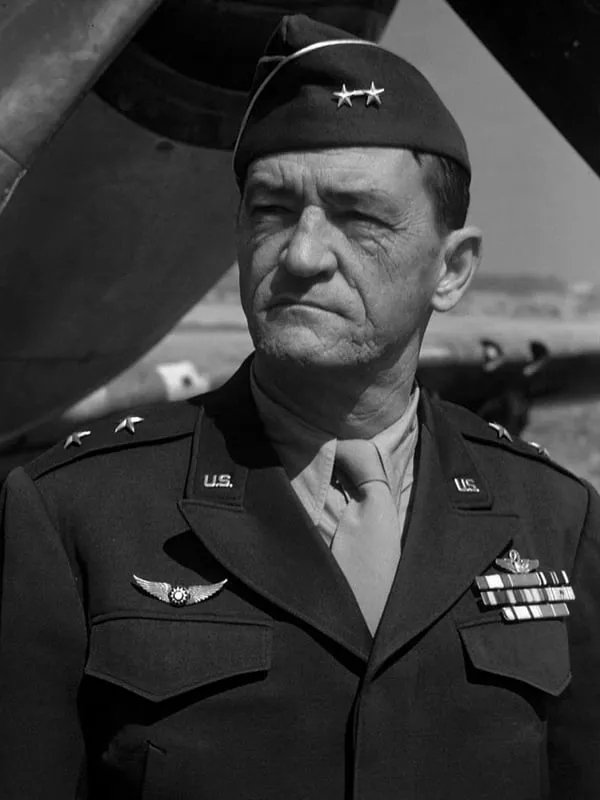
Claire Chennault
Air adviser to Chiang Kai-shek (from 1937), commander of the American Volunteer Group "Flying Tigers" (1941–1942), the China Air Task Force (1942–1943) and the US Fourteenth Air Force (1943–1945)
- Born:
- 6 September 1893, Commerce (Texas, United States)
- Died:
- 27 July 1958, New Orleans (Louisiana, United States)
- Author:
- Natalia
- Photo:
- autor nieznany, domena publiczna, Wikimedia Commons

Claire Chennault was the best-known American in wartime China. When in 1937 he left the Army air arm as a captain going deaf and at odds with his superiors, he went to China as a civilian adviser and became a trusted man of Chiang Kai-shek and his wife. In 1941 he organised the American Volunteer Group, the famous Flying Tigers, which in the first months of the Pacific war defended Rangoon and Kunming while nothing but bad news came from the other fronts. Later, by then a general, he commanded the Fourteenth Air Force in China. He argued to Roosevelt that a small, well-supplied air force would defeat Japan in China more cheaply than armies on the ground, and for three years he fought over this with General Joseph Stilwell. The Japanese offensive of 1944, which took his airfields away from him, showed the limits of his concept.
A schoolteacher from Louisiana
According to the accepted version, he was born on 6 September 1893 in Commerce, Texas, although no document survives to confirm it; for most of his life he gave 1890 as the year, and the date was corrected after his death by his widow. He grew up in Louisiana, in the small towns of Gilbert and Waterproof. He lost his mother as a child and was brought up by an aunt. He studied briefly at Louisiana State University, graduated from a teachers’ college and before the war was the principal of a rural school. In 1911 he married Nell Thompson; they had eight children.
During the First World War he graduated from officers’ school, in November 1917 transferred to aviation and learned to fly, but he never got to France: he served at home as an instructor. In 1920 he received a regular commission. He was a fighter pilot by vocation. He flew along the Mexican border, served in a fighter squadron in Hawaii, and in the early 1930s at the Air Corps Tactical School at Maxwell Field he headed the pursuit section and led a three-aircraft aerobatic team.
A heretic in the age of the bomber
The American air arm then believed that the heavy bomber would always get through to its target, and that fighters had a future at most as escorts. Chennault argued that this was a mistake and that interceptor fighters, well directed and warned of the enemy’s approach, could break up a bomber raid. He preached his views stubbornly and without tact, which alienated his superiors. On top of that he was going deaf and suffered from bronchitis. Passed over for promotion, he left the service on 30 April 1937 with the rank of captain (some sources say major).
In China
In June 1937 he came to China on a three-month contract to assess the state of the Chinese air force. His immediate superior was Song Meiling, Chiang Kai-shek’s wife, who headed the aeronautical commission. A month later the Sino-Japanese War broke out, and Chennault became the Generalissimo’s chief air adviser. He trained Chinese pilots, and when the Japanese occupied the coast he moved the flying school to Kunming in the interior. The Chinese air force, worn down in the first months of fighting, could not, however, stop the Japanese bombing of Chongqing and other cities.
In the autumn of 1940 Chiang sent him to Washington to obtain aircraft, spare parts and pilots together with T. V. Soong. Over the turn of 1940 and 1941, with the consent of President Franklin Roosevelt, China bought a hundred P-40 fighters originally intended for Britain, and American Army and Navy airmen were allowed to leave the service and sign contracts with a private company that in practice recruited them for China. Some three hundred pilots and mechanics sailed to Burma, where from August 1941 they trained at the airfield at Toungoo. Chennault taught them to fight by his own rules: never get into a turning fight with the more agile Japanese fighters, attack in pairs from above and break away in a dive. The height advantage came from the network of observers he built, who reported approaching Japanese aircraft early enough for the P-40s to take off and climb.
The Flying Tigers
They went into action only after the attack on Pearl Harbor. On 20 December 1941 the group’s fighters broke up a Japanese bombing raid over Kunming, and on 23 and 25 December one of its squadrons, together with British fighters, defended Rangoon. The American press, which in those weeks reported almost nothing but defeats, made heroes of the volunteers with shark’s jaws painted on the noses of their aircraft. The Tigers then covered the retreat of the Allied forces in the Burma campaign and the Burma Road, until in May 1942 they withdrew to China. Among the pilots was Gregory Boyington, later a Marine Corps ace, with whom Chennault was on bad terms. According to the official tally, the group was credited with destroying 296–297 Japanese aircraft for the loss of fourteen pilots in combat.
After the United States entered the war, the volunteers were absorbed into the Army air forces. On 4 July 1942 the group was disbanded and replaced by the 23rd Fighter Group. Chennault returned to active duty in April 1942 and within a few weeks rose from major to brigadier general, but command of all American air forces in China went to Colonel Clayton Bissell. He himself received only the China Air Task Force, a formation subordinate to the Tenth Air Force in India.
The quarrel with Stilwell
In October 1942 Chennault sent Roosevelt a letter in which he promised that with 105 modern fighters and a few dozen bombers he would smash the Japanese air force in China and bring about Japan’s collapse. The plan was cheap, needed no great armies or reconquest of Burma, and therefore appealed to Roosevelt and to Chiang Kai-shek, who did not want to risk his best divisions. Stilwell considered it an illusion: in his view any successful air offensive would provoke a Japanese attack on the airfields, which the weak Chinese troops would not be able to defend. The Army Chief of Staff George Marshall shared this view, and Henry Arnold doubted Chennault’s organisational abilities. Supplies for China were then carried only by air over the Himalayas, across the so-called Hump, so every ton of fuel for the airmen was a ton taken from the Chinese infantry.
Politics decided the dispute. In March 1943 Chennault became a major general, and his air force the independent Fourteenth Air Force. In May, at the Trident Conference in Washington, Chennault and Stilwell presented Roosevelt with conflicting plans, and the President gave priority to the airmen. The Fourteenth Air Force’s aircraft attacked Japanese airfields, railways and shipping from the Yangtze to the South China Sea, in November 1943 struck Taiwan for the first time, and one of its bomber groups took part in the raid on Rangoon. At the Cairo Conference Chennault made an impression on Churchill, who asked loudly who this officer was and, on hearing the name, declared that he was glad he was on their side. Less generous was the British Chief of the Imperial General Staff, Alan Brooke, who noted that Chennault was a gallant airman with a limited brain.
Ichi-gō
Stilwell’s warnings came true in 1944. The Japanese Operation Ichi-gō, the largest land offensive of their army in this war, was intended among other things to destroy the bases from which Chennault’s aircraft attacked shipping and Taiwan. Changsha fell in June, and from July the Japanese besieged Hengyang. Chennault wanted to drop weapons and ammunition to the defenders, but Stilwell, who controlled the supplies, considered it a waste; on 8 August the city fell. In the autumn the Japanese took Guilin and Liuzhou, and in November Nanning. The aircraft inflicted heavy losses on them on the roads and railways but could not stop the infantry. Chennault blamed the defeat on the lack of supplies and on Stilwell; Stilwell held that the supplies swallowed by the air force had been taken from the troops who were supposed to defend the bases. Chiang Kai-shek, backed by Chennault, brought about Stilwell’s recall in October 1944, but for Chennault himself the autumn of 1944 was the defeat of his concept.
In March 1945, after the Japanese coup in Indochina, Chennault on his own responsibility sent aircraft to help the retreating French troops, against Washington’s guidance not to become involved in Indochina. In Kunming he also met Hồ Chí Minh, whose men helped rescue downed airmen. After a reorganisation of the air forces in China carried out at Arnold’s request, Chennault lost his independence and in July 1945 asked to be relieved. He left the service on 31 October 1945.
After the war and assessment
Chennault returned to China and founded the airline Civil Air Transport, which in the civil war supplied the forces of the Kuomintang and after their defeat moved to Taiwan. In time it became a tool of American intelligence, supplied among others the French forces in Indochina and was the forerunner of the later Air America (PL). In 1946 he divorced his first wife, and in 1947 he married the Chinese journalist Chen Xiangmei, later known as Anna Chennault, an influential lobbyist for Taiwan in Washington. In 1949 he published his memoirs, “Way of a Fighter”, largely devoted to his quarrel with Stilwell, and before congressional committees he argued that China had been “lost” because of the arms embargo on the Nationalists. He died of lung cancer on 27 July 1958 in New Orleans, shortly after being given the honorary rank of lieutenant general by a special act of Congress. He was buried in Arlington National Cemetery.
Chennault was an outstanding fighter tactician who recognised early the importance of air raid warning and communications. In the worst months of the war the Flying Tigers gave the Americans proof that the Japanese could be beaten, and today a monument to him stands in Taipei. As a strategist, however, he overestimated air power: he promised to defeat Japan in China with forces that could not even defend their own airfields. Historians judge his quarrel with Stilwell in different ways. The loss of the bases in 1944 bore out Stilwell’s warnings, although some writers, such as the British journalist and historian Jonathan Fenby, blame Stilwell in turn for refusing help to the defenders of Hengyang.
Sources
Commanded in battles
(01)Mentioned in battles
(02)Often appears with
People who appear in the same events.