Equipment
The battleship Scharnhorst
The German battleship that sank Rawalpindi and Glorious, dashed through the English Channel and was lost on 26 December 1943 in the Barents Sea.
- Role:
- battleship
- State:
- Germany
- Maker:
- Kriegsmarinewerft Wilhelmshaven
- Launched:
- 3 October 1936
- Author:
- Łukasz
- Updated:
- 1 November 2026
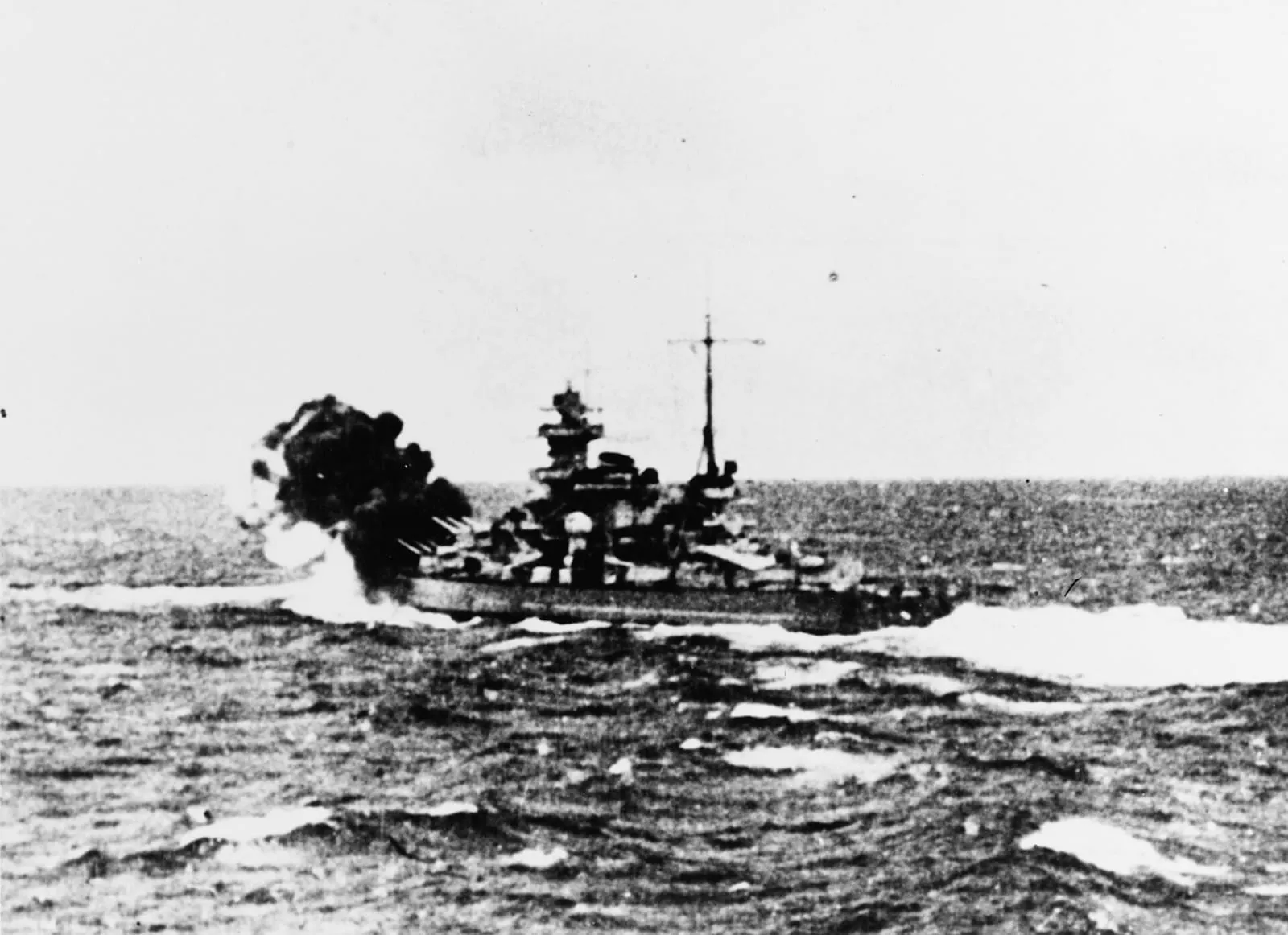
Scharnhorst was the most active heavy ship of the Kriegsmarine. For four years she came back from one sortie after another, often damaged but always back to port. Together with her sister Gneisenau she sank an armed merchant cruiser, an aircraft carrier and more than a dozen merchant ships, and in February 1942 she sailed through the English Channel in broad daylight under the noses of the British. Armed with guns of only 280 mm calibre, but fast and well armoured, she is often called a battlecruiser in English-language literature; in Germany and Poland she is counted as a battleship. Her end in the polar night of 1943 showed that without radar and air reconnaissance even a powerful ship becomes blind.
The Reich’s first battleship
Scharnhorst’s keel was laid in 1935 at the state shipyard in Wilhelmshaven, once the naval agreement with Britain had allowed Germany to build large capital ships. She was launched on 3 October 1936 and commissioned in January 1939. Her designers wanted to give her 380 mm guns, but they were not ready; the ship was therefore given nine 280 mm guns in three turrets, with a later exchange in mind that never happened. A speed of more than 31 knots let her escape any stronger opponent, and thick armour protected her against weaker ones. In the Z Plan of 1939 Admiral Erich Raeder saw her as part of a great fleet that would be ready for war with Britain only in the mid-1940s. The war came sooner, and Scharnhorst and Gneisenau had to fight as raiders rather than as part of a battle fleet. Her first trials showed that the sea swept over her bow, and in 1939 it was rebuilt higher and with more flare.
From Rawalpindi to Glorious
In November 1939 the two ships went out into the waters between Iceland and the Faroe Islands and on 23 November ran into the armed merchant cruiser Rawalpindi, a converted liner whose captain took up a hopeless fight. Depending on the count, between 238 and 279 Britons were killed. In April 1940 Scharnhorst and Gneisenau covered the destroyers carrying troops to Narvik in the Norwegian campaign, and on 9 April, in a snowstorm off the Lofoten Islands, they fought a brief duel with the battlecruiser Renown, which hit Gneisenau; the Germans made off to the north, using their advantage in speed.
On 8 June, in the Norwegian Sea, the Germans surprised the carrier Glorious and her two destroyers on their way back from Narvik. Scharnhorst hit her from more than twenty kilometres away, a shot still listed among the longest-range hits by naval gunfire. The carrier and both destroyers went down, and according to the figures based on John Winton’s research 1,519 sailors and airmen were killed. Before the destroyer Acasta sank, however, one of her torpedoes struck Scharnhorst by the after turret: about 2,500 tons of water poured into the hull and 48 Germans were killed. The ship limped into Trondheim and disappeared from the war for half a year.
The Atlantic, Brest and the Channel
From January to March 1941 the two ships, under Admiral Günther Lütjens, hunted merchant ships in the Atlantic. Lütjens was under orders to avoid battle with an equal opponent, and twice he turned away from convoys when he saw old British battleships in their escort. Instead of convoys he caught single ships: in all 22 were sunk or captured, about eight of them by Scharnhorst. On 22 March the force put into Brest, where Scharnhorst began a refit of her boilers. That is why she could not accompany Bismarck in May on Operation Rheinübung.
Brest was within reach of Bomber Command. On 24 July 1941, at La Pallice, where the ship had been moved, she was hit by five bombs from Halifaxes and went back into dock for several months. Hitler decided that the ships would be more useful in Norway, and on the night of 11/12 February 1942, in Operation Cerberus, Scharnhorst, Gneisenau and Prinz Eugen left Brest and passed through the Strait of Dover in daylight. The British attacks from the air and from the sea came too late and scored no hits; the serious damage was done only by mines laid earlier by aircraft. Scharnhorst, the flagship of Vice Admiral Otto Ciliax, struck two of them and reached Wilhelmshaven with a thousand tons of water in her hull. The repairs took several months.
The last sortie
In March 1943 Scharnhorst joined Tirpitz in northern Norway. After the Battle of the Barents Sea Hitler wanted to take the big ships out of service, but the new head of the navy, Karl Dönitz, persuaded him to keep them. In September the two ships shelled Spitsbergen, and a couple of weeks later British midget submarines crippled Tirpitz in Operation Source. Scharnhorst was out on exercises at the time and became the only serviceable German heavy ship in the north.
On 25 December 1943 she left Altafjord with five destroyers to attack convoy JW 55B. The British, who were reading messages encrypted with Enigma, knew almost at once. On 26 December the cruisers of Vice Admiral Robert Burnett twice drove her away from the convoy; one of the first shells destroyed her forward radar aerial. In the evening, as she was running for Norway, the battleship Duke of York of Admiral Bruce Fraser, guided by radar, appeared out of the darkness. A hit in a boiler room took away Scharnhorst’s advantage in speed, and torpedoes from destroyers and cruisers finished the job. The ship sank at about 19.45 in the Battle of the North Cape. Of the roughly 1,968 men on board the British picked up 36; Rear Admiral Erich Bey and Captain Fritz Hintze were lost.
It was the last battle between capital ships in European waters. Only the damaged Tirpitz was left in the north, and the Arctic convoys no longer had to fear German surface ships. The wreck, lying upside down, was found in 2000 by an expedition of the BBC, Norwegian radio NRK and the Norwegian navy at a depth of about 290 metres. It is a war grave.