Germany
Erich Raeder
Chief of the Naval Command (1928–1935), Commander-in-Chief of the Kriegsmarine (1935–1943), Grand Admiral (1939)
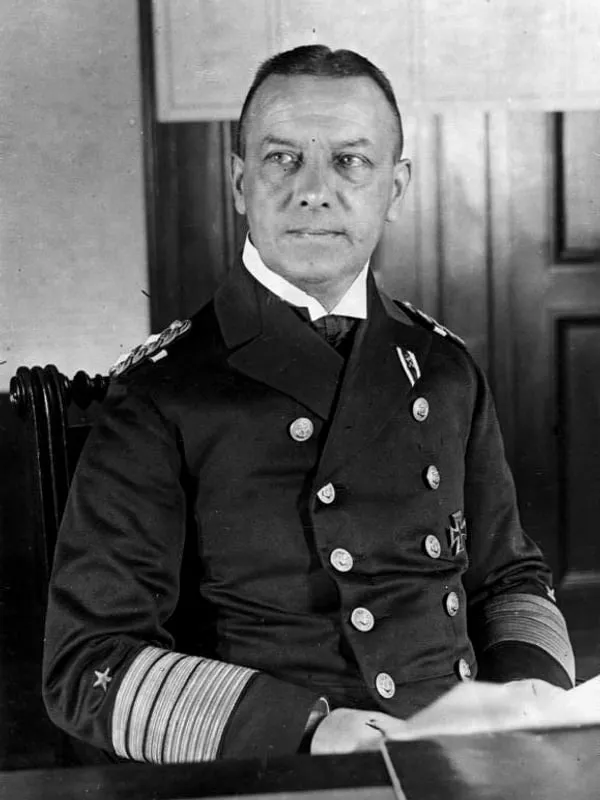
- Born:
- 24 April 1876, Wandsbek (Kingdom of Prussia)
- Died:
- 6 November 1960, Kiel
- Author:
- Łukasz
- Photo:
- autor nieznany, CC BY-SA 3.0 DE, Wikimedia Commons

For fourteen and a half years Erich Raeder stood at the head of the German navy, longer than anyone else in the twentieth century. He took it over in 1928 as the small coastal fleet of the Weimar Republic, cut down to size by the Treaty of Versailles, and in the 1930s turned it into the Kriegsmarine of Adolf Hitler, with the battleships Bismarck and Tirpitz and the first U-boats since 1918. He saw himself as a professional “above politics”, but in practice he served the regime loyally, wore the Golden Party Badge and publicly repeated Nazi slogans. He was present at the conferences at which Hitler announced war, and it was he who put the idea of invading Norway into Hitler’s head. His Plan Z was to give Germany, by the mid-1940s, a fleet capable of threatening Britain, but the war came sooner. In 1943, after a series of failures by the surface ships, he made way for Karl Dönitz. The Nuremberg tribunal sentenced him to life imprisonment.
Officer of the imperial navy
He was born on 24 April 1876 in Wandsbek near Hamburg, into the Protestant family of a grammar-school teacher, Hans Raeder. His father, a strict educator of authoritarian views, instilled in him diligence, thrift, piety and discipline, as well as a distrust of democracy and the Social Democrats. When his father became headmaster of the grammar school in Grünberg in Silesia, today’s Zielona Góra, the son took his school-leaving examination there in 1894. In April of that year he joined the imperial navy, the Kaiserliche Marine, and in 1897, after passing the officers’ examination with distinction, he was commissioned as a Leutnant zur See.
His career advanced quickly thanks to hard work and intelligence, and to patronage as well. Raeder served on cruisers as a signals officer, went through the Naval Academy, and in 1901–1903 was on the staff of Prince Henry of Prussia, the Kaiser’s brother. From 1906 he worked in the press office of the Reich Naval Office, where, as an assistant to Admiral Alfred von Tirpitz, he won over journalists and deputies to the naval laws that drove the naval arms race with Britain. In 1910–1912 he was navigating officer of the imperial yacht Hohenzollern, which allowed him to get to know Wilhelm II. To the end of his life he made no secret of his affection for the Kaiser.
In 1912 he became first staff officer to the commander of the scouting forces of the High Seas Fleet, Admiral Franz von Hipper. In this post, called chief of staff from 1917, he spent almost the whole of the First World War. He took part in the Battle of the Dogger Bank in 1915 and in the Battle of Jutland in 1916, in which he helped plan the battlecruiser sortie and had to transfer with Hipper from the sinking Lützow to another ship. Hipper disliked paperwork and left a large part of the staff work to him. Raeder came out of the war with an experience that shaped him for life: the great battle fleet had lain idle in port for four years in the face of British superiority, and then mutinied. At the beginning of 1918 he took command of the cruiser Cöln, and in October he moved to the Reich Naval Office in Berlin, where he lived through the sailors’ mutiny and the revolution.
The Weimar Republic
In the winter of 1918–1919 Raeder was the naval officer corps’ liaison with the minister Gustav Noske, who with the help of the Freikorps was crushing the workers’ and soldiers’ councils. At the same time the fleet interned at Scapa Flow was scuttled on the orders of Admiral Ludwig von Reuter. In 1919 Raeder’s first marriage broke up, which for so prudish a man was a personal disgrace; he never spoke of it for the rest of his life. In 1920 he married again; his wife Erika remained at his side until her death in 1959.
In March 1920, during the Kapp Putsch, almost the entire naval officer corps declared for the putschists. Raeder later wrote that he had remained loyal to the government, but as a close associate of the head of the Admiralty, Adolf von Trotha, who lost his post for his part in the putsch, he was regarded as compromised. He was transferred to the naval archives, where he wrote two volumes of the official history of cruiser warfare in distant waters. In them he concluded that the inactivity of the fleet in the North Sea had allowed the British to destroy Admiral Maximilian von Spee’s squadron off the Falklands, and that operations on the oceans and in home waters had to be treated as a whole. This idea – war on the enemy’s trade waged by powerful surface ships – stayed with him until the end of his career. In 1926 the University of Kiel awarded him an honorary doctorate.
He soon returned to favour. In 1922 he became a Rear Admiral and Inspector of Naval Education, and in 1925 a Vice Admiral and commander of the Baltic naval station in Kiel. On 1 October 1928, after a financial scandal which revealed that the navy had secretly been funding, among other things, a film company and work on forbidden submarines, the Reichswehr minister Wilhelm Groener dismissed Admiral Hans Zenker and appointed Raeder Chief of the Naval Command – that is, commander of the Reichsmarine – with the rank of Admiral.
Raeder publicly professed loyalty to the Weimar constitution, but in his private correspondence he favoured an authoritarian government of the right. In 1931 he dismissed Oberleutnant zur See Reinhard Heydrich from the navy for conduct unbecoming an officer. Amid fierce political disputes he pushed through the construction of the first “pocket battleship”, the Deutschland, against which the Social Democrats and Communists ran a campaign of “food for children instead of battleships”. In November 1932 he presented a plan for rebuilding the fleet, approved by the minister Kurt von Schleicher, which provided for an aircraft carrier, U-boats and naval aviation – in other words, an open breach of Versailles.
Hitler’s admiral
Until 1933 Raeder was no supporter of Hitler, and in 1932 he called his speeches criminal in private correspondence. After Hitler came to power, however, he quickly reached an understanding with him. In Mein Kampf Hitler had written that Germany should not repeat the mistake of naval rivalry with England, but Raeder persuaded him to expand the fleet by pointing to the threat from France. In August 1934 the navy, like the whole army, swore an oath of loyalty to Hitler personally. Raeder greeted the Anglo-German Naval Agreement of 1935 with mixed feelings: he considered the ratio of 35 to 100 too modest, but the agreement at last allowed battleships to be built. On 1 June 1935 the Reichsmarine was renamed the Kriegsmarine, and Raeder became its Commander-in-Chief. On 20 April 1936 he was promoted to the new rank of Generaladmiral, with the status of a Reich minister.
At the unveiling of the naval memorial at Laboe in 1936 he was the only officer present to give the Hitler salute. On 30 January 1937 he received the Golden Party Badge of the NSDAP from Hitler. He was one of the six participants in the secret conference at the Reich Chancellery on 5 November 1937 at which Hitler set out his plans to win “living space” by force; he raised no objection and complained chiefly about the shortage of steel for the shipyards. When at the beginning of 1938 the war minister, Werner von Blomberg, was compromised by his marriage, Raeder reportedly took the view that the field marshal ought to take his own life. He also sat on the court of honour in the case of General Werner von Fritsch.
After the Sudeten crisis, when it became clear that Britain would not remain neutral in the event of war, Raeder’s staff drew up a fleet-building programme aimed at England. On 27 January 1939 Hitler approved it as Plan Z and gave the construction of the fleet priority over the rest of rearmament. On 1 April 1939, the day the Tirpitz was launched at Wilhelmshaven, he appointed Raeder Grand Admiral, the first since imperial times. A few weeks earlier, on 12 March, in a speech on Heroes’ Memorial Day, Raeder had proclaimed a “merciless struggle against Bolshevism and international Jewry”; the Nuremberg tribunal cited these words as evidence of his ideological closeness to Nazism. He was present when, on 23 May and 22 August 1939, Hitler announced to his generals the attack on Poland. He later claimed that Hitler had assured him that war with Britain would not break out before the mid-1940s. Yet as early as April 1939 Hitler had renounced the naval agreement of 1935.
The Second World War
On 1 September 1939 the old training battleship Schleswig-Holstein shelled the Polish depot on the Westerplatte, and the Kriegsmarine took part in the fighting for the Polish coast. The British declaration of war on 3 September spelt ruin for Raeder’s plans. He noted at the time that the surface fleet was so weak that it could do no more than show that it knew how to “die with honour”. That same day the U-boat U-30 sank the British passenger liner SS Athenia without warning. The naval command concealed the truth, and Goebbels’s propaganda blamed the British for the sinking. Lacking battleships, Raeder waged war on trade. In December 1939, after the Battle of the River Plate, the Admiral Graf Spee was scuttled by her own crew, which Raeder regarded as a disgrace; he ordered that from then on ships were to fight to the last shell.
In the autumn of 1939 Raeder was the first to put to Hitler the idea of occupying Norway, in order to secure Atlantic bases for the navy and safeguard the supply of Swedish iron ore. In December he brought the Norwegian fascist Vidkun Quisling to see Hitler. The invasion in April 1940 succeeded, but it cost the fleet the heavy cruiser Blücher, two light cruisers and half its destroyers. He was sceptical of the planned invasion of Britain, Operation Sea Lion, and made it conditional on the Luftwaffe winning command of the air. In the autumn of 1940 he urged Hitler to strike at the British in the Mediterranean, at Gibraltar and at the Suez Canal, and to postpone the attack on the Soviet Union until Britain had been defeated. Hitler chose war with the Soviet Union. At the same time Raeder pressed for an escalation of the conflict with the United States, and in December 1941 he supported the declaration of war on them.
In 1941 the sorties of heavy ships into the Atlantic brought moderate successes and ever-growing losses. In May 1941 the Bismarck was sunk, after which Hitler took away Raeder’s freedom to use his battleships. In February 1942 the ships stationed in France broke through the English Channel to Germany, and they were then concentrated in Norway against the convoys to the Soviet Union. When, on 31 December 1942, a force including the cruiser Admiral Hipper and the “pocket battleship” Lützow failed to destroy a weakly escorted convoy in the Battle of the Barents Sea, Hitler, in a fit of rage, announced that the big ships would be scrapped. Raeder asked to be relieved. On 30 January 1943 he was replaced by the commander of the U-boats, Karl Dönitz, with whom he had quarrelled for years over the shape of the fleet. Raeder was given the honorary post of Admiral Inspector, without any authority.
Nuremberg and the last years
At the time of Germany’s capitulation he was undergoing treatment in a hospital in Potsdam. On 23 June 1945 he was arrested by the Russians. He and his wife were taken to the outskirts of Moscow, where he was held in good conditions and made to write studies of the German navy. In the autumn of 1945 he was taken to Nuremberg for the trial of the major war criminals before the International Military Tribunal. On 1 October 1946 the tribunal found him guilty of participation in a common plan or conspiracy, of crimes against peace and of war crimes. It pointed to his part in secret rearmament and in planning wars of aggression, above all the invasion of Norway, to unrestricted submarine warfare, and to the fact that he had passed on to his subordinates without objection the Commando Order, which required captured Allied special forces soldiers to be killed. He was sentenced to life imprisonment. He had expected the death penalty and asked the Allied Control Council to commute his sentence to death by firing squad. The request was refused.
He served his sentence in Spandau Prison in Berlin. His wife and circles of former naval officers campaigned for his release. On 26 September 1955, by then in poor health, he was released on medical grounds. In 1956–1957 he published his memoirs, Mein Leben (“My Life”), largely written by the former admiral Erich Förste, in which he defended himself and the unity of the naval command and passed over his disputes with Dönitz in silence. He died in Kiel on 6 November 1960. Dönitz spoke at his funeral.
Significance
Raeder was above all an institutional man. He served the navy all his life, and he pursued his goal – a strong navy able to stand up to Britain – under the Kaiser, the Republic and Hitler. He rebuilt German sea power from what was left after Scapa Flow and Versailles, and in the Third Reich Hitler gave him everything he could have wished for: battleships, U-boats, Plan Z and priority in rearmament. The price was accepting a role in a regime whose plans for war he had known since 1937. As a commander he proved a prisoner of his experience in the First World War: he built a surface fleet for which Germany had neither the time, the steel nor the fuel, and in 1939 he had too few U-boats to cut Britain off from the world. After the war many German naval officers portrayed him as an apolitical professional. Historians, weighing his speeches, his part in planning aggression and his acceptance of criminal orders, see him as one of those representatives of the old elites without whom Hitler could not have prepared and unleashed the war.
Sources
Commanded in battles
(01)Mentioned in battles
(07)Often appears with
People who appear in the same events.
On the timeline
(66)The 40 most important of 66 events. All tagged “Erich Raeder” (4) →
1919
1931
1935
1937
1939
1940
January
February
March
April
- 10
- The sinking of the KönigsbergOn 10 April 1940 Skua dive bombers from the Orkneys sank the German cruiser Königsberg at Bergen, damaged the day before by a Norwegian coastal battery.
- The first Battle of NarvikAt dawn on 10 April 1940 five British destroyers surprised a German flotilla at Narvik. Each side lost two ships, and both commanders were killed.