Germany
Karl Dönitz
Commander of U-boats (1936–1943), Commander-in-Chief of the Kriegsmarine (1943–1945), Reich President (1945)
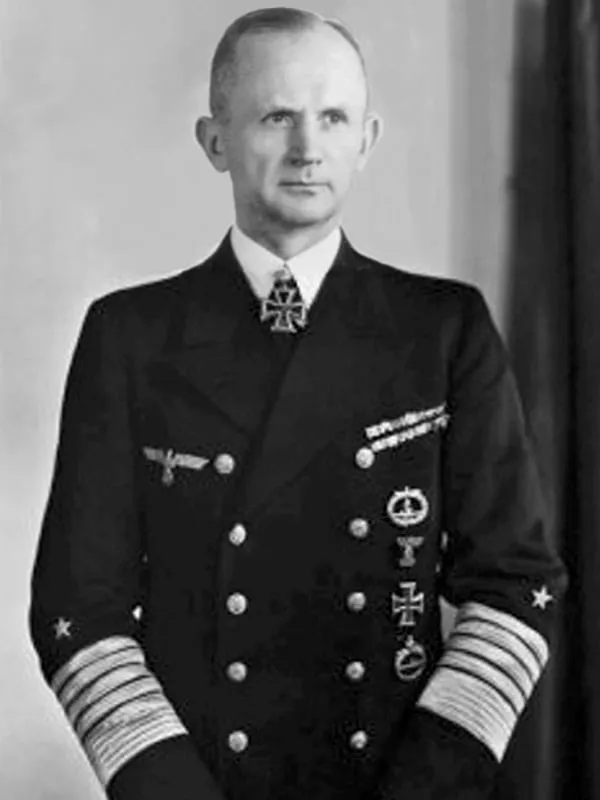
- Born:
- 16 September 1891, Grünau near Berlin (German Empire)
- Died:
- 24 December 1980, Aumühle (West Germany)
- Author:
- Natalia
- Photo:
- Heinrich Hoffmann, CC BY-SA 3.0 DE, Wikimedia Commons

Karl Dönitz was Germany’s most important naval commander of the Second World War and the last head of state of the Third Reich. A veteran of the submarine war of 1917–1918, he rebuilt the German U-boat arm after 1935, trained its crews for night-time group attacks on convoys and for almost six years directed the Battle of the Atlantic, in which his U-boats sank thousands of ships while themselves suffering heavier losses than any other branch of the armed forces. In 1943 he succeeded Erich Raeder at the head of the Kriegsmarine and became one of the most trusted men around Adolf Hitler, who named him his successor in his testament. After the war he presented himself as an apolitical sailor, but the documents and his own speeches reveal a convinced National Socialist. The International Military Tribunal at Nuremberg sentenced him to ten years’ imprisonment.
Early years and the First World War
He was born on 16 September 1891 in Grünau near Berlin, into the Protestant family of Emil Dönitz, an optical engineer employed by the Carl Zeiss works. His mother died when he was three. He spent his childhood in Jena and Weimar, where he passed his school-leaving examinations. On 1 April 1910 he joined the Imperial Navy, the Kaiserliche Marine, as a cadet. From 1912 he served on the light cruiser Breslau, which in August 1914, together with the battlecruiser Goeben, escaped the British and French fleets to Constantinople. Both ships passed under the Ottoman flag and helped draw Turkey into the war. Dönitz fought in the Black Sea against the Russian fleet, and in 1915 served for several months as an airman over the Dardanelles. In May 1916, in Constantinople, he married Ingeborg Weber, the daughter of a Prussian general. They had three children: Ursula and two sons, Klaus and Peter.
In the autumn of 1916 he volunteered for the submarine service. Throughout 1917 he was a watch officer on U-39, operating in the Mediterranean, and on 1 March 1918 he took command of the minelaying submarine UC-25. In her he forced his way into the Sicilian port of Augusta and torpedoed a ship lying there which he took for a British repair ship; he was decorated for it. In September 1918 he took over the larger UB-68. On 4 October 1918, during a night attack on a British convoy off Malta, a malfunction left the boat unable to dive; she came under fire from the escorts and the crew had to abandon her. Dönitz was taken prisoner by the British and released in the summer of 1919. By his later account, that night left him with a conviction that shaped the rest of his life: a single submarine is powerless against a convoy, but several boats attacking at once can break it up.
The Weimar Republic
Accepted into the small Reichsmarine, he commanded torpedo boats. In March 1920, during the Kapp Putsch, his torpedo boat stood ready to support the putschists; he reportedly felt the coup’s collapse as a personal defeat. In the years that followed he rose quickly. He worked on staffs, learned under Raeder, commanded a half-flotilla of torpedo boats, and in 1930 became first staff officer of the North Sea naval station. His superiors rated him very highly; only Captain Wilhelm Canaris faulted him in 1931 for excessive ambition and a craving for recognition, only to judge a year later that he had overcome these failings. In the autumn of 1934 he took command of the training cruiser Emden, in which in 1935 he made a long voyage across the Indian Ocean to South-East Asia.
Creator of the U-boat arm
On his return he was given the task that defined the rest of his career. The Anglo-German Naval Agreement of June 1935 allowed Germany, contrary to the Treaty of Versailles, to build submarines. In September 1935 Dönitz became commander of the first U-boat flotilla, “Weddigen”, made up of three small boats, and on 1 January 1936 Commander of U-boats (Führer der U-Boote). At first he regarded the post as a sideline, but he soon found his feet in it. He trained the crews with enormous intensity, making them practise submerged and surface attacks day and night, and worked out the tactics later known as “wolf packs” (Rudeltaktik): boats deployed in a line were to detect a convoy, shadow it and call up the others by radio for a joint night attack on the surface. In 1936–1937 he directed the secret Operation Ursula, in which two German submarines operated in the Mediterranean on the Nationalist side in the Spanish Civil War.
Dönitz argued that in a war with Britain the navy should stake everything on submarines, and called for 300 boats. Raeder and Hitler chose the surface fleet of Plan Z. In January 1939 Dönitz was made Commodore. He received coolly the warnings that radar, radio direction-finding, aircraft and sonar might one day defeat night attacks and tactics based on radio communication; he was convinced that the enemy would find no answer to them.
The Battle of the Atlantic
In September 1939 Dönitz had 57 submarines, of which only about twenty were capable of ocean operations. On the very first day of the war with Britain U-30, in breach of orders, sank the liner SS Athenia, and German propaganda blamed the British; Dönitz had the traces removed from the boat’s log. A few weeks later he relaxed the restrictions on submarine warfare, and the sinking of the aircraft carrier HMS Courageous brought him fame. On 1 October 1939 he was promoted to rear admiral, and two weeks later Günther Prien’s U-47 sank the battleship Royal Oak in the British fleet base at Scapa Flow. Dönitz had planned the attack personally. In the autumn his post was renamed Commander-in-Chief of U-boats (Befehlshaber der U-Boote, BdU).
After the fall of France he moved his headquarters to Kernével near Lorient, on the Bay of Biscay, from where, with a handful of officers, he directed his boats across the whole Atlantic. In the autumn of 1940 the wolf packs smashed several convoys, and the crews called this period “the happy time”. After Germany declared war on the United States in December 1941, Dönitz sent his boats to the unprepared American coast, where in the first half of 1942 they sank hundreds of ships. He was promoted to vice admiral (1940) and, on 14 March 1942, to admiral. He waged a “tonnage war”, aimed at sinking ships faster than the Allies could build new ones. He did not know that for most of the war the British were reading his Enigma-encrypted signals, and when losses mounted he ordered the security of the ciphers to be investigated, but each time they were judged unbroken.
On 17 September 1942, after the sinking of the troopship Laconia and an attack by an American aircraft on the boats rescuing the survivors, he issued an order forbidding the rescue of crews of sunk ships and demanding “hardness”. This so-called Laconia Order became the main charge against him after the war.
Commander-in-Chief of the Kriegsmarine
On 30 January 1943 Hitler, disappointed by the failures of the heavy ships, accepted Raeder’s resignation and appointed Dönitz Grand Admiral and Commander-in-Chief of the Kriegsmarine. Dönitz also kept command of the U-boats. He first carried out the order to stop building large warships, but then persuaded Hitler not to scrap the battleships. In this way he won Hitler’s trust. Until the end of the war he visited Hitler’s headquarters more often than any other naval commander and rarely questioned his decisions.
In the spring of 1943 his boats lost the decisive convoy battles. In “Black May” the Germans lost more than forty U-boats, and on 24 May Dönitz withdrew them from the North Atlantic. A few days earlier, on 19 May, his younger son Peter had been killed aboard U-954. Dönitz did not, however, end the submarine war. He sent crew after crew into a fight in which they stood no chance, ordering them to fight aircraft on the surface, and in June 1944 he threw 36 boats, most of them without snorkels, against the Normandy invasion; they suffered heavy losses and achieved almost nothing. He pinned his hopes on the new Type XXI and XXIII “electro-boats” and assured Hitler to the end of the war that they would bring a breakthrough. Of some 40,000 German submariners, between 26,000 and 30,000 were killed. In December 1943 his pressure led to the battleship Scharnhorst being sent against an Arctic convoy in the polar night; she sank with almost two thousand men. On 13 May 1944 his elder son Klaus was killed after going out on a combat patrol in the English Channel aboard a torpedo boat.
Dönitz was a National Socialist by conviction. At the beginning of 1944 he received the Golden Party Badge and formally became a member of the Nazi Party. He supported the introduction of National Socialist leadership officers into the navy, and in his speeches demanded fanatical devotion to Hitler. On 12 March 1944, Heroes’ Memorial Day, he said on the radio that without Hitler Germany would have been “susceptible to the spreading poison of Jewry”. After the 20 July plot of 1944 he broadcast a speech that same night condemning the conspirators and pledging the navy’s loyalty. He agreed to the employment of thousands of concentration camp prisoners in the shipyards and did not rescind the Commando Order, under which captured Allied soldiers were killed. From January 1945 the navy carried out Operation Hannibal, the evacuation by sea of soldiers and civilians from Courland, East Prussia and Pomerania ahead of the Red Army. After the war Dönitz presented it as his greatest achievement. Historians point out that troop transports and the continuation of the fighting had priority to the end, and that he committed every available ship to rescuing refugees only a few days before the surrender.
Hitler’s successor
In the second half of April 1945, as the Allied armies were cutting the Reich in two, Hitler gave Dönitz command in the north. In his political testament of 29 April he named him his successor as Reich President and Supreme Commander, and expelled Hermann Göring and Heinrich Himmler from the party for attempting to negotiate with the Allies. Dönitz learned of this at Plön from a signal sent by Martin Bormann, and on 1 May he announced on the radio that Hitler had “fallen” in the fight against Bolshevism, saying nothing of his suicide. He took into his government neither Himmler nor Joseph Goebbels, whom Hitler had named chancellor and who was already dead. At the head of the government, which sat at Flensburg from 3 May, he placed the Finance Minister, Lutz Schwerin von Krosigk.
Dönitz wanted to drag out the surrender so that as many soldiers and refugees as possible could get away to the west, into the hands of the British and Americans, and he hoped for a separate peace with the Western powers. On 4 May his envoy, Admiral Hans-Georg von Friedeburg, signed the surrender of the forces in north-western Germany, the Netherlands and Denmark before Field Marshal Montgomery. General Dwight Eisenhower, however, demanded a total surrender. On 7 May at Reims General Alfred Jodl, with Dönitz’s authority, signed the instrument of unconditional surrender, which came into force on 8 May; late on the evening of 8 May, in Berlin-Karlshorst, Field Marshal Wilhelm Keitel, von Friedeburg and General Stumpff repeated the act. Even in those days naval courts martial were still sentencing deserters to death. The Flensburg government carried on for another two weeks, no longer in control of anything. On 23 May 1945 the British arrested Dönitz together with his ministers.
Nuremberg and Spandau
Before the International Military Tribunal at Nuremberg Dönitz faced three charges: participation in a conspiracy, crimes against peace and war crimes. He was defended by a former naval judge, Otto Kranzbühler. The prosecution, conducted by the British, rested on the Laconia Order, unrestricted submarine warfare, the use of camp prisoners and the Commando Order. Kranzbühler obtained a written statement from the American Admiral Chester Nimitz that from the first day of the war the US Navy in the Pacific had attacked Japanese ships without warning and as a rule had not rescued survivors. On 1 October 1946 the tribunal acquitted Dönitz on the conspiracy charge, because he had not taken part in planning the war, but found him guilty of crimes against peace and war crimes. It held that the German navy had broken the law of submarine warfare, but in view of the Allies’ conduct imposed no punishment for it. It sentenced him to ten years’ imprisonment, the lightest sentence among those convicted at the main trial. Some historians and Allied naval commanders considered the verdict unjust; others thought it too lenient for a close associate of Hitler.
He served his full sentence in Berlin’s Spandau Prison, together with Raeder, Rudolf Hess and Albert Speer, who tried in vain to persuade him to acknowledge his responsibility. He was released on 1 October 1956.
Last years
He settled in Aumühle near Hamburg. In 1958 he published his memoirs, Ten Years and Twenty Days, in which he portrayed himself as an apolitical soldier doing his duty and the German navy as having fought honourably. The book, which for a long time rested on the author’s exclusive access to the documents, shaped the picture of the submarine war for decades. He expressed no remorse for his role in the Third Reich and to the end regarded himself as the last legitimate head of the German state. His visit in 1963 to a grammar school in Geesthacht, at the invitation of the head of the student council, Uwe Barschel, caused a scandal throughout West Germany. His wife died in 1962. Dönitz died of a heart attack on 24 December 1980 in Aumühle. The West German Ministry of Defence refused him military honours and forbade soldiers to attend the funeral in uniform, but several thousand former sailors came.
Significance
Dönitz was one of the ablest commanders of the Second World War in his field. From a few dozen boats he built a weapon that for almost four years threatened Britain’s very survival, and his wolf-pack tactics forced the Allies into an enormous industrial and scientific effort. The same man went on to the very end sending thousands of young men to certain death in a fight that had been pointless since the middle of 1943, and served Hitler loyally down to his last will. After the war he skilfully built up the legend of a clean war at sea and of an apolitical professional. Historians’ research, especially since the 1990s, has shown how closely he was bound to the regime and how deeply he shared its ideology, antisemitism included. He has gone down in history as the creator of the German U-boat arm and the last leader of the Third Reich, in whose name its unconditional surrender was signed.
Sources
Commanded in battles
(01)Mentioned in battles
(07)Often appears with
People who appear in the same events.
On the timeline
(88)The 40 most important of 88 events. All tagged “Karl Dönitz” (17) →
1939
1940
1941
1942
1943
1944
1945
March
April
May
- 08
- Key eventVictory in Europe DayOn 8 May 1945 the West celebrated Germany's surrender in London, Paris and New York. The guns fell silent at 11.01 p.m.; in Poland, joy was clouded by doubt.
- Key eventThe surrender at KarlshorstOn 8 May 1945 in Berlin-Karlshorst, Keitel, Friedeburg and Stumpff signed Germany's final act of unconditional surrender before Zhukov and Tedder.