Norwegian Campaign
- Dates:
- 9 April – 10 June 1940
- Front:
- Scandinavia
- Location:
- Norway: landings at Oslo, Kristiansand, Egersund, Stavanger, Bergen, Trondheim and Narvik; land fighting in the Gudbrandsdalen and Østerdalen valleys, in western Norway, in Trøndelag (Namsos, Steinkjer, Åndalsnes), in Nordland (Mosjøen, Mo i Rana, Bodø) and around Narvik; naval and air operations in the North Sea and the Norwegian SeaOn the battle map →
- Sides:
- Nazi GermanyNikolaus von Falkenhorst, Eduard DietlNorwayHaakon VII, Otto Ruge, Carl Gustav FleischerUnited KingdomWilliam Boyle, Pierse Mackesy, Adrian Carton de Wiart, Bernard Paget, Claude AuchinleckFranceAntoine BéthouartPolandZygmunt Bohusz-Szyszko
- Result:
- German victory. The Allies withdrew from central Norway at the beginning of May and from Narvik on 4–8 June. On 10 June the Norwegian army capitulated, while the King and government carried on the war from London.
- Author:
- Łukasz
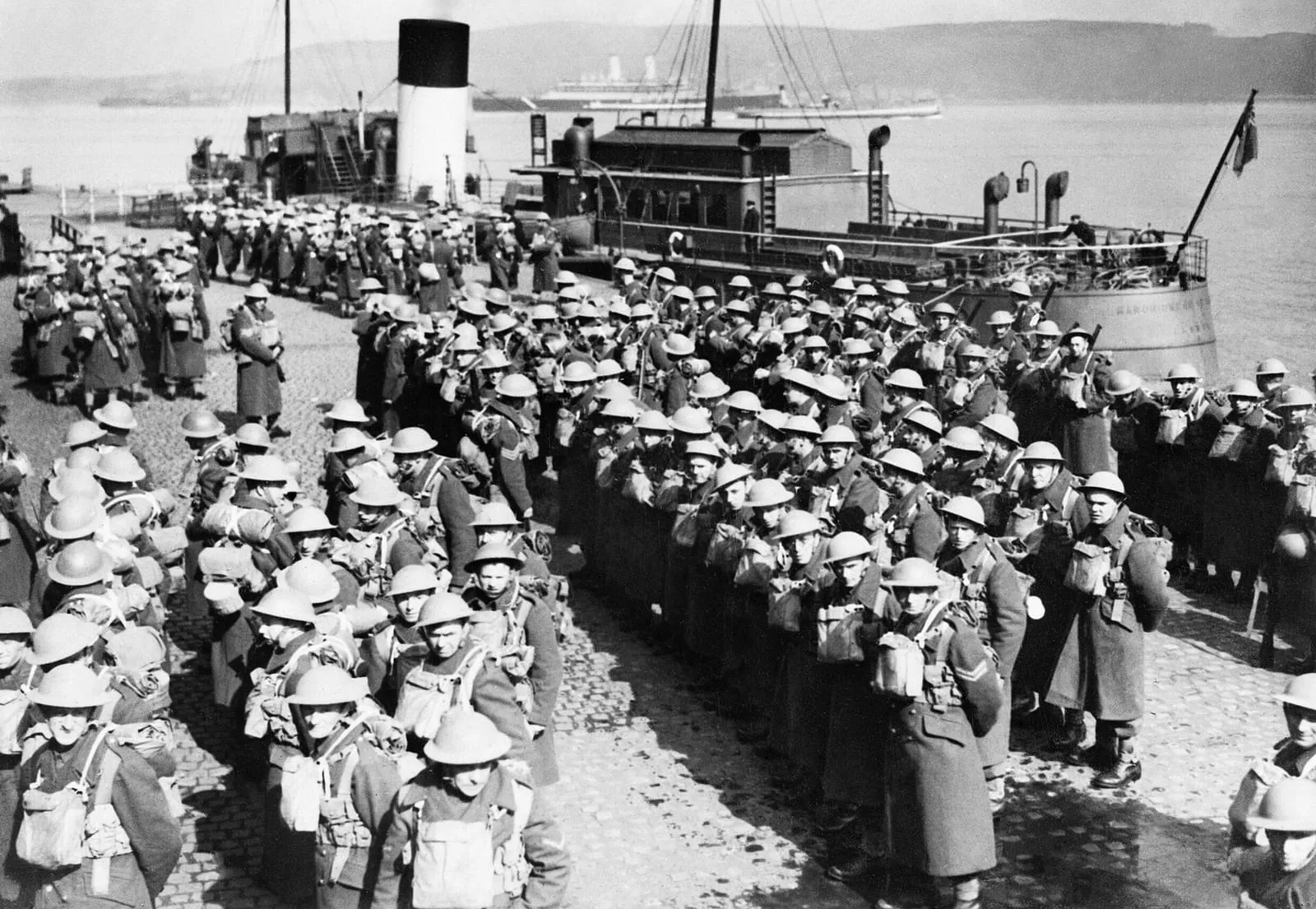
The Norwegian Campaign was the first campaign of the Second World War in which the Wehrmacht faced not only the army of the country it had invaded but also the land forces of Britain and France. On 9 April 1940, without a declaration of war, Germany put troops ashore from ships and aircraft in Norway’s principal ports, from Oslo to Narvik, and took the capital that same day. The plan, prepared since the winter by the staff of Nikolaus von Falkenhorst, forestalled Anglo-French designs on Scandinavia by a matter of a day or two. Despite the surprise, the Norwegians did not give in. King Haakon VII and the government escaped from the capital, rejected the German demands and took up the fight, while the Allies landed troops near Trondheim and Narvik. In central Norway the expedition ended after two weeks in defeat and evacuation, which in London brought down the government of Neville Chamberlain. In the north the Allies, among them Polish Podhale riflemen, recaptured Narvik on 28 May, but in the face of the catastrophe in France they left Norway in the first days of June. On 10 June 1940 the Norwegian army capitulated. Norway had held out for two months, longer than any other country attacked by Germany in 1939–1940.
Name and dates
In Poland and in Norway the term used is the Norwegian Campaign (Norwegian felttoget i Norge); in Germany it is Operation Weserübung, which covered the occupation of both Denmark (“Weserübung Süd”) and Norway (“Weserübung Nord”). Denmark, which capitulated within a few hours on the first day of the invasion, is a separate chapter.
The campaign is taken to have begun on 9 April 1940, when at dawn (at “Weser time”, 5.15 a.m. German time, or 4.15 a.m. Norwegian time) German troops entered Norwegian ports. Some historians, particularly in the English-speaking world, date it from 8 April, when the British began laying mines in Norwegian waters and the first clashes took place at sea. It ended on 10 June 1940, when an agreement on the capitulation of the Norwegian land forces at home was signed in Trondheim. The fighting stopped at midnight on 9/10 June, and the last Allied troops had left the Narvik area on 8 June. The campaign therefore lasted 62 days.
Background
From the outbreak of the war Norway tried to remain neutral, but its long coastline became an object of rivalry between the two sides. In winter, Swedish iron ore from the mines at Kiruna, indispensable to German war industry, was shipped from the ice-free port of Narvik through Norwegian coastal waters, out of reach of the British blockade. From the autumn of 1939 the German naval command under Grand Admiral Erich Raeder argued that British bases in Norway would bar the Reich’s way to the Atlantic, whereas German bases there would open it to German warships. In December Raeder introduced Adolf Hitler to the Norwegian politician Vidkun Quisling, who warned of an imminent British move. On 27 January 1940 the planning was taken over by the High Command of the Wehrmacht (OKW); after the Altmark incident in February Hitler entrusted the command to General von Falkenhorst, and on 1 March he signed the directive for the occupation of Denmark and Norway.
For the Allies Norway mattered for the same reasons. In February 1940 the Supreme War Council adopted a plan for an expedition through Narvik to the Swedish mines, officially to help Finland, then fighting the Winter War. The Moscow Peace Treaty of 12 March deprived it of its pretext, but the new French Prime Minister, Paul Reynaud, and the First Lord of the Admiralty, Winston Churchill, pressed for action. On 28 March the Council decided to mine Norwegian waters (Operation Wilfred) and, in case of a German reaction, to prepare landings at Narvik, Trondheim, Bergen and Stavanger (Plan R 4). British ships laid the mines on the morning of 8 April, when the German groups were already at sea.
Forces and plans
The German plan rested on surprise and simultaneity. Six naval groups were to land infantry in six ports at the same hour: ten destroyers under Commodore Friedrich Bonte, carrying some two thousand mountain troops of General Eduard Dietl, at Narvik; the heavy cruiser Admiral Hipper with four destroyers at Trondheim; the light cruisers Köln and Königsberg at Bergen; the light cruiser Karlsruhe at Kristiansand; minesweepers at Egersund; and the strongest group, with the heavy cruiser Blücher, the pocket battleship Lützow and the light cruiser Emden, at Oslo. Paratroops (Fallschirmjäger (PL)) and air-landed infantry were to seize the airfields of Fornebu near Oslo and Sola near Stavanger. Cover was provided by the battleships Scharnhorst and Gneisenau. Behind the first wave came ships with supplies and further units. In the end some 100,000–120,000 German soldiers in seven divisions took part in the campaign, together with most of the Kriegsmarine’s warships and X Fliegerkorps with about a thousand aircraft, several hundred of them transports.
Norway was unprepared for war. Its army, divided into six district divisions, was in peacetime little more than a school for recruits, and most of its soldiers had yet to be mobilised. It lacked tanks, anti-aircraft artillery and modern aircraft. Part of its strength, including the 6th Division of General Carl Gustav Fleischer, had been stationed in Finnmark, on the border with the USSR, since the Winter War. The navy had more than a hundred vessels, most of them obsolete, and coastal defence relied on forts dating from the turn of the 20th century. Some 50,000–55,000 Norwegians took part in the fighting. In April and May the Allies sent a total of about 38,000 British, French and Polish soldiers to Norway.
Course of events: 9 April
The first clashes at sea preceded the invasion. On 8 April the British destroyer HMS Glowworm, which had become separated from the escort of the battlecruiser Renown, ran into the group bound for Trondheim. Before Admiral Hipper sank her, she rammed the German cruiser. The same day the Polish submarine ORP Orzeł sank the transport Rio de Janeiro, carrying German troops, off Lillesand. The survivors told the Norwegians that they were on their way to defend Bergen against the British, but neither London nor Oslo drew any conclusions from this. The British Home Fleet under Admiral Charles Forbes was searching for the Germans in the North Atlantic, convinced that they were trying to break out into the ocean. On the morning of 9 April Renown clashed off the Lofoten Islands with Gneisenau and Scharnhorst, which made off to the north.
During the night of 8/9 April the government of Johan Nygaardsvold ordered a partial mobilisation, without realising that under the regulations in force this would be a “silent” mobilisation, with call-up papers sent by post. The mistake caused chaos in the first days of the war. At dawn the Germans struck simultaneously across the whole country. At Narvik German destroyers sank two old coastal defence ships, Eidsvold and Norge, and the garrison commander surrendered the town without a fight. Trondheim, Bergen, Egersund and Stavanger fell quickly; Kristiansand, after Odderøya fort had twice beaten off the landing, fell before noon. At Bergen the shore batteries badly damaged Königsberg.
The decisive events took place in the Oslofjord. In the Drøbak Narrows the old guns and torpedo tubes of Oscarsborg fortress, commanded by Colonel Birger Eriksen, sank Blücher, which was carrying the staffs of a division and of the occupation administration. Several hundred men died; estimates range from about 320 to about a thousand. The rest of the group turned back and landed its troops far from the capital. Oslo was therefore taken only in the afternoon, by soldiers flown in to Fornebu airfield. The delay saved the Norwegian state: the King, Crown Prince Olav, the government, most members of the Storting and the central bank’s gold reserves, about 50 tonnes, managed to leave before noon for the north, to Hamar.
On the evening of 9 April Quisling announced on Oslo radio that he was taking power as prime minister, although nobody in Berlin had agreed this with him. That same night the Storting, meeting at Elverum, granted the government full powers to conduct the affairs of state until the next regular session, and an improvised Norwegian unit at Midtskogen stopped a German paratroop detachment that was on its way to capture the King. On 10 April the German minister, Curt Bräuer, presented Haakon VII with a demand that he recognise a Quisling government. The King replied that he would rather abdicate, and the government rejected the demands. The next day the Luftwaffe bombed Elverum and Nybergsund, where the King and ministers were staying. On 10 April Colonel Otto Ruge, promoted to major general, was appointed commander-in-chief of the Norwegian army in place of General Kristian Laake, who had been accused of passivity.
Course of events: the war at sea in April
The first days of the campaign were costly for the Kriegsmarine. On the evening of 9 April the British submarine HMS Truant torpedoed Karlsruhe, which the Germans had to finish off themselves. On 10 April Blackburn Skua dive-bombers of the Fleet Air Arm, flying from the Orkneys, sank Königsberg at Bergen. During the night of 10/11 April the submarine HMS Spearfish torpedoed Lützow on her way home, putting her out of action for a year. The Luftwaffe, for its part, showed as early as 9 April that warships could not operate with impunity within range of its bases: bombers sank the destroyer HMS Gurkha and forced the Home Fleet to withdraw northwards. The British abandoned surface operations off Norway’s southern coast, leaving them to submarines and aircraft.
In the far north Bonte’s group was stuck at Narvik, waiting for tankers. At dawn on 10 April five destroyers of the 2nd Flotilla under Captain Bernard Warburton-Lee attacked it in the Ofotfjord, off the port of Narvik. They sank two German destroyers and several merchant ships, but lost two of their own, and both commanders were killed. On 13 April a squadron under Vice-Admiral William Whitworth, with the battleship Warspite and nine destroyers, entered the fjord. Warspite’s floatplane sank the submarine U-64, and the destroyers destroyed or forced the scuttling of the remaining eight German destroyers. At Narvik the Kriegsmarine lost half of its destroyers. Some 2,600 shipwrecked sailors, however, reinforced Dietl’s troops as improvised infantry, armed with weapons from a captured Norwegian mobilisation depot. The British had no troops at hand to take the town at once.
Course of events: central and southern Norway (14 April – 5 May)
General Ruge understood that he could not recapture the towns and ports, but he wanted to gain time until the Allies retook Trondheim, which opened the way north and linked the two halves of the country. The British command agreed to his request, although Churchill would have preferred to go for Narvik first. In the end troops were sent to both. The plan for a direct assault on Trondheim from the sea (Operation Hammer) was cancelled on 19 April as too risky. Instead the town was to be taken in a pincer movement by two groups: from the north, from Namsos, and from the south, from Åndalsnes.
On 14 April Royal Marines landed at Namsos, followed over the next few days by the British 146th Infantry Brigade under Major General Adrian Carton de Wiart and, on 19 April, by battalions of French Chasseurs Alpins. The troops had neither anti-aircraft artillery nor fighter cover. On 20 April the Luftwaffe reduced Namsos to ashes, destroying the stores. The British advanced as far as Steinkjer, but on 21–22 April the Germans, landing troops from ships deep in the Trondheimsfjord, attacked them at Vist and forced them to retreat, while aircraft razed Steinkjer.
In the south, on 17–19 April, the British 148th Infantry Brigade, made up of poorly trained Territorial Army soldiers, landed at Åndalsnes and Molde. At Ruge’s request it was sent south into the Gudbrandsdalen valley, where the Norwegians were falling back before the German advance from Oslo. The Germans, who since 14 April had been pushing inland up the Gudbrandsdalen and Østerdalen valleys, had tanks, artillery and superiority in the air. Near Lillehammer and, on 23 April, at Tretten they routed the brigade, which lost most of its men. Earlier, on 14 April, a German paratroop company had dropped near Dombås, a railway junction on the route from Åndalsnes; the Norwegians forced it to surrender only on 19 April. The regular 15th Infantry Brigade under Major General Bernard Paget, sent out later, fought a hard action at Kvam on 25–26 April and delayed the Germans at Otta, but could not change the situation.
On the other sectors Norwegian resistance was weakening. On 13–14 April about 3,000 soldiers of the 1st Division from Østfold crossed into Sweden and were interned, and on 15 April the 3rd Division in the Setesdal valley capitulated without a fight. The 4th Division in western Norway mobilised efficiently and beat off an advance from Bergen, but Ruge had to take part of it to the eastern front. Two weeks after the landings it was clear that the pincers around Trondheim would not close. On 26–27 April the British Cabinet decided to withdraw its troops from central Norway. The King and government left Molde on 29 April aboard the cruiser HMS Glasgow and moved to Tromsø, which until June was the de facto capital of free Norway. The evacuation from Åndalsnes lasted from 30 April to 2 May, and that from Namsos took place during the night of 2/3 May. During the withdrawal from Namsos aircraft sank the French destroyer Bison and the British HMS Afridi. On 30 April the German columns from Oslo and Trondheim joined up. Left to their own devices, the Norwegian units in the south of the country capitulated at the beginning of May, and the last pockets of resistance, Hegra fortress near Trondheim and Vinjesvingen in Telemark, surrendered on 5 May.
Course of events: Narvik and the north (14 April – 8 June)
In the north the Allies had more time and space. On 14–15 April the British 24th Guards Brigade began to disembark at Harstad on the island of Hinnøya. Command, however, was divided. Admiral of the Fleet William Boyle, Earl of Cork, wanted to attack Narvik at once, while the commander of the land forces, Major General Pierse Mackesy, bound by instructions to avoid casualties and not to destroy towns, regarded a landing in deep snow, without artillery or landing craft, as suicidal. Lord Cork gave way, and London eventually placed both forces under him. At the same time Fleischer’s Norwegian 6th Division launched an offensive from the north; on 24–25 April at Gratangen the Germans destroyed one of its battalions, but the Norwegians, at home fighting in the mountains and on skis, gradually pushed Dietl back towards Narvik. Cut off from Germany and supplied only by air, Dietl was in a difficult position. According to the diary of General Alfred Jodl, Hitler wanted as early as 17 April to allow him to cross into Sweden and be interned; the OKW staff held back the order.
At the end of April and in May reinforcements arrived: French battalions of Chasseurs Alpins and the 13th Demi-Brigade of the Foreign Legion under Brigadier General Antoine Béthouart, and on 8–9 May the Polish Independent Podhale Rifles Brigade of Brigadier General Zygmunt Bohusz-Szyszko, formed in France during the winter with a view to helping Finland. Polish destroyers fought in the waters around Narvik. On 4 May a German bomber sank ORP Grom in the Rombaksfjord, and 59 of her sailors went down with her. On 13 May Lieutenant General Claude Auchinleck took over command of the land forces, and during the night of 12/13 May the Foreign Legion, with tanks, landed at Bjerkvik, north of Narvik, in one of the first amphibious landings of the war carried out under enemy fire.
Meanwhile a relief force for Dietl was advancing north from Trondheim through Nordland: the 2nd Mountain Division of General Valentin Feurstein. Against it were sent the British Independent Companies of Lieutenant Colonel Colin Gubbins and part of the Guards. Supported by aircraft and seaborne landings, the Germans took in turn Mosjøen, Mo i Rana and Bodø, from which the British had evacuated by 31 May. Along the way, during the night of 14/15 May, aircraft sank the Polish troopship MS Chrobry, carrying a battalion of the Irish Guards, and a few days later the cruiser HMS Effingham was lost after running aground.
It was France, however, that decided the fate of Narvik. On 10 May Germany attacked in the west, and on 24 May the British Cabinet decided to abandon Norway. Béthouart nevertheless carried out the planned attack, so that the evacuation would not take place under fire and the port installations could be destroyed. During the night of 27/28 May French legionnaires and a Norwegian battalion crossed the fjord and on 28 May recaptured Narvik, while Polish Podhale riflemen on the Ankenes peninsula, on the far side of the Beisfjord, took fortified heights after heavy fighting and cut the German units off from the town. It was the first victory of Allied land forces over the Wehrmacht in the war. Dietl fell back into the mountains along the Swedish border, where the Norwegians and Poles continued to press him. The Norwegian government learnt of the Allied decision only on 1 June.
The evacuation (Operation Alphabet) lasted from 4 to 8 June and took off some 25,000 soldiers. On 7 June the King, the Crown Prince and the government sailed from Tromsø to Britain aboard the cruiser HMS Devonshire. On 8 June in the Norwegian Sea Scharnhorst and Gneisenau surprised the returning aircraft carrier HMS Glorious and her two escorting destroyers (Operation Juno). 1,519 sailors and airmen were killed, but before going down the destroyer Acasta torpedoed Scharnhorst. General Ruge refused to leave and stayed with his troops. The fighting stopped at midnight on 9/10 June, and on 10 June an agreement on the capitulation of the Norwegian forces at home was signed in Trondheim. The same day Dietl accepted the capitulation of the 6th Division at Bjørnfjell on the Swedish border. Ruge went into captivity.
Losses
Figures for the losses vary according to the source and the method of counting. According to official German figures cited in the literature, the Wehrmacht lost 5,296 men: 1,317 killed on land, 2,375 killed and missing at sea, and 1,604 wounded. The Kriegsmarine lost the heavy cruiser Blücher, two of its six light cruisers, ten of its twenty destroyers, several submarines (usually given as six) and numerous smaller vessels, while Scharnhorst, Gneisenau and Lützow were out of action for many months. In the summer of 1940, according to the British official history, it had only one heavy cruiser, two light cruisers and four destroyers ready for action. Official German sources put aircraft losses at about 90; some historians at more than 200.
The Norwegian army lost about 860 killed and some 1,700 killed and wounded in all; about 400 civilians died, mainly in German air raids on towns. The Norwegian navy was almost entirely destroyed or captured: a dozen or so vessels reached Britain. The British lost 1,869 killed, wounded and missing on land and about 2,500 men at sea; an aircraft carrier, two cruisers, seven destroyers and several submarines went down. The French and Poles together lost about 530 killed, wounded and missing. According to Polish figures, the Independent Podhale Rifles Brigade lost 97 killed, 28 missing and 189 wounded. The Polish Navy lost Grom and Orzeł, which disappeared in the North Sea at the turn of May and June.
Significance
The Norwegian Campaign was a German victory, won with small forces thanks to surprise, daring and command of the air. The Reich secured the supply of Swedish ore through Narvik, although the wrecked port could not handle it for six months, and gained bases from which its submarines, surface raiders and aircraft could reach out into the Atlantic and over Scotland, and from 1941 attack the convoys sailing to the USSR. The price, however, was high. The Kriegsmarine’s losses meant that in the summer of 1940, when Hitler was considering an invasion of Britain, the German surface fleet was almost powerless. To defend Norway against an imaginary Allied landing, Germany kept several hundred thousand soldiers there until the end of the war. From 24 April civil authority in occupied Norway was exercised by Reich Commissioner Josef Terboven, while Quisling, pushed aside after a few days in April, returned to power as a tool of the occupier.
For the Allies the campaign was an object lesson in how not to wage war: improvised plans, orders changed from one day to the next, divided command, no anti-aircraft artillery and no air cover, against an enemy who ruled the skies. In London its course led to the debate in the House of Commons on 7–8 May in which Chamberlain’s government lost the confidence of a large part of its own party. On 10 May, the day of the German offensive in the west, Churchill became Prime Minister, even though as First Lord of the Admiralty he had been one of the chief authors of the Norwegian plans. Norway did not capitulate as a state. The King and the government in exile in London placed at the Allies’ disposal one of the largest merchant fleets in the world, organised as early as April into the state-run company Nortraship, and on 3 July 1940 Haakon VII rejected a demand for his abdication put forward under German pressure by the Presidium of the Storting. For the Poles, Narvik became their first victorious land battle since September 1939, and Polish warships and Podhale riflemen proved that Poland was fighting on alongside its allies.
Sources
On the timeline
(09)1940
April
- 09
- Key eventGermany invades NorwayOn 9 April 1940 Germany landed troops in Norwegian ports and took Oslo from the air. The king, government and gold left the capital, and Norway fought on.
- The sinking of the Blücher in the Drøbak NarrowsOn 9 April 1940 the guns and torpedoes of Norway’s Oscarsborg fortress sank the cruiser Blücher. The delay let the king, government and gold leave Oslo.