United Kingdom
Bruce Fraser
Third Sea Lord (1939–1942), Commander-in-Chief Home Fleet (1943–1944), Commander-in-Chief British Pacific Fleet (1944–1946), First Sea Lord (1948–1951)
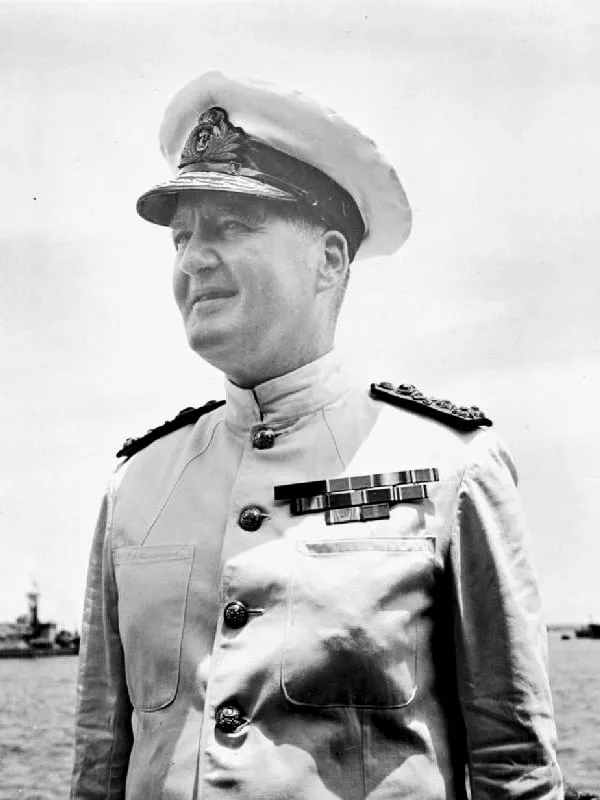
- Born:
- 5 February 1888, Acton (Middlesex, England)
- Died:
- 12 February 1981, London
- Author:
- Łukasz
- Photo:
- Royal Navy official photographer, domena publiczna, Wikimedia Commons

Bruce Austin Fraser, from 1946 Baron Fraser of North Cape, was one of the most outstanding British admirals of the 20th century. A naval gunnery specialist who had fought at Gallipoli as a young man and in 1920 sat in a Bolshevik prison in Baku, in the first years of the Second World War he was responsible at the Admiralty for building warships, and from 1943 he commanded the Home Fleet. On 26 December 1943, while covering a convoy to the Soviet Union, he set a trap for the German battleship Scharnhorst and sank her in a night battle in the Barents Sea. He then created the British Pacific Fleet, which fought alongside the Americans against Japan, and in Tokyo Bay he signed the Japanese surrender on behalf of Britain. He ended his career as First Sea Lord, helping to shape NATO’s naval structure.
Youth and the First World War
He was born on 5 February 1888 in Acton, near London, the son of General Alexander Fraser and Monica, née Smith. He was educated at Bradfield College, and in September 1902 he joined the training ship HMS Britannia as a cadet. In 1904 he became a midshipman in the battleship Hannibal of the Channel Fleet, and then served in battleships, a destroyer and a cruiser in the Mediterranean; in 1907–1908 he received his first commissioned ranks.
From 1911 he specialised in gunnery at the HMS Excellent school on Whale Island in Portsmouth, where he passed the so-called long course with the best result and then became an instructor. He was an advocate of the central direction of the fire of all a ship’s guns from a single position, a system that the Royal Navy was just introducing. This specialisation – mathematical, technical and demanding precision – shaped his entire career.
During the First World War he served first as gunnery officer of the cruiser Minerva, which provided fire support for landings in the Gallipoli campaign and carried troops defending Egypt’s western frontier. In 1916, by now a lieutenant commander, he became gunnery officer of the new battleship Resolution in the Grand Fleet. In November 1918 he took part in the internment of the German High Seas Fleet, which a few months later scuttled itself at Scapa Flow.
Baku and the interwar years
In 1919 he was promoted to commander. He volunteered for service with the Caspian flotilla supporting the White Russians, but when he arrived in Azerbaijan with a British naval mission in 1920, he fell into the hands of the Bolsheviks and was held for several months in harsh conditions in prison in Baku; he was released in November 1920. The experience did not make him an enemy of the Russians – more than twenty years later, as commander of the Home Fleet, he won over the Soviet admirals in the Kola Inlet.
In the 1920s he worked in the Admiralty’s Naval Ordnance Department and was fleet gunnery officer of the Mediterranean Fleet – during exercises he was known to stand on the deck of the target ship to observe the results of the shooting – and in 1926 he was promoted to captain. He headed the Admiralty’s Tactical Division, commanded the cruiser Effingham on the East Indies Station, and in 1933–1936 was Director of Naval Ordnance. In 1936 he took command of the aircraft carrier HMS Glorious. Aboard her he broke down the barriers between the navy and the aviators, who at that time were still under the RAF; under his command the carrier carried out the first trials of night flying operations. This experience served him well years later in the Pacific.
In January 1938 he became a rear admiral and chief of staff of the Mediterranean Fleet under Dudley Pound. In this role he pressed for better cooperation between the services, citing the lesson of the failed Gallipoli operation.
Controller of the Navy
In March 1939, a few months before the outbreak of war, Fraser became Third Sea Lord and Controller of the Navy, the member of the Board of Admiralty responsible for building and equipping warships. In the first years of the war he ran the wartime construction programme: hundreds of escort vessels needed to protect convoys, the completion of the King George V-class battleships, aircraft carriers and destroyers, and the fitting of radar to ships. In May 1940 he was promoted to vice admiral. In June 1940 his former carrier Glorious was sunk by the guns of Scharnhorst and Gneisenau – Fraser had a personal score to settle with the German ship.
In June 1942 he returned to sea as second-in-command of the Home Fleet and commander of the 2nd Battle Squadron. A few weeks later the Admiralty in London ordered convoy PQ 17 to scatter, which ended in disaster. Fraser drew from it the lesson that the commander at sea must know more and decide for himself – even at the cost of breaking radio silence.
Commander of the Home Fleet
In May 1943 Fraser succeeded John Tovey as Commander-in-Chief of the Home Fleet. Soon afterwards, when the ailing Dudley Pound stepped down as First Sea Lord, Winston Churchill offered the post to him. Fraser declined, saying that he had the confidence of his own fleet, whereas Andrew Cunningham had the confidence of the whole navy; according to another account, he added that if he ever sank the Scharnhorst he might change his mind. Cunningham took the post.
The Home Fleet’s main task was to cover the Arctic convoys to the Soviet Union and to keep watch on the German warships in Norway. After Operation Source had put Tirpitz out of action in September 1943, the only dangerous ship left in the north was Scharnhorst. Fraser, true to his gunnery training, assembled radar specialists on his staff and resolved to fight the German ship at night, in a battle in which radar would take the place of eyesight. In December 1943 he personally escorted convoy JW 55A to the Kola Inlet, where – despite his Bolshevik imprisonment years before – he established good relations with his Soviet hosts.
The next convoy, JW 55B, served as bait. Thanks to German signals read by intelligence, Fraser knew that Scharnhorst had put to sea on Christmas Day. On the morning of 26 December he broke radio silence, took control of the whole operation, ordered the convoys to change course and placed his force, with the battleship Duke of York, across the German ship’s path. Vice Admiral Robert Burnett’s cruisers twice drove Scharnhorst away from the convoy and led her straight under the guns of Duke of York. That evening, after more than two hours of gunnery action and torpedo attacks by destroyers, Scharnhorst sank; of a crew of almost two thousand, 36 survived. That evening Fraser paid tribute before his officers to the enemy’s gallantry. It was the last action between capital ships in European waters.
For this victory he was made a Knight Grand Cross of the Order of the Bath, and Joseph Stalin awarded him the Soviet Order of Suvorov, 1st Class. In February 1944 he was promoted to admiral.
The Eastern Fleet and the British Pacific Fleet
In August 1944 Fraser took command of the Eastern Fleet in the Indian Ocean, with the task of preparing a strong force to fight Japan alongside the Americans. In November 1944 the British Pacific Fleet, built around aircraft carriers, was formed from its most modern ships, and Fraser became its Commander-in-Chief. He commanded from ashore, from his headquarters in Sydney, while his second-in-command led the fleet at sea. He had to solve a problem that the Royal Navy had never faced before: supplying a large fleet thousands of kilometres from its bases, including replenishing fuel and ammunition at sea.
The political task was just as difficult. Part of the American high command, led by Admiral Ernest King, was unwilling to see the British in the Pacific. Fraser, patient and tactful, made friends with Chester Nimitz, adopted the American system of signals and procedures and, against resistance in London, introduced tropical khaki uniforms for the crews. From January 1945 British carriers attacked the oil refineries on Sumatra, and from March, during the Battle of Okinawa, the Sakishima Islands, from which Japanese aircraft, including kamikazes, were flying. In the summer the fleet took part in strikes on the Japanese home islands.
On 2 September 1945, aboard the battleship USS Missouri in Tokyo Bay, Fraser signed the instrument of Japan’s surrender on behalf of the United Kingdom, alongside Douglas MacArthur, Nimitz and the representatives of the other Allied nations.
After the war
In 1946 he became First and Principal Naval Aide-de-Camp to the King and was created Baron Fraser of North Cape – the title commemorated the battle regarded as the high point of his career. In 1947–1948 he was Commander-in-Chief, Portsmouth, and in September 1948 he became First Sea Lord and Chief of the Naval Staff; in October of that year he received the highest rank, Admiral of the Fleet. He led the Royal Navy through the post-war budget cuts and the early years of the Cold War. He took part in building NATO’s structures and, against strong opposition at home, agreed that the Supreme Allied Commander Atlantic should be an American. He retired in December 1951.
He never married. He died in London on 12 February 1981, aged 93; the barony became extinct with him.
Significance
Fraser was a seaman of a new era: a gunnery officer who understood that technology, radar and communications decide the outcome of battle, and a commander who knew how to turn them into weapons. The Battle of the North Cape, in which he surprised and destroyed a faster ship in the polar night, was a demonstration of modern command, and its outcome ended the period in which German heavy ships could threaten the Arctic convoys. In the Pacific he displayed another talent – a diplomatic one – and brought the Royal Navy into a war in which the Americans were now playing first fiddle. His signature in Tokyo Bay closed the road that Britain had travelled from the defeats of 1940 and 1942 to victory.
Sources
Often appears with
People who appear in the same events.