Germany
Günther Lütjens
Fleet Commander of the Kriegsmarine (1940–1941), Admiral (1940)
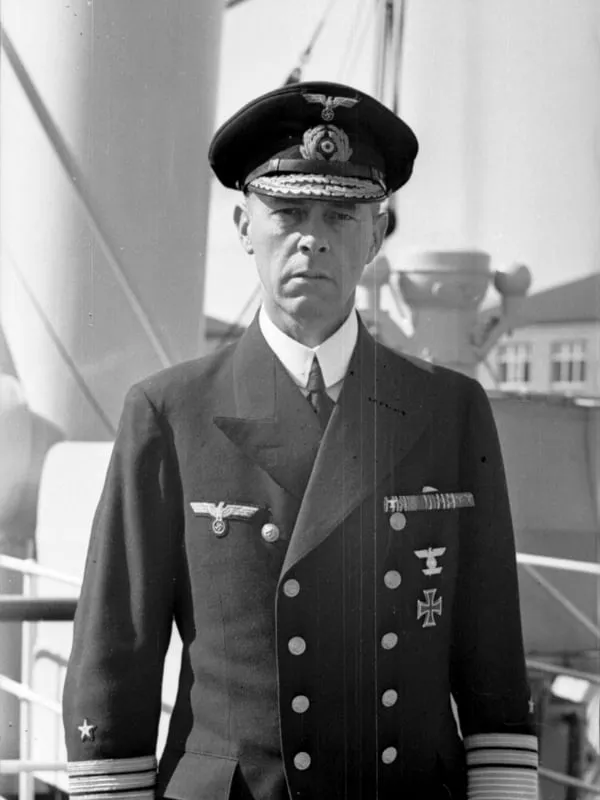
- Born:
- 25 May 1889, Wiesbaden (Kingdom of Prussia)
- Died:
- 27 May 1941, Atlantic Ocean, west of Brest
- Author:
- Łukasz
- Photo:
- autor nieznany, CC BY-SA 3.0 DE, Wikimedia Commons

Günther Lütjens was the highest-ranking German naval officer to be killed in action in the Second World War. A professional seaman from the Imperial Navy, a specialist in torpedo boats and personnel matters, he directed the Kriegsmarine’s most important surface operations as its Fleet Commander in 1940–1941. In September 1939 he shelled Polish warships off Hel, in the spring of 1940 he covered the landings in Norway, in the winter of 1941 he led the successful Atlantic raid of the battleships Scharnhorst and Gneisenau, and in May 1941, aboard the battleship Bismarck, he sank the British battlecruiser Hood. Three days later he died along with almost the entire crew of the Bismarck. He was regarded as a conscientious, taciturn and aloof officer who kept to his orders almost to the letter – a trait that largely determined the course of his last operation.
Early life and the Imperial Navy
He was born on 25 May 1889 in Wiesbaden, the son of the merchant Johannes Lütjens and Luise, née Volz. He grew up in Freiburg im Breisgau, where he passed his Abitur. On 3 April 1907 he entered the Kaiserliche Marine as a cadet. He graduated from the naval school at Kiel twentieth out of the 160 cadets of his year. He went on training cruises round the world in cruisers, was commissioned Leutnant zur See in 1910 and then trained cadets and ratings. From 1913 he served in torpedo boats, which were to become his speciality.
During the First World War he commanded a succession of torpedo boats, and from 1915 served with the Flanders torpedo-boat flotilla, operating from occupied Belgian ports. From February 1916 until the end of the war he commanded a half-flotilla. He took part in raids against British and French ships in the English Channel and in the bombardment of Dunkirk. In 1917 he was promoted to Kapitänleutnant. He ended the war with the Iron Cross of both classes and the Knight’s Cross of the Royal House Order of Hohenzollern with Swords.
The Reichsmarine
After Germany’s defeat Lütjens remained in the Reichsmarine, cut down by the Treaty of Versailles to a mere 15,000 men. He quickly gained a reputation as an excellent staff officer. In 1921–1923 he worked in the fleet department of the naval command, where his duties included analysing the Washington Naval Treaty and its limits on naval armaments. He then commanded a torpedo-boat half-flotilla, was adjutant at the North Sea Station command, and in 1929–1931 commanded the 1st Torpedo Boat Flotilla at Swinemünde (today Świnoujście). In 1929, at the age of forty, he married Margarete Backenköhler, sister of the future admiral Otto Backenköhler; they had three sons and a daughter, the youngest son being born after his father’s death.
In 1931 the head of the navy, Erich Raeder, brought him to Berlin, where Lütjens took over the naval officers’ personnel department. Raeder thought highly of him, and the trust built up over years of working together was to shape the whole of his later career.
In Hitler’s Kriegsmarine
When Adolf Hitler came to power in 1933 and the navy began to expand, Lütjens was already a captain. In 1934–1935 he commanded the light cruiser Karlsruhe, which as a training ship made a long voyage round South America and along the west coasts of both Americas. At Vigo in June 1935 he got to know Karl Dönitz, then captain of the cruiser Emden, better; the two remained on good terms. On his return Lütjens became head of the naval personnel office and built up the officer corps of the new Kriegsmarine, which under the Anglo-German Naval Agreement of 1935 could reach 35 per cent of the tonnage of the British fleet. In October 1937 he was promoted to rear admiral and became Commander of Torpedo Boats (Führer der Torpedoboote) at Swinemünde.
According to his German biographers, his attitude to Nazism was cool and detached. As head of personnel he did not apply the Nuremberg Laws to naval officers; his close associate and later first staff officer of the fleet, Paul Ascher, was of Jewish descent, and according to the same studies Lütjens’s wife and her brother were also regarded as “half-Jews” under Nazi law. After Kristallnacht in November 1938, Lütjens and Dönitz are said to have lodged a protest against the pogrom with the Fleet Commander, Admiral Hermann Boehm. Boehm and Raeder mentioned this in their memoirs, but no documents have survived and some historians question the story. The protest, if there was one, did Lütjens’s career no harm.
September 1939 and Norway
In the first days of the war Lütjens commanded the German destroyers and torpedo boats in the Baltic. On 3 September 1939, aboard the destroyer Leberecht Maass, he led the attack on the Polish ships Wicher and Gryf off Hel. Fire from the Polish ships and a coastal battery hit his ship, killing four sailors; Lütjens himself was slightly wounded, and the German destroyers withdrew after several dozen minutes. Soon afterwards his destroyers were laying minefields in the North Sea. In October 1939 he became Commander of Reconnaissance Forces (Befehlshaber der Aufklärungsstreitkräfte), with the light cruisers under his command, and led minelaying operations off the British coast. On 13 December 1939, during one of them, a British submarine torpedoed two of his cruisers, the Leipzig and the Nürnberg. On 1 January 1940 he was promoted to vice admiral.
In April 1940, when the Fleet Commander, Vice Admiral Wilhelm Marschall, fell ill, Lütjens commanded the force covering the German landings in Norway. Flying his flag in the battleship Gneisenau, he escorted the destroyers carrying troops for Narvik and Trondheim. On the morning of 9 April, off the Lofoten Islands, his battleships fought a brief action with the British battlecruiser Renown and then used their superior speed to break away to the north. Raeder praised the decision, but the destroyers left behind at Narvik were destroyed over the following days in the battles of Narvik, which, according to those around the admiral, weighed heavily on him.
Fleet Commander
In June 1940 Raeder dismissed Marschall, who had sunk the Glorious but had acted against orders. Lütjens became Fleet Commander, first temporarily and then, in July, permanently; on 14 June he received the Knight’s Cross of the Iron Cross, and on 1 September he was promoted to admiral. He was the third Fleet Commander in less than two years, and his predecessors had gone after disputes with Raeder over how strictly a commander at sea had to keep to his orders. Lütjens drew a conclusion that he later repeated to those he spoke to: he had no intention of being the third to lose the post for acting on his own initiative.
In the summer of 1940 he planned the naval side of the invasion of Britain. From his headquarters at Trouville he directed the assembly of the barges, tugs and ships needed for the crossing, but the Kriegsmarine, weakened by its losses off Norway, had no ships capable of shielding the landing from the Royal Navy. After the Luftwaffe lost the Battle of Britain the invasion was postponed.
Operation Berlin
In the winter of 1940–1941 Lütjens led his most successful operation. On 22 January 1941 he sailed from Kiel with the Gneisenau and the Scharnhorst. When a British cruiser sighted him off Iceland he turned back, refuelled in the Arctic and on 4 February broke out into the Atlantic through the Denmark Strait. Twice he came upon convoys escorted by old British battleships (the Ramillies and the Malaya) and, in accordance with his orders, avoided battle; he directed German submarines on to the second of these convoys. On 22 February his ships sank ships from a dispersed convoy east of Newfoundland, and on 15–16 March they scattered another group of ships on the route from Halifax. On 22 March the force entered Brest. In all, the Germans sank or captured 22 ships of about 115,000 GRT. Raeder judged the conduct of the operation “faultless”, although staff officers of the Seekriegsleitung (Naval War Staff) felt the admiral could have acted more boldly.
Rheinübung and death
The next operation, Rheinübung, was originally planned to involve all four modern battleships. When it turned out that only the Bismarck and the heavy cruiser Prinz Eugen would be available, Lütjens asked Raeder to postpone it and warned against committing the fleet to battle “teaspoon by teaspoon”. Raeder would not give way. According to his friends, Lütjens set out convinced he would not return; he is said to have told Vice Admiral Hans-Erich Voss that, given British superiority, survival was unlikely. On 5 May 1941, during Hitler’s visit to the Bismarck at Gotenhafen (Gdynia), he spoke to him about the threat from torpedo aircraft, but the operation was not called off.
The force left Gotenhafen on the night of 18–19 May. The British soon learnt of it, and Lütjens, for reasons that remain unclear, did not top up the Bismarck’s fuel in the fjord near Bergen. On 24 May in the Denmark Strait his ships sank the Hood and damaged the battleship Prince of Wales. According to survivors, Lütjens delayed opening fire for a long time, and after the battle he rejected the request of the Bismarck’s captain, Kapitän zur See Ernst Lindemann, to pursue the damaged enemy. The hit Bismarck was losing fuel, so the admiral decided to make for Saint-Nazaire and detached the Prinz Eugen. During the night of 24–25 May he shook off the British cruisers, but still believed he was being tracked by radar and sent long signals that allowed the British to work out his course. On 25 May, his 52nd birthday, he addressed the crew in such terms that many sailors understood that the admiral did not believe they would be saved.
On the evening of 26 May a torpedo from an aircraft from the carrier Ark Royal jammed the battleship’s rudder. Lütjens then signalled to headquarters: “Ship unmanoeuvrable. We shall fight to the last shell. Long live the Führer”, and later sent another signal, addressed to Hitler, promising to fight to the end. On the morning of 27 May the Bismarck was destroyed by the fire of the British battleships King George V and Rodney and sank. Lütjens was most probably killed in the first phase of the action, when shells destroyed the ship’s forward command positions; of the more than 2,000 men on board, just over a hundred survived.
Assessment and memory
Lütjens remains a controversial figure. His critics charge him with failing to refuel in Norway, missing the chance to finish off the Prince of Wales, giving away the ship’s position with his radio signals and undermining the crew’s morale with his gloomy address. His defenders point out that he acted within the limits of Raeder’s rigid orders, and that his signals on the last night echoed the wording of an order Raeder had issued after the scuttling of the Admiral Graf Spee, which forbade the surrender of a ship still able to fight. The German historian Holger Afflerbach (PL), however, saw the leading of the Bismarck’s crew to their deaths as an expression of the “mystique of doom” prevailing in the Kriegsmarine and judged it very harshly.
In 1969 the West German navy gave his name to the US-built guided-missile destroyer Lütjens. The decision by Defence Minister Gerhard Schröder caused controversy, because it was the first time a Wehrmacht commander unconnected with the resistance had been honoured in this way. It was justified by his distance from Nazism and his protest of 1938. The ship served until 2003. In the 1960 film Sink the Bismarck! Lütjens was portrayed as a fanatical Nazi – a picture with which historians disagree.
Sources
Commanded in battles
(01)Often appears with
People who appear in the same events.