Equipment
The Short Stirling
The RAF's first four-engined bomber of the war: agile but flying too low, withdrawn from Germany at the end of 1943, then a glider tug and transport.
- Role:
- heavy bomber
- State:
- United Kingdom
- Maker:
- Short Brothers
- First flight:
- 14 May 1939
- Built:
- about 2,370
- Author:
- Natalia
- Updated:
- 1 November 2026
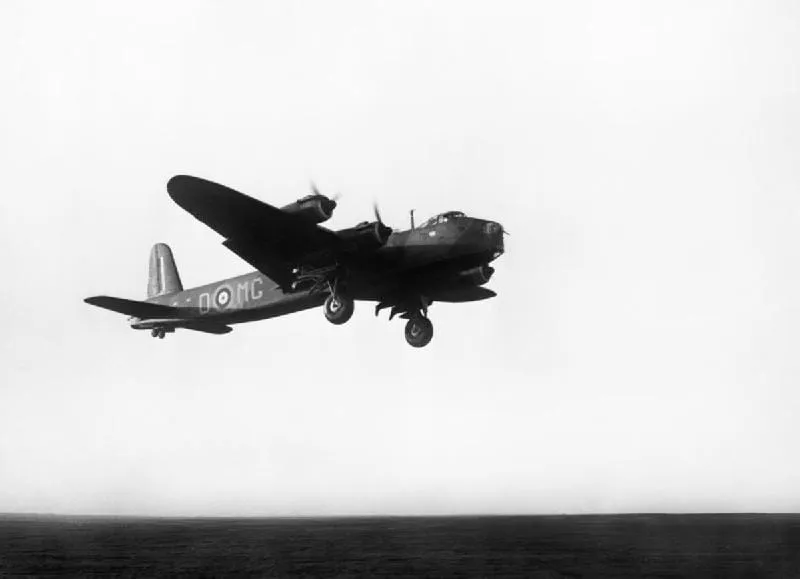
The Short Stirling was the first four-engined bomber the RAF brought into action in this war, and the first to show that Britain could carry the war to Germany on a larger scale. It was big, strong and, for its size, surprisingly agile, but faults built into it on the drawing board meant that it flew too low and could not take the largest bombs. Once Halifaxes and Lancasters reached the squadrons, Stirlings began to suffer heavier losses than they did, and at the end of 1943 they were withdrawn from operations over Germany. Glider towing, parachute landings and supply drops to the resistance gave them a second life.
Wings shorter than they should be
In 1936 the Air Ministry called for a heavy bomber with four engines. Among the officers shaping the new requirements in those years was the deputy director of plans, Arthur Harris. The favourite was a Supermarine design, but when it fell through, production went to the Stirling of Short Brothers, a firm that had until then built mainly flying boats. The specification limited the span to just under a hundred feet, about 30 metres; this is often explained by the width of hangar doors, but that explanation is doubtful. The short, thick wings gave excellent manoeuvrability and a low ceiling: with bombs the Stirling often flew at about 12,000 feet, under 4 kilometres, well below the later four-engined bombers. The bomb bay was divided by partitions into narrow cells and could not take bombs heavier than 2,000 pounds.
Before the full prototype Short built a half-scale flying model, first flown in September 1938. The real Stirling took off on 14 May 1939 (the RAF Museum gives 13 May) and was wrecked on landing when a brake locked. The first production aircraft flew in May 1940.
Bombs on the factories
The Luftwaffe knew where the new bombers were being built. In August 1940, during the Battle of Britain, Dorniers bombed the Short Brothers works at Rochester on the Medway; the destruction of finished aircraft and assembly halls set production back by many months, as we describe under Black Thursday. In the spring of 1941 it was the turn of the second production line, the Short & Harland works in Belfast: in the raid of 7–8 April the fuselage assembly hall burned down with several dozen fuselages, and in May production stopped after further bombing. Manufacture was dispersed to smaller plants, and some Stirlings were built at the Austin factory at Longbridge.
Over Germany (1941–1943)
The first Stirlings went to No. 7 Squadron in August 1940, and on the night of 10–11 February 1941 three of them attacked oil tanks at Vlaardingen near Rotterdam. Throughout 1941 there were few of them, often grounded by defects, but from 1942 the squadrons of No. 3 Group sent them on every major Bomber Command raid. In the thousand-bomber raid on Cologne 88 Stirlings took part, and in August No. 7 Squadron joined the target-marking force, the Pathfinder Force. The low ceiling cost dearly: in the raid on Hamburg in July 1942 No. 3 Group lost 16 Wellingtons and 9 Stirlings, more than 15 per cent of the aircraft sent.
The long flights over the Alps brought Stirling pilots both their Victoria Crosses. On the night of 28–29 November 1942 the Australian Rawdon Middleton of No. 149 Squadron, badly wounded over Turin, brought his aircraft back to the English coast, let five airmen bail out and died over the Channel with the two who stayed on board. In August 1943 Arthur Aaron of No. 218 Squadron, wounded over the same city, helped his crew bring the aircraft to Algeria, where he died.
In 1943 Stirlings flew in the Battle of the Ruhr and in the raid on Peenemünde, but they were already being taken off the Berlin raids in January because they flew too low. On the night of 18–19 November 1943, 114 Stirlings flew to Ludwigshafen as part of the diversion covering the first raid of the Battle of Berlin; nine did not return. Soon afterwards Harris gave up using them over Germany. According to British returns Stirlings flew more than 18,000 sorties with Bomber Command and lost more than six hundred aircraft in action.
Tugs and transports
Withdrawn from bombing, the Stirlings laid mines off France and Germany, and from 1944 the Mark IV, without nose and dorsal turrets, served in No. 38 Group RAF as a glider tug and paratroop aircraft. On the night before the Normandy landings they dropped paratroops of the British 6th Airborne Division and towed Horsa gliders to Normandy. In September 1944 they flew for several days over Arnhem, dropping supplies to the surrounded paratroops through heavy flak, and on 24 March 1945 they towed gliders during the Rhine crossing. Others dropped weapons and agents for the resistance in occupied Europe.
About 2,370 Stirlings were built, some six hundred of them as transports. After the war the Avro York quickly replaced them; a few were sold to Belgium and Egypt. None survives complete: museums can show only fragments recovered from wrecks.
Sources
In the chronicle
(25)1941
1942
- 13 March 1942Gee raids on the Ruhr
- 28 March 1942The bombing of Lübeck
- 5 April 1942RAF raids on Cologne and Hamburg
- 30 May 1942The thousand-bomber raid on Cologne
- 2 June 1942The thousand-bomber raid on Essen
- 25 June 1942The thousand-bomber raid on Bremen
- 27 July 1942The RAF raid on Hamburg of 26/27 July
- 10 September 1942The raid on Düsseldorf
- 22 October 1942The raid on Genoa
- 18 November 1942RAF raids in November 1942
1943
- 16 January 1943RAF raids on Berlin in January 1943
- 5 March 1943The Battle of the Ruhr begins
- 15 April 1943The raids on Stuttgart and Pilsen
- 29 May 1943The raid on Wuppertal
- 24 June 1943The raid on Elberfeld and the evacuation of the Ruhr
- 17 August 1943Operation Hydra
- 18 November 1943The air Battle of Berlin begins
- 27 November 1943Raids on Berlin in November 1943