1944–1945: The liberation of Western Europe
Operation Market Garden
- Dates:
- 17–25 September 1944
- Front:
- Western Front
- Location:
- The Netherlands: a corridor along the road from the bridgehead on the Meuse–Scheldt Canal near Neerpelt (Belgium) through Valkenswaard, Eindhoven, Son, Veghel, Grave and Nijmegen to Arnhem and Oosterbeek on the Lower Rhine (Nederrijn), and to the village of Driel on its south bankOn the battle map →
- Sides:
- United Kingdom, United States and PolandBernard Law Montgomery, Frederick Browning, Roy Urquhart, Brian Horrocks, Stanisław Sosabowski, James Gavin, Maxwell TaylorNazi GermanyWalter Model, Wilhelm Bittrich, Kurt Student
- Result:
- Allied defeat. The American airborne divisions and British XXX Corps took the bridges from Eindhoven to Nijmegen, including the Waal bridge on 20 September, but failed to break through to Arnhem. Lieutenant Colonel John Frost’s battalion held the northern end of the Rhine bridge until the morning of 21 September, while the rest of the British 1st Airborne Division held out at Oosterbeek. The Polish 1st Independent Parachute Brigade, dropped near Driel on 21 September, managed to get only part of its men across the river. During the night of 25/26 September about 2,400 men were evacuated across the Rhine; over 6,000 were taken prisoner. The Allies gained a salient from the Belgian border to Nijmegen but did not cross the Rhine or open the way to the Ruhr.
- Author:
- Łukasz
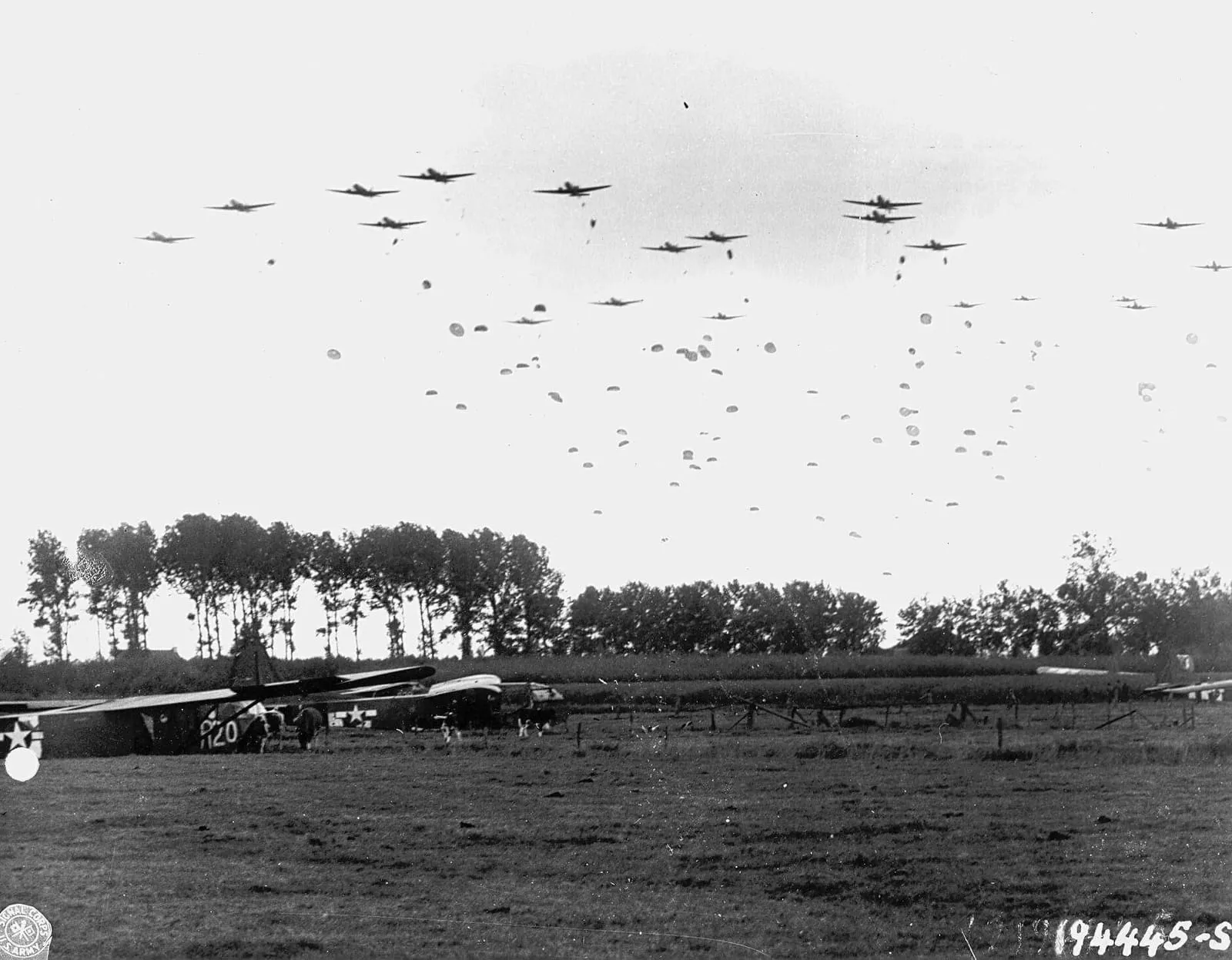
Operation Market Garden – the Allied offensive in the occupied Netherlands in September 1944 – was the largest airborne operation mounted up to that time and one of the best-known defeats of the Western Allies in the Second World War. Field Marshal Bernard Law Montgomery intended to use three airborne divisions to seize a chain of bridges over the canals and rivers between the Belgian border and Arnhem, and then push British XXX Corps across them and beyond the Rhine, outflanking the Siegfried Line from the north. The “Market” part – the airborne landing – was carried out by the American 101st and 82nd Airborne Divisions, the British 1st Airborne Division and the Polish 1st Independent Parachute Brigade under Brigadier General Stanisław Sosabowski; the “Garden” part – the ground advance – by Lieutenant General Brian Horrocks’s XXX Corps. The Americans and British captured one bridge after another as far as Nijmegen, but the last of them, over the Lower Rhine at Arnhem, remained in German hands. The British paratroopers, who from the outset were fighting units of two SS panzer divisions – whose presence in the area, as most historians stress, Allied headquarters had been warned about – were withdrawn across the river after nine days with heavy losses.
Name and dates
The code name had two parts: “Market” denoted the airborne operation, conducted by the First Allied Airborne Army under the American Lieutenant General Lewis Brereton and its subordinate British I Airborne Corps under Lieutenant General Frederick Browning; “Garden” denoted the ground advance of the British Second Army under General Miles Dempsey, spearheaded by XXX Corps. The fighting of the 1st Airborne Division and the Polish brigade on the Rhine, which formed part of the operation, is usually called the Battle of Arnhem.
The start is unambiguous: on Sunday 17 September 1944, at around 1 p.m., the first airborne waves came down on the drop and landing zones in the Netherlands, and at 2.35 p.m. XXX Corps launched its attack from the bridgehead on the Meuse–Scheldt Canal at Neerpelt in Belgium. The end date can be taken as 25 September, when the Allied command decided to withdraw the remnants of the 1st Airborne Division; the evacuation across the Rhine (Operation Berlin) was carried out during the night of 25/26 September. The fighting in the captured corridor, especially for the road between Veghel and Uden and for the so-called Island (the Betuwe) between Nijmegen and Arnhem, went on for several more weeks, but was no longer part of this operation.
Background
After the Germans were routed in the Falaise pocket in August 1944, the Allied armies set off in pursuit across northern France and Belgium. The British Guards Armoured Division entered Brussels on 3 September, and on 4 September the 11th Armoured Division took the port of Antwerp intact. The banks of the Scheldt estuary, however, remained in German hands, and the German Fifteenth Army was withdrawing across it. The Allied armies were still being supplied over the Normandy beaches, hundreds of kilometres from the front, and at the beginning of September the pursuit began to falter for lack of fuel. The Supreme Commander, Dwight Eisenhower, held to the concept of an advance on a broad front, while Montgomery demanded that supplies be concentrated on a single thrust in the north, towards the Ruhr, which in his view could end the war before the close of 1944.
The first idea was a limited operation, Comet: the British 1st Airborne Division and the Polish brigade were to seize the bridges at Grave, Nijmegen and Arnhem on their own. After several postponements because of the weather and stiffening resistance, Montgomery cancelled it on 10 September and replaced it with a much larger plan, which he presented to Eisenhower that same day at Brussels airfield. The Supreme Commander approved it – he was tempted by the prospect of getting across the Rhine, of using the First Allied Airborne Army, which had stood idle since Normandy, and of cutting off the western Netherlands, from which the Germans had been firing V-2 rockets at London since 8 September.
Under the plan, Major General Maxwell Taylor’s 101st Airborne Division was to take the bridges between Eindhoven and Veghel; Brigadier General James Gavin’s 82nd Division the bridges over the Meuse at Grave, over the Meuse–Waal Canal and over the Waal at Nijmegen, together with the high ground near Groesbeek; and Major General Roy Urquhart’s British 1st Division, reinforced by the Polish brigade, the bridges at Arnhem. XXX Corps was to cover some 100 km along a single road, running largely on an embankment through waterlogged polders, and reach Arnhem in two, at most four, days. There were only enough transport aircraft to lift part of the force at once, so the landing was spread over three days. The air command, fearing anti-aircraft artillery and the marshy ground, assigned the British drop zones 8–13 km west of the Arnhem bridge, which deprived them of surprise. According to Sosabowski’s own account and those of his biographers, the Polish general openly criticised these assumptions; the remark attributed to Browning that they were going “a bridge too far” is known only from his later recollections and the accounts of others.
The Germans, meanwhile, were regaining their balance. On 5 September Gerd von Rundstedt returned as Commander-in-Chief West, and Colonel General Kurt Student cobbled together the 1st Parachute Army from parachute divisions, training units and Luftwaffe detachments, and manned the canals along the Belgian–Dutch border. SS-Obergruppenführer Wilhelm Bittrich’s II SS Panzer Corps, bled white in Normandy, had been sent to the Arnhem area to refit with the 9th SS Panzer Division “Hohenstaufen” and the 10th SS Panzer Division “Frundsberg” – by historians’ estimates now only a few thousand men strong, but experienced and equipped with assault guns, half-tracks and some tanks. Its presence was reported by the Dutch resistance and by Ultra intercepts; the intelligence chief of Browning’s corps, Major Brian Urquhart, produced aerial photographs showing tanks near Arnhem, and Eisenhower’s chief of staff, General Walter Bedell Smith, tried to persuade Montgomery to change the plan. The warnings were dismissed as exaggerated, and Brian Urquhart was sent away on sick leave.
Course: 17 September
On the morning of 17 September Allied bombers attacked anti-aircraft positions and barracks along the flight path; civilians were also killed in Arnhem, Nijmegen and the surrounding villages. Around midday more than a thousand transport aircraft and several hundred towed gliders of the first lift arrived over the Netherlands, escorted by hundreds of fighters; they carried nearly 20,000 troops. The daylight drop went better than in Normandy: most units landed accurately and assembled quickly, with light losses to anti-aircraft fire.
The 101st Division took the bridges at Veghel and over the Dommel at Sint-Oedenrode, but the Germans blew up the main bridge over the Wilhelmina Canal at Son when the American paratroopers were only a few dozen metres away. The 82nd Division seized the long bridge over the Meuse at Grave and the bridge over the Meuse–Waal Canal at Heumen, and occupied the high ground near Groesbeek, where a German counter-attack from the Reichswald forest was expected. Gavin, whom Browning had ordered to secure the high ground first, sent a battalion of the 508th Regiment to the road bridge at Nijmegen only in the evening; by then German units were already in the town and stopped it. Browning’s headquarters also landed by glider on the high ground near Groesbeek, taking up several dozen aircraft that could have carried combat troops – a decision that has long been criticised.
The British 1st Airborne Division landed on the heaths near Wolfheze and Heelsum. Owing to the shortage of aircraft only half the division arrived on the first day, and only half of that – Brigadier Gerald Lathbury’s 1st Parachute Brigade – could set off for Arnhem; the rest had to guard the landing zones for the next lift. Almost at once the British ran into Major Sepp Krafft’s SS training battalion near Wolfheze, and then into hastily formed battle groups of the 9th SS Division. The radios failed, so divisional headquarters kept losing contact with the battalions. Field Marshal Walter Model, commander of Army Group B, who happened to be quartered in the Tafelberg Hotel in Oosterbeek, left the village and with Bittrich’s help quickly organised the defence: the 9th SS Division was to stop the British in Arnhem, and the 10th SS Division was to move to Nijmegen and hold the Waal bridge. The same day the Germans found a copy of the operation order in a glider shot down near Vught; historians differ over how much it influenced their decisions.
Two of Lathbury’s three battalions got bogged down in Oosterbeek and on the western outskirts of Arnhem. The third, Lieutenant Colonel John Frost’s 2nd Parachute Battalion, advanced along the road by the river, although the railway bridge at Oosterbeek was blown up before his men’s eyes. In the evening Frost, with some 700–750 men from various sub-units, occupied the houses at the northern end of the Arnhem road bridge (today the John Frost Bridge); an attempt to cross to the south bank failed.
XXX Corps’ attack was preceded by a barrage from 300 guns and by ground-attack aircraft. The tanks of the Irish Guards of the Guards Armoured Division lost several vehicles to German anti-tank ambushes within the first few kilometres. By evening the head of the corps had got only as far as Valkenswaard, roughly halfway to Eindhoven, and halted there for the night.
Course: 18–19 September
The second lift, due to arrive on the morning of 18 September, was held on its airfields for several hours by fog over England. When it reached the Netherlands in the afternoon, Brigadier John Hackett’s 4th Parachute Brigade landed under fire on heaths that the British were barely able to hold. Meanwhile, at the Arnhem bridge, Frost’s men beat off a morning attack by the reconnaissance battalion of the 9th SS Division, returning from the south across the bridge; of its dozen or more vehicles several were burned out on the ramp, and the battalion commander was killed. Attempts by the remaining battalions of the 1st Brigade to break through to the bridge along the Rhine collapsed under the fire of German assault guns and riflemen. Lathbury was wounded, and Major General Roy Urquhart, who had gone to the outskirts to take command personally, spent more than a day hiding in the attic of a house in Arnhem, cut off from his own headquarters. Brigadier Philip Hicks took command of the division in the meantime.
In the south things went better. On 18 September the 101st Division liberated Eindhoven, welcomed by crowds of inhabitants, and in the evening linked up with the Guards’ tanks. During the night XXX Corps engineers threw a Bailey bridge across the Wilhelmina Canal at Son, and on the morning of 19 September the armoured columns moved on. Within a few hours they passed through the stretch of corridor held by the Americans, reaching Grave before noon and then Nijmegen. There, however, the attack by the Grenadier Guards and the 505th Regiment on the road bridge stalled in front of German positions in the Valkhof park and at the roundabout at the approach to the bridge. Meanwhile the 82nd Division spent the whole of 18 September repelling attacks from the Reichswald on the Groesbeek heights, and the 101st Division a thrust by the German 107th Panzer Brigade, which on 19 September almost reached the new bridge at Son. The narrow road, which the Americans had to defend from both sides at once, became known to them as “Hell’s Highway”.
In Arnhem, 19 September was the decisive day. In the morning four depleted battalions – the 1st, 3rd and 11th Parachute Battalions and the 2nd Battalion, South Staffordshire Regiment – made a last attempt to break through to the bridge along the narrow strip between the Rhine and St Elisabeth’s Hospital and were shattered. Hackett’s brigade, attacking north of the railway line, was held up on the high ground near Johannahoeve and had to withdraw, losing many men. In the afternoon, in the midst of this fighting, several dozen glider loads of the Polish brigade, with its anti-tank battery, landed on the Johannahoeve landing zone, across which the British were just then retreating; of the eight guns brought in, only three could be unloaded and saved, and many Poles were killed or wounded as soon as they left their gliders. The supply drop, aimed at a zone long since taken by the Germans, mostly fell into their hands, even though the transport crews flew low through heavy anti-aircraft fire. The drop of the Polish brigade’s main body was again postponed because of the weather. Urquhart, back at his headquarters in the Hartenstein Hotel, began drawing the remnants of the division into a defensive perimeter at Oosterbeek.
Course: 20 September – the Waal bridge and the end of the defence of the Arnhem bridge
Since the frontal attack on the Nijmegen bridge was getting nowhere, Gavin and Browning decided on a crossing of the Waal downstream of the bridges in order to seize them from the north. The assault boats brought up by XXX Corps arrived late, however, and it was not until around 3 p.m. on 20 September that Major Julian Cook’s 3rd Battalion of the 504th Parachute Infantry Regiment set off in 26 canvas boats across the river, several hundred metres wide, under fire from the far bank and from the old Hof van Holland fort. Half the boats sank or failed to return for further groups, but the paratroopers took the bank, crossed the flood dyke and reached the northern ends of the railway and road bridges. At the same time the Grenadier Guards and the 505th Regiment drove the Germans out of the Valkhof. In the evening the first Guards tanks crossed the road bridge and linked up with the Americans in Lent. The bridge remained intact. Model had earlier forbidden its destruction, counting on a counter-attack, and according to the commander of the 10th SS Division, Heinz Harmel, an attempt to blow it up that evening failed; the reasons have never been conclusively explained.
Arnhem was some fifteen kilometres away, but the column halted for the night at Lent: the Grenadier Guards had little infantry or ammunition, and the British commanders believed that tanks could not advance along the embanked road across the Island without infantry support. American officers, who had paid for the crossing with heavy losses, described this in their accounts as a squandered opportunity; British historians tend to stress that by that evening the Germans had already manned a line near Ressen and Elst, and that the defence of the Arnhem bridge was just coming to an end. The dispute over that night is one of the most enduring in the historiography of the operation.
At the Arnhem bridge Frost’s men had for three days been beating off attacks by infantry, tanks and guns, which methodically demolished and set fire to the houses they held. On 20 September Frost was wounded in the legs, and Major Freddie Gough took over command. In the evening, with several hundred wounded lying in the cellars and fire engulfing the last buildings, the British arranged a short truce with the Germans to hand over the wounded as prisoners. The able-bodied still tried to fight on in scattered groups, but by the morning of 21 September resistance at the bridge had ceased and most of Frost’s men had been taken prisoner. They had held the bridge far longer than the plan had envisaged, but no one came to relieve them.
The rest of the 1st Division – several thousand men from various battalions, glider pilots and gunners – had been holding out since 20 September in the Oosterbeek perimeter, with its back to the Rhine on the south. Headquarters was in the Hartenstein Hotel, and the dressing stations in the Tafelberg and Schoonoord hotels and in private houses, among which the home of Kate ter Horst by the church in lower Oosterbeek became widely known. The Germans surrounded the perimeter on three sides and shelled it with guns and mortars. The bridge no longer mattered to the defenders of Oosterbeek; their only link with the south was the ferry at Heveadorp, but it ceased to operate during the night of 20/21 September.
Course: 21–25 September – Driel, Oosterbeek and the evacuation
The 1st Independent Parachute Brigade, formed in Scotland as the only Polish unit intended to fight in Poland itself, at the disposal of the Polish Commander-in-Chief rather than the British command, was in the summer of 1944 – under British pressure – released for use on the Western Front. When the Warsaw Uprising broke out in August, the Polish authorities pressed for it to be sent to Warsaw, but the British judged this impracticable. The Poles were originally to jump on 19 September onto the south bank of the Rhine by the Arnhem bridge and cross it to the north. The weather delayed take-off two days running, and when the aircraft finally took off on 21 September the objective was changed to the polder by the village of Driel, opposite Oosterbeek, from where the brigade was to cross by the Heveadorp ferry. Of the 114 aircraft, 41 were turned back because of the weather; about 1,000 paratroopers jumped shortly after 5 p.m. under German fire. The ferry turned out to have been sunk, and there was nothing with which to make the crossing. The appearance of the Poles nevertheless prompted the Germans to shift part of their forces to the south bank to cover the road from Nijmegen to Arnhem.
On 22 September patrols of British armoured cavalry reached Driel, and in the evening the first battalion of Major General Ivor Thomas’s 43rd (Wessex) Infantry Division, which was to advance from Nijmegen across the Island but was moving slowly through country cut by ditches and embankments. During the night of 22/23 September the Poles crossed the Rhine in a few rubber dinghies and rafts under fire from the high north bank – about 50 soldiers made it. The following night about 150 got across. On 23 September the rest of the brigade landed near Grave and joined up at Driel. At a conference at Valburg on 24 September Horrocks and Thomas decided to send the 4th Battalion of the Dorset Regiment and a Polish battalion across the river; Sosabowski, by his own account, protested against the choice of crossing point and the insufficient number of boats. During the night of 24/25 September about 300 men of the Dorsets got across, most of whom were killed or captured; the Polish crossing did not take place for lack of boats.
At the same time the Germans twice cut the corridor in the south: on 22 September near Veghel and on 24 September near Koevering, halting for more than a day the flow of supplies and the movement of reinforcements northwards. In the Oosterbeek perimeter, under constant fire, food, water, ammunition and dressings were running out, and most of the supply drops fell to the Germans. On 24 September a truce of several hours was agreed, during which the Germans removed hundreds of wounded from the dressing stations.
On the morning of 25 September Urquhart accepted a withdrawal plan prepared on the other side of the river. During the night of 25/26 September, in pouring rain and under covering fire from XXX Corps artillery, units withdrew from the perimeter to the river along paths marked out by glider pilots, and British and Canadian engineers ferried them in assault boats to the south bank. By dawn, according to British tallies, some 2,400 men had been evacuated – including over 2,100 from the 1st Division and about 160 Poles. About 300 soldiers were left on the north bank when the crossing was halted at dawn; together with the wounded in the dressing stations they were taken prisoner. Several hundred paratroopers in hiding were sheltered by the Dutch underground; some of them were brought across the Rhine in October.
Losses
Loss figures vary, depending on whether only the fighting at Arnhem or the whole corridor is counted, and whether the lightly wounded are included. The British 1st Airborne Division, together with its attached glider pilots, sent just over 10,000 men to Arnhem (studies give 10,005 or, with attached units, about 10,600). According to British tallies, including that of Martin Middlebrook, about 1,500 of them were killed or died of wounds, over 6,000 – several thousand of them wounded – were taken prisoner, and about 2,400 returned across the Rhine; in all the division lost nearly 8,000 men, including two of its three brigade commanders and eight of its nine battalion commanders. The Polish brigade lost, according to various studies, between about 340 and about 590 killed, wounded and missing (the higher figure being about a quarter of its fighting strength), including more than 90 killed. The American 82nd and 101st Divisions together lost some 3,500–4,000 men, and the British ground corps – according to the British official history and later studies – several thousand, of which XXX Corps accounted for fewer than 1,500. Total Allied losses are estimated at 15,000–17,000 killed, wounded and missing.
German losses cannot be established precisely. Rundstedt’s official return gave 3,300 killed and wounded across the whole area of the operation; the British historian Robert Kershaw, working from incomplete records, estimated them at 6,000–9,000, and other estimates exceed 10,000. According to Dutch figures, at least 453 civilians were killed in the fighting and bombing in the Arnhem area, and about 500 or more in the corridor as a whole. After the battle the Germans expelled the entire population of Arnhem and the surrounding villages – tens of thousands of people in all – and turned the north bank of the Rhine into a defensive line; the abandoned houses were largely looted.
Significance
Operation Market Garden gave the Allies a salient from the Belgian border to Nijmegen, with intact bridges over the Meuse and the Waal, which in early 1945 served as a springboard for the offensive in the Rhineland. It achieved none of its main objectives, however: the Allies did not cross the Rhine, did not outflank the Siegfried Line, did not cut off the Germans in the western Netherlands and did not open the way to the Ruhr. The war, which according to the hopes of early September was to be over by Christmas, lasted more than seven months longer. Montgomery judged the operation 90 per cent successful and defended it for the rest of his life; Eisenhower’s deputy, Air Chief Marshal Arthur Tedder, is said to have replied that jumping off a cliff is also a success almost all the way down, and Prince Bernhard of the Netherlands that his country could not afford another Montgomery success. Historians identify as the main causes of the defeat a risky plan dependent on a single road, drop zones too far from the objectives and the spreading of the landing over three days, the disregard of intelligence, unreliable communications, the weather, and the swift reaction of Model and Bittrich.
The concentration of forces and supplies on Arnhem delayed the clearing of the Scheldt estuary, without which Antwerp, captured on 4 September, could not receive shipping. The Canadians and British fought a hard Battle of the Scheldt that autumn, and the first convoy entered the port only at the end of November. The Netherlands north of the rivers remained under occupation until the spring of 1945. The Germans’ response to the Dutch railway strike, called by the government in London on 17 September in support of the operation, was a blockade of food supplies to the western provinces; together with a harsh winter this led to the Hunger Winter of 1944–1945, in which, according to Dutch estimates, some 18,000–22,000 people died. Arnhem was not liberated until April 1945.
In October 1944 Montgomery wrote to the Chief of the Imperial General Staff, Alan Brooke, that the Polish brigade had “fought very badly”, and Browning in his report blamed Sosabowski for part of the failure of the river crossings. Under British pressure the Polish authorities removed him from command of the brigade in December 1944. Many later historians, British ones among them, regard these charges as shifting the blame onto an ally who had been given the most thankless role, and Sosabowski himself considered himself a scapegoat for the rest of his life. In the Netherlands, especially in Driel, the memory of the Polish paratroopers had long been cherished; official recognition came on 31 May 2006, when Queen Beatrix awarded the 1st Independent Parachute Brigade the Military William Order and General Sosabowski, posthumously, the Bronze Lion. The Arnhem road bridge has borne John Frost’s name since 1977, and the story of the operation, immortalised in Cornelius Ryan’s book and the film A Bridge Too Far, has become one of the best-known symbols of wartime daring and its limits.