1944–1945: The liberation of Western Europe
The Rhine crossings
- Dates:
- 7–31 March 1945
- Front:
- Western Front
- Location:
- The Rhine valley in western Germany – from Wesel and Rees on the Lower Rhine through Cologne, Remagen, Koblenz, Boppard and St. Goar, Mainz, Oppenheim and Worms to Speyer and Germersheim in the Palatinate, together with the Rhineland, the Eifel, the Hunsrück and the Saar on the left bankOn the battle map →
- Sides:
- United States, United Kingdom, Canada and FranceDwight Eisenhower, Omar Bradley, Courtney Hodges, George Patton, William Simpson, Bernard Law Montgomery, Miles Dempsey, Harry CrerarNazi GermanyAlbert Kesselring, Gerd von Rundstedt, Walter Model
- Result:
- Allied victory. By the end of March 1945 American, British, Canadian and French troops had cleared almost the entire left bank of the Rhine and established bridgeheads on the right bank at Remagen, Oppenheim, Boppard and St. Goar, Worms, Wesel and Rees, and Speyer and Germersheim. West of the Rhine the Wehrmacht lost several hundred thousand men in February and March, most of them taken prisoner; on 1 April the ring closed around the Ruhr.
- Author:
- Natalia
Name and dates
The Rhine crossings is the name given to the passage of the Rhine by the Western Allies in March 1945 – a series of crossings along a stretch several hundred kilometres long, from the Lower Rhine near the Dutch border to the Palatinate. The Rhine was the last great natural obstacle on the Reich’s western frontier and for centuries had been a symbol of German defence. For the Allies, crossing it meant entering the heart of Germany; for the Germans, it meant losing the last line on which they could still hope to halt the enemy.
The starting date is 7 March 1945, when the US 9th Armored Division captured the Ludendorff railway bridge at Remagen intact and crossed to the right bank. The closing date is 31 March, when the French First Army crossed at Speyer and Germersheim – the last of the month’s great crossings. In between came the US Third Army’s crossing at Oppenheim on the night of 22–23 March, the Anglo-American Operation Plunder at Wesel and Rees on the night of 23–24 March, the Varsity airborne landing on 24 March, and the crossings at Boppard, St. Goar and Worms on 25–26 March.
The crossings were not a single operation. Each army crossed the river on its own sector and according to its own plan, and some of the crossings – above all Remagen and Oppenheim – were the fruit of opportunity rather than months of preparation. At the same time fighting went on to clear the left bank: the final stages of Operations Lumberjack and Grenade, the elimination of the German bridgehead at Wesel, and Operation Undertone in the Saar and the Palatinate. These were inseparable from the crossings, since it was the destruction of the German armies west of the Rhine that ensured the crossings in the second half of March met such feeble resistance.
Background
In the autumn of 1944 the Allies had made their first attempt to cross the Rhine on the run. Operation Market Garden was meant to open a route across the bridges of the Netherlands as far as Arnhem on the Lower Rhine, but it ended in failure. On the Reich’s border the front stalled on the Siegfried Line: the Americans bled in the Battle of Aachen and in the Hürtgen Forest, and in December the Germans took them by surprise with the Ardennes offensive. Repelling that blow cost the Allies several weeks, but in it the Wehrmacht used up its last armoured and air reserves in the west.
A dispute over future strategy had been running since the summer. Field Marshal Bernard Law Montgomery, commander of the British and Canadian 21st Army Group, demanded a single powerful thrust north of the Ruhr under his own command. The Supreme Commander, General Dwight Eisenhower, preferred a “broad front”: first reach the Rhine along its whole length, and only then cross it at several points. At the Malta Conference at the turn of January and February 1945 the Combined Chiefs of Staff approved a compromise. The main blow was to be delivered by Montgomery on the Lower Rhine, with the US Ninth Army of General William Simpson placed under him; the secondary one by General Omar Bradley’s 12th Army Group, towards Frankfurt am Main and Kassel. First, however, the left bank of the river had to be cleared.
That task began in February. On 8 February General Harry Crerar’s First Canadian Army – with the British XXX Corps in the first wave – attacked through the Reichswald between the Meuse and the Rhine in Operation Veritable. The other arm of the pincer, the American Operation Grenade, was to set off two days later from the south across the river Roer, but the Germans opened the sluices of the dams upstream and flooded the valley. The Ninth Army crossed the Roer only on 23 February, once the water had subsided. To its south, on the sector of General Courtney Hodges’s First Army and General George Patton’s Third Army, Bradley prepared Operation Lumberjack, which on 1 March sent both armies towards Cologne, Bonn and Koblenz. In the far south, in Alsace, the French First Army (PL) and the US Seventh Army eliminated the Colmar Pocket in early February – the last German foothold on the west bank in Alsace.
On the German side the commander in the west (Oberbefehlshaber West) was Field Marshal Gerd von Rundstedt. His forces formed three army groups: Colonel General Johannes Blaskowitz’s Army Group H on the Lower Rhine, Field Marshal Walter Model’s Army Group B in the Rhineland and the Eifel, and SS General Paul Hausser’s Army Group G in the Palatinate and the Saar. Rundstedt and his commanders wanted to pull their troops back behind the Rhine and defend the broad river. Adolf Hitler forbade it: every inch of the left bank was to be held, and the bridges blown only at the last moment, on written orders. This prohibition meant that the best German divisions bled to death west of the river instead of preparing a defence on its eastern bank. In the east, after the Vistula–Oder offensive, the Red Army was already standing on the Oder, some 70 kilometres from Berlin.
Course: the left bank and the bridge at Remagen (1–7 March)
At the beginning of March the German front west of the Rhine began to fall apart. On 2 March the leading units of the Ninth Army reached the Rhine opposite Düsseldorf, near Neuss, and on 3 March they linked up with the Canadians and British at Geldern. The Germans blew every bridge on the Ninth Army’s sector before the Americans could seize them. The remnants of General Alfred Schlemm’s 1st Parachute Army were still holding out in a bridgehead around Wesel, covering the retreat across the last bridges.
In Operation Lumberjack the First Army’s VII Corps crossed the river Erft, took Euskirchen on 4 March and entered Cologne on 5 March. The great city, wrecked by air raids, put up only weak resistance; on 6 March the Germans blew the Hohenzollern Bridge, and by 7 March the Americans held the whole of Cologne on the left bank. Further south, III Corps was heading for the valley of the Ahr to cut the line of retreat of the German corps in the Eifel, while the 4th Armored Division of Patton’s army broke through the Eifel and on 7 March reached the Rhine at Andernach, north of Koblenz.
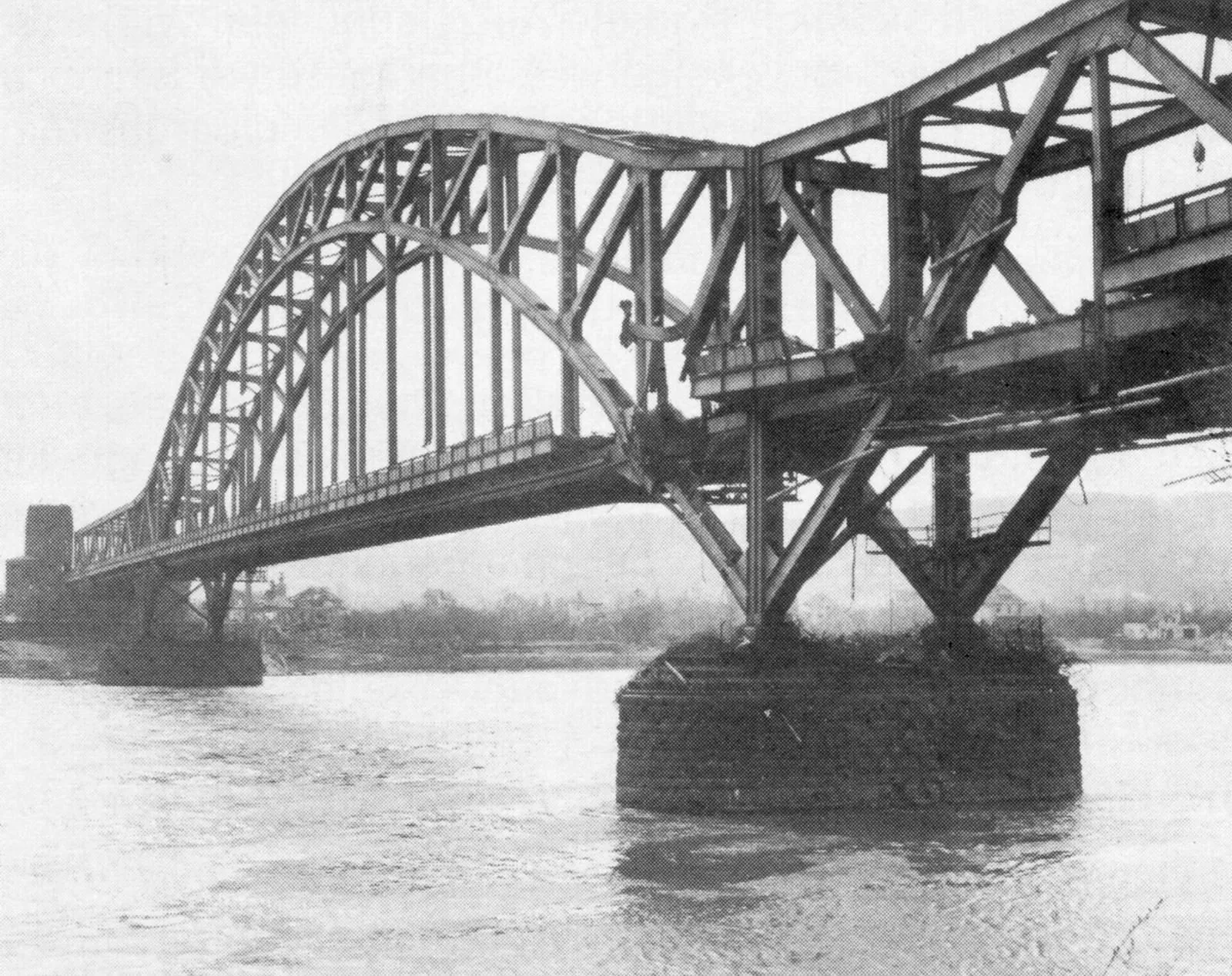
In III Corps’ path lay the small town of Remagen with the Ludendorff railway bridge, built during the First World War. The bridge had been prepared for demolition, but its garrison was weak: Captain Willi Bratge commanded a handful of convalescents and Captain Karl Friesenhahn a company of engineers, alongside a few hundred men from anti-aircraft units, the Volkssturm and the Hitler Youth. On the morning of 7 March command of the bridge passed to Major Hans Scheller, who had been sent without the reinforcements he had been promised. Supply columns and broken units were streaming back across the bridge in disorder, and the explosives delivered to the engineers were weaker and fewer than had been requested.
Around midday Combat Command B of the 9th Armored Division, under Brigadier General William Hoge, appeared above the valley. To the Americans’ surprise, the bridge was still standing. Hoge ordered it taken at once. In the afternoon Lieutenant Karl Timmermann’s Company A of the 27th Armored Infantry Battalion advanced onto the bridge. The Germans first fired a charge under the approach to blow a crater in the embankment and then, after several failed attempts, the main charge. The bridge rose in a cloud of smoke and settled back onto its piers – damaged, but intact. Under machine-gun fire from the tower and the bank, Timmermann’s men ran across to the other side and took the Erpeler Ley, the height above the village of Erpel. The first man to reach the right bank was Sergeant Alexander Drabik; Timmermann was the first officer. American engineers cut the wires to prevent another attempt. By evening the bridgehead held several hundred men.
The Remagen bridgehead and a change of command (8–24 March)
The news reached Bradley in the evening. Eisenhower’s chief of operations, General Harold Bull, warned that a bridgehead at Remagen did not fit the plan, since it lay in difficult, wooded country far from the main axis of advance. Eisenhower nevertheless decided at once to send several divisions there – in keeping with his own earlier instruction that any bridge captured intact should be used to establish a bridgehead. At the same time he ordered that the bridgehead be expanded only to an area that some five divisions could hold, so as not to draw forces away from Montgomery’s operation. Units of III Corps, and then of V and VII Corps, crossed by the bridge and by the pontoon bridges being built beside it.
The Germans tried every means of destroying the bridge. It was attacked by bombers and fighter-bombers, including Arado Ar 234 jets. The Americans massed such strong anti-aircraft defences around it that, by their own figures, they shot down 109 of the 367 attacking aircraft. Heavy artillery shelled the bridge, and eleven V-2 rockets were fired at it from the Netherlands – the only known use of the weapon against a battlefield target; none hit the bridge. An attempt by frogmen from Otto Skorzeny’s units was detected and beaten off. Even so, the bridge, weakened by the explosion of 7 March, by hits and by vibration, collapsed on the afternoon of 17 March, burying the engineers working on it; several dozen Americans were killed. By then the bridgehead already had enough pontoon bridges.
The loss of the bridge provoked fury at Hitler’s headquarters. A special “flying court martial” presided over by Generalleutnant Rudolf Hübner sentenced five officers to death; four, including Major Scheller, were shot, while Bratge, who had been taken prisoner, was sentenced in absentia. The sentences were announced in an order to the whole Wehrmacht as a warning.
That same week Hitler dismissed Rundstedt for the last time. On 10 March he was replaced as commander in the west by Field Marshal Albert Kesselring, until then in command in Italy and known for his stubborn defence on one line after another down the Italian peninsula. On arrival he had at his disposal – by his own assessment – exhausted divisions without reserves, with few tanks and little fuel, facing the crushing superiority of Allied air power. Counter-attacks against the Remagen bridgehead, made by a scratch collection of units from Army Group B, failed to eliminate it. By 24 March the bridgehead had grown to some 40 kilometres wide and a dozen or so deep, reaching the Cologne–Frankfurt autobahn.
In the north, on 10 March, the last German units left the Wesel bridgehead and blew the bridges behind them. The left bank of the Lower Rhine was in Allied hands; Operations Veritable and Grenade were over. The Canadians, British and Americans began preparing the crossing that Montgomery had been contemplating since the autumn.
The Saar and the Palatinate: Operation Undertone (12–25 March)
South of the Moselle the Germans still held a large salient on the left bank: the Palatinate and the Saar, shielded by the Siegfried Line and defended by the Seventh Army and First Army of Army Group G. Eisenhower decided to eliminate it before Montgomery crossed the Rhine, and to secure crossing sites between Mainz and Mannheim for the 6th Army Group. The plan called for two blows. From the south, General Alexander Patch’s Seventh Army, together with French units, was to attack the Siegfried Line fortifications head-on on 15 March in Operation Undertone. From the north, Patton’s army was to cross the lower Moselle and come out in the defenders’ rear.
Patton did not wait. His XX Corps attacked from the Trier area from 12 March, and on 14 March XII Corps crossed the Moselle and sent its armoured divisions south-east through the Hunsrück hills. Koblenz was taken on 17–19 March. The German Seventh Army disintegrated, and the First Army, still defending the bunkers of the Siegfried Line against Patch, was in danger of encirclement. The German command long forbade a withdrawal; permission to fall back across the Rhine was given only on 23 March. By then the Germans had blown every bridge from Ludwigshafen northwards, and they blew the last, at Germersheim, on the morning of 24 March. The evacuation of the left bank ended on the night of 24–25 March.
For the Germans the outcome was catastrophic. According to American figures compiled in the US Army’s official history, the Third Army took more than 68,000 prisoners in this campaign, and the Seventh Army with the French units about 22,000; Patch’s staff estimated that the two German armies had lost 75–80 per cent of their infantry. The Third Army’s losses came to about 5,200 men, 681 of them killed; those of the Seventh Army, which had to fight its way through the fortifications, to about 12,000, nearly a thousand of them killed. Even so, the German First Army conducted its delaying actions skilfully and avoided being trapped in a pocket.
Oppenheim (22–23 March)
Patton wanted to cross the Rhine before Montgomery did, and without elaborate preparations. He feinted a crossing at Mainz and directed the real blow a little further south, at Nierstein and Oppenheim. Late on the evening of 22 March soldiers of XII Corps’ 5th Infantry Division crossed the river in assault boats, without an artillery preparation. At Nierstein the defenders offered almost no resistance; at Oppenheim the fighting was brief but sharper. According to the US Army’s official history, the division lost 8 killed and 20 wounded during the crossing. By the evening of 23 March three regiments were on the east bank and the engineers had built a bridge.
At Patton’s urging, Bradley announced the crossing on the morning of 23 March – some hours before Montgomery’s great assault, deliberately stealing some of his thunder. The rivalry between the commanders was, however, a secondary matter: the Allies now had two bridgeheads, and the Germans had nothing with which to destroy them.
Wesel and Rees: Operations Plunder and Varsity (23–28 March)
The 21st Army Group’s crossing was the opposite of Patton’s improvisation. Montgomery prepared it for weeks, like a seaborne landing. From 16 March a smoke screen shrouded several dozen kilometres of the bank, behind which ammunition, bridging equipment, amphibious vehicles and Royal Navy landing craft were assembled. Operation Plunder was assigned to General Miles Dempsey’s Second Army with XII and XXX Corps and to Simpson’s US Ninth Army with XVI Corps, with the First Canadian Army behind them. According to frequently cited figures, Montgomery then had more than 1.25 million men under his command.
On the evening of 23 March several thousand guns opened a bombardment of the far bank that lasted for hours, and RAF bombers almost completely destroyed Wesel. At 9 p.m. the first battalions of the 51st (Highland) Division crossed in Buffalo amphibious vehicles at Rees; around 10 p.m. the 1st Commando Brigade crossed the river at Wesel and entered the ruined town. At 2 a.m. on 24 March the 15th (Scottish) Infantry Division attacked between Wesel and Rees, and south of Wesel the US 30th and 79th Infantry Divisions went in, suffering minimal losses. The stiffest resistance came from the paratroopers of the 1st Parachute Army at Rees and Bienen, where fighting lasted several days.
On the morning of 24 March, after the infantry had already crossed, an armada of transport aircraft and gliders carrying General Matthew Ridgway’s XVIII Airborne Corps appeared over the Rhine. In Operation Varsity the British 6th Airborne Division and the US 17th Airborne Division – more than 16,000 men in all, among them the 1st Canadian Parachute Battalion – landed in the Diersfordt Forest and around Hamminkeln, within range of their own artillery. It was the largest single-day airborne operation in history. German anti-aircraft guns shot down or damaged many transports and gliders, and the two divisions lost more than 2,000 men on the first day; they nevertheless took all their objectives, captured some 3,500 prisoners and in the afternoon linked up with the infantry of the 15th Division. Whether this costly operation had been necessary was later a matter of dispute.
Prime Minister Winston Churchill watched the landing from Montgomery’s headquarters and on 25 March crossed to the east bank by boat. By 27 March the bridgehead was some 56 kilometres wide and 32 deep. The 1st Parachute Army, whose commander Schlemm had been wounded, was falling back to the north-east, and a gap was opening between it and the forces in the Ruhr. In the first week alone the Allies took some 30,000 prisoners north of the Ruhr.
Boppard, St. Goar, Worms and Speyer (25–31 March)
One crossing followed another. In the early hours of 25 March the 87th Infantry Division of the Third Army’s VIII Corps crossed the Rhine at Boppard, and a day later the 89th Division crossed a dozen or so kilometres further on, at Sankt Goar, at the foot of the Lorelei rock. In the narrow, rocky gorge of the river the terrain caused more difficulty than the defenders, although fire from the high slopes inflicted casualties on the Americans. On 26 March the Seventh Army’s XV Corps – the 3rd and 45th Infantry Divisions – forced the Rhine at Worms, and its bridgehead quickly joined up with Patton’s at Oppenheim. Mannheim, opposite the already captured Ludwigshafen, surrendered a few days later.
The last crossing of March belonged to the French. General Jean de Lattre de Tassigny, pressed by Charles de Gaulle – who wanted France to enter Germany with its own forces and to hold a strong position in post-war talks on the occupation zones – did not wait for bridging equipment. On 31 March troops of the 2nd Moroccan and 3rd Algerian Infantry Divisions crossed in makeshift boats at Speyer and Germersheim. By the end of the month every Allied army on the Western Front, from the First Canadian to the First French, had units on the east bank of the Rhine.
The collapse of the defence and the encirclement of the Ruhr
From 25 March the Allies went over to the pursuit. That day the First Army broke out of the Remagen bridgehead; the 3rd Armored Division set off towards Paderborn in one of the fastest drives of the campaign, and its commander, General Maurice Rose, was killed on 30 March. From the Oppenheim bridgehead the Third Army struck towards Frankfurt am Main and on to Kassel; in the north the Ninth Army and the Second Army were breaking out of the Wesel bridgehead onto the Westphalian plain. Kesselring no longer had anything with which to plug the gaps. Divisions numbered a few thousand men apiece, fuel and ammunition were short, and replacements consisted of the Volkssturm and teenagers. On 19 March Hitler issued the Nero Decree, ordering the destruction of all industrial, transport and supply installations before the enemy arrived; the armaments minister Albert Speer and some commanders sabotaged its execution. Thousands of soldiers surrendered without a fight.
The Allies’ objectives were changing too. On 28 March Eisenhower informed Joseph Stalin in a cable that he would direct his main thrust through the centre of Germany towards Leipzig and Dresden, to meet the Red Army, rather than on Berlin – to the displeasure of the British. On 1 April the spearheads of the US 2nd Armored Division of the Ninth Army and the 3rd Armored Division of the First Army met at Lippstadt, closing a pocket around the Ruhr with Model’s Army Group B inside it. Resistance in the pocket ended on 18 April; according to American figures more than 300,000 men were taken prisoner, and on 21 April Model committed suicide.
Losses
A complete tally of losses for March 1945 alone cannot be given, since the fighting for the left bank, the crossings and the pursuit merged seamlessly into one another, and German records from the period are fragmentary. The most frequently cited estimates cover the whole of the fighting in the Rhineland in February and March: according to them the Wehrmacht lost some 400,000 men, of whom roughly 280,000–300,000 were taken prisoner. The armies defending the Palatinate and the Saar alone lost, by American estimates, more than 100,000 men.
Allied losses were many times smaller, though unevenly spread. The crossings at Oppenheim and Worms and on the American sector of Operation Plunder cost little, whereas the fighting against German paratroopers at Rees, Operation Varsity (more than 2,000 killed, wounded and missing on the first day) and the assault on the Siegfried Line in the Palatinate were bloody. The fighting also claimed the towns on the Rhine – Wesel, Cologne, Mainz, Koblenz – most of them already ruined by air raids, as well as the civilian population, whom the German authorities often forced to stay put.
Significance
The Rhine crossings sealed Germany’s fate in the west. Hitler’s ban on withdrawal meant that the Wehrmacht’s main forces were destroyed while still on the left bank, and the river itself – contrary to the German command’s hopes – never became a line of defence. The capture of the bridge at Remagen, which the Germans regarded as a catastrophe, hastened this defeat but did not cause it: within three weeks the Allies crossed the Rhine at more than a dozen points, both on the run and in an operation prepared on the scale of a seaborne landing.
After the crossings, the war in the west turned into a pursuit. The encirclement of the Ruhr in April deprived the Reich of its main industrial centre and of one of its last army groups, and American, British and French columns pushed deep into the country – towards the Elbe, the Baltic, Bavaria and the Alps. Eisenhower’s decision not to race the Red Army to Berlin fixed the meeting place of the two fronts on the Elbe and influenced the post-war division of Germany.
The March crossings also closed the long dispute over strategy on the Western Front. The “broad front” plan proved effective given overwhelming material superiority and a disintegrating enemy, and the rivalry between Patton and Montgomery – plainly visible in these weeks – did not change the outcome. The Rhine, for centuries a frontier and a symbol in Franco-German disputes, and in 1936 the scene of the remilitarisation of the Rhineland, with which the open revision of the Versailles order had begun, no longer protected the Third Reich. Little more than five weeks remained until the surrender.