1944–1945: The liberation of Western Europe
Battle of Normandy
- Dates:
- 6 June – 30 August 1944
- Front:
- Western Front
- Location:
- Normandy (France): the coast of the Bay of the Seine between the mouth of the Orne and the Cotentin Peninsula with the Utah, Omaha, Gold, Juno and Sword beaches, Cherbourg, the bocage around Saint-Lô, the plain around Caen and Falaise, Avranches and Mortain, the pocket between Falaise, Argentan, Trun and Chambois, and the Seine valleyOn the battle map →
- Sides:
- United States, United Kingdom, Canada and their alliesDwight Eisenhower, Bernard Law Montgomery, Omar Bradley, Miles Dempsey, George Patton, Harry Crerar, Stanisław MaczekNazi GermanyGerd von Rundstedt, Erwin Rommel, Günther von Kluge, Walter Model, Friedrich Dollmann, Paul Hausser
- Result:
- A decisive Allied victory. On 6 June 1944 American, British and Canadian troops landed on five Normandy beaches; within a week they had linked up the beachheads, on 26 June they took Cherbourg, and after gruelling fighting for Caen and in the Norman hedgerows they broke through the front near Saint-Lô on 25 July (Operation Cobra). The German counter-attack at Mortain failed, and in the Falaise Pocket, closed on 19–21 August with the participation of the Polish 1st Armoured Division, the remnants of the Seventh Army and the Fifth Panzer Army were destroyed. Paris was liberated on 25 August, and at the end of the month the German survivors withdrew across the Seine. Allied losses amounted to about 226,000 men; German losses, according to various estimates, to between 400,000 and 500,000, including more than 200,000 prisoners. Between about 14,000 and 20,000 French civilians were also killed.
- Author:
- Łukasz
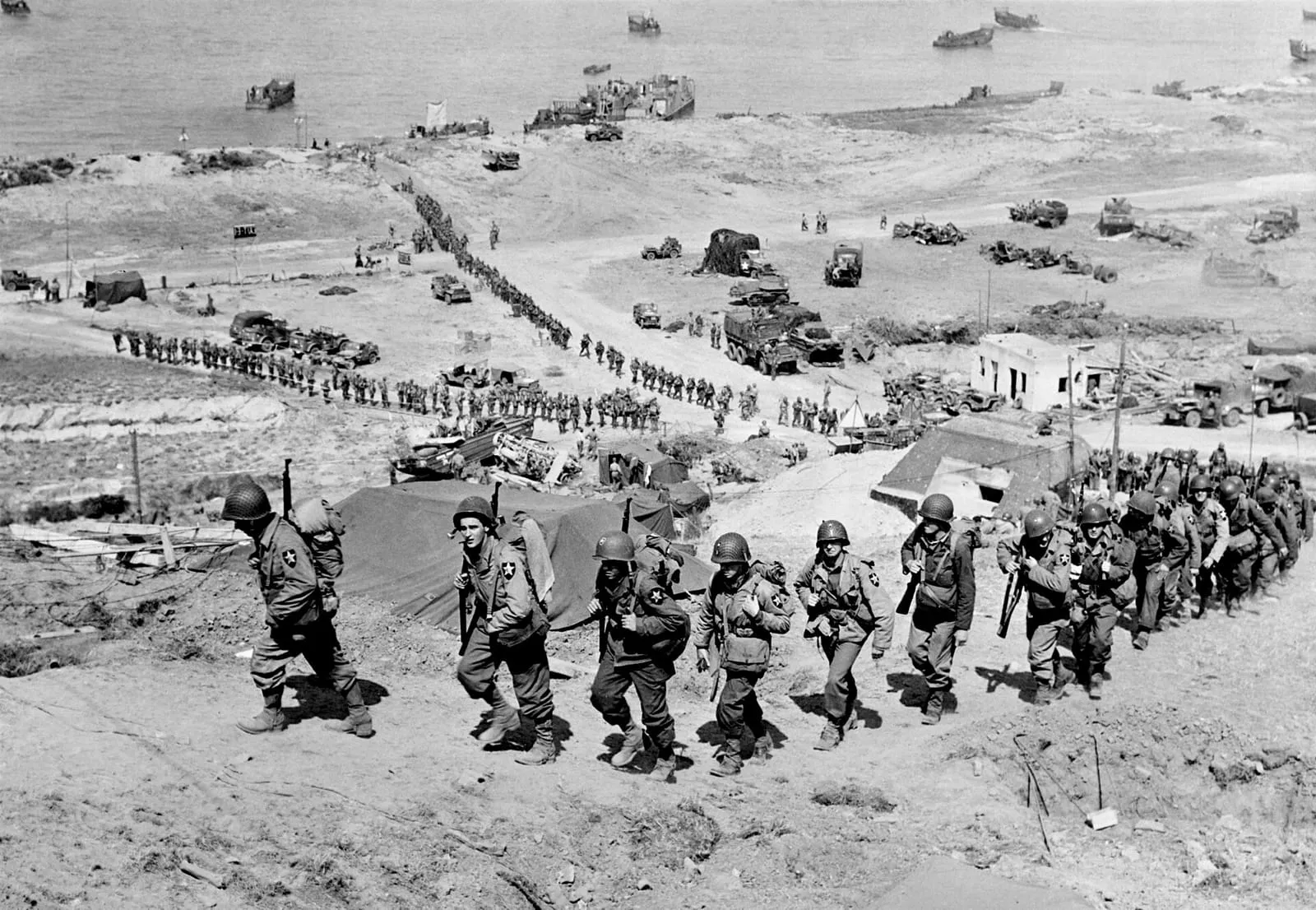
The Battle of Normandy – the fighting from the Allied landings on 6 June 1944 to the end of August that year – opened the second front in Western Europe that Joseph Stalin had been demanding since 1942. Operation Overlord, preceded by the seaborne and airborne assault codenamed Neptune, was the largest amphibious undertaking in the history of warfare: on the first day, according to the most frequently cited estimates, some 156,000 soldiers came ashore or were dropped behind the coast, and by 21 August the Allies had moved more than two million men into northern France.
On the beaches the fighting lasted a single day, but the Battle of Normandy turned out to be something quite different from the rapid advance inland the planners had expected. For seven weeks the Allied armies inched forward through the dense hedgerows of western Normandy and bled in front of Caen, which was meant to fall on the first day but fell only in July. Not until the breakthrough near Saint-Lô at the end of July did positional warfare give way to a war of manoeuvre. In August the German armies in Normandy, which Hitler had kept in place to the last, were almost encircled and destroyed near Falaise, and their survivors fled across the Seine. The Poles contributed to the victory – with warships and fighter squadrons on the day of the landings and, in August, with the 1st Armoured Division of Brigadier General Stanisław Maczek, which closed the pocket at Chambois and on the Mont-Ormel heights.
Name and dates
Polish, French and English-language literature speaks of the Battle or the Normandy campaign (French bataille de Normandie). The codename Overlord denoted the whole operation of invading France and establishing a lodgement there; Neptune denoted its naval part and the assault of 6 June. The start of the battle is clear: on the night of 5/6 June 1944 the parachute drops began, and at dawn on 6 June the first waves of infantry landed on the beaches. The end date is a matter of convention. The Falaise Pocket was closed on 19–21 August, the Germans in Paris capitulated on 25 August, and their last units crossed the Seine by 29–30 August; on 30 August British and Canadian troops entered Rouen. On 1 September Montgomery handed over command of all ground forces in France to Eisenhower, which ends the period in which a single headquarters directed the whole battle.
Background
Ever since the evacuation from Dunkirk in 1940, a return to the Continent had been for the British a question not of “whether” but of “when” and “how”. From the moment they entered the war the Americans pressed for a cross-Channel attack as soon as possible, and Stalin demanded a second front to relieve the Red Army. Winston Churchill and the British Chiefs of Staff, mindful of the slaughter on the Somme and of the failed Dieppe Raid in August 1942, preferred first to wear Germany down on the periphery – in North Africa, Sicily and Italy. The date of the invasion, spring 1944, was set at the Trident Conference in Washington in May 1943, confirmed at Quebec in August, and finally promised to Stalin at the Tehran Conference at the end of November.
From 1943 the plan was drawn up by the COSSAC staff under General Frederick Morgan. Morgan chose Normandy rather than the Pas-de-Calais, which lies closest to England: the coast between the mouth of the Orne and the Cotentin Peninsula was less heavily fortified, sheltered from westerly winds, and within range of fighters flying from southern England. In December 1943 President Franklin Delano Roosevelt appointed General Dwight Eisenhower to command the invasion. His deputy was Air Chief Marshal Arthur Tedder; command of the ground forces during the assault phase went to General Bernard Law Montgomery (21st Army Group), of the naval forces to Admiral Bertram Ramsay, and of the tactical air forces to Air Chief Marshal Trafford Leigh-Mallory. Montgomery and Eisenhower enlarged the COSSAC plan from three to five divisions in the first wave and added a beach on the east coast of the Cotentin so as to reach the port of Cherbourg sooner; in February 1944 SHAEF was formally established.
In the spring of 1944 southern England turned into one vast camp. The exercises cost lives: in April, off Slapton Sands, German E-boats sank American landing ships carrying hundreds of soldiers. The Allies built two artificial Mulberry harbours from concrete caissons, which were to keep supplies flowing until a real port was captured, and a fuel pipeline under the Channel. Operation Fortitude – a fictitious First United States Army Group under General George Patton, bogus radio traffic and reports from double agents – confirmed the Germans in their belief that the main blow would fall on the Pas-de-Calais. From the spring onwards Allied aircraft destroyed railways, bridges and radar stations in France and Belgium so as to cut the future beachhead off from German reserves. On 15 May Montgomery presented the plan to the King, Churchill and the commanders at the briefing at St Paul’s School, and on 8 May Eisenhower had fixed the day of the invasion as 5 June.
On the German side the defence of the West was in the hands of Field Marshal Gerd von Rundstedt as Commander-in-Chief West (OB West). From December 1943 the coasts were inspected by Field Marshal Erwin Rommel, from January commander of Army Group B. Rommel accelerated the construction of the Atlantic Wall: millions of mines, beach obstacles, and stakes against gliders in the meadows. He was convinced that the invasion had to be smashed on the beaches within the first twenty-four hours, because with Allied air superiority the panzer divisions would not be able to arrive later. Rundstedt and the commander of Panzer Group West, General Leo Geyr von Schweppenburg, wanted to hold the tanks back inland and destroy the landing with a single powerful counter-stroke. Adolf Hitler settled the dispute with a compromise: he assigned some of the panzer divisions (three) to Rommel, and kept four – including the 12th SS Panzer Division “Hitlerjugend” and the Panzer Lehr Division – as a high command reserve that only his own headquarters could commit. Normandy was defended by the Seventh Army under General Friedrich Dollmann, mostly static divisions with many older soldiers and “Ost battalions” made up of former Soviet prisoners of war.
The weather almost wrecked the plan. On 4 June, faced with a stormy forecast, Eisenhower postponed the invasion by a day, and early on the morning of 5 June, relying on a short break in the bad weather predicted by the meteorologists, he gave the final order. The bad weather lulled the Germans: Rommel had gone to Germany, and many Seventh Army commanders had left for a war game in Rennes. On the night of 5/6 June aircraft carrying three airborne divisions flew in over Normandy, and more than a thousand RAF bombers bombed the coastal batteries.
Course of the battle
D-Day (6 June)
The first to land were paratroopers and glider troops. On the eastern flank the British 6th Airborne Division seized the bridges over the Caen Canal and the Orne just after midnight, destroyed the Merville battery and screened the beachhead from the east. In the west the American 82nd and 101st Airborne Divisions were scattered over a wide area of the Cotentin Peninsula, but they took Sainte-Mère-Église and secured most of the causeways leading inland from Utah Beach, and the chaos of the drops confused the Germans as well.
According to the most frequently cited figures, the invasion fleet numbered close to 7,000 vessels, including more than 1,200 warships and over 4,000 landing ships and craft. Among the covering and fire-support ships were Polish ones: the cruiser ORP Dragon, the escort destroyers ORP Krakowiak and ORP Ślązak, and the destroyers ORP Błyskawica and ORP Piorun, which guarded the western approaches to the assault area. Over the beaches flew, among others, Polish fighter squadrons of Nos. 131 and 133 Wings (including No. 302 Squadron). Allied aircraft flew well over ten thousand sorties that day; the Luftwaffe appeared over the beachhead only a handful of times.
The seaborne landings began at 6.30 a.m. on the American beaches and, because of the tides, about an hour later on the British and Canadian ones. On Utah Beach the current carried the landing craft of the American 4th Infantry Division about two kilometres south of the intended spot, where the defences proved weak; the division lost fewer than 200 men and by evening had linked up with the paratroopers. On Omaha Beach the American 1st Infantry Division and a regiment of the 29th Division ran into the whole of the 352nd Infantry Division, which intelligence had not expected. The air bombardment fell inland, most of the amphibious tanks sank, and the infantry lay pinned down for several hours under fire from the bluffs. General Omar Bradley, commander of the First Army, even considered diverting the following waves to other beaches. The situation was saved by destroyers that steamed in close to the shore and by small groups of soldiers who climbed the gullies to the top of the bluffs; by evening the beachhead was little more than two kilometres deep, and American losses on Omaha are estimated at about 2,000–3,000 men. Between Utah and Omaha, American Rangers scaled the cliff at Pointe du Hoc, where they found that the guns had been moved inland.
Further east the British 50th Division from Gold Beach reached the outskirts of Bayeux by evening, and the Canadian 3rd Division from Juno Beach, despite heavy losses in getting ashore, advanced the furthest of all. The British 3rd Division from Sword Beach linked up with the paratroopers on the Orne but failed to take Caen, one of the main objectives of the first day. In the afternoon the only panzer division close at hand, the 21st Panzer Division, counter-attacked; some of its units reached the sea near Lion-sur-Mer in the gap between Juno and Sword, but in the evening, fearing that fresh glider landings would cut them off, they withdrew. Hitler released the high command’s armoured reserves only in the afternoon, and Rommel returned to his headquarters in the evening.
By the end of the day the Allies had – according to the most frequently cited estimates – some 156,000 soldiers ashore (about 23,000 of them from the air). Their losses amounted to at least 10,000 killed, wounded and missing, including – according to research from the 2000s – about 4,400 dead; estimates of German losses vary widely, from several thousand to over ten thousand. The Atlantic Wall had been breached within a few hours, but unevenly: none of the five beachheads had reached the line planned for the evening, Omaha had been on the verge of disaster, and Caen, Bayeux and Carentan remained in German hands.
Linking up the beachheads and the race for strength (7–18 June)
In the following days both sides raced against time. The Allies shipped division after division across the Channel, while the Germans brought up reserves from the depths of France – under bombing and fighter attacks that hunted down every vehicle on the roads by day, and amid growing activity by the French Resistance, which blew up railway lines and telephone cables. On 7 June the British entered Bayeux without a fight, the first sizeable town liberated in France; a week later General Charles de Gaulle spoke there, and his authority – from 3 June that of the Provisional Government – took over the administration of the liberated areas, contrary to the Americans’ original intentions. On 8 June the Omaha and Gold beachheads joined up, and on 12 June, after American paratroopers captured Carentan, so did Utah and Omaha. From then on the Allies held a continuous front about a hundred kilometres long.
At Caen the front froze almost at once. The 21st Panzer Division was joined by the 12th SS Panzer Division “Hitlerjugend” and the Panzer Lehr Division, which on 7 and 8 June halted the Canadians north-west of the city. In the first days of the fighting, “Hitlerjugend” soldiers murdered – according to Canadian findings – about 150 Canadian prisoners at the Ardenne Abbey and several other places; one of their commanders, Kurt Meyer, was sentenced for this by a Canadian court martial in 1945. An attempt to outflank Caen from the west (Operation Perch) ended on 13 June at Villers-Bocage, where a few Tigers of an SS heavy tank battalion, among them the tank of Michael Wittmann, shattered the spearhead of the British 7th Armoured Division. The British Second Army under General Miles Dempsey fell back to its earlier positions.
The Germans, however, could not gather their forces for a single great counter-stroke: every panzer division that arrived was thrown straight in to patch the front. Hitler, still convinced that the main invasion would come in the Pas-de-Calais, kept the Fifteenth Army on standby there. On 17 June he met Rundstedt and Rommel at a headquarters at Margival near Soissons; the field marshals demanded freedom of manoeuvre and permission to abandon untenable positions, and Hitler answered with promises of new weapons – the first V-1s had been falling on London since 13 June – and an order to stand fast. Meanwhile the American VII Corps under General Joseph Lawton Collins cut across the Cotentin Peninsula on 18 June, reaching the west coast at Barneville-Carteret, and isolated the Cherbourg garrison.
The storm and Cherbourg (19 June – 1 July)
On 19 June a storm swept into the English Channel, the worst June storm in several decades. By 22 June it had destroyed the Mulberry harbour off Omaha Beach, which was never rebuilt, damaged the harbour at Arromanches-les-Bains and driven ashore or damaged – according to various tallies – several hundred landing craft. Unloading almost stopped for several days, and a planned British attack near Caen had to be postponed.
Collins turned north and on 22 June, after a heavy air bombardment, attacked the ring of forts around Cherbourg. Hitler demanded a defence to the last man, but on 26 June the fortress commander, General Karl-Wilhelm von Schlieben, surrendered; the arsenal capitulated on 27 June and the last units on the La Hague peninsula by 1 July. The Germans had wrecked the port installations and mined the basins so thoroughly that the first ships were unloaded at Cherbourg only in the second half of July, and the port reached full capacity much later. Meanwhile, on 28 June, the commander of the Seventh Army, General Dollmann, died – officially of a heart attack, according to some accounts by suicide after the fall of Cherbourg; he was succeeded by the Waffen-SS general Paul Hausser.
Caen and the hedgerows (26 June – 24 July)
Montgomery’s plan, as he later presented it, was for the British and Canadians at Caen to draw the main German armoured forces onto themselves while the Americans in the west prepared a breakthrough. Historians still argue over how far this was the plan from the start and how far a later explanation of the setbacks at Caen; what is certain is that throughout June and July most of the German panzer divisions faced the Second Army. The first major British offensive, Operation Epsom (26–30 June), was intended to outflank Caen from the west through the Odon valley. The 15th (Scottish) Infantry Division drove a wedge several kilometres deep, and the tanks of the 11th Armoured Division reached Hill 112, but a counter-attack by the II SS Panzer Corps, newly arrived from the east, stopped the advance. The German counter-stroke in turn collapsed under artillery fire, and the Germans had to commit to the defence divisions that had been meant for an attack on the beachhead.
At the turn of June and July the German command changed. Rundstedt, asked by Field Marshal Keitel what should be done, is said – according to post-war accounts – to have replied: “Make peace, you fools.” On 2 July Hitler replaced him with Field Marshal Günther von Kluge, and Geyr von Schweppenburg with General Heinrich Eberbach.
On the evening of 7 July more than 450 RAF heavy bombers bombed the northern suburbs and centre of Caen, and on 8 July Operation Charnwood began. After two days the British and Canadians had taken the ruined northern part of the city up to the Orne; the southern districts, with the suburb of Vaucelles, remained in German hands. The city, many of whose inhabitants had not left, was largely destroyed over the course of the summer, and – according to French estimates – about 2,000 of its residents were killed in the bombing or under the rubble. On 10 July the fighting for Hill 112 resumed in Operation Jupiter, again without a decision.
In the west the Americans were fighting in the bocage – a landscape of small fields enclosed by earth banks overgrown with thick hedges, each of them a ready-made line of defence. Tanks climbing over the banks exposed their thinly armoured bellies, and the infantry took one field after another. Only steel blades improvised from German beach obstacles and welded onto the tanks allowed them to cut through the hedgerows. In the July fighting for the road to Saint-Lô the First Army lost – according to the US official history – about 40,000 men, and the town itself, taken on 18–19 July by the 29th and 35th Infantry Divisions, was a sea of ruins.
On 18 July Montgomery launched Operation Goodwood at Caen. After the heaviest supporting bombardment yet, three British armoured divisions advanced south from the bridgehead beyond the Orne towards the Bourguébus ridge. The German defensive positions in depth, with 88 mm anti-tank guns, survived the bombing; in three days the British lost or had damaged – according to various estimates – some 300–400 tanks and advanced only a few kilometres, while the Canadians, in the simultaneous Operation Atlantic, at last took southern Caen. The disappointment at SHAEF was immense, and Tedder and some air force officers even demanded Montgomery’s dismissal. Goodwood nevertheless held the German panzer divisions in the east, and further Canadian attacks on Verrières ridge, including the bloody Operation Spring on 25 July, kept them pinned there on the day of the American breakthrough as well.
On the German side July brought two shocks. On 17 July Rommel’s car was strafed by Allied aircraft near Sainte-Foy-de-Montgommery and the field marshal was seriously wounded; Kluge personally took over command of Army Group B as well. Three days later, on 20 July, Colonel Claus Schenk Graf von Stauffenberg set off a bomb at Hitler’s headquarters in East Prussia. In Paris the conspirators arrested SS officials for a few hours, and Kluge, who knew of the plotters’ intentions, drew back once it became clear that Hitler had survived.
Cobra and the breakthrough (25 July – 6 August)
Bradley prepared the breakthrough on a narrow sector a few kilometres wide west of Saint-Lô, along the road to Périers. Operation Cobra, postponed several times because of the weather, was preceded on 25 July by carpet bombing: about 1,500 heavy bombers and hundreds of medium bombers and fighter-bombers saturated the positions of the Panzer Lehr Division. Some of the bombs – as in the aborted raid the day before – fell on the Americans’ own troops; more than a hundred American soldiers were killed, among them General Lesley McNair, who had come to watch the attack. On the first day the VII Corps infantry advanced slowly, but the German defence was already shattered, and on 26–27 July the armoured divisions moved into the gap. On 28 July the Americans took Coutances, on 30 July Avranches at the base of the Breton peninsula, and on 31 July they captured the bridge at Pontaubault intact. The German front on the western flank had ceased to exist. At the same time the British struck south from Caumont in Operation Bluecoat to tie down the German armoured reserves.
On 1 August Bradley took command of the new 12th Army Group, the First Army passed to General Courtney Hodges, and Patton’s Third Army entered the battle. Within a few days its columns passed through the bottleneck at Avranches – seven divisions in three days – and spread out across Brittany, reaching Brest, Lorient and Saint-Nazaire, whose garrisons shut themselves up in their fortresses. Brest fell only on 19 September after a hard siege, and its port was wrecked. Meanwhile, on 23 July, the First Canadian Army under General Harry Crerar had also entered the fighting, taking over the eastern sector at Caen. Montgomery and Bradley realised that instead of capturing the Breton ports they could turn their main forces east and outflank the entire German deployment in Normandy.
Mortain and the Falaise Pocket (7–21 August)
Instead of falling back behind the Seine, Hitler ordered Kluge to cut the corridor at Avranches. On the night of 6/7 August four weakened panzer divisions attacked at Mortain in Operation Lüttich. Forewarned by Ultra signals intelligence, the Americans were ready: a battalion of the 30th Infantry Division, surrounded on Hill 317 above the town, directed artillery fire from there for six days, and once the mist lifted British Typhoons and American Thunderbolts attacked the armoured columns. By 8 August the attack had stalled; Hitler still demanded that it be renewed, and every day of delay drew the German divisions deeper into the trap.
The Canadians struck from the north. In the night-time Operation Totalize, launched on the night of 7/8 August, General Guy Simonds for the first time carried his infantry forward in armoured personnel carriers converted from self-propelled guns. On 8 August the Polish 1st Armoured Division, landed in Normandy at the turn of July and August, went into action for the first time; together with the Canadian 4th Armoured Division it was to break through the second German position. The attack was preceded by a bombardment by American bombers, some of which dropped their bombs on the rear of their own forces, killing and wounding several hundred Canadian and Polish soldiers. After initial success the attack stalled in front of the defences of the 12th SS Panzer Division; the Poles, advancing across open ground straight into German anti-tank guns, suffered heavy tank losses in the first days. A second operation, Tractable (14–16 August), again marred by the mistaken bombing of friendly troops, brought the Poles, after several days of fighting, a crossing of the Dives at Jort, and carried the Canadians to Falaise on 16–17 August.
From the south the American XV Corps of Patton’s army reached Argentan on 13 August, but Bradley halted it on the boundary with the 21st Army Group, fearing a collision with the Canadians and German pressure. Between Falaise and Argentan there remained a gap some twenty-odd kilometres wide, through which the Germans began to withdraw headquarters and some of their troops. Bradley’s decision – whether it saved the Americans from needless losses or let thousands of Germans escape – is one of the most hotly debated in the history of the campaign. On 15 August Kluge’s car was caught under fire inside the pocket and the field marshal was out of contact for many hours; Hitler suspected him of trying to negotiate with the Allies. On 17 August Field Marshal Walter Model arrived to replace him, and Kluge, summoned to Germany, committed suicide on the way on 19 August. Model immediately ordered a retreat.
Closing the pocket fell largely to the Poles. Maczek’s division, split into battle groups, advanced in a wide arc to the south-east. On 19 August its units entered Chambois, where they linked up with a battalion of the American 90th Infantry Division, while two battle groups occupied the Mont-Ormel heights (Hill 262, which the Poles called Maczuga, “the Mace”), which dominated the escape route from the pocket. Throughout 20 and 21 August the Poles, surrounded on the heights, beat off attacks from the west – by retreating units of the Seventh Army, among whom Hausser was seriously wounded – and from the east, where the II SS Panzer Corps was trying to open a corridor from outside. Supplies dropped by parachute were not enough, and ammunition and dressings ran short. At midday on 21 August tanks of the Canadian 4th Armoured Division broke through to the Mace and the pocket was finally sealed. In the fighting to close the pocket the Polish division lost – according to one frequently cited tally – 1,441 men, including 466 killed. According to various historians, between 80,000 and 100,000 Germans were caught in the pocket; about 10,000–15,000 were killed, 40,000–50,000 were taken prisoner, and between 20,000 and 50,000 managed to escape, mostly without their heavy equipment. Eisenhower, who walked across the battlefield two days after the pocket was closed, recalled that one could walk for hundreds of yards stepping on nothing but dead bodies.
Paris and the Seine (19–30 August)
Even before the pocket was closed, Patton’s army was racing east: on 8 August it took Le Mans, and on 19–20 August the American 79th Infantry Division crossed the Seine at Mantes-la-Jolie. On 15 August the Allies also landed in the south of France (Operation Dragoon), and German forces in the south and west of the country began to withdraw. On 19 August an uprising of the French Forces of the Interior broke out in Paris. Eisenhower had intended to bypass the city, so as not to tie down troops in street fighting or take on the burden of feeding millions of inhabitants, but under pressure from de Gaulle, and given the risk that the uprising would be bloodily crushed, he agreed on 22 August to send General Philippe Leclerc’s French 2nd Armoured Division and the American 4th Infantry Division towards Paris. Leclerc’s first detachment drove into the centre on the evening of 24 August, and on 25 August the commandant of Greater Paris, General Dietrich von Choltitz, who had not carried out the orders to destroy the city in full, signed the surrender. That same day de Gaulle spoke at the Hôtel de Ville, and on 26 August he walked down the Champs-Élysées amid the crowds.
North of Paris, during the last week of August, the Germans ferried across the Seine – on ferries, boats and pontoons – everything that had survived from the pocket and from the reserves: according to some estimates more than 200,000 men, but only a few hundred tanks and little heavy equipment. The British and Canadians, the Polish division among them, reached the river in the last days of the month, and on 30 August they took Rouen. On 1 September Eisenhower assumed direct command of the ground forces, and Montgomery, now commanding only the 21st Army Group, received his field marshal’s baton that same day.
Losses
Casualty figures differ depending on the source and the time frame adopted. According to figures cited in English-language literature, the American armies lost about 124,000 men between 6 June and the end of August, including almost 21,000 killed, and the British Second Army and the First Canadian Army about 83,000, including nearly 16,000 killed; of these, the Canadians accounted for more than 18,000 casualties, including about 5,000 killed. Over the same period the Allied air forces lost more than 4,000 aircraft and nearly 17,000 airmen. In total, Allied losses are estimated at about 226,000 men.
German losses are less well known. German reports from France alone gave almost 160,000 men up to 14 August, and in June, July and August the Allies took a total of about 230,000 prisoners. Estimates of total German losses in the battle range from about 210,000 (Niklas Zetterling, for the ground forces in Normandy alone) to 400,000–500,000 killed, wounded and captured. The Wehrmacht also lost almost all its heavy equipment: of the roughly 2,300 tanks and assault guns committed to the fighting, only 100–120 made it back across the Seine, according to post-war British studies.
The people of Normandy paid an enormous price. According to estimates by French historians, between about 14,000 and 20,000 civilians were killed during the fighting, most of them by Allied bombing and shelling; Caen, Saint-Lô, Lisieux, Vire, Falaise and dozens of smaller places lay in ruins. To this must be added the victims of the bombing that preceded the invasion and of German crimes – the shooting of hostages and prisoners, including the execution in Caen prison on 6 June of several dozen inmates, most of them members of the Resistance.
Significance
The Battle of Normandy sealed Germany’s fate in the West. In less than three months the Wehrmacht lost two armies and most of its armour in France, and for several weeks its Western front ceased to exist; in September the Allies liberated Brussels and Antwerp and stood on the borders of the Reich. At the same time, in the east, Operation Bagration was destroying Army Group Centre – in the summer of 1944 Germany suffered defeats on both fronts from which it never regained the initiative, and the end of the war in Europe now depended chiefly on the pace of the Allied advance and on their supplies.
The campaign revealed both the strengths and the weaknesses of the Allies. Superiority in the air, in artillery and in logistics – the artificial harbours, beaches unloaded directly from ships, the pipeline under the Channel – enabled them to hold the beachhead and win a war of attrition. Yet for a long time Allied divisions were outfought tactically by smaller German forces, and the controversies over Caen, Goodwood and the Falaise gap started tensions between Montgomery and the American commanders that would last until the end of the war. The lack of a large, working port – Cherbourg was in ruins, and the Breton ports were destroyed or still in German hands – meant that in the autumn of 1944 the Allied offensive stalled for want of fuel and ammunition.
For France the battle marked the beginning of liberation and, at the same time, de Gaulle’s political triumph: his authority took over the administration of Normandy and, after the liberation of Paris, became the country’s de facto government, recognised by the Allies in October 1944. For Poles, Normandy – the part played by warships and airmen on the day of the landings, and above all the battles of the 1st Armoured Division at Falaise and on the Mace – became one of the most important places of remembrance of the Polish Armed Forces in the West; the division’s fallen were buried in the Polish war cemetery at Grainville-Langannerie. The landing beaches, their codenames and the vast war cemeteries – the American one at Colleville-sur-Mer, the British, Canadian, Polish and German ones – remain to this day among the principal places of remembrance of the Second World War.