Germany
Gottfried Feder
Economic ideologue of the early NSDAP, member of the Reichstag (1924–1936), State Secretary in the Reich Ministry of Economics (1933–1934)
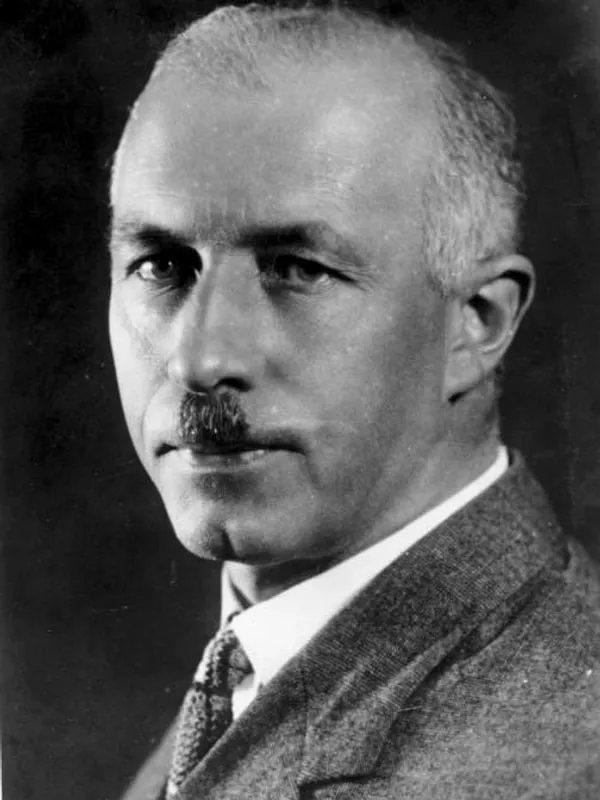
- Born:
- 27 January 1883, Würzburg (Bavaria, German Empire)
- Died:
- 24 September 1941, Murnau am Staffelsee
- Author:
- Natalia
- Photo:
- autor nieznany, CC BY-SA 3.0 DE, Wikimedia Commons

Gottfried Feder was a Bavarian civil engineer who, shaken by the defeat of 1918, proclaimed himself an economic reformer and coined the slogan of “breaking interest slavery”. He maintained that the source of Germany’s misfortunes was international finance capital, which he identified with the Jews. In the summer of 1919 he lectured on the Reichswehr’s propaganda courses in Munich, among whose participants was Adolf Hitler, and on 12 September 1919 it was his talk at a meeting of the German Workers’ Party that drew Hitler to the small party from which the NSDAP grew. His slogans found their way into the party programme of 1920, and for years Feder himself was regarded as its chief economic theorist. But when Hitler began courting the industrialists, and later when he took power, Feder’s anti-capitalist ideas became a liability. He ended his days as a professor of town planning, far from politics.
The engineer
He was born on 27 January 1883 in Würzburg into a family of senior Bavarian civil servants. He took his school-leaving examinations at the gymnasium in Ansbach and then studied civil engineering, specialising in reinforced-concrete structures, at the technical universities of Munich, Berlin-Charlottenburg and Zurich. As a student he belonged to a student fraternity and was reckoned a good fencer. A head injury he suffered in a duel left him unfit for military service.
He qualified as an engineer in 1905, and in 1908 he became a partner in a construction firm and head of its Munich branch; the firm built warehouses, bridges and other large structures in Germany, Italy and Bulgaria, and during the war also munitions factories and aircraft hangars. Every project the firm undertook was financed with loans, and Feder, by his own account, began to study questions of money and finance on his own. His economic knowledge was that of an autodidact, and professional economists never took it seriously.
Interest slavery
In November 1918, under the impact of defeat and revolution, Feder wrote the Manifesto for Breaking the Interest Slavery of Money (Das Manifest zur Brechung der Zinsknechtschaft des Geldes), published in 1919. In it he argued that the cause of all ills was interest, which allowed the “rapacious capital” (raffendes Kapital) of the great financiers to multiply its wealth without labour at the expense of the “creative capital” (schaffendes Kapital) of industry, the crafts and agriculture. The state was to abolish interest, take over the banks and the stock exchange, and even declare bankruptcy to free itself of debt. Feder was not opposed to private property and rejected Marxism. He maintained that workers and employers had a common interest and that the enemy was finance capital, which he identified with the Rothschilds and “international Jewry”. This division into “good” national capital and “bad” Jewish capital became one of the pillars of Nazi propaganda.
In 1919 Feder gave up his job with the firm to devote himself to politics. He came into contact with the nationalist Thule Society and with the journalist Dietrich Eckart, for whose weekly he wrote. He was also one of the most active speakers of the antisemitic German Nationalist Protection and Defiance Federation (Deutschvölkischer Schutz- und Trutzbund). Above all, however, he became a lecturer on the “anti-Bolshevik courses” that the propaganda department of the Reichswehr command in Bavaria, headed by Captain Karl Mayr, ran at the University of Munich from June 1919. Mayr valued his ideas and, as he wrote, supported him against the resistance of influential circles.
Feder and Hitler
In the summer of 1919 one of those attending a course was Gefreiter (Lance Corporal) Adolf Hitler. In Mein Kampf Hitler wrote that Feder’s lecture had been a revelation to him and that through it he had found the way to one of the essential premises for founding a new party. The distinction between creative capital and “Jewish” speculative capital allowed him to attack capitalism without attacking German industrialists, and to combine social slogans with antisemitism.
On 12 September 1919, at a meeting of the German Workers’ Party in the Sterneckerbräu beer hall, Feder gave a talk entitled “How and by what means can capitalism be eliminated?”. Hitler, sent by Mayr’s department, was in the audience. It was after this talk, in the discussion, that Hitler caught the attention of the party chairman, Anton Drexler, and a few days later he joined the party. Feder joined it too, with the number 531 on the membership list kept from 1920.
In the 25-point programme that Hitler proclaimed on 24 February 1920 in Munich’s Hofbräuhaus, when the party adopted the name NSDAP, Feder’s ideas appeared in points 10 and 11, which demanded the abolition of unearned income and the “breaking of interest slavery”. According to some accounts, including that of Alfred Rosenberg, Feder drafted the programme together with Hitler and Drexler, but historians point out that his direct involvement cannot be conclusively proved. In any case he remained somewhat on the margins of the party. In January 1920 he founded his own German Fighting League for the Breaking of Interest Slavery, which never gained much importance, and only in 1922 did he draw close to the NSDAP again. At the party congress in January 1923 he spoke immediately after Hitler as its spokesman on economic affairs.
The putsch and the Reichstag
During the Munich Putsch of 8–9 November 1923, Feder, together with Max Amann and other party propagandists, occupied the offices of a bank and set up a propaganda headquarters there, where posters and proclamations for the new “authorities” were prepared. After the putsch collapsed he took refuge for a time in Czechoslovakia, according to some sources. In May 1924, while the NSDAP was banned and Hitler was in prison at Landsberg, Feder was elected to the Reichstag on the list of the völkisch groups. He sat there until 1936, from 1928 in what was then the small NSDAP parliamentary group.
Feder presented himself as the movement’s “programmatic thinker” and the guardian of its ideas. At the turn of 1925 and 1926 he helped Hitler in his dispute with the north German wing of the party under Gregor Strasser, which wanted to change the programme. He obtained the draft amendments, informed Hitler of them and, as Hitler’s representative, attended a meeting of party officials in Hanover in January 1926, where the young Joseph Goebbels demanded that the “spy” be thrown out. At the Bamberg conference in February 1926 Hitler pushed through the inviolability of the 1920 programme and forbade any discussion of it. In 1927 Feder published the official commentary on the programme and edited the party’s book series, the National Socialist Library. He was never given executive power in the party, however.
Disappointment after 1933
In the late 1920s and early 1930s Hitler increasingly sought money and support from big business. Feder’s slogans about nationalising the banks and abolishing interest frightened industrialists such as Fritz Thyssen and bankers such as Hjalmar Schacht. In 1931 Feder became head of the NSDAP’s economic council, but there he competed with Hitler’s other advisers, and his influence waned. In the same year, together with the architect Paul Schultze-Naumburg, he founded the Fighting League of German Architects and Engineers, which gained some two thousand members within a year. A failed publishing venture – several party newspapers in southern Germany – cost him his entire fortune in these years.
After Hitler came to power Feder hoped to become Minister of Economics. In mid-1933 he was given only the post of State Secretary in the Reich Ministry of Economics, alongside a second state secretary from the career civil service. The regime’s economic policy went in a completely different direction from his programme: instead of breaking “interest slavery”, the government cooperated with big industry and the banks and financed rearmament. The antisemitic part of Feder’s views, on the other hand, was taken up in full. In 1933 he published a collection of speeches, The Struggle against High Finance, and a pamphlet, The Jews. From March to December 1934 he was Reich Commissioner for Settlement. When Schacht became Minister of Economics in August 1934, Feder’s fate was sealed. In December 1934 he was retired.
Professor of town planning
In November 1934 Feder became an honorary professor, and in 1936 an extraordinary professor, at the Technical University of Berlin, where he taught settlement, regional planning and town planning. In 1939 he published The New Town (Die neue Stadt), in which he proposed building towns of about 20,000 inhabitants, divided into self-sufficient units and surrounded by farmland. Its ideas drew on the concept of the garden city. He was also a member of the Nazi Academy for German Law. He died on 24 September 1941 at Murnau am Staffelsee in Bavaria, where he had lived since 1920.
Significance
Historians disagree about Feder’s influence on Hitler. Hitler himself stressed how much he owed to Feder’s lectures, and the slogans about “interest slavery” and “rapacious capital” were for years a fixture of Nazi propaganda. Yet as soon as Feder’s anti-capitalism began to stand in the way of winning power, Hitler dropped it without hesitation. What proved more lasting was the most dangerous part of his teaching: the conviction that behind Germany’s misfortunes stood Jewish capital, which had to be “eliminated”. In this way Feder, the self-taught economist from Würzburg, gave the Nazi movement a language in which antisemitism took on the appearance of an economic and social programme. That language allowed the NSDAP to appeal simultaneously to workers, craftsmen and small businessmen and to promise them liberation from an enemy who, in Nazi propaganda, always had the same face.
Sources
Often appears with
People who appear in the same events.