Germany
Ernst Röhm
Chief of Staff of the SA (1931–1934), Reich Minister without Portfolio (1933–1934), participant in the Munich Putsch (1923)
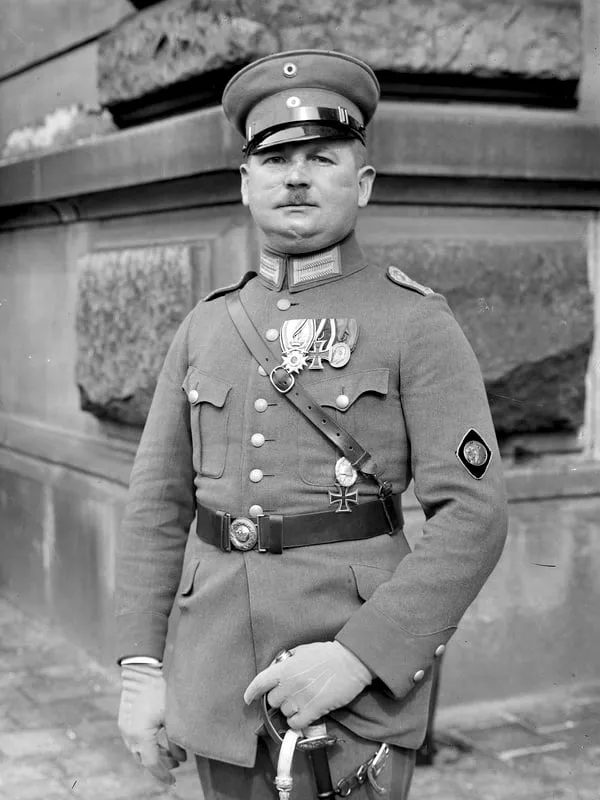
- Born:
- 28 November 1887, Munich (Bavaria, German Empire)
- Died:
- 1 July 1934, Munich, Stadelheim Prison
- Author:
- Natalia
- Photo:
- autor nieznany, domena publiczna, Wikimedia Commons

Ernst Röhm was a Bavarian career officer and one of the first and most important patrons of Adolf Hitler. In 1919–1923 it was he who opened the doors of barracks, arms depots and nationalist paramilitary leagues to a little-known agitator, and in 1931–1934 he turned the NSDAP’s strong-arm squad, the Sturmabteilung (SA), into a party army several million strong whose terror helped the Nazis seize and consolidate power. He was one of the few people with whom Hitler was on first-name terms. But when he demanded that the SA replace the army and carry out a “second revolution”, he became an obstacle to Hitler’s accommodation with the generals. On 1 July 1934 he was shot in a cell in a Munich prison on the orders of his former protégé. His death removed the last barrier on Hitler’s road to absolute power and opened the way to power for Heinrich Himmler and the SS.
Youth and the Great War
He was born on 28 November 1887 in Munich, the youngest of three children of an official of the Bavarian railways. The family was Protestant, which in Catholic Bavaria made it part of a minority, and deeply attached to the Wittelsbach dynasty. Röhm long remained a monarchist. After leaving the Maximiliansgymnasium in 1906 he joined the Bavarian Army as an officer cadet, and in 1908 he was commissioned a lieutenant in the 10th Infantry Regiment “König Ludwig” in Ingolstadt.
In the first weeks of the war, on 24 September 1914, he was badly wounded in the face in Lorraine. His nose, shot away, was reconstructed none too successfully, and the scars and wounds, which festered for a long time, stayed with him for life. In 1916, as a captain and company commander, he fought at Verdun, where on 23 June he was again seriously wounded. He was awarded both classes of the Iron Cross. No longer fit for service in the trenches, in the last years of the war he was a staff officer with the 12th Bavarian Infantry Division in Romania and on the Western Front, where he was responsible for supply and proved an outstanding organiser. He regarded the defeat and the revolution as treason. He later wrote that he was an “immature and wicked man” who needed war and unrest more than bourgeois order.
“The machine-gun king”
In the spring of 1919 Röhm joined the Freikorps of Colonel Franz von Epp, which together with government troops crushed the Bavarian Soviet Republic. Afterwards, as a staff officer of the Bavarian Reichswehr, he dealt with weapons and equipment. This seemingly clerical post gave him enormous influence. The Treaty of Versailles limited the German army to 100,000 men and required surplus weapons to be handed over, but Röhm hid them from the Allied control commissions in secret depots and distributed them among right-wing citizens’ militias and paramilitary leagues. He was known as the “machine-gun king of Bavaria”.
Together with other nationalist officers, among them Captain Karl Mayr, he belonged to an informal officers’ association, the “Iron Fist”. It was there, in the autumn of 1919, that he met Hitler, who had just begun his activity in the German Workers’ Party. Röhm joined this small party in 1919 too and brought soldiers and officers into it. He was the first man with influence in the state to recognise Hitler’s talent. Thanks to him the party – from February 1920 the NSDAP – gained contacts in the army, the police and among Bavarian politicians, money and, above all, the protection of authorities who turned a blind eye to its violence.
Röhm also helped at the birth of the SA, which grew in 1921 out of the stewards’ squad at party rallies. He supplied it with weapons and men, including former members of Hermann Ehrhardt’s naval brigade who had taken part in the Kapp Putsch. At that time, however, he was not its commander. It was led in turn by Ehrhardt’s men and, from 1923, by Hermann Göring. Röhm saw himself rather as the political guardian of the whole movement. In February 1923 he brought about the merger of the SA with other Bavarian paramilitary leagues in a common front, and in the autumn he ensured that Hitler became political leader of the Kampfbund (Combat League). He treated Hitler as a “drummer” whose job was to rouse the crowds, while he himself believed in the “primacy of the soldier over the politician”.
Putsch and trial
In 1923, during the occupation of the Ruhr and hyperinflation, Röhm left active service to avoid being transferred out of Munich and took over the Reichskriegsflagge (“Reich War Flag”) league, in which the standard-bearer was a young agriculture student, Heinrich Himmler. On the night of 8–9 November 1923, during the Munich Putsch, his men occupied the headquarters of the military district in Munich. In the morning they were surrounded by troops and police. Two members of the Reichskriegsflagge were killed in the exchange of fire, and after Hitler’s march was broken up at the Feldherrnhalle, Röhm surrendered.
At the trial before the Munich People’s Court he was a co-defendant with Hitler and Erich Ludendorff. On 1 April 1924 he was sentenced to one year and three months’ imprisonment, but the sentence was suspended because he had already spent several months in custody. In the May 1924 elections he entered the Reichstag on the list of the National Socialist Freedom Party, the joint label of the völkisch groups and the Nazis, who had been banned after the putsch. While Hitler was in Landsberg, Röhm built up the Frontbann, a legal paramilitary organisation under Ludendorff’s patronage, intended to replace the dissolved SA.
After his release from prison in February 1925, Hitler entrusted Röhm with rebuilding the SA, but their paths soon diverged. Hitler now wanted to win power legally, through elections, and needed a strong-arm squad subordinate to the party to protect its meetings and fight the Communists in the streets. Röhm wanted an independent military formation, free from the orders of “party politicians”. At the end of April 1925 he resigned command of the SA and the Frontbann. At the same time Hitler, for his own protection, began to form a small bodyguard, from which the SS grew.
On the sidelines and in Bolivia
The following years were a time of failure for Röhm. He lived on odd jobs as a travelling salesman, and in 1928 he published his memoirs, The Story of a Traitor (Die Geschichte eines Hochverräters). At the end of 1928 he accepted an offer to become an instructor in the army of Bolivia, which was being reorganised by the German general Hans Kundt. From January 1929 he served with the rank of lieutenant colonel, first as a lecturer at the military academy in La Paz, then as an inspector and divisional chief of staff in Oruro. Even there he stayed in constant contact with Germany, including with Himmler, who had headed the SS since 1929.
Chief of Staff of the SA
While Röhm was across the ocean, the NSDAP grew into a mass party. In September 1930 it won 107 seats, and at the same time the Berlin SA rebelled, dissatisfied with its pay, with its places on the electoral lists and with its subordination to the party. Hitler proclaimed himself Supreme Leader of the SA and called Röhm back from Bolivia, as he was not entangled in party quarrels and enjoyed the respect of the stormtroopers. On 5 January 1931 Röhm became Chief of Staff of the SA. He proved an excellent organiser: from 77,000 members at the beginning of 1931 the SA grew to some 290,000 in January 1932 and around 430,000 at the beginning of 1933. Unemployed young men found in it a uniform, a meal, comradeship and an opportunity for violence. When in April 1932 the government of Heinrich Brüning, at the request of the minister Wilhelm Groener, banned the SA, and Franz von Papen lifted the ban in June, some three hundred people were killed in the streets during the campaign before the July elections. Röhm also held talks with General Kurt von Schleicher on using the SA for pre-military training.
In 1931–1932 the Nazis’ opponents, especially the Social Democratic press, waged a campaign against Röhm centred on his homosexuality, which was punishable in Germany under Paragraph 175. In March 1932 his private letters were published. Röhm’s enemies in the NSDAP leadership even planned to murder his closest associates. At that point, however, Hitler publicly took his side, as he valued the SA chief’s loyalty and effectiveness more than his private morals.
The terror of 1933 and the “second revolution”
After Hitler was appointed chancellor on 30 January 1933, the SA became one of the main instruments for building the dictatorship. In February its members in Prussia were enrolled as auxiliary police. After the Reichstag fire the stormtroopers arrested thousands of Communists, Social Democrats, trade unionists and Jews and beat them in cellars and in the first, “wild” concentration camps. In the spring of 1933 Röhm became a commissioner and state secretary in the Bavarian government, and in December 1933 Reich Minister without Portfolio. As its chief he bore responsibility for many of the SA’s crimes of this period. On 31 July 1933 he issued an order permitting up to twelve members of a hostile organisation to be “judged” for the killing of one SA man.
Once its opponents had been crushed and the parties dissolved, the SA lost its purpose. Röhm spoke of a “second revolution” that would remove the conservative elites from power, and demanded that the SA become the nucleus of a new National Socialist people’s army, with the Reichswehr dissolved into a militia under his command. At the beginning of 1934, after absorbing veterans from the Stahlhelm and other leagues, the SA numbered, according to various figures, from three to over four million men – many times the size of the army. For Hitler this was unacceptable. For the war he was planning he needed professional generals, and to take over the office of president after the death of the aged Paul von Hindenburg he needed the support of the Reichswehr. On 28 February 1934 he forced Röhm to sign an agreement with the Reichswehr minister Werner von Blomberg that left national defence exclusively to the army. That same day a drunken Röhm is said to have spoken among his own men of a “ridiculous corporal” to whom he had no intention of submitting.
The Night of the Long Knives
In the spring of 1934 all of Röhm’s rivals united against him: the generals, Göring, Himmler and the head of his security service, Reinhard Heydrich, as well as party functionaries, including Rudolf Hess. The SS and SD fabricated evidence that the SA was preparing a putsch, and even that Röhm had taken money from France. Historians agree that there was no conspiracy. In June Röhm, who was ill, went to take a cure at Bad Wiessee on the Tegernsee, and the SA was sent on leave for July.
On the morning of 30 June 1934 Hitler arrived at the hotel in Bad Wiessee, where the SA leaders had gathered after being summoned to a conference, and personally arrested Röhm in his bed. The SA leaders were taken to Stadelheim Prison in Munich, and six of them were shot that same evening. In Berlin, in Silesia and elsewhere, SS and Gestapo men killed according to prepared lists. For a day Hitler hesitated over whether to spare his old friend. On 1 July, pressed by Himmler and Göring, he gave the order. The commandant of Dachau concentration camp, Theodor Eicke, and his subordinate Michael Lippert left Röhm a pistol with a single round in his cell. When he had not fired within the allotted time, they went in and shot him. According to one account, Röhm refused to kill himself, saying that if he was to die, Hitler should do it himself.
During the Night of the Long Knives at least 85–90 people were killed, and according to some estimates many more. The victims included not only SA leaders but also people with whom Hitler wanted to settle scores: Schleicher and his wife, Gregor Strasser, Gustav von Kahr, who in 1923 had broken with the putschists and turned against Hitler, and associates of Vice-Chancellor Papen. Propaganda called the events the “Röhm Putsch” and, to turn public opinion against him, dragged out his homosexuality, which Hitler had known about for years. On 3 July the government declared the killings “lawful acts of self-defence by the state”, and on 13 July Hitler told the Reichstag that in those hours he had been the “supreme judge of the German people”. Michael Lippert was convicted of Röhm’s murder by a West German court only in 1957.
Significance
Röhm’s death was one of the turning points in the building of the Third Reich. Deprived of its leaders, the SA was pushed into the background under Viktor Lutze, although its members were still setting fire to synagogues during Kristallnacht in 1938. On 20 July 1934 Hitler removed the SS from the authority of the SA and placed it directly under himself, which opened the way for Himmler to build a police state and the apparatus that carried out the Holocaust during the war. The generals, pleased to be rid of a rival, turned a blind eye to the murder of two of their own colleagues, Schleicher and Ferdinand von Bredow, and after Hindenburg’s death on 2 August 1934 they swore an oath of allegiance to Hitler personally. That alliance led the German army into Poland in 1939. After the Röhm affair the regime also intensified the persecution of homosexuals: in 1935 Paragraph 175 was made harsher, and thousands of men were sent to prisons and camps.
Röhm was not a victim in the moral sense of the word. He was a co-founder of the movement that destroyed Weimar democracy and head of the formation that tortured and murdered opponents in 1933. His career shows how much Hitler owed to the army in his early years, and his end shows that in the new state only the will of the leader now counted – a leader who in 1934 for the first time openly used murder as a method of government.
Sources
Often appears with
People who appear in the same events.