Germany
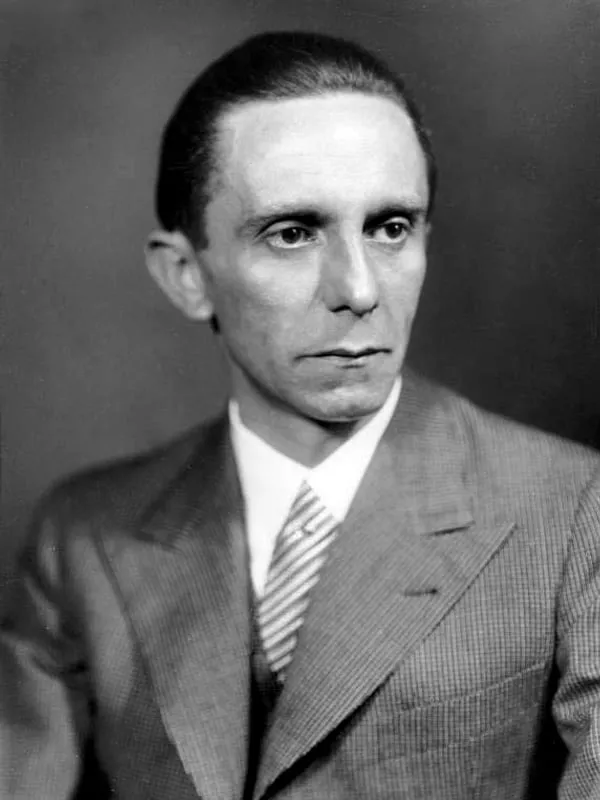
Joseph Goebbels
Gauleiter of Berlin (1926–1945), Nazi Party propaganda chief (1930–1945), Reich Minister of Public Enlightenment and Propaganda (1933–1945), Reich Chancellor (1945)
- Born:
- 29 October 1897, Rheydt (Rhineland, German Empire)
- Died:
- 1 May 1945, Berlin
- Author:
- Łukasz
- Photo:
- Heinrich Hoffmann, CC BY-SA 3.0 DE, Wikimedia Commons

Joseph Goebbels was Adolf Hitler’s chief propagandist and one of his closest associates. As Gauleiter of Berlin from 1926 he fought to win for the Nazi Party a capital he regarded as “red”, and as the party’s propaganda chief from 1930 he ran the election campaigns that made it the strongest party in Germany. After 1933, as Minister of Public Enlightenment and Propaganda, he took control of the press, radio, film, theatre and the arts and harnessed them to a single purpose: convincing the Germans that Hitler was an infallible leader and that the Jews were their mortal enemy. He was one of the chief authors of the antisemitic campaign of hatred that led to Kristallnacht and prepared the ground for the Holocaust. During the war he called for “total war”, and in May 1945, the day after Hitler’s suicide, he and his wife took their own lives and those of their six children.
Early years
Paul Joseph Goebbels was born on 29 October 1897 in Rheydt in the Rhineland, into a modest Catholic family. His father was a clerk in a small wick factory; his mother had been born in the Netherlands. As a child the boy suffered from osteomyelitis, which left his right leg shorter and deformed. He limped all his life and was short, which his opponents mocked. He compensated for his disability and his sense of inferiority with ambition. He was the best pupil at his school, read widely and wrote poems and plays. In 1917 he wanted to volunteer for the war, but because of his leg he was declared unfit for service. The war that shaped his generation he therefore knew only from afar.
In 1917–1921 he studied German literature and history at several universities, from Bonn to Munich. In 1921 he submitted his doctoral thesis at Heidelberg, and in April 1922 he received his degree. The thesis dealt with the Romantic dramatist Wilhelm von Schütz. His supervisor was the Jewish Germanist Max von Waldberg. From then on he always styled himself “Doctor”. He tried to become a writer and journalist, but publishers rejected his work, and he regarded the few months he spent working at a bank in Cologne in 1923 as a humiliation. He drifted away from the Church, sought faith in Dostoevsky and Spengler, and wrote in his diary of despair and of waiting for a great man who would show the Germans the way.
From Strasser to Hitler
In 1924, while Hitler was in prison after the Munich Putsch, Goebbels became involved in the National Socialist movement in the Rhineland. He quickly proved to be an outstanding speaker and writer. In 1925 he joined the refounded Nazi Party and became secretary of the party district in Elberfeld, and then a close associate of Gregor Strasser, leader of the party’s north German wing, which stressed the “socialism” in the party’s name. Goebbels despised the bourgeoisie, admired the zeal of the communists and dreamed of an alliance with Russia. At the Bamberg conference in February 1926 Hitler rejected the programme of Strasser and his supporters, and Goebbels wrote that it was one of the greatest disappointments of his life.
Hitler, however, set out to win him over. In April 1926 he invited him to Munich, courted him, let him speak at the famous Bürgerbräukeller beer hall and talked with him at length. Goebbels was enchanted. “I love him,” he wrote in his diary. From then on he was unconditionally devoted to Hitler, although his diaries reveal that he had moments of doubt in the years that followed. In the autumn of 1926 Hitler appointed him Gauleiter of Berlin.
Conquering Berlin
At that time the Berlin Nazi Party had a few hundred quarrelling members. Goebbels turned it into a force through propaganda and violence. “Whoever conquers the street also conquers the state,” he wrote. He organised rallies in working-class districts dominated by the communists, provoked brawls with them and paraded wounded SA men on stage as martyrs. In May 1927, after a pastor who had heckled him was beaten up at a rally, the police banned the party in Berlin. Goebbels responded by founding the weekly Der Angriff (“The Attack”), which appeared from July 1927. In its columns and cartoons he waged a campaign against the Jewish deputy police president of Berlin, Bernhard Weiss, whom he nicknamed “Isidor”, turning him into the symbol of the antisemitic campaign against the Republic.
In 1928 he was elected to the Reichstag. He made no secret of why he was going there: he wrote that the Nazis were entering parliament to destroy democracy with its own weapons, and that they were coming “as the wolf breaks into the sheepfold”. In 1930 he turned Horst Wessel, an SA man shot by a communist, into a martyr of the movement, and Wessel’s song became the party anthem. On 27 April 1930 Hitler appointed him the Nazi Party’s propaganda chief. The campaign before the elections of 14 September 1930, in which the party won 107 seats, was the first he directed. Then came the campaigns of 1932: the presidential election, in which Hitler lost to Hindenburg but became a national politician, and the July elections, in which the party won 37 per cent of the vote. Goebbels used aeroplanes, films, gramophone records, hundreds of thousands of posters and, above all, the cult of Hitler as Germany’s saviour.
On 19 December 1931 he married Magda Quandt, the divorced wife of an industrialist. Hitler, who became a frequent guest in their home, was a witness at the wedding. The Goebbelses had six children.
Minister of Propaganda
After Hitler came to power, on 13 March 1933 Goebbels became minister of the new Reich Ministry of Public Enlightenment and Propaganda. He quickly gathered into his hands control over the whole of public life. The press came under the supervision of the ministry, which issued daily instructions to editors on what to write and what not to. Radio had already been brought under state control in the days of the Republic, so it only had to be taken over, and cheap “people’s receivers” found their way into millions of homes. From September 1933 Goebbels headed the Reich Chamber of Culture, to which writers, actors, musicians, painters and journalists had to belong; Jews and political opponents were excluded from it. On 10 May 1933, in the square in front of the Berlin opera house, he spoke during the burning of books by Jewish, left-wing and pacifist authors. Thousands of artists and scholars left Germany.
Goebbels created the myth of the “Führer”: a man who was always right, who had worked an economic miracle and restored to the Germans their honour and their jobs. He staged great ceremonies, Hitler’s birthdays, plebiscites and the propaganda setting of the 1936 Olympic Games in Berlin. He supported the film industry, which produced propaganda films alongside entertainment. Every step Hitler took towards war – leaving the League of Nations, remilitarising the Rhineland, the Anschluss and the dismemberment of Czechoslovakia – his propaganda presented as an act of justice that righted the wrongs of Versailles.
Kristallnacht
For Goebbels antisemitism was a tool, but also a conviction. He directed the propaganda build-up to the boycott of Jewish shops on 1 April 1933, and in Berlin, his own district, he harassed the Jews with persecution for years. In November 1938, when the German diplomat Ernst vom Rath died in Paris after being shot by Herschel Grynszpan, a young Jew with Polish citizenship, Goebbels gave a speech to the assembled party functionaries in Munich on the evening of 9 November that was understood as a call for “spontaneous” retaliation. On the night of 9–10 November synagogues burned throughout Germany and Austria, thousands of shops and homes were wrecked, at least several dozen people – by more recent estimates several hundred – were murdered, and some 30,000 Jewish men were taken to concentration camps. The pogrom, which the Nazis called Kristallnacht, was the prelude to the complete exclusion of Jews from the economic life of the Reich.
War
In the summer of 1939 Goebbels’s propaganda prepared the Germans for war with Poland. Newspapers and radio described daily the persecution of Germans in Poland – partly real, but very largely invented or exaggerated – and accused Britain of “encircling” the Reich. After the outbreak of war, propaganda used the killings of Germans in Bydgoszcz in September 1939, known in Germany as “Bloody Sunday”, to justify terror against the Poles, giving numbers of victims inflated many times over. In private Goebbels feared war with the Western powers, and on 3 September, when the British declaration of war arrived, he was, according to witnesses, dejected. In public he extolled “the strongest army in the world”.
During the war Goebbels directed propaganda at home and in the occupied territories, in constant rivalry with the Foreign Minister, Joachim von Ribbentrop. From 1940 he wrote a weekly leading article for the paper Das Reich, which was then read out on the radio. His ministry produced the antisemitic films Jud Süß and The Eternal Jew. Goebbels pressed for Jews to be marked with the yellow star in September 1941 and for the deportation of Berlin’s Jews to the east. In November 1941 he wrote in Das Reich that the Jews were undergoing a “gradual process of extermination” that they had brought upon themselves, and on 27 March 1942 he noted in his diary that a “barbaric” procedure was being applied to them in the east, to which some 60 per cent of them would fall victim. He thus knew about the Holocaust and provided its propaganda justification. In 1943 he declared Berlin “free of Jews”.
After the defeat at Stalingrad, on 18 February 1943, he delivered his most famous speech to a carefully chosen audience at the Berlin Sportpalast: “Do you want total war?” In April 1943 German propaganda revealed the graves of Polish officers murdered by the NKVD at Katyn. Goebbels hoped in this way to split the Allied coalition. When Stalin accused the Germans of the crime and the Polish government asked the Red Cross to investigate, Moscow broke off relations with the government of General Władysław Sikorski, even though the crime had been committed by the Soviets. On 20 July 1944 Goebbels, who was in Berlin, played a key part in crushing the coup: he put Major Otto Ernst Remer, commander of the guard battalion, through by telephone to Hitler, who ordered him to arrest the conspirators. A few days later he became Reich Plenipotentiary for Total War Mobilisation. He closed theatres and businesses and sent one age group after another into the army and the factories, and in the spring of 1945, as Reich Defence Commissioner for Berlin, he organised the defence of the city by old men and boys of the Volkssturm.
Death
In April 1945 Goebbels moved with his wife and children into Hitler’s bunker beneath the Reich Chancellery. In his political testament, drawn up on 29 April, Hitler named him Reich Chancellor. After Hitler’s suicide on 30 April, Goebbels held that office for one day. On 1 May he tried, through General Hans Krebs, to open talks with the Soviet command, but the Russians demanded unconditional surrender. That evening the six Goebbels children, aged 4 to 12, were drugged and poisoned with cyanide, with the involvement of Magda Goebbels and an SS doctor. Joseph and Magda Goebbels then committed suicide in the Chancellery garden. Soviet soldiers found their partly burned bodies on 2 May.
Significance
Goebbels did not create National Socialism, nor did he decide on war, but without him Hitler would not have won millions of followers so quickly or kept them obedient until the last days of the war. He grasped earlier than others the power of the new media, radio and film, and combined them with spectacle, street violence and ruthless lies. His propaganda dehumanised Jews, Poles and Russians, accustomed the Germans to violence against them and supplied justifications for crime. The diary he kept from 1924 until his last days, running to tens of thousands of pages, is one of the most important sources for the history of the Third Reich, and it reveals a man who consciously and zealously served the worst cause of his century.
Sources
Mentioned in battles
(05)Often appears with
People who appear in the same events.
On the timeline
(143)The 40 most important of 143 events. All tagged “Joseph Goebbels” (21) →