Germany
Anton Drexler
Co-founder and chairman of the DAP (1919–1920), chairman of the NSDAP (1920–1921), honorary chairman of the NSDAP (1921–1923)
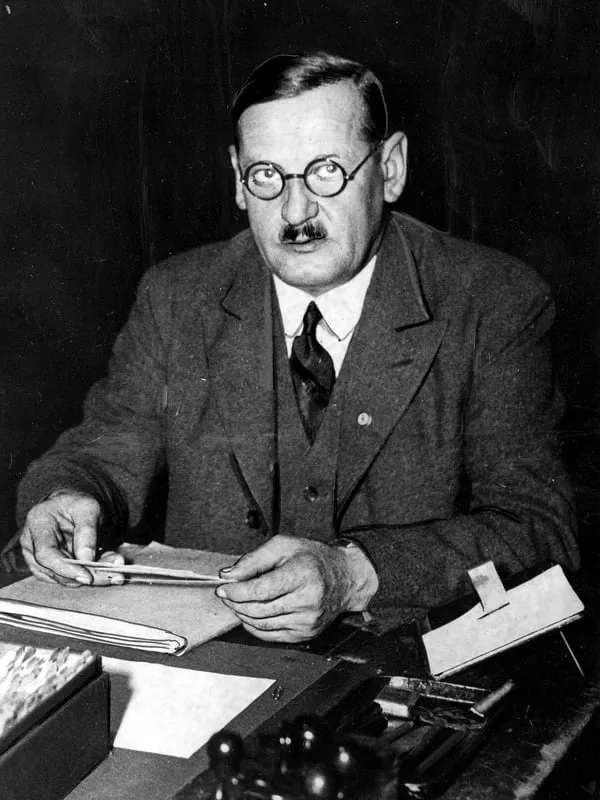
- Born:
- 13 June 1884, Munich (Bavaria, German Empire)
- Died:
- 24 February 1942, Munich
- Author:
- Natalia
- Photo:
- autor nieznany, domena publiczna, Wikimedia Commons

Anton Drexler was a Munich toolmaker at the state railway workshops who in January 1919 founded the small nationalist German Workers’ Party (Deutsche Arbeiterpartei, DAP). He wanted to win workers over to nationalism and antisemitism and to take them away from the Social Democrats and the Communists. It was he who in September 1919 spotted an orator’s talent in an unknown soldier, Adolf Hitler, and invited him into the party. Within two years Hitler had turned the DAP into the National Socialist German Workers’ Party (NSDAP) and shunted Drexler into an honorary post without power. The founder of the party that ruled Germany from 1933 to 1945 played no part in the Third Reich.
A worker from the railway workshops
He was born on 13 June 1884 in Munich, the son of Georg Drexler, a fitter and railway worker, and his wife Maria. He completed elementary school and a few years of continuation school. From 1902 he worked as a fitter in the main workshops of the Bavarian State Railways in Munich, and from 1903 in the railway tool shop, where he remained a toolmaker until 1923. English-language accounts state that for a time he also worked in Berlin and earned extra money playing the zither in bars. He was married to Anna and had two children.
By his own account, he volunteered for the army when war broke out in 1914 but was not accepted. German sources say the railways deemed him indispensable at work; English ones that he was found unfit for service. He spent the war in the workshops. He was typical of those German workers who did not follow the socialists but took up the slogans of the nationalist right. In 1917 he joined the German Fatherland Party, a mass movement of supporters of a victorious peace with annexations, which fought the Reichstag’s peace resolution.
The birth of the party
On 7 March 1918 Drexler and a few dozen colleagues from the workshops founded the Munich branch of the Free Workers’ Committee for a Good Peace. The organisation, inspired by nationalists from Bremen, was meant to strengthen the will to victory among the workers, but it never had more than forty members. A strong influence on Drexler was his mentor Paul Tafel, one of the directors of the MAN works, an activist of the Pan-German League and a member of the Thule Society. In the autumn of 1918 Drexler, together with the sports journalist Karl Harrer, a member of Thule, set up the secret Political Workers’ Circle, which discussed the nation, socialism and the “Jewish question”. In a leaflet and a pamphlet entitled My Political Awakening he described how, as a worker, he had turned away from socialism, and argued that Bolshevism was a “Jewish swindle”.
On 5 January 1919, a week before the elections to the Bavarian Landtag, Drexler and Harrer, with a group of about twenty people, founded the German Workers’ Party at the Fürstenfelder Hof hotel in Munich. Drexler became chairman of the party in Munich, while Harrer took the honorary title of Reich chairman. The members were mainly Drexler’s colleagues from the railway workshops, and they were soon joined by men who were to play an important part in the Nazi movement: the engineer Gottfried Feder, the writer Dietrich Eckart and the Baltic German Alfred Rosenberg. In 1919 an expanded version of Drexler’s pamphlet appeared with the subtitle From the Diary of a German Socialist Worker; it is regarded as the first programmatic text of National Socialism. In it Drexler preached a “national community” above class divisions, socialism without Marxism, and a struggle against “Jewish” capital. The party, however, was more a discussion club than a political organisation. It met in the back rooms of beer halls, and Drexler, a poor speaker, could not carry an audience with him.
Meeting Hitler
On 12 September 1919 Lance Corporal Adolf Hitler, sent by the propaganda department of the Reichswehr under Captain Karl Mayr, came to a party meeting at the Sterneckerbräu beer hall. After a talk by Feder, Hitler sharply rebutted, in the discussion, a speaker who favoured separating Bavaria from the Reich. Drexler is said to have remarked that this man “has got a mouth on him” and could be made use of. He caught up with Hitler at the door, gave him his pamphlet and invited him to the next meeting. Within a few days Hitler was a member of the party and of its committee, responsible for propaganda.
Drexler backed the new member from the start, although Hitler’s growing ambitions soon led to quarrels in the leadership. Hitler wanted to take the party out of the back rooms of beer halls and turn it into a mass movement. Harrer, who preferred a small, closed circle, lost the dispute and left at the beginning of 1920, and Drexler became first chairman. On 24 February 1920, in a hall of the Hofbräuhaus, Hitler read out to an audience of about two thousand the party’s 25-point programme, which he had drawn up together with Drexler under the influence of Feder’s ideas. That day the new name was announced: the National Socialist German Workers’ Party. On the first membership list, kept from 1920 and starting at number 501, Drexler had number 526 and Hitler 555.
Sidelined
In the summer of 1921, while Hitler was away in Berlin, Drexler and part of the leadership held talks on merging the NSDAP with another National Socialist group, the German Socialist Party, and on toning down the programme. Drexler hoped that this would take the party beyond Munich. Hitler saw it as an attack on his position. On 11 July 1921 he announced that he was leaving the party, and three days later set out his conditions for returning: he wanted to be chairman with dictatorial powers. The leadership, knowing that without its best speaker the party would fall apart, gave way. On 25 July Drexler went to the Munich police to warn them about Hitler, but to no avail. On 29 July 1921 an extraordinary members’ meeting elected Hitler chairman by 553 votes to one, and Drexler was given the title of honorary chairman, with no say in decisions. In Mein Kampf Hitler later described him condescendingly as a simple worker with neither military experience nor talent, “incapable of the brutal ruthlessness” a leader needs.
On 27 April 1923 Drexler was badly beaten in an assault and had to stop working on the railways, which he later left because of ill health. When Hitler launched the Munich Putsch on 8 November 1923, Drexler was brought to him, but after hearing the plans he took no part in them. Even so, he was briefly arrested after the putsch. In December 1923, together with the lawyer Lorenz Roder, he persuaded the imprisoned Hitler to end his hunger strike, and he collected money for the families of the putschists who had been killed.
On the margins
After the NSDAP was banned, Drexler was active in the bloc of völkisch groups that replaced the banned party, and from 1924 to 1928 he sat in the Bavarian Landtag. He took no part in Hitler’s refounding of the NSDAP in 1925. He set up his own organisation, the National Social People’s League, which never gained any significance. In the nationalist movement he was a figure from the past, a symbol of the party’s working-class beginnings, which Hitler preferred not to be reminded of.
After the Nazis took power, Drexler rejoined the NSDAP on 1 May 1933. At his request his admission was backdated to 1929. In 1934, as the party’s founder, he received the Blood Order, a decoration for participants in the putsch and the oldest activists. Propaganda occasionally presented him as an “old fighter”, but he was given no post. In January 1940 he drafted a letter to Hitler reminding him that he had not been the seventh member of the party, as he claimed in Mein Kampf, but at most the seventh member of its committee. He probably never sent it. He died in Munich on 24 February 1942 after a long illness, according to some sources linked to alcoholism.
Significance
Drexler was neither an outstanding organiser nor a thinker, and without Hitler his party would probably have disappeared like dozens of other völkisch groups in post-war Munich. His significance lies elsewhere. It was he who created the framework in which Hitler began his career, and he who brought into it the idea that became the core of the movement: a fusion of nationalism with social slogans and antisemitism, aimed at workers who were to be drawn away from Marxism. The name “National Socialism” and the slogan of the “national community” grew out of that milieu. His fate also shows how Hitler treated people to whom he owed something. Once they were no longer needed, he pushed them aside and reworked his own biography so that he alone stood at the party’s beginnings.
Sources
Often appears with
People who appear in the same events.