Poland
Janusz Kusociński
Athlete, Olympic champion in the 10,000 metres (1932), defender of Warsaw (1939) and member of the underground (1939–1940)
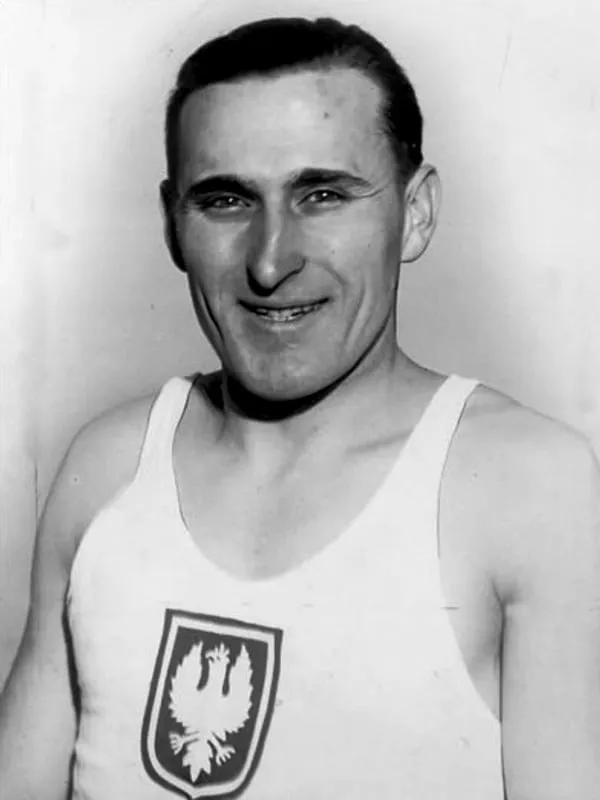
- Born:
- 15 January 1907, Warsaw (Russian Empire)
- Died:
- 21 June 1940, Palmiry (General Government)
- Author:
- Natalia
- Photo:
- autor nieznany, domena publiczna, Wikimedia Commons

Janusz Kusociński, “Kusy”, was, alongside Stanisława Walasiewicz, the most popular Polish sportsman of the inter-war years. On 31 July 1932, at the Games in Los Angeles, he won the 10,000 metres, beating the favoured Finns. In September 1939 he volunteered for the army and defended Warsaw as a corporal. Under the occupation he was active in the underground. In the spring of 1940 the Gestapo arrested him, and on 21 June that year he was killed in the Palmiry massacre.
From football to the track
He was born on 15 January 1907 in Warsaw. He spent his childhood in Ołtarzew (PL) outside Warsaw, where his father Klemens, a railway official, had a small farm. The family was hit hard by the wars: his eldest brother Zygmunt was killed during the First World War, and his brother Tadeusz fell in 1920 near Zamość in the Polish-Soviet War. In 1929 his youngest sister, to whom he was closest, died, which affected Kusociński deeply. His mother and eldest sister survived the war. In 1928 Janusz graduated from a horticultural school in Warsaw.
As a boy he played palant, a Polish bat-and-ball game, and then football – as a forward in the team of the Workers’ Sports Club “Sarmata”. He took up running by chance: in 1925, at a workers’ sports meeting, a relay team was one runner short, Kusociński agreed to run and his team won. From 1926 he competed for Sarmata over 800 and 1,500 metres. His coach was the Estonian Aleksander Klumberg (PL), who introduced him to interval training, which Kusociński then developed in his own way. In 1928 Kusociński won his first Polish titles, and in 1929 he moved to the Warszawianka (PL) club, for which he competed until 1939. In 1931 the readers of “Przegląd Sportowy” voted him sportsman of the year.
Gold in Los Angeles
1932 was the best year of his career. On 19 June in Antwerp he ran 3,000 metres in 8:18.8, and on 30 June 4 miles in 19:02.6 – both the best times in the world. At the Los Angeles Games (PL) on 31 July 1932 he lined up for the 10,000 metres against the Finns, who had dominated the long distances for years. He won in 30:11.4, an Olympic record. Volmari Iso-Hollo (PL), in second place, finished 1.2 seconds later, and the third-placed Lauri Virtanen (PL) was more than 23 seconds behind the Pole. The Polish runner had thus beaten two Finns over a distance at which, in the 1920s, in the days of Paavo Nurmi, the Finns had had no equal. The gold medal brought him enormous popularity in Poland – he became a familiar figure in Warsaw’s salons too. After the race, it was reported, his shoes were full of blood.
Two years later, at the first European Championships (PL) in Turin, he won the silver medal in the 5,000 metres and finished fifth in the 1,500 metres. The same year he won the 3 miles at the British championships. In all he set 25 Polish records over various distances. His greatest rival at home was Józef Noji (PL). A serious knee injury kept him out of the Berlin Games of 1936. He spent a long time in treatment, including in sanatoriums, and returned to competitive sport only in 1938; in 1939 he became Polish champion over 10,000 metres once more.
At the same time he completed his education. In 1937 he passed his school-leaving examination as an external candidate, and in 1938 he graduated from the Central Institute of Physical Education in Warsaw. He worked as a physical education teacher, coach and journalist, and was editor-in-chief of “Kurier Sportowy”. He also published a memoir, “Od palanta do olimpiady” (From palant to the Olympics).
Defender of Warsaw
In September 1939, as a reserve corporal, he volunteered for the army. He was assigned to the machine-gun company of the 2nd Battalion of the 360th Infantry Regiment (PL), which fought in the defence of Warsaw. He was wounded twice, among other occasions on 25 September at Fort Czerniaków on Powsińska Street, where a plaque marks the spot today. On 28 September 1939, the day of the capitulation of the capital, General Juliusz Rómmel awarded him the Cross of Valour.
In the underground
Under the occupation Kusociński worked as a waiter at the “Pod Kogutem” bar on Jasna Street, known as the Sportsmen’s Inn. Many of the regulars knew him from the track, and he passed underground newspapers to the customers. He wanted to set up a cell of the Union of Armed Struggle among sportsmen. He belonged to the clandestine Military Organisation “Wilki” (PL) (“Wolves”), in which he used the pseudonym “Prawdzic”. The organisation was part of the Central Committee of Independence Organisations, and its commander was Józef Rylski-Brückner. According to pl.wikipedia, Kusociński headed its intelligence. Part of the “Wilki” later joined the ZWZ and the Home Army.
The Gestapo broke up the organisation, according to pl.wikipedia after a denunciation. Kusociński was seized in the gateway of the house at 16 Noakowskiego Street where he lived. Sources give different dates for the arrest: the IPN says 28 March 1940, pl.wikipedia and some accounts 26 March. He was held first in Mokotów prison and then at the Gestapo headquarters at 25 Szucha Avenue (PL). He was tortured during interrogations to force a confession. Another member of the “Wilki”, 20-year-old Agnieszka Dowbor-Muśnicka, was also later killed at Palmiry.
Death at Palmiry
In the spring and summer of 1940 the Germans carried out in the General Government the AB-Aktion, aimed at the Polish intelligentsia and people suspected of pro-independence activity. On 20 and 21 June 1940 hundreds of prisoners were taken from Pawiak in three transports to the forest near Palmiry, on the edge of the Kampinos Forest. The prisoners were allowed to take their luggage, so many believed they were being sent to a concentration camp. In a clearing in the forest the Germans led them in groups to the edge of pits dug in advance and shot them with machine guns. The shooting was done by soldiers of an SS cavalry regiment stationed in Warsaw and by German policemen. Kusociński was killed there on 21 June together with the former Marshal of the Sejm Maciej Rataj and the socialist Mieczysław Niedziałkowski. Among those shot were other sportsmen too: the Olympic cycling silver medallist from Paris in 1924, Tomasz Stankiewicz (PL), and the athlete Feliks Żuber, an Olympian from Amsterdam. In the course of two days the Germans murdered 358 people at Palmiry. Kusociński was 33.
The graves were disguised with young pines, but foresters marked the burial pits at the risk of their lives. Thanks to this a Polish Red Cross team was able to carry out an exhumation after the war. Kusociński’s grave – in section II, numbered XVII – was identified in October 1947 by his sister, by a figurine of St Anthony and a comb she had once given him. He lies in the Palmiry cemetery (PL).
Remembrance
Before the war he received the Silver (1931) and Gold (1932) Cross of Merit for his sporting achievements. In 2009 he was posthumously awarded the Commander’s Cross with Star of the Order of Polonia Restituta. Since 1954 the Janusz Kusociński Memorial (PL) has been held in Poland. The athletics hall of the Warsaw Academy of Physical Education, dozens of schools and streets bear his name, and a path in the Olympic village in Munich is called Kusocinskidamm. The 1977 film “Ostatnie okrążenie (PL)” (The Last Lap) is devoted to the runner’s wartime fate.