Poland
Juliusz Rómmel
Commander of the 1st Cavalry Division (1920), army inspector (1929–1939), commander of the Łódź Army and the Warsaw Army (1939), major general
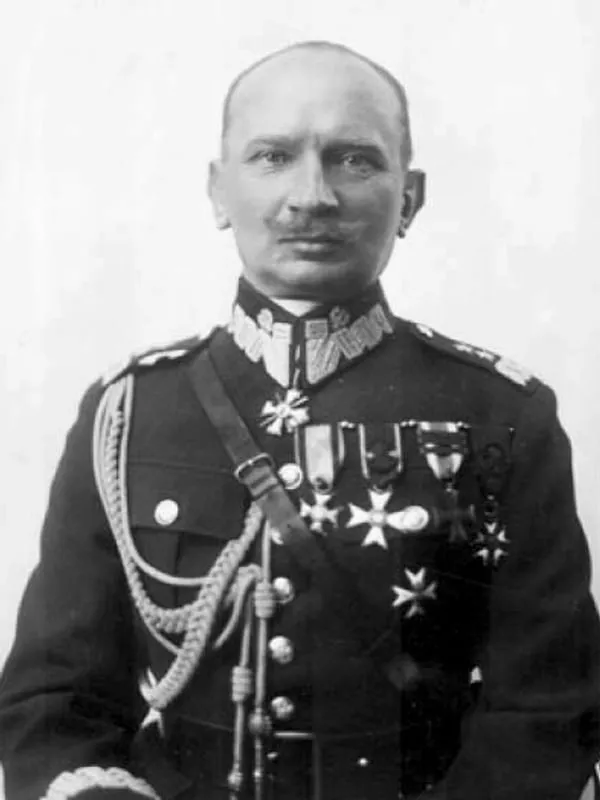
- Born:
- 3 June 1881, Grodno (Russian Empire)
- Died:
- 3 September 1967, Warsaw
- Author:
- Łukasz
- Photo:
- autor nieznany, domena publiczna, Wikimedia Commons

Juliusz Rómmel was one of the most senior generals of the Polish Army in 1939 and one of the most controversial figures of the September Campaign. A professional officer of the Russian army, he won fame in 1920 with his victory over Budyonny’s cavalry at Komarów. Between the wars he served for ten years as an army inspector, and in the spring of 1939 he took command of the Łódź Army. After it was broken up he led the defence of Warsaw and Modlin from 8 September as commander of the Warsaw Army. It was he who decided on the capitulation of the capital on 28 September, and he who authorised General Michał Tokarzewski-Karaszewicz to set up the first underground organisation, Service for Poland’s Victory. Historians judge him harshly for abandoning the headquarters of the Łódź Army, for his passivity towards the armies fighting on the Bzura and for his wavering in the face of the Soviet invasion. At the same time his life illustrates the path of many officers who passed from the Tsarist army into the Polish Army and after 1945 had to find their place in the Polish People’s Republic.
Origins and service in the Russian army
He was born on 3 June 1881 (22 May by the Julian calendar) in Grodno, the son of Karol Aleksander Rummel, an officer in the Russian army, and Maria, née Marcinkiewicz. The Rummel family descended from the German nobility of Livonia, settled in Courland in the fourteenth century, but Polish was spoken at home. All his brothers also became officers in the Tsarist army. Until 1918 he bore the surname Rummel; thereafter he used the form Rómmel.
He graduated from the cadet corps in Pskov (1900) and the Konstantinovsky Artillery School in St Petersburg (1903). As a second lieutenant he joined the Guards artillery and took part in the Russo-Japanese War. In the First World War he fought on the front against Austria-Hungary, was twice wounded and in July 1916 was promoted to colonel. After the February Revolution he became involved in forming Polish units in Ukraine. At the beginning of 1918 he commanded Polish units in Kiev, then an independent horse artillery battalion and a light brigade of the Polish III Corps (PL). After the corps was disbanded in the summer of 1918 he was interned by the Austrians.
Komarów and the war with the Bolsheviks
In November 1918 he joined the Polish Army. At Rembertów he disarmed the Germans and formed the 8th Field Artillery Regiment from the captured guns. He then commanded the Legions’ artillery brigade, and in June and July 1920 he was acting commander of the 1st Legions Infantry Division. In July 1920 he took over the 1st Cavalry Division, the main force of the Polish cavalry in the war against the Bolsheviks.
On 31 August 1920 his division fought the Battle of Komarów against Semyon Budyonny’s 1st Cavalry Army, which was withdrawing from Zamość. It is regarded as the last great cavalry battle in Europe and one of the largest cavalry engagements of the twentieth century. The Russian cavalry, encircled and worn out by earlier fighting, suffered heavy losses and had to retreat. The victory brought its westward drive into Poland to an end and won Rómmel a fame that he later burnished in his own memoirs. In the autumn of 1920 he also commanded the Cavalry Corps in the Niemen operation.
General of the Second Polish Republic
In July 1921 he became inspector of cavalry in Wilno (Vilnius), and in May 1922 his rank of brigadier general was confirmed. From 1924 he commanded the 1st Cavalry Division in Białystok, and from 1926 he was a general attached to the General Inspector of the Armed Forces. On 1 January 1928 he was promoted to major general. A year later he became an army inspector based in Warsaw and remained one until the outbreak of war. In that post he prepared in peacetime to command one of the armies planned for wartime. In an assessment attributed to Józef Piłsudski he was described as an energetic officer of strong character and a good commander of his own troops. Rómmel published memoirs of the Polish–Soviet War, among them Wspomnienia z bojów kawalerji (“Memories of Cavalry Battles”, 1934).
On 23 March 1939, when Poland accelerated its war preparations after Germany’s occupation of the Czech lands, he became commander of the Łódź Army. Its task was to defend the approaches to Łódź and Warsaw and to link the northern and southern groupings. Its positions stretched along the Warta and the Widawka, close to the border, with no natural obstacles behind them.
The Łódź Army in September 1939
After the German attack of 1 September the Łódź Army held its position for several days, but the German 10th Army broke through on its southern flank and routed the reserve Prusy Army. On the evening of 5 September the Commander-in-Chief, Edward Rydz-Śmigły, agreed to a withdrawal and then ordered the army to fall back behind the Vistula. On the morning of 6 September the Luftwaffe bombed Rómmel’s headquarters in Łódź, and he himself was slightly wounded. That day he left with his staff for Mszczonów, without leaving a liaison officer behind or informing his subordinates of his new location. An officer from General Wiktor Thommée’s staff sent to Łódź found the headquarters deserted and, feeling disgraced, took his own life. After further air raids the staff moved to near Piaseczno, and on 8 September Rómmel arrived in Warsaw, although the road to his troops through Sochaczew was still open. Some historians regard this as abandoning his army; he himself blamed the loss of communications.
Commander of the Warsaw Army
In the capital the Chief of Staff of the Commander-in-Chief, General Wacław Stachiewicz, offered him command of the entire defence of the middle Vistula and the Narew. Rydz-Śmigły agreed to a narrower arrangement: Rómmel was to “draw as many enemy forces as possible onto Warsaw” and defend the city “for as long as ammunition and food last”. From 10 September, in the defence of Warsaw, he commanded the Warsaw Army, to which were subordinated Brigadier General Walerian Czuma’s Warsaw Defence Command, the Modlin garrison and the units on the Vistula. As the most senior general in the city he signed the proclamations to the population and later presented himself as the commander of the capital’s defence, although the fighting in the city was directed by Czuma and its soul was the mayor, Stefan Starzyński.
His command was criticised from the outset. Rómmel attached importance to detailed regulations and staff work, took little interest in the involvement of the civilian population and kept the reserves exclusively to himself. Above all, he rejected the plans of Czuma, Colonel Marian Porwit and other officers who wanted to strike westwards from Warsaw to help the Poznań and Pomorze Armies fighting in the Battle of the Bzura. On the evening of 16 September he called off a sortie by seven battalions towards the Kampinos Forest that had already been prepared. He believed that General Tadeusz Kutrzeba should have marched straight on Warsaw rather than attack on the Bzura, and he was afraid of weakening the capital’s garrison. The remnants of the armies from the Bzura fought their way into the city without support, and Kutrzeba later became Rómmel’s deputy.
His attitude to the Soviet invasion is the most controversial issue of all. According to some historians, after 17 September the Warsaw Army command sent out a telegram ordering that the advancing Red Army be treated as allied forces, and Rómmel himself did not pass on the Commander-in-Chief’s instructions permitting resistance to the Soviets. As late as 26 September he proposed holding out a few days longer, in the hope that the appearance of the Red Army near Warsaw would change the situation. The circumstances of that telegram and its consequences remain a matter of dispute.
Capitulation and the underground
After the defeat on the Bzura, with no water, electricity or ammunition, and after the great air raid of 25 September, Rómmel heard the views of the Citizens’ Committee and a council of officers on 26 September and then decided on his own authority to open talks. That evening Major Edmund Galinat flew into the city with the Commander-in-Chief’s order to form an underground organisation. Rómmel entrusted the task to General Michał Tokarzewski-Karaszewicz, who on 27 September founded Service for Poland’s Victory, the nucleus of the later Union of Armed Struggle and the Home Army. Selected officers were released from the obligation to go into captivity so that they could form the cadres of the underground. Although they could have been evacuated by air, Rómmel, Kutrzeba and Starzyński stayed in the city. The capitulation was signed at Rakowiec on 28 September by Kutrzeba and General Johannes Blaskowitz. On 1 October, when taking leave of the German commander, Rómmel said: “The war goes on! And its fortunes are changeable.”
In captivity
He was first taken to Oflag IV-A Hohnstein in Saxony and then to Oflag VII-A Murnau in Bavaria, where he was the senior prisoner and represented the Polish officers to the camp authorities. According to accounts, in 1941, at the age of 60, he was preparing an escape. At the end of April 1945, as the Americans approached, the German commandant handed over control of the camp to him, and on 29 April the camp was liberated by the US 12th Armored Division.
In People’s Poland
In May 1945 he met General Władysław Anders, the acting Commander-in-Chief, in France. According to rumours at the time, he hoped that Anders, his junior in seniority, would hand over command to him. When this did not happen, he returned to Poland in the summer of 1945. He was ceremonially received at the Belweder Palace by Bolesław Bierut and taken into the Polish People’s Army as training adviser to Marshal Michał Rola-Żymierski. Communist propaganda readily presented him as the hero of the defence of Warsaw, setting him against the generals in exile. In June 1947 he retired.
During the Stalinist years he lived modestly and, fearing repression, kept out of public life. According to the historian Paweł Wieczorkiewicz, for a time he ran a haulage business and delivered coal himself. After 1956 he was active in the Union of Fighters for Freedom and Democracy and took part in verifying the ranks and decorations of the soldiers of September 1939. In 1958 he published his memoirs, Za honor i ojczyznę (“For Honour and Fatherland”), in which he defended his decisions of 1939. He died in Warsaw on 3 September 1967 (some sources give 8 September) and was buried with honours at the Powązki Military Cemetery.
Significance
Rómmel embodies the contradictions of the Polish September. He was a brave cavalry commander in 1920, but in 1939 he commanded an army whose deployment close to the border gave it no chance against the German panzer divisions, and he abandoned its headquarters at a critical moment. In Warsaw he held on to the defence of the city in accordance with the Commander-in-Chief’s order, but he failed to seize the chance of supporting the armies on the Bzura, and his attitude to the Red Army still raises doubts today. On the other hand, it was his decision of 26–27 September that gave rise to the structures of the Polish Underground State, and the defence of the capital, which he formally commanded, became one of the symbols of Polish resistance in 1939. His chief of staff, Colonel Aleksander Pragłowski, judged years later that Rómmel had been capable but unpredictable, and reproached him for failing to help the Poznań Army. That verdict captures well the disputes that surround the general to this day.
Sources
Commanded in battles
(01)Mentioned in battles
(04)Often appears with
People who appear in the same events.