Siege of Warsaw (1939)
- Dates:
- 8–28 September 1939
- Front:
- Poland
- Location:
- Warsaw (the left bank and Praga) and its approaches, from Okęcie and Rakowiec to Bielany, the Kampinos Forest and GrochówOn the battle map →
- Sides:
- PolandJuliusz Rómmel, Walerian Czuma, Tadeusz Kutrzeba, Stefan StarzyńskiNazi GermanyWalter von Reichenau, Georg von Küchler, Johannes Blaskowitz
- Result:
- German victory. Warsaw capitulated on 28 September 1939; some 100,000 soldiers laid down their arms and the city was occupied by the Wehrmacht.
- Author:
- Łukasz
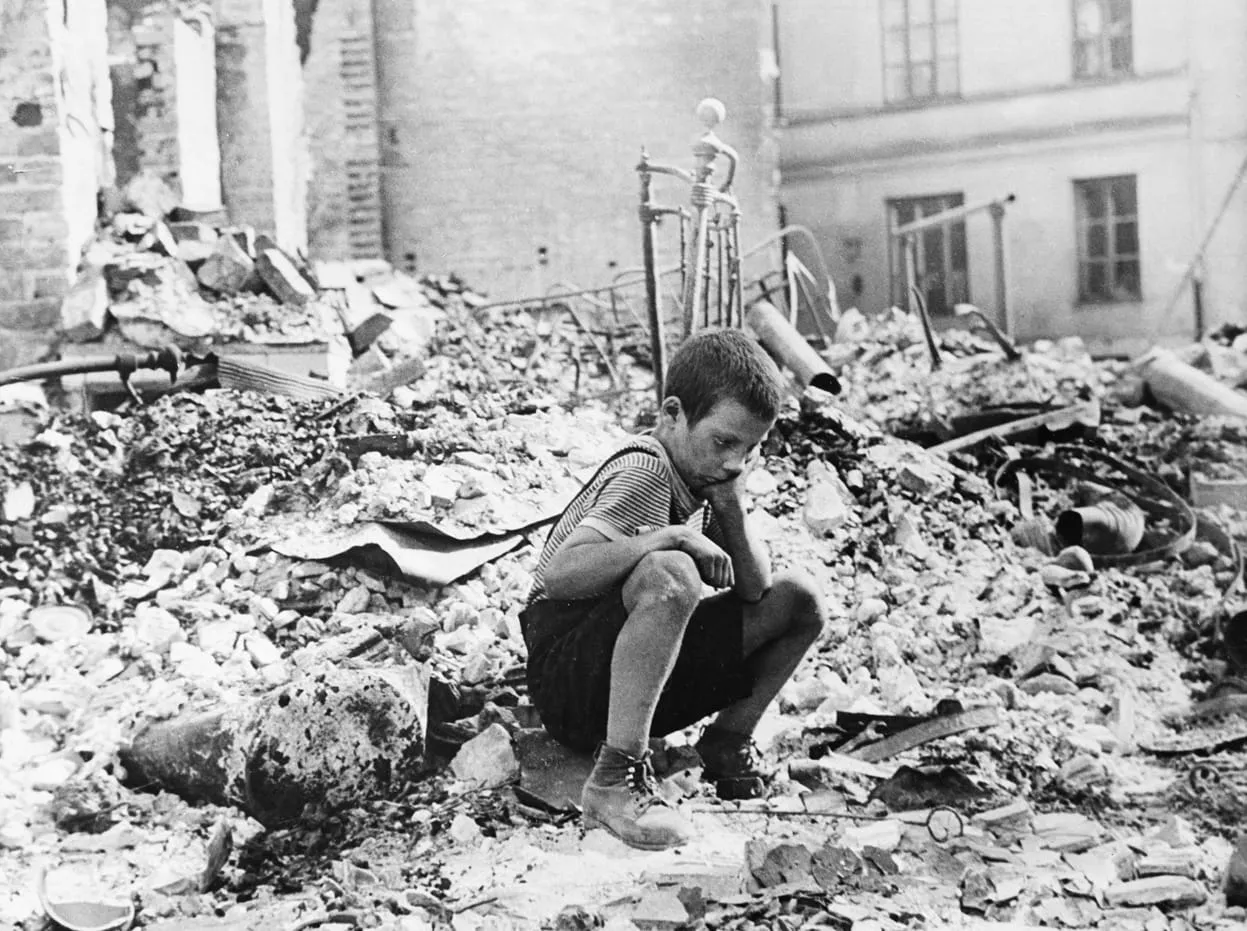
The defence of Warsaw in 1939 was the first great battle for a city of the Second World War. The capital, which pre-war plans had never envisaged as a scene of land fighting, was turned within a few days into an improvised fortress. On 8 and 9 September its defenders repulsed a German panzer division that had tried to take the city on the move. For the next three weeks Warsaw, encircled first from the east and then from every side, was bombed from the air and shelled by artillery, while its garrison grew from a few thousand to some 100,000 men. After the defeat on the Bzura and the entry of the Red Army there was no longer any hope of relief. The heaviest air raid, on 25 September, the destruction of the power station and waterworks, and the lack of ammunition led the command to capitulate, and the surrender was signed on 28 September. The defence of the city, in which soldiers fought shoulder to shoulder with civilians, became one of the symbols of the Polish September.
Name and dates
Polish historians call the battle the defence of Warsaw; German and English-language writers call it the siege of Warsaw. Polish historians sometimes date it from 1 September, since the Luftwaffe bombed the city from the first day of the war. Most accounts, however, date its start to 8 September 1939, when tanks of the German 4th Panzer Division reached the city and land fighting began in Ochota. Fire ceased at noon on 27 September under a preliminary agreement, and 28 September, the day the capitulation was signed, is taken as the end of the battle. The march of Polish units into captivity lasted from the evening of 29 September to 2 October.
Background
A city not prepared for battle
Warsaw was the capital, the largest city in the country, its main rail and road hub, a centre of the arms industry and the seat of the highest authorities of the state. The Polish operational plan “West”, however, assumed that the fighting would take place far from it. The only preparations were the strongest air-defence zone in the country and the Pursuit Brigade, a fighter formation that shot down German aircraft over the city during the first days of the war. The old tsarist forts had been neglected, and there were too few shelters and emergency water supplies. Meanwhile, in the German Case White, Warsaw lay on the axis of advance of the 10th Army under General Walter von Reichenau, in which two-thirds of the German mobile forces were concentrated. From the north, out of East Prussia, the 3rd Army under General Georg von Küchler was to cut the city off from the east.
The first week of the war
From 1 September the Luftwaffe bombed Okęcie airfield, railway stations and housing estates. In the first days the inhabitants dug air-raid trenches, and on 3 September crowds celebrated outside the British and French embassies when the two countries declared war on Germany. At the front the situation was deteriorating rapidly. The German 10th Army broke through the defences near Częstochowa, on 5 and 6 September it routed the Prusy Army near Piotrków and Tomaszów Mazowiecki, and the Łódź Army of Major General Juliusz Rómmel was falling back. The road to Warsaw lay open.
On 3 September the Minister of Military Affairs entrusted the organisation of the capital’s defence to the commandant of the Border Guard, Brigadier General Walerian Czuma. The Warsaw Defence Command, with Colonel Tadeusz Tomaszewski of the General Staff as chief of staff, started practically from nothing: on 5 September it had some 4,000 men under arms. At the same time a chaotic evacuation began. The government, President Ignacy Mościcki, the government commissioner for Warsaw and a large part of the police and fire brigade left for the east; half the anti-aircraft guns were taken away, and on 6 September the Pursuit Brigade flew off. On the night of 6–7 September the Commander-in-Chief, Edward Rydz-Śmigły, left the capital. A few hours later Lieutenant Colonel Roman Umiastowski called on the radio for all men capable of bearing arms to go east. Thousands took to the roads, and many concluded that the city would not be defended.
The crisis was brought under control by Czuma and the city’s acting president (mayor), Stefan Starzyński, who refused to be evacuated. On 8 September Czuma appointed him Civil Commissioner attached to the Warsaw Defence Command. In radio speeches Starzyński announced that Warsaw would be defended, called on officials to return to their posts, and organised a Citizens’ Guard to replace the evacuated police. The garrison was reinforced with battalions of the 5th Infantry Division that had been held in the city, among them the 40th Infantry Regiment “Children of Lwów”, with heavy artillery and with volunteers. The inhabitants built barricades and anti-tank ditches. On 8 September the city had 17 infantry battalions and more than a dozen artillery batteries at its disposal.
Course of the fighting
The armoured assault repulsed (8–9 September)
On 8 September General Erich Hoepner’s XVI Corps arrived outside Warsaw. The 4th Panzer Division of General Georg-Hans Reinhardt, with some 250 tanks, took Okęcie, Włochy and Raszyn. Berlin radio had already announced that the Wehrmacht had entered Warsaw. Around 5 p.m. a German column moved up Grójecka Street into Ochota, but halted at the first barricade under fire from infantry and anti-tank guns. Fearing street fighting after dark, Reinhardt broke off the attack. That same day German artillery shelled the capital for the first time.
At 7.30 a.m. on 9 September the division attacked again, with two main columns on Ochota and subsidiary thrusts on Wola and across the Mokotów Field. On Grójecka Street the Germans forced the first barricade, but a 75 mm gun under Second Lieutenant Józef Suchocki destroyed several tanks and armoured cars at close range. The attack along Żwirki i Wigury Avenue broke down in front of an anti-tank ditch, and the units that got across the Mokotów Field were stopped in crossfire on Wawelska Street. On Wolska Street soldiers of the 40th Infantry Regiment under Lieutenant Zdzisław Pacak-Kuźmirski set fire to barrels of turpentine from a nearby factory in front of their barricade, and the German column, packed into the narrow street, was almost completely destroyed. In the afternoon a Polish counter-attack regained part of the line of Opaczewska Street. In two days the 4th Panzer Division lost, according to various estimates, anything from several dozen to more than a hundred tanks damaged or destroyed. For the first time the defenders and the inhabitants saw that German panzer divisions could be stopped.
The Warsaw Army and the Battle of the Bzura (10–21 September)
On 9 September the Poznań and Pomorze Armies under Major General Tadeusz Kutrzeba launched their counter-offensive on the Bzura. The Germans abandoned their attempt to take the capital quickly and sent the 4th Panzer Division against Kutrzeba; outside Warsaw it was replaced by the 31st Infantry Division. At the same time the Polish command changed. On 8 September General Rómmel arrived in the city with orders from the Commander-in-Chief to defend the capital “for as long as ammunition and food last” and to draw as many enemy forces onto it as possible. From 10 September he commanded the Warsaw Army, made up of the capital’s garrison, the garrison of Modlin Fortress and units along the Vistula. Czuma divided the defence into the “Warsaw-West” sector under Colonel Marian Porwit and the “Warsaw-East” sector in Praga.
The garrison conducted an active defence: sorties against Rakowiec, Wawrzyszew and Okęcie and night raids on German outposts. A failed sortie against Okęcie airfield on 12 September cost some 280 men and 7 tanks. Czuma, Porwit and most of the staff officers wanted more, however: an attack westwards by more than a dozen battalions, along the Kampinos Forest, to help the armies on the Bzura. Rómmel consistently opposed this, and on the evening of 16 September he called off an attack by seven battalions that had already been prepared. All that came of it was a limited sortie by Lieutenant Colonel Leopold Okulicki on 18 September, which took Jelonki and Blizne. This passivity in the face of the decisive battle of the campaign is the most frequently criticised aspect of the Warsaw Army’s command.
Encirclement and the fighting in Praga (13–21 September)
From the east came the 3rd Army. Its units forced the Narew and the Bug, took Mińsk Mazowiecki on 12 September, and on 13 September made contact with the 10th Army on the right bank of the Vistula. The troops of Brigadier General Juliusz Zulauf fell back from the Narew into Praga, and on 15 September German infantry reached its approaches. Küchler, convinced that right-bank Warsaw was not prepared for defence, ordered it to be taken on the move. The Germans captured Szembeka Square and the Gocław Embankment, but in Grochów the 21st Infantry Regiment “Children of Warsaw” under Colonel Stanisław Sosabowski repulsed the attack along Grochowska Street and took more than a hundred prisoners in a night counter-attack. On 16 September Küchler demanded surrender, and aircraft dropped leaflets giving the population 12 hours to leave the city. Rómmel refused to receive the German envoy, and the authorities did not let the civilians go. On 17 September Hitler halted further attacks in order to concentrate his forces on destroying Kutrzeba’s troops.
Between 19 and 22 September the remnants of the Poznań and Pomorze Armies broke through to Warsaw across the Kampinos Forest, without any support from the garrison. On 21 September, near the village of Placówka, a battalion of the 30th Infantry Regiment under Major Bronisław Kamiński covered the passage of the 25th Infantry Division and lost some 500 men; the action was dubbed “the Warsaw Thermopylae”. On 22 September the German 24th Infantry Division reached the Vistula at Młociny and cut the link with Modlin. That day Colonel General Werner von Fritsch, the former Commander-in-Chief of the Army, who had come to the front as honorary colonel of the 12th Artillery Regiment, was killed in Praga. The capital’s garrison now numbered some 100,000 men and around 400 guns, but most of the newly arrived units were bled white, and artillery ammunition had been short ever since the depots at Palmiry were lost. Kutrzeba became Rómmel’s deputy and proposed breaking out of the city to spare it destruction, but Rómmel and Starzyński rejected the plan.
Bombardment and siege
From the start of the siege the city was bombed and shelled by day and by night. Particularly heavy raids fell on 8, 9, 10, 13, 17, 20 and 24 September. The Luftwaffe attacked not only military positions but also hospitals, churches, historic buildings and the northern district inhabited by Jews, especially heavily on the holidays of Rosh Hashanah (13 September) and Yom Kippur (23 September). On 17 September the Royal Castle burned. On 21 September, during a ceasefire of several hours, diplomats and more than a thousand foreigners left the city. On 23 September the power station’s equipment was destroyed, and a day later the water supply from the Filter Station stopped. The radio, printing presses and telephones were out of action, and there was nothing with which to fight the fires. Starzyński gave his last radio address on 23 September.
Hitler and the Army High Command decided that left-bank Warsaw would be taken by the 8th Army under General Johannes Blaskowitz, part of Gerd von Rundstedt’s Army Group South, by 3 October at the latest, while Praga was to be handed over to the Red Army after the partition of Poland. Almost a thousand guns and two air fleets were assembled around the city. According to Colonel Porwit’s calculations, on the left bank the Germans had at least a twofold superiority in infantry and a sixfold one in artillery.
The general assault (25–27 September)
On 25 September, later known as “Black Monday” or by a grim pun on “Wet Monday” (the Easter Monday custom of drenching), the Luftwaffe carried out the heaviest air raid in the history of warfare up to that time. Some 400 aircraft flying more than a thousand sorties dropped several hundred tonnes of high-explosive bombs and several dozen tonnes of incendiaries. Hundreds of fires broke out; the Holy Spirit Hospital and the main building of the Infant Jesus Hospital burned down, and Deputy Mayor Jan Około-Kułak was killed in the town hall. The number of dead that day is estimated at several thousand. At the same time the infantry attacked the outer positions, and the Germans took the Mokotów, Piłsudski and Bielany forts.
At 8 a.m. on 26 September, after an artillery preparation, the 46th and 10th Infantry Divisions attacked Czerniaków and Mokotów, and the 31st Division attacked Ochota. German pioneers blew in the walls of Fort Dąbrowski in Czerniaków and forced its garrison to surrender, and Królikarnia also fell, but the attackers were halted on Chełmska Street and Niepodległości Avenue. In Ochota, where according to witnesses the Germans drove Polish prisoners ahead of their tanks as human shields, a counter-attack by the 56th Infantry Regiment regained the line of Częstochowska Street. In the north Fort Wawrzyszew fell. From dawn on 27 September the Germans took the Bielany Forest and Boernerowo, but the defenders’ main positions still held in every sector.
Capitulation
The soldiers had not been beaten in the field, but the city could hold out no longer. There was artillery ammunition for two days, tens of thousands of wounded and sick lay in hospitals and cellars, and without water epidemics threatened. On 26 September Rómmel heard the Citizens’ Committee and a council of officers and took the decision to capitulate himself. That evening Major Edmund Galinat flew into the city with an order from the Commander-in-Chief on setting up an underground organisation; on its basis General Michał Tokarzewski-Karaszewicz founded the Service for Poland’s Victory on 27 September. At noon on 27 September Czuma ordered a ceasefire, and Kutrzeba agreed a suspension of hostilities with the Germans.
On 28 September Kutrzeba and Blaskowitz signed the capitulation agreement in the former Škoda factory at Rakowiec. Officers were to go into captivity with their swords, while NCOs and private soldiers were to return home after a short time. The Germans wrote the term “Fortress Warsaw” into the agreement in order to justify the bombing of the city. Modlin capitulated on 29 September. From the evening of 29 September Polish columns marched out of the city while the Wehrmacht occupied one district after another. Many soldiers hid their weapons, which later served the underground.
Losses
According to Polish studies, 5,000–6,000 soldiers were killed in the defence of Warsaw and some 16,000 were wounded. A total of 5,031 officers and 97,425 NCOs and men laid down their arms; English-language sources give a higher figure of some 140,000 prisoners. The civilian population suffered the most. The most cautious estimates speak of some 10,000 dead; others, cited by most Polish historians, of 18,000–25,000 dead and several tens of thousands wounded. At least 10–12 per cent of the city’s buildings were destroyed and many more damaged. According to official Wehrmacht figures, German losses amounted to 1,782 killed and 5,652 wounded.
Significance
The defence of Warsaw could not reverse the course of the campaign, but for three weeks it tied down substantial German forces and was one of the last organised battles of September 1939. It showed that German panzer divisions were helpless against a determined defence in built-up areas. It also revealed the new character of the war: a city full of civilians was bombed as a military target, and the capitulation was decided not by the army’s losses but by the suffering of the population. Contrary to German propaganda, Warsaw was not a fortress but an open city with an improvised defence.
The figure of Mayor Starzyński and the common struggle of soldiers, the Citizens’ Guard, volunteer workers’ battalions and inhabitants of both nationalities, Polish and Jewish, became a legend. Even before the capitulation the Service for Poland’s Victory was born in Warsaw, and from it grew the Union of Armed Struggle and the Home Army. Some of the weapons hidden in September found their way into the hands of the insurgents of 1944. For the Germans the capture of Warsaw marked the end of the main fighting in Poland and the beginning of an occupation that in this city was to take one of the cruellest forms anywhere in occupied Europe.
Places·Warsaw