Germany
Josef Mengele
Camp doctor at Auschwitz-Birkenau (1943–1945), SS-Hauptsturmführer
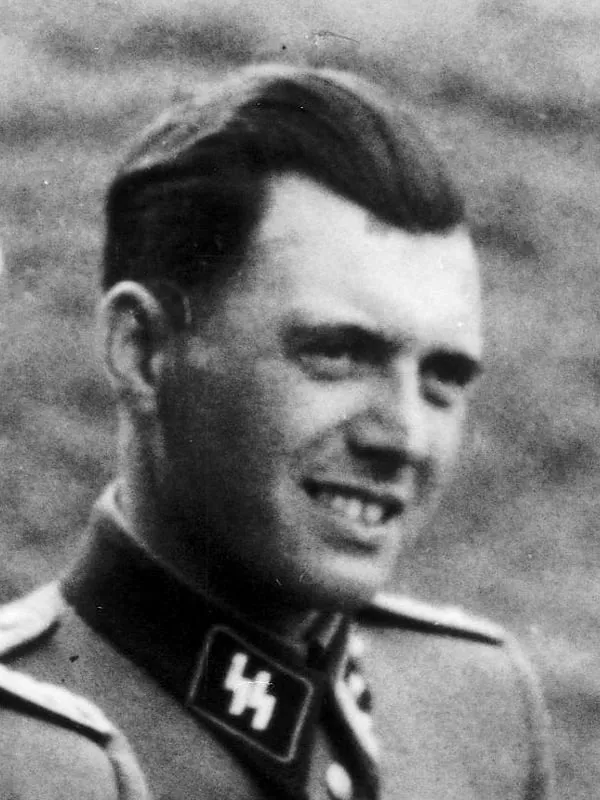
- Born:
- 16 March 1911, Günzburg (Kingdom of Bavaria, German Empire)
- Died:
- 7 February 1979, Bertioga (Brazil)
- Author:
- Natalia
- Photo:
- autor nieznany, domena publiczna, Wikimedia Commons

Josef Mengele was a German physician and anthropologist and an SS officer who served at the Auschwitz-Birkenau camp from May 1943 to January 1945. As one of the SS doctors he decided on the railway ramp which of the new arrivals would go straight to the gas chambers, and in the camp barracks he carried out pseudo-scientific experiments on prisoners – above all on Jewish and Roma twins – as part of research supported by renowned scientific institutions of the Reich. He was neither the most senior doctor in the camp nor the only one who committed crimes there, but the testimony of survivors made him the symbol of the criminal medicine of the Third Reich. After the war he hid in South America for more than thirty years and died without ever facing trial.
Childhood and studies
He was born on 16 March 1911 in Günzburg in Bavaria, the eldest of three sons of Karl Mengele, owner of a prosperous agricultural machinery factory, and his wife Walburga. The family was wealthy, Catholic and conservative. In 1930 he passed his school-leaving examinations and began studying philosophy and medicine at the University of Munich, supplemented by semesters at other universities. In 1931 he joined the youth wing of the Stahlhelm, a veterans’ organisation that was absorbed into the SA after the Nazis came to power.
He studied at a time when German anthropology and genetics were becoming ever more closely bound up with the ideology of “racial hygiene”. Among his teachers were the anthropologist Theodor Mollison and the psychiatrist Ernst Rüdin, co-author of the Nazi compulsory sterilisation law of 1933. In 1935 Mengele obtained a doctorate in anthropology in Munich with a thesis on the morphology of the lower jaw in four “racial” groups. In 1936 he passed the state medical examination and worked briefly at the university clinic in Leipzig.
On 1 January 1937 he became an assistant at the Institute of Hereditary Biology and Racial Hygiene at the University of Frankfurt am Main, headed by the geneticist Otmar von Verschuer, a specialist in twin research. Verschuer became his mentor and patron for the whole of his professional life. Mengele worked on the inheritance of cleft lip and palate – on this basis he obtained a doctorate in medicine in 1938 – and together with Verschuer prepared “racial” expert opinions for courts ruling under the Nuremberg Laws. In 1937 he joined the NSDAP and in 1938, after his ancestry had been checked, the SS. On 28 July 1939 he married Irene Schönbein, whom he had met in Leipzig.
The war
In 1940 he was called up for medical service and joined the Waffen-SS. He first worked for the SS Race and Settlement Office in occupied Poznań, where the “racial value” of inhabitants earmarked for Germanisation or expulsion was assessed. In the summer of 1941, after the launch of Operation Barbarossa, he fought in Ukraine and received the Iron Cross Second Class. From January 1942 he was a battalion medical officer in the SS “Wiking” Division. For pulling two wounded soldiers out of a burning tank under fire he received the Iron Cross First Class. In the summer of 1942, during the German offensive in the south, he was seriously wounded near Rostov-on-Don and declared unfit for front-line service.
After recovering he was posted to the headquarters of the SS Race and Settlement Main Office in Berlin, and at the beginning of 1943 he was again working for Verschuer, who by then headed the Kaiser Wilhelm Institute of Anthropology, Human Heredity and Eugenics in Berlin-Dahlem. In April 1943 he was promoted to SS-Hauptsturmführer (captain). At Verschuer’s urging he volunteered for service in the concentration camps.
Auschwitz
On 24 May 1943 he was assigned to Auschwitz, and on 30 May he reported to the camp. The SS garrison doctor, Eduard Wirths, appointed him doctor of the Gypsy family camp at Birkenau (section BIIe) – so, contrary to an often repeated version, he did not become chief doctor of Auschwitz. The camp commandant at the time was Rudolf Höss, and the whole camp system was under Heinrich Himmler.
The SS doctors did not treat prisoners – they supervised imprisoned doctors and decided on the deaths of the sick. Mengele regularly sent patients from the camp hospitals to the gas chambers, and he fought epidemics by killing the sick and entire blocks of prisoners: when typhus broke out in the women’s camp, he had some 600 Jewish women prisoners from one block gassed. For this “efficiency” he received the War Merit Cross with Swords. Like the other SS doctors he took turns on duty on the ramp, carrying out selections of arriving transports; he also came there when not on duty to look for subjects for his research. Particularly many selections took place in the spring and summer of 1944, when Jews from Hungary were being brought to Birkenau. After the liquidation of the Gypsy camp on the night of 2–3 August 1944, in which some 2,900 Roma were murdered in the gas chambers, he became the senior camp doctor at Birkenau.
He conducted his research for Verschuer’s institute and with money from the German Research Foundation. He was most interested in twins – mainly children, Jewish and Roma – of whom, according to the historian Nikolaus Wachsmann’s estimates, there may have been as many as a thousand pairs, and also in people with dwarfism, heterochromia of the irises and other anomalies. He subjected them to hours of measurements, took blood, performed procedures without anaesthesia and infected them with diseases. Some of the victims were killed so that dissections could be carried out and organs compared; the imprisoned pathologist Miklós Nyiszli testified that he had witnessed Mengele kill fourteen pairs of twins in a single night. Blood and specimens, including eyeballs, were sent to Berlin. Mengele also studied noma, a disease of the facial tissues that spread among starving Roma children. Historians regard some of the stories told about him as unconfirmed, and most of the documentation of his research has been lost. It had no scientific value whatsoever.
Survivors remembered the contradiction in his behaviour: he could be courteous to children and bring them sweets, while sending them to their deaths without hesitation. Among the prisoners he was called the “Angel of Death”.
Escape
On 17 January 1945, ten days before the Red Army entered Auschwitz, Mengele left with other doctors for the Gross-Rosen camp in Lower Silesia, taking some of the documentation and specimens with him. When that camp too was evacuated, he moved from one subcamp to another and reached Czech territory, where he joined a Wehrmacht field hospital and exchanged his SS uniform for an army one. In June 1945 he was taken prisoner by the Americans. He was registered under his real name but not recognised: he did not have the blood-group tattoo typical of SS members, and the Allied lists of wanted war criminals were circulating chaotically. At the end of July he was released with papers that he later altered to the name Fritz Hollmann.
For almost four years he worked as a farmhand near Rosenheim in Bavaria, keeping in touch with his family, who assured those around them that he was dead. During this time his name came up in witness testimony and in post-war trials, but for a long time the Allies believed him dead. On 17 April 1949 he left Germany. With the help of a network of former SS men he reached Genoa, where he obtained a passport in the name of Helmut Gregor, and in July 1949 he sailed for Argentina.
In South America
In Buenos Aires he worked at first as a carpenter, later as a representative of the family firm, and also as a partner in a pharmaceutical company. His wife refused to join him, and they divorced in 1954. In 1956, feeling safe, he obtained documents in his real name and travelled to Europe, where he met his son Rolf (born in 1944), who knew him as “Uncle Fritz”. In 1958 in Uruguay he married Martha, the widow of his brother Karl.
Meanwhile the Nazi hunter Simon Wiesenthal and the former Auschwitz prisoner Hermann Langbein gathered witness testimony and established Mengele’s address in Argentina. In 1959 a West German court issued a warrant for his arrest, and the Federal Republic requested his extradition. Before Argentina had considered the request, Mengele left for Paraguay, where he settled in the German colony of Hohenau and was granted citizenship. The abduction of Adolf Eichmann from Buenos Aires by the Mossad in May 1960 convinced him that he was safe nowhere. Later in 1960 he moved to Brazil.
There, with the help of an Austrian Nazi sympathiser, Wolfgang Gerhard, he lived with a Hungarian émigré couple, the Stammers, on farms at Nova Europa and Serra Negra, and later at Caieiras near São Paulo. Israeli intelligence continued the search but in the 1960s gave it a lower priority. Mengele lived in isolation and in constant fear of capture, kept afloat by family money sent through a trusted employee of the firm in Günzburg. From 1971 he used Gerhard’s papers. He never renounced his views; in conversation with his son, who visited him in 1977, he showed no remorse.
On 7 February 1979, while swimming in the ocean at the resort of Bertioga, he suffered a stroke and drowned. He was buried under the name Wolfgang Gerhard in the cemetery at Embu das Artes. His death was kept secret.
The discovery of his remains
For years afterwards the world went on searching for Mengele. Reports came in of sightings in Paraguay, Spain or Egypt, ever larger rewards were offered, and in 1985 a symbolic “trial” with surviving twins was held in Jerusalem. The breakthrough came on 31 May 1985, when West German police searched the house of the trusted employee of the Mengele firm in Günzburg and found correspondence, including a letter reporting the fugitive’s death. The Brazilian police located the grave; on 6 June 1985 the remains were exhumed, and an international team of forensic experts concluded with a high degree of probability that they were Mengele’s. A few days later Rolf Mengele confirmed his father’s death. In 1992 DNA tests dispelled the last doubts.
Significance
Mengele was one of several dozen SS doctors at Auschwitz and did not head the camp’s medical service. His exceptional place in collective memory was determined by the testimony of survivors – especially the twins who passed through his hands as children and struggled with the consequences all their lives – and by his successful escape from justice. His story shows that the crimes at Auschwitz were not the work of guards and functionaries alone: people with academic titles took part in them, and their research was funded and received by renowned institutions. Verschuer, Mengele’s mentor, continued his academic career after the war as professor of genetics in Münster.
The fact that Mengele evaded trial for thirty-four years became in turn a symbol of the post-war failures in prosecuting Nazi criminals – on the part of the Allies as well as the West German authorities, the countries of South America and the circles that helped the fugitives. His name remains one of the most recognisable symbols of the Holocaust and of the genocide of the Roma, and the memory of his victims is preserved today by the Auschwitz-Birkenau State Museum in Oświęcim.
Sources
Often appears with
People who appear in the same events.