Germany
Rudolf Höss
Commandant of Auschwitz concentration camp (1940–1943), head of Office D I of the SS Economic and Administrative Main Office (1943–1945)
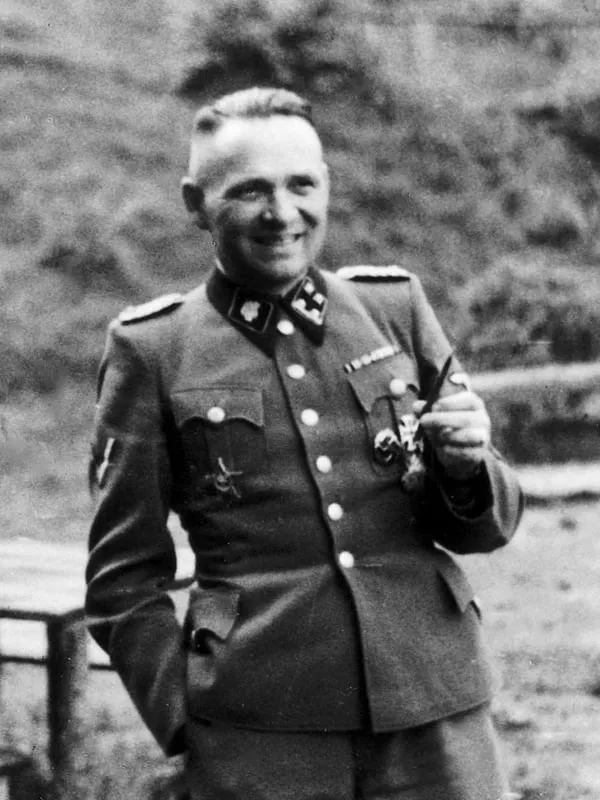
- Born:
- 25 November 1901, Baden-Baden (Grand Duchy of Baden, German Empire)
- Died:
- 16 April 1947, Oświęcim
- Author:
- Natalia
- Photo:
- Bernhard Walther or Ernst Hofmann or Karl-Friedrich Höcker, domena publiczna, Wikimedia Commons

Rudolf Höss (in German Höß, also spelled Hoess) was the first and longest-serving commandant of the German concentration camp at Auschwitz. A veteran of the Freikorps militias, convicted in his youth as an accomplice to murder, he served his apprenticeship in the SS camps at Dachau and Sachsenhausen, and in May 1940 he was given the task of setting up a new camp at Oświęcim. Within three years he turned what had been a quarantine camp for Polish political prisoners into a complex equipped with gas chambers and crematoria, in which more than a million people were murdered, the vast majority of them Jews. He was not an ideologue but an executor: conscientious, obedient to Heinrich Himmler and proud of the efficiency of his organisation. After the war, in a Polish prison, he wrote memoirs that are among the most important testimonies to how the machinery of the Holocaust worked. He was sentenced to death by Poland’s Supreme National Tribunal and hanged on the grounds of the camp he had run.
Childhood and youth
He was born on 25 November 1901 in Baden-Baden into the Catholic family of a merchant, Franz Xaver Höß; in later years he himself sometimes gave his year of birth as 1900. The family moved to Mannheim, where Rudolf went to school. In his autobiography he described his father as a stern, deeply religious man who intended him for the priesthood; an upbringing based on absolute obedience to parents and superiors; and how he lost his trust in the Church when – as he believed – his confessor betrayed the secret of the confessional to his father. His father died in May 1914 and his mother in April 1917.
For decades biographers repeated, following the autobiography, that in 1916 the fourteen-year-old Höss joined the 21st Dragoon Regiment, fought in Iraq and Palestine in German units supporting the Ottoman army, was wounded several times, became an NCO at seventeen and received the Iron Cross of both classes and the Turkish Iron Crescent. The Mannheim historians Wilhelm Kreutz and Karen Strobel, who in 2018 published the results of their research in the local archives, showed that Höss does not appear in the regiment’s records and that until the end of 1917 he was registered as resident in Mannheim, where he finished elementary school and began an apprenticeship. He probably became a soldier only in 1918. The war legend, like the story of a family with officer traditions, was part of the image Höss cultivated throughout his life.
The Freikorps and the murder at Parchim
At the beginning of 1919 he joined the volunteer corps of Lieutenant Gerhard Roßbach, one of the most brutal of the Freikorps (PL). He fought in the Baltic states, where, as he recalled, no prisoners were taken and villages were burned along with their inhabitants, then in the Ruhr, and in 1921 in Upper Silesia against the Polish insurgents in the Third Silesian Uprising (PL). According to his autobiography, in November 1922 in Munich he heard a speech by Adolf Hitler and joined the NSDAP, and all his life he gave a low membership number, 3240. The party files do not confirm this: he was formally admitted to the party only in 1939, backdated to 1937.
On the night of 31 May/1 June 1923, in a forest near Parchim in Mecklenburg, a group of former Roßbach men beat Walther Kadow, a young teacher who worked with them on an estate, and finished him off with gunshots. They accused him of embezzling money and, according to some accounts, of informing for the communists or the French. Among the perpetrators were Höss and Martin Bormann, later head of the NSDAP Party Chancellery. In March 1924 the State Court for the Protection of the Republic (Staatsgerichtshof zum Schutze der Republik) in Leipzig sentenced Höss, as one of the principal perpetrators, to ten years’ penal servitude and Bormann to one year. Höss served his sentence in the prison at Brandenburg, where, as he wrote, he learned how prison changes a man. He was released in July 1928 under an amnesty.
The Artamanen and the SS
After his release he became involved with the Artaman League, a völkisch movement which settled young Germans on the land and sought to drive Polish seasonal workers off German estates. He worked on farms in Brandenburg and Pomerania and led groups of Artamanen. On 17 August 1929 he married Hedwig Hensel, whom he had met in the movement. They had five children, the youngest of whom was born at Oświęcim in 1943. Himmler, too, was active among the Artamanen, and in 1930 he spoke at one of their rallies about winning land in the east.
When Himmler was building up the SS, Höss joined him: in September 1933 he became a candidate member and in April 1934 a full member of the SS. After a display by a mounted SS unit in Pomerania, Himmler offered him service in the concentration camp guard units. Höss, disappointed with farm work, accepted.
Dachau and Sachsenhausen
On 1 December 1934 he joined the staff of Dachau concentration camp. There he went through the school of Theodor Eicke, the architect of the SS camp system, who taught SS men that a prisoner was an “enemy of the state” and that pity was weakness. Höss was a block leader, then worked in the camp administration, and in 1936 he became an SS officer. In the summer of 1938 he was transferred to Sachsenhausen near Berlin as adjutant to the commandant. On 15 September 1939 he commanded the firing squad there that shot the Jehovah’s Witness August Dickmann, the first German conscientious objector executed after the outbreak of war, and himself fired the finishing shot. At the end of 1939 he became head of the prisoners’ compound (Schutzhaftlagerführer). In the winter of 1939/1940 Sachsenhausen received, among others, the Kraków professors arrested in Sonderaktion Krakau, several of whom died in the camp. According to prisoners’ accounts, on 18 January 1940, with the frost reaching minus 26 degrees, Höss ordered the prisoners not assigned to work to stand on the roll-call square; more than 140 of them died that day and night.
Commandant of Auschwitz
In the spring of 1940 the Inspector of Concentration Camps, Richard Glücks, sent Höss to Oświęcim, a town annexed to the Reich after Poland’s defeat, to assess the suitability of the former Polish Army barracks in the Zasole district. Following his report, on 27 April 1940 Himmler ordered a camp to be established there, and on 4 May Höss became its commandant. The camp was initially intended as a transit quarantine camp for some 10,000 Poles. On 20 May thirty German criminals, who became kapos, were brought from Sachsenhausen, and on 14 June 1940 the first mass transport arrived: 728 Polish political prisoners from Tarnów. Over the gate Höss had the inscription “Arbeit macht frei”, familiar to him from Dachau, put up.
Höss was an ambitious and tireless organiser. He extracted building materials from the authorities, had Poles evicted from nearby houses, which were demolished for building material, and marked out a closed zone of some 40 square kilometres around the camp. In July 1940 he wrote to Glücks that the local population was “fanatically Polish” and ready to do anything against the SS men. The regime he introduced or sanctioned – back-breaking labour, flogging, the post punishment, standing cells in Block 11, punitive drill, starvation – killed thousands of people in the first months. On 23 April 1941 Höss for the first time selected ten hostages to be starved to death in the bunker in reprisal for a prisoner’s escape. At a similar selection on 29 July 1941, Father Maximilian Maria Kolbe volunteered to die in place of a fellow prisoner. The commandant’s family lived in a villa with a garden just beyond the camp wall, and prisoners worked in the house and garden.
On 1 March 1941 Himmler visited the camp for the first time and ordered its expansion to hold 30,000 prisoners and the assignment of prisoners to build the nearby IG Farben plant. According to Höss, Himmler also demanded at that time the construction of a camp for 100,000 prisoners of war at Brzezinka; some historians believe that this decision was taken only in the autumn of 1941. With Höss as commandant, within two years Auschwitz became a complex of camps: the main camp, the camp at Brzezinka (Birkenau), the camp next to the IG Farben factory at Monowice (Monowitz) and several dozen subcamps at mines, steelworks and farms.
The Holocaust
Höss later claimed that in the summer of 1941 Himmler summoned him to Berlin and told him that Hitler had ordered the “Final Solution of the Jewish question” and that Auschwitz, because of its rail connections and isolated location, was to become its principal site; the details were to be worked out with Adolf Eichmann. Historians believe that Höss shifted many dates in his accounts and that this conversation may have taken place later, possibly even in 1942. What is certain is that at the beginning of September 1941 his deputy, Karl Fritzsch, in the commandant’s absence, tested Zyklon B in the cellars of Block 11 on some 600 Soviet prisoners of war and 250 sick prisoners. Höss found the method “reassuring”: in his memoirs he wrote that it relieved him of his anxiety about mass shootings of women and children.
From the beginning of 1942 transports of Jews condemned to death began to arrive at Auschwitz: first from Upper Silesia, then from Slovakia, France, the Netherlands, Belgium, the ghettos of occupied Poland, Greece and the whole of Europe. On the ramp SS doctors selected those fit for work, while the rest – the old, the sick, children and their mothers – were sent straight to the gas chambers in two converted farmhouses at Birkenau and, from the spring of 1943, to four large crematoria with gas chambers. Höss personally supervised this process, improved it and saw to its “efficiency”. On 17–18 July 1942 he showed Himmler the gassing of a transport of Jews from the Netherlands, and the next day he was promoted to SS-Obersturmbannführer. During his time as commandant the camp also received Poles, Roma, Soviet prisoners of war and prisoners of many other nationalities. Witnesses described him as a cold, composed bureaucrat who rarely beat prisoners himself but did nothing about the crimes of his subordinates – indeed, he expected them to commit them.
In Berlin and the Hungarian operation
In November 1943, after a reorganisation of the camp, Höss handed over command to Arthur Liebehenschel and moved to the SS Economic and Administrative Main Office (WVHA) at Oranienburg, where he headed Office D I and was Glücks’s deputy in the administration of all the concentration camps. The Hösses’ youngest child was born at Oświęcim in November 1943, and the family went on living in the villa by the camp for several months after the commandant’s departure.
In May 1944 he returned to Auschwitz as commander of the SS garrison to direct the murder of the Jews of Hungary. He speeded up the construction of the railway ramp inside Birkenau, had all the crematoria put into operation and pits dug for burning bodies, and enlarged the Sonderkommando. Between mid-May and early July 1944 more than 430,000 Jews were deported from Hungary to Auschwitz, most of whom were murdered immediately on arrival. In the camp the operation was called “Aktion Höss”. At the end of July he returned to Oranienburg. In the last months of the war he helped organise the evacuation of the camps, during which tens of thousands of prisoners died on death marches.
Flight and capture
At the beginning of May 1945 Höss and his family were in Flensburg, the last seat of the Reich’s government, where he met Himmler for the last time. Himmler told the SS men to go into hiding under false names. Höss, with the papers of a sailor named Franz Lang, spent a short time in British captivity, from which he was released because nobody recognised him, and then worked as a farmhand at Gottrupel near Flensburg. A British war crimes investigation team under Captain Hanns Alexander tracked him down through his wife, who, under the threat that her eldest son would be deported to the USSR, revealed her husband’s hiding place. Höss was arrested on 11 March 1946. British soldiers beat him, and on 14 March, after several sleepless nights, he signed his first statement on the killings at Auschwitz.
Taken to Nuremberg, on 15 April 1946 he testified before the International Military Tribunal as a defence witness for Ernst Kaltenbrunner, head of the Reich Security Main Office. Calmly, matter-of-factly and without a trace of emotion, he described the mechanism of extermination. In a written affidavit he stated that at least 2.5 million people had been murdered at Auschwitz and that half a million more had died of starvation and disease. This figure, based, as he claimed, on information from Eichmann, proved to be exaggerated: according to the research of Franciszek Piper, at least 1.1 million people died in the Auschwitz complex, including some 960,000 Jews. Höss’s testimony was nevertheless among the most powerful evidence at the Nuremberg trials. The American psychologist Gustave Gilbert, who talked to him, described him as mentally normal but with the apathy and lack of empathy typical of a schizoid personality.
Trial and death
On 25 May 1946 the Americans handed Höss over to Poland. He was held in Warsaw and from July in Montelupich Prison in Kraków. There, at the request of the investigating judge Jan Sehn and the psychologist Stanisław Batawia, he wrote extensive accounts of the camp and its staff, as well as an autobiography entitled “My Psyche: Development, Life and Experiences”. Published in Polish in 1956 and in German in 1958 as Kommandant in Auschwitz (in English as Commandant of Auschwitz), it became one of the basic sources for the history of the camp, although – as later research has shown – it also contains self-fashioning, omissions and wrong dates.
The trial before the Supreme National Tribunal took place in Warsaw from 11 to 29 March 1947. Several dozen witnesses testified, including former Auschwitz prisoners. Höss did not deny the facts and admitted responsibility for the deaths of hundreds of thousands of people, but argued that he had been carrying out orders. On 2 April 1947 the tribunal sentenced him to death. President Bolesław Bierut did not exercise his right of clemency. In the prison at Wadowice Höss asked for a priest; on 10 April the Jesuit Władysław Lohn (PL) heard his confession, and Höss returned to the Catholic Church. In his last days he wrote that in the solitude of his cell he had come to understand how gravely he had sinned against humanity, and he asked the Polish nation for forgiveness. On 16 April 1947 he was hanged on a specially built gallows next to the former camp headquarters building and the old crematorium of Auschwitz I, not far from the villa where he had lived with his family.
Significance
Rudolf Höss did not take the decisions about the Holocaust, but without men like him it could not have been carried out. He created and ran the largest site of mass murder in history, transforming a camp he had taken over as a set of neglected barracks into an industrial complex where thousands of people were killed every day. His post-war testimony and writings, composed from the perspective of a perpetrator who to the end considered himself a decent man and a conscientious official, became one of the most important testimonies to the mentality of those who carried out genocide. The psychiatrists Antoni Kępiński and Maria Orwid, who analysed his autobiography, noted that what affected him most was not the suffering of the prisoners but administrative difficulties.
Höss has been portrayed many times in literature and film. On the basis of Gilbert’s conversations Robert Merle wrote the novel Death Is My Trade (1952), and the life of the commandant’s family in the villa beyond the camp wall was shown in Jonathan Glazer’s film The Zone of Interest (2023), loosely based on the novel by Martin Amis. The gallows on which he was executed still stands on the grounds of the Auschwitz-Birkenau State Museum.
Sources
Often appears with
People who appear in the same events.