Operation Barbarossa
- Dates:
- 22 June – 5 December 1941
- Front:
- Eastern Front
- Location:
- The western Soviet Union from the Baltic to the Black Sea: the eastern lands of the Second Polish Republic seized in 1939, Lithuania, Latvia and Estonia, Belarus (Minsk), Bessarabia and Ukraine (Uman, Kiev, Kharkiv, the Donbas), the Crimea, and in Russia Smolensk, Vyazma and Bryansk, the Leningrad area, the approaches to Moscow and Rostov-on-DonOn the battle map →
- Sides:
- Nazi Germany, Romania, Hungary, Slovakia and ItalyWilhelm von Leeb, Fedor von Bock, Gerd von RundstedtSoviet UnionGeorgy Zhukov, Semyon Timoshenko, Semyon Budyonny
- Result:
- A strategic defeat for Germany. The Wehrmacht and its allies occupied the Baltic states, Belarus and most of Ukraine and the Crimea, closed the blockade of Leningrad and took more than three million Soviet soldiers prisoner, but they destroyed neither the Red Army nor the Soviet state. At the beginning of December the offensive stalled on the approaches to Moscow, and on 5 December 1941 the Red Army went over to the counter-offensive. The plan for a lightning war had collapsed, and the Germans were drawn into a long war of attrition in the east.
- Author:
- Łukasz
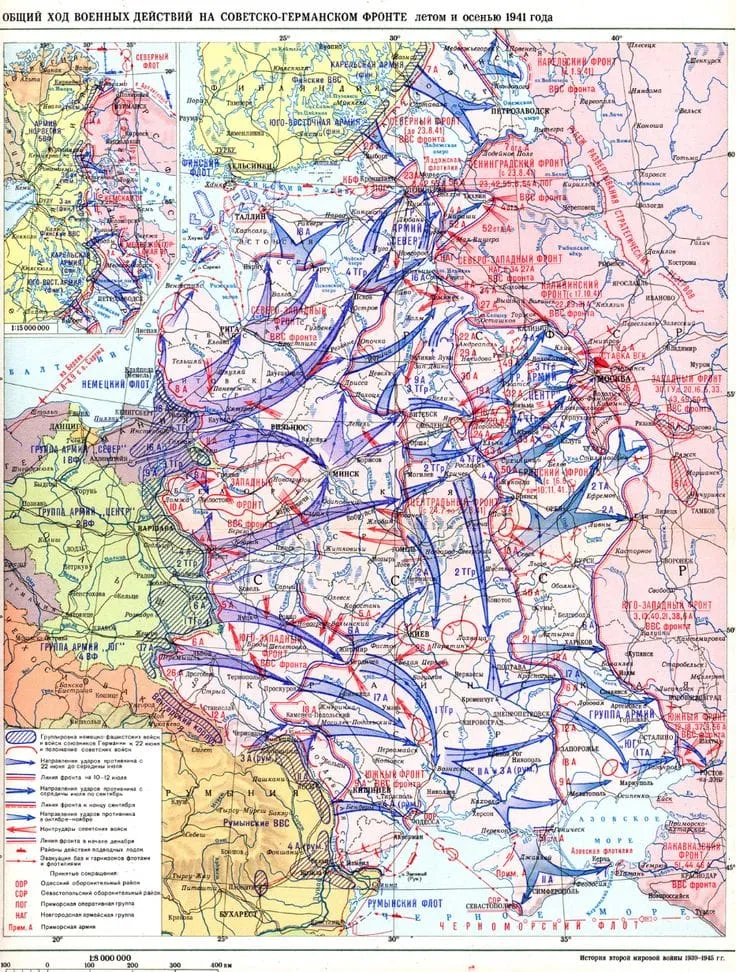
Operation Barbarossa was the largest land operation in history and the opening of the bloodiest war Europe had ever known. At dawn on Sunday 22 June 1941, without a declaration of war, German forces attacked the Soviet Union along a front stretching from the Baltic to the Carpathians, and soon from Romania and Finland as well. Within the first weeks the Wehrmacht shattered the Soviet armies in the frontier battles and encircled them at Białystok, Minsk and Smolensk, and in September it trapped the entire Southwestern Front in a pocket around Kiev. In the north the Germans and the Finns cut off Leningrad; in the south the Wehrmacht reached the Crimea and Rostov-on-Don. In October, in Operation Typhoon, Army Group Centre broke the defences of Moscow at Vyazma and Bryansk.
Even so, Adolf Hitler’s plan failed. The Red Army lost more than four million men in 1941, and by their own count the Germans took more than three million prisoners, yet it kept fielding new armies. Exhausted, poorly supplied and lacking winter equipment, the German divisions came to a halt at the beginning of December a few dozen kilometres from the Kremlin, and on 5 December Soviet forces went over to the counter-offensive. From the very first day it was also a war of annihilation: behind the front, SS and police task forces shot Jews, and Soviet prisoners of war died in vast numbers of starvation in German camps.
Name and dates
The war took its code name from Directive No. 21 of 18 December 1940, which spoke of “Fall Barbarossa”, the Barbarossa variant. The name referred to the medieval emperor Frederick I Barbarossa, “Redbeard”, and from January 1941 Wehrmacht documents referred to Operation Barbarossa. In Soviet and Russian historiography the war against Germany that began on 22 June 1941 is the Great Patriotic War. This reckoning leaves out the years 1939–1941, when, under the Molotov–Ribbentrop Pact, the USSR invaded Poland, attacked Finland and annexed the Baltic states.
The operation began on 22 June 1941. German artillery opened fire and Luftwaffe aircraft crossed the border at around 3.15 a.m. German time (4.15 a.m. Moscow time). Its end is usually set at 5 December 1941, when the troops of the Soviet Kalinin Front went over to the counter-offensive at Moscow (the Western Front followed the next day). Some studies end the operation earlier, at the beginning of October, when the offensive against Moscow began, or later, in January 1942. The Soviet winter counter-offensive and the fighting in Finland, which from 25 June waged its own war against the USSR, known to the Finns as the Continuation War, belong to separate chapters of this history.
Background
The conquest of “living space” in the east and the destruction of “Jewish Bolshevism” had been Hitler’s central aim since the 1920s, and he regarded the 1939 pact as a manoeuvre that allowed him to crush Poland and France without fighting a war on two fronts. On 31 July 1940, when Britain refused to make peace, he told his generals that Russia had to be “dealt with” in the spring of 1941, because it was England’s last hope on the Continent. After Vyacheslav Molotov’s visit to Berlin in November 1940, which showed that Joseph Stalin would not give up his influence in Finland, Romania and Bulgaria and over the Straits, Hitler signed Directive No. 21 on 18 December. The Wehrmacht was to crush the Red Army “in a quick campaign” with deep thrusts by armoured spearheads and reach a line running from Arkhangelsk to the Volga (the A-A line).
The plan envisaged an attack by three army groups. The strongest, in the centre, was to destroy the Soviet forces in Belarus and advance by way of Smolensk; the northern group was to move through the Baltic states on Leningrad, and the southern group on Kiev and Ukraine, with a supporting thrust from Romania. Moscow was to come only after the capture of Leningrad. The planners counted on the Red Army being destroyed west of the Dvina and the Dnieper within a few weeks, after which the rest of the campaign would be a pursuit. The oilfields of the Caucasus were not an objective of the first phase. They appeared in Hitler’s orders only in August, when the plan was beginning to fall apart.
From March 1941 Hitler told his commanders that this would be a “struggle between two world views” in which the “Jewish-Bolshevik intelligentsia” had to be destroyed. His instructions gave rise to orders that exempted soldiers in advance from courts martial for crimes against civilians (13 May), demanded ruthlessness towards “Bolshevik agitators, partisans, saboteurs and Jews” (19 May) and directed that captured political commissars of the Red Army be shot (the Commissar Order, 6 June). Heinrich Himmler was given “special tasks” in the rear of the front, and Reinhard Heydrich prepared four task forces of the Security Police and the SD, Einsatzgruppen A, B, C and D, numbering some three thousand men in all. Economic planners assumed from the outset that, once the Wehrmacht lived off the resources of the occupied country, “tens of millions of people” would starve to death (the Hunger Plan).
The directive set 15 May 1941 as the date for readiness. In the spring, however, the Germans first had to occupy Yugoslavia and Greece, and on 30 April Hitler fixed the date of the attack for 22 June. Historians still argue over whether the postponement was forced by the Balkan campaign or rather by a wet spring and the unfinished concentration of troops. Most believe that it did not decide the outcome of the war.
On the Soviet side preparations were slow and headed in the wrong direction. Stalin knew that war with Germany was possible, but he was convinced that Hitler would not attack while he was still fighting Britain, and that the Red Army needed another year or two. Up to the last day the USSR delivered grain, oil and ores to the Reich under the agreement of January 1941, and in April it concluded a neutrality pact with Japan to secure its rear in the Far East. Warnings came from many quarters: from Soviet intelligence in Berlin, from Richard Sorge in Tokyo, from the British and American governments, and finally from German deserters. Stalin regarded them as provocations, especially those from London, and Rudolf Hess’s flight to Scotland in May only deepened his suspicion of the British. On 14 June the TASS agency announced that rumours of an imminent war were “clumsy propaganda” by hostile forces. That same day the NKVD carried out the great deportations from the Baltic states and the occupied Polish lands.
The Red Army was large but in the middle of reorganisation. The Great Purge of 1937–1938 had stripped it of much of its command cadre, and rapid expansion meant that most officers had held their posts for less than a year. The mechanised corps were being formed from scratch and lacked lorries, radios and trained drivers. The new T-34 and KV-1 tanks, better than the German ones, made up only a small part of the tank fleet. The troops were stationed close to the new border, in the territories seized in 1939–1940, where fortifications were only just being built, while the old fortified districts on the former border (the Stalin Line) had largely been stripped of their armament. In June the People’s Commissar for Defence, Marshal Semyon Timoshenko, and the Chief of the General Staff, General of the Army Georgy Zhukov, asked for the border troops to be put on alert, but Stalin refused so as not to give the Germans a pretext. Only late in the evening of 21 June did they sign a directive that ordered combat readiness but at the same time forbade “provocative actions”. Many units received it only after the attack had begun.
Opposing forces
In the east the Germans concentrated some three million soldiers in 153 divisions, including 19 armoured and more than a dozen motorised divisions, between 3,350 and about 3,600 tanks, more than 600,000 motor vehicles and some 600,000–700,000 horses. Support came from about 2,500–2,800 Luftwaffe combat aircraft, almost two-thirds of its strength. Together with the Romanian and Finnish forces, the Axis fielded some 3.8 million men.
Field Marshal Wilhelm von Leeb’s Army Group North, with the 16th and 18th Armies and General Erich Hoepner’s 4th Panzer Group, stood in East Prussia and was to advance through Lithuania, Latvia and Estonia on Leningrad. Field Marshal Fedor von Bock’s Army Group Centre, the strongest, had two panzer groups, General Heinz Guderian’s 2nd and General Hermann Hoth’s 3rd, as well as the 4th and 9th Armies. It was deployed between Suwałki and Brest, on the Polish lands the Germans had seized in 1939. Field Marshal Gerd von Rundstedt’s Army Group South, with General Ewald von Kleist’s 1st Panzer Group and the 6th and 17th Armies, was to strike from the Lublin region and from around Przemyśl, while its 11th Army stood on the Prut together with two Romanian armies. Each army group was supported by one air fleet, the central one by Field Marshal Albert Kesselring’s Luftflotte 2. In the far north, Army Norway advanced on Murmansk from Norway and Finnish Lapland.
In June 1941 the Red Army numbered some 5.4 million men, of whom, according to various calculations, 2.6–2.9 million in 171 divisions stood in the western military districts. By various counts it had 11,000 or more tanks there and 7,000–9,000 aircraft, more than the Germans, but many of them obsolete, unserviceable or without crews. In the path of the German thrusts stood, from the north, General Fyodor Kuznetsov’s Northwestern Front, General of the Army Dmitry Pavlov’s Western Front and General Mikhail Kirponos’s Southwestern Front, the strongest, because Stalin expected the main blow to fall on Ukraine. Behind them a second strategic echelon was forming, several dozen divisions on the Dvina and the Dnieper, of which German intelligence knew nothing. The USSR’s greatest asset, however, proved to be its reserves: well over ten million men with military training, from whom the Red Army formed new armies throughout the summer and autumn.
22 June
The attack opened with air raids and an artillery bombardment along the whole length of the border. The Luftwaffe struck several dozen airfields where aircraft stood in neat rows. According to various calculations, on the first day the USSR lost between 1,200 and more than 2,000 aircraft, most of them destroyed on the ground; the Germans lost a few dozen. Sabotage teams and air raids cut communications, and for many hours the front headquarters did not know what was happening. In Berlin Joachim von Ribbentrop handed the Soviet ambassador a note accusing the USSR of preparing an attack. In Moscow Ambassador Friedrich-Werner von der Schulenburg delivered it to Molotov at about 5.30 a.m., when German troops had been crossing the border for more than an hour.
For a long time Stalin refused to accept the scale of the attack. In the morning Directive No. 2 ordered the troops to destroy the forces that had violated the border, but not to cross it. In the evening Directive No. 3 ordered them to go over to the offensive and carry the fighting onto enemy territory. Divorced from reality, over the following days it drove the mechanised corps into chaotic counter-attacks. At noon Molotov announced the war to the citizens over the radio, ending with the words: “Our cause is just. The enemy will be beaten. Victory will be ours.” Stalin did not speak until 3 July, when he addressed his listeners as “brothers and sisters”.
The fortress of Brest-on-the-Bug, which the Germans had handed over to the Red Army in 1939, became the first symbol of Soviet resistance. The German 45th Infantry Division was supposed to take it within hours, but the fighting in the citadel went on until 29 June, and isolated groups held out into July. On the evening of 22 June Winston Churchill, for years an avowed opponent of communism, announced on the radio that Britain would give Russia and the Russian people whatever help it could. That same day Benito Mussolini’s Italy declared war on the USSR, and Ion Antonescu ordered Romanian soldiers to cross the Prut to regain Bessarabia and northern Bukovina, lost a year earlier. Slovakia entered the war on 23 June and Hungary on 27 June, and on 25 June, after Soviet air raids, Finland declared that a state of war existed.
Frontier battles and great encirclements
On the central axis the Germans achieved more in the first days than they had planned. Guderian’s and Hoth’s panzer groups bypassed the Białystok salient from the south and the north and met near Minsk on 27–28 June. Most of the Western Front was caught in the pockets at Białystok and Minsk. On 9 July the Germans announced that they had taken more than 320,000 prisoners there. Stalin had General Pavlov and several of his generals arrested, and on 22 July they were shot. In the north the 4th Panzer Group smashed Soviet mechanised corps at Raseiniai, and as early as 26 June the corps of General Erich von Manstein seized the bridges over the Dvina at Daugavpils. On 1 July the Germans entered Riga, and on 8–9 July Pskov. In Ukraine, where Soviet defences were strongest, they advanced more slowly. In the tank battle around Dubno, Lutsk and Brody (23–30 June), five Soviet mechanised corps, thrown into battle one after another and without air cover, lost most of their tanks but delayed the march of the 1st Panzer Group. On 30 June the Germans took Lwów (Lviv). On 2 July German and Romanian forces went over to the attack from Romania.
As it retreated, the NKVD murdered political prisoners. Historians estimate that several tens of thousands of people were killed in this way, some 20,000–30,000 of them in the former eastern lands of Poland, including Lwów, Łuck, Dubno and Brzeżany (the NKVD prisoner massacres).
In Moscow the Stavka of the High Command was set up on 23 June, and on 30 June the State Defence Committee under Stalin, who in August also became Supreme Commander. On 10 July three directional commands were created: the Northwestern under Marshal Kliment Voroshilov, the Western under Timoshenko and the Southwestern under Marshal Semyon Budyonny. Order No. 270 of 16 August declared soldiers who surrendered to be traitors and threatened their families with reprisals. At the same time industry was evacuated to the Volga, the Urals and Central Asia: according to Soviet figures, more than 1,500 plants and millions of people by the end of 1941.
In mid-July Army Group Centre reached the Dnieper. On 16 July a German motorised division burst into Smolensk, and east of the city another pocket formed. This time the Soviet armies defended themselves stubbornly and counter-attacked, and some of the soldiers broke out of the encirclement. When the fighting in the pocket died down at the beginning of August, Bock reported more than 300,000 prisoners. In Ukraine the 1st Panzer Group and the 17th Army encircled the Soviet 6th and 12th Armies at Uman in early August and took some 100,000 soldiers prisoner.
On 3 July the Chief of the Army General Staff, General Franz Halder, noted that it would be “no exaggeration” to say that the campaign against Russia had been won within 14 days. By 11 August he was writing something quite different: before the war they had reckoned with about 200 enemy divisions, “now we have already counted 360”. The divisions were losing men and equipment faster than replacements arrived, and supplies had to travel hundreds of kilometres over bad roads and railways of a different gauge. At Yelnya, east of Smolensk, the troops of the Reserve Front under Zhukov, who had been removed from the General Staff at the end of July, forced the Germans at the beginning of September to abandon an exposed bridgehead. It was the Red Army’s first such success in the war.
Moscow or Ukraine: Kiev and Leningrad
In the summer a dispute broke out within the German command over the direction of the advance. Halder, Bock and the Commander-in-Chief of the Army, Field Marshal Walther von Brauchitsch, wanted to throw everything at Moscow, where the main Soviet forces stood and where the country’s railways converged. Hitler considered more important the grain and coal of Ukraine, the industry of the Donbas, the Crimea, from which Soviet aircraft could attack the Romanian oilfields, cutting the USSR off from Caucasian oil, and Leningrad. On 21 August he settled the dispute by order, and two days later he won over to his plan even Guderian, whom Bock and Halder had sent to argue for the advance on Moscow. The 2nd Panzer Group and the 2nd Army turned south, into the rear of the Southwestern Front, which was still holding on along the Dnieper.
Stalin would not allow the troops to be withdrawn from Kiev in time. Zhukov lost his post as Chief of the General Staff when he proposed abandoning the city at the end of July, and Budyonny, who asked in September for permission to retreat, was recalled and replaced by Timoshenko. On 15–16 September the spearheads of Guderian and Kleist met at Lokhvytsia, some 200 kilometres east of Kiev. On 19 September the Germans entered the city, and on 20 September General Kirponos was killed trying to break out of the encirclement. The Germans announced that they had taken 665,000 prisoners. The figure is inflated, but according to Russian data the Southwestern Front lost more than 600,000 killed, missing and captured in the Battle of Kiev. In terms of the number of soldiers encircled, it is regarded as the largest battle of encirclement in history.
In the north, Army Group North spent July and August fighting its way through the fortifications on the Luga. On 28 August the Baltic Fleet evacuated Tallinn under fire, losing dozens of ships, and on 8 September a German motorised division took Shlisselburg on Lake Ladoga. Leningrad’s land links with the rest of the country were cut. To the north, on the Karelian Isthmus, stood the Finns of Marshal Carl Gustaf Mannerheim, who halted there close to the old border, and east of Ladoga reached the River Svir. In September Zhukov flew into the city, replaced Voroshilov and, together with the party secretary Andrei Zhdanov, organised its defence. Hitler, however, had no intention of storming the city. At the end of September the German command decided to surround it, shell it and starve it out, and not to accept any capitulation. Thus began the siege of Leningrad. On 8 November the Germans took Tikhvin, through which supplies for the city passed, and from then on it could be supplied only across the lake, and from the second half of November by a road over the ice known as the Road of Life.
In the south, Romanian troops besieged Odessa from 8 August. They took it only on 16 October, after the Soviet garrison had been evacuated by sea to the Crimea, and lost more than 90,000 killed, wounded and missing before its walls. The German 11th Army, taken over by Manstein after the death of General Eugen von Schobert, broke through the defences of the Perekop Isthmus and by mid-November had occupied almost the whole of the Crimea except Sevastopol. At the beginning of October Kleist encircled two Soviet armies by the Sea of Azov; on 24 October the Germans took Kharkiv, and on 21 November Rostov-on-Don, the gateway to the Caucasus. A week later a counter-attack by the Soviet Southern Front drove them out of the city. Rundstedt withdrew his troops to the River Mius against Hitler’s wishes and on 1 December lost his command. The Battle of Rostov was the Wehrmacht’s first serious retreat of the war.
Typhoon and the halt before Moscow
After Kiev Hitler returned to Moscow. The offensive, named Operation Typhoon, began on 30 September in the south and on 2 October on the main axis. Reinforced, Army Group Centre numbered nearly two million men. Guderian took Oryol as early as 3 October, and on 7 October two great pockets closed at Vyazma and Bryansk. The Germans announced that they had taken more than 600,000 prisoners in them, and their propaganda proclaimed that the war in the east had been decided. Between Vyazma and Moscow there were almost no troops. On 10 October Zhukov took command of the Western Front and gathered every unit he could find for the line at Mozhaysk. On 15 October the State Defence Committee decided to evacuate the government, the ministries and the diplomatic corps from Moscow to Kuibyshev (Samara). The next day panic broke out in the city, and on 19 October a state of siege was declared. Stalin stayed in the Kremlin, and on 7 November he took the salute on Red Square at the traditional parade for the anniversary of the revolution, from which units marched straight to the front.
In mid-October the rasputitsa set in, the autumn thaw that turned the roads into mud. By the end of the month the German offensive had bogged down. When frost set in at the beginning of November, the Germans moved again. On 15 November they attacked north of Moscow, and on 18 November Guderian struck at Tula, which he failed to take. At the end of November German spearheads crossed the Moscow–Volga Canal north of the city, and at the beginning of December patrols reached the outskirts of the capital near Khimki. There their strength gave out. German divisions were often at half strength or less, tanks stood idle without fuel, and soldiers without winter uniforms froze in temperatures falling to minus 30 degrees and below. Meanwhile the Stavka had assembled new armies behind Moscow. Some of the divisions came from Siberia and the Far East, because in the autumn Stalin, thanks in part to Sorge’s reports, had become certain that Japan would not attack the USSR.
On 5 December the troops of General Ivan Konev’s Kalinin Front struck the northern wing of Army Group Centre, and the next day Zhukov’s forces went over to the attack. Operation Barbarossa was over. On 8 December Hitler ordered a switch to the defensive along the whole Eastern Front.
A war of annihilation
From the first days genocide was under way behind the front. Einsatzgruppen, Order Police battalions, SS brigades and Wehrmacht units shot first Jewish men, communists and “suspects”, and from August whole Jewish communities, women and children included. At Kamianets-Podilskyi more than 23,000 Jews were killed at the end of August; in the ravine of Babi Yar near Kiev, on 29–30 September, 33,771 according to a German report; in Odessa in October Romanian troops killed, according to various estimates, 25,000–34,000; and in the Rumbula forest near Riga, at the turn of November and December, some 25,000. Historians estimate that by the end of 1941 at least half a million Jews had been murdered in the occupied Soviet territories. In the first weeks part of the local population also took part in pogroms, often incited by the Germans: in Lithuania, in Lwów and other towns of Eastern Galicia, and in July in the small towns of the Łomża region, such as Radziłów and Jedwabne, where Jews were murdered by their Polish neighbours in the presence of the Germans and at their instigation.
The fate of Soviet prisoners of war was just as terrible. By the end of 1941 the Germans had taken some 3.3 million of them. Held in the open behind barbed wire, with almost no food, they died of hunger, disease and cold, while commissars and Jews among them were picked out and shot. By February 1942 some two million of them had died. From September Zyklon B gas was tested on Soviet prisoners at Auschwitz. The occupiers plundered food, burned villages in reprisal for partisan actions and took hostages. The USSR answered with terror of its own: in addition to the prison massacres, in the autumn of 1941 it deported the Volga Germans and other groups deemed unreliable to the east.
Losses
Figures for losses vary according to the source and the period they cover. According to German medical reports cited by historians, the army lost some 186,000 killed, 40,000 missing and 655,000 wounded in the east in 1941, nearly 880,000 men in all, or more than a quarter of the strength with which it had begun the campaign. Halder put the losses up to the end of November at about 740,000. The Luftwaffe lost some 2,800 aircraft and the army about 2,700 tanks. Romania lost more than 110,000 men, most of them at Odessa.
Soviet losses were many times higher. According to Russian archive-based tallies (Grigoriy Krivosheev), in 1941 the Red Army suffered irrecoverable losses of some 3.1 million soldiers, including more than 2.3 million missing and captured, with a further 1.3 million wounded and sick. It also lost some 20,000 tanks and 21,000 aircraft. The areas that fell under occupation had been home before the war to about 40 per cent of the population of the USSR and had produced a large share of its coal, steel and grain.
Significance
Operation Barbarossa was both the Wehrmacht’s greatest operational victory and its greatest strategic defeat. The Red Army and the Soviet state survived the first blow, and the Reich, which had expected to defeat the USSR in a few weeks, became bogged down in a war of attrition with an opponent commanding greater reserves of manpower and industry. After the defeat before Moscow Hitler dismissed Brauchitsch and on 19 December 1941 took personal command of the army. On 11 December, a few days after the Japanese attack on Pearl Harbor, he declared war on the United States. In the summer of 1942 the Germans attacked again, this time only in the south, towards the Volga and the Caucasus. That offensive ended in defeat at Stalingrad.
The attack on the USSR also changed the political balance of power. On 12 July 1941 Britain concluded an agreement with the USSR on joint action, and at the end of August the first aid convoy arrived in Arkhangelsk. For Poland it meant the end of the Soviet occupation and the beginning of German occupation of the whole country, but also a turn in relations with Moscow. General Władysław Sikorski’s government concluded an agreement with the USSR on 30 July, and a Polish army in the USSR began to be formed from Poles released from the Gulag camps and from exile. The war in the east that began on 22 June 1941 lasted almost four years. It was the bloodiest front of the Second World War and, according to the most commonly accepted estimates, cost the lives of some 26–27 million Soviet citizens. In the lands seized in 1941 the Germans also began the mass, organised extermination of the Jews, which in the following years they extended to the whole of occupied Europe.