Germany
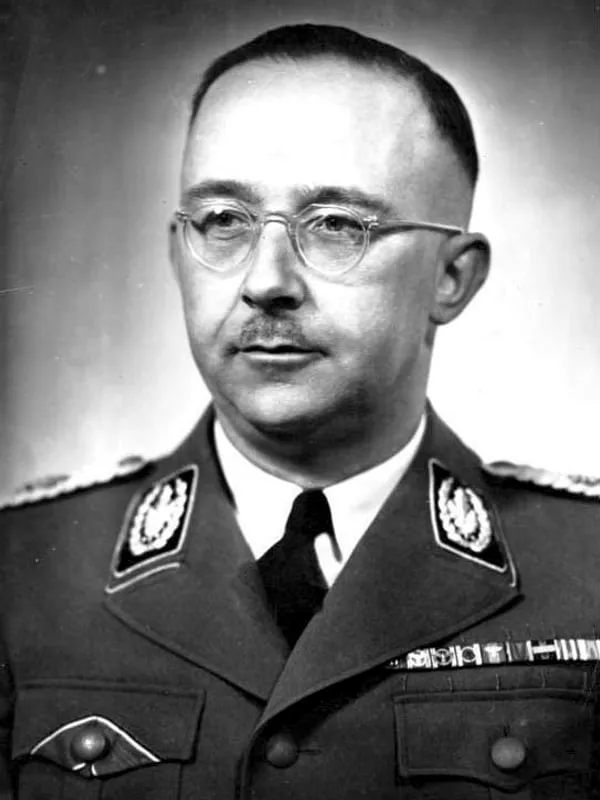
Heinrich Himmler
Reichsführer-SS (1929–1945), Chief of the German Police (1936–1945), Reich Commissioner for the Strengthening of German Nationhood (1939–1945), Reich Minister of the Interior (1943–1945)
- Born:
- 7 October 1900, Munich (Bavaria, German Empire)
- Died:
- 23 May 1945, Lüneburg
- Author:
- Łukasz
- Photo:
- Friedrich Franz Bauer, CC BY-SA 3.0 DE, Wikimedia Commons

After Adolf Hitler, Heinrich Himmler was the most powerful man in the Third Reich and one of the principal executors of its crimes. The pedantic son of a Munich grammar-school headmaster, a would-be officer and a qualified agronomist, he took over the leadership of the Nazi Party’s small bodyguard, the SS, in 1929 and within a decade turned it into a state within the state: a political police, a system of concentration camps, an intelligence service, an army of its own and an office that decided who in Europe was to live, where, and whether at all. As commissioner for “the strengthening of German nationhood” he directed the expulsions and Germanisation in occupied Poland, and as head of the SS and police he organised the mass killings of the Einsatzgruppen and the extermination camps. He was one of the chief perpetrators of the Holocaust, of the genocide of the Roma and of the deaths of millions of Poles, Soviet citizens and other inhabitants of occupied Europe. He escaped justice by committing suicide in British captivity in May 1945.
Childhood and youth
He was born on 7 October 1900 in Munich, the second of three sons of the grammar-school teacher Gebhard Himmler and his wife Anna Maria. The family was Catholic, middle-class and loyal to the Bavarian dynasty: his father had once been tutor to Prince Heinrich of Bavaria, who became the boy’s godfather and gave him his name. Heinrich was a diligent but sickly pupil. From childhood he kept a meticulous diary, which is an invaluable source for historians of his life. In 1913 the family moved to Landshut, where his father became headmaster of the grammar school.
He dreamed of a career as an officer. In 1918 he became an officer cadet in the 11th Bavarian Infantry Regiment, but the war ended before he had finished his training. For the rest of his life he regarded this as a personal blemish, and after 1933 Nazi propaganda falsely claimed that he had served at the front. In the spring of 1919 he belonged to the volunteer units raised against the Bavarian Soviet Republic, although there is no evidence that he actually took part in any fighting. In 1919–1922 he studied agriculture at the Munich Technical College (today the Technical University of Munich) and qualified as an agronomist, then worked in the laboratory of a fertiliser factory. In these years he moved from devout Catholicism and support for the Bavarian People’s Party to völkisch nationalism, antisemitism and a fascination with the “Germanic” past. He drew close to the Artaman League, a movement that wanted to settle young Germans on the land in the east. In 1921 he noted in his diary that if there were ever another war in the east, he would go with the army, because “the East is what matters most to us” and it was there that the Germans had to “fight and settle”.
From the putsch to the leadership of the SS
In August 1923 he joined the Nazi Party and the paramilitary Reichskriegsflagge of Ernst Röhm. During the Munich Putsch on 9 November 1923 he was the standard-bearer of Röhm’s detachment, which occupied the headquarters of the military district. He was not charged, but he lost his job. In 1924 he toured Bavaria as a speaker for the völkisch grouping that stood in for the banned party, and became secretary to Gregor Strasser, the Nazi Party’s most important organiser in northern Germany. After the party was refounded in 1925 he worked as a full-time official: he was deputy Gauleiter and, in 1926, deputy head of propaganda, and in 1925 he joined the newly created SS, a small formation meant to protect Hitler. In 1927 he became its deputy leader. On 3 July 1928 he married Margarete Boden, a nurse older than himself. They had a daughter, Gudrun (1929), and an adopted son. An attempt to support the family by keeping chickens near Munich came to nothing.
On 6 January 1929 Hitler appointed him Reichsführer-SS. At that time the formation numbered some 280–290 men and was subordinate to the SA. Himmler set out to make it the elite of the movement: an order of “racially valuable” men, blindly obedient to Hitler. He introduced strict selection and black uniforms and, from the end of 1931, the requirement to obtain permission to marry, granted after the “racial” ancestry of the bride had been checked. That same year he entrusted a former naval officer, Reinhard Heydrich, with building up the party’s intelligence service, the Sicherheitsdienst (SD). In the September 1930 elections he won a seat in the Reichstag. By the time the Nazis seized power, the SS had grown to some 52,000 members.
The police and the camps
After Hitler’s appointment as chancellor, Himmler began building his power in Bavaria. On 9 March 1933 he became acting police president of Munich, and soon afterwards commander of the Bavarian political police. On 20 March he announced the creation of a concentration camp at Dachau, where the first prisoners, mainly communists and Social Democrats, arrived only two days later. The camp, run from June 1933 by Theodor Eicke, became the model for the entire SS camp system. Over the following year Himmler took over the political police of the other German states, and on 20 April 1934 Hermann Göring handed him control of the Prussian Gestapo.
When Hitler decided in 1934 to settle accounts with the SA, the SS was his instrument. Himmler and Heydrich fabricated evidence of a Röhm conspiracy, and during the Night of the Long Knives at the turn of June and July 1934 their men murdered the leaders of the SA and other opponents of the regime. Himmler sacrificed the two men to whom he owed his career, Röhm and Strasser, and so proved his ruthless loyalty. As a reward, on 20 July 1934 the SS ceased to be subordinate to the SA and became answerable to Hitler alone.
On 17 June 1936 Himmler became chief of the entire German police. Formally he was subordinate to the Interior Minister, Wilhelm Frick; in reality he fused the state police with the party’s SS. He placed the Gestapo and the criminal police under Heydrich, and the uniformed police (the Ordnungspolizei) under Kurt Daluege. The police could send people to the camps without trial, in “protective custody”. The camps received political opponents, Jehovah’s Witnesses, homosexuals, people classed as “asocial” and “professional criminals”, and, after Kristallnacht in November 1938, some 30,000 Jewish men. Himmler was the chief driving force behind the persecution of homosexuals: in 1936 he set up a special central office for “combating homosexuality and abortion”.
At the same time he built an ideology of its own around the SS. He founded the Lebensborn association, meant to increase the number of “racially valuable” children, and the Ahnenerbe institute, meant to provide scientific proof of the Germanic past. Wewelsburg castle in Westphalia was to be the ideological centre of the “order”. Himmler revered the medieval King Henry I as the man who had begun German expansion to the east, and spun visions of a “Greater Germanic Reich” reaching to the Urals. The armed units of the SS, from which the Waffen-SS later grew, already numbered several tens of thousands of men by 1939.
Poland 1939–1941
The invasion of Poland in September 1939 was the first great opportunity to put these visions into practice. Behind the army came the Einsatzgruppen of the Security Police and the SD, which in the Intelligenzaktion murdered Polish teachers, priests, officials, landowners and community leaders, as well as Jews. On 27 September 1939 the Security Police and the SD were merged into the Reich Security Main Office (RSHA) under Heydrich. On 7 October 1939 Hitler appointed Himmler Reich Commissioner for the Strengthening of German Nationhood. In this capacity Himmler was responsible for the “Germanisation” of the Polish lands annexed to the Reich: hundreds of thousands of Poles and Jews were thrown out of their homes and deported to the General Government, and in their place came Germans from the Baltic states, Volhynia and Bessarabia, which the pact with Molotov had handed over to the Soviet Union. In a memorandum for Hitler in May 1940 Himmler wrote that the population of the East should receive no more than a four-year elementary school, where they would learn to count up to five hundred, to write their names and to understand that obedience to the Germans was a divine commandment. Reading, in his view, they did not need. Hitler judged the memorandum “very good”.
In the spring of 1940 the SS established the Auschwitz concentration camp at Oświęcim. On 14 June 1940 the first transport of Polish political prisoners arrived there from Tarnów. In March 1941 Himmler visited the camp and ordered it to be expanded to hold 30,000 prisoners and to supply prisoners for the construction of the IG Farben plant. Work on the camp at Brzezinka (Birkenau) began in the autumn of 1941; Rudolf Höss linked that decision to the March visit, but according to historians it was taken in September 1941.
The Holocaust
Before the invasion of the Soviet Union, Hitler entrusted Himmler with “special tasks” behind the front. According to the post-war testimony of one participant, at a secret meeting at Wewelsburg in June 1941 Himmler spoke to SS generals of reducing the number of Slavs by thirty million. From 22 June 1941 the Einsatzgruppen, police battalions and SS brigades murdered Jews in the occupied territories of the USSR – at first men, and from August women and children as well. Himmler travelled east himself and put pressure on the killers. In mid-August 1941 in Minsk he watched Jews being shot and took it badly, which, according to witnesses, led him to look for methods that would be less of a strain on the executioners. By the end of the war more than a million Jews had been killed in mass shootings in the occupied Soviet territories.
At the turn of 1941 and 1942 the SS began killing people in gas chambers. At the Wannsee Conference on 20 January 1942 Heydrich, acting on Göring’s authority and in agreement with Himmler, settled the organisation of the deportations with ministry officials. Himmler’s subordinate, the SS and Police Leader in the Lublin district, Odilo Globocnik, directed Operation Reinhard, in which some 1.5–1.7 million Jews, mainly from the General Government, were murdered in the extermination camps of Bełżec, Sobibór and Treblinka. On 19 July 1942 Himmler ordered that the “resettlement” of the entire Jewish population of the General Government be completed by the end of the year. A few days earlier, on 17–18 July, he had watched the gassing of a transport of Jews from the Netherlands at Auschwitz-Birkenau. Birkenau became the largest site of the Holocaust, where some one million Jews from all over Europe were murdered. On Himmler’s order of December 1942 Roma from the Reich were also deported to Auschwitz, and the Nazi genocide of the Roma claimed, by various estimates, from about two hundred thousand to five hundred thousand victims. In February 1943 Himmler ordered the destruction of the Warsaw Ghetto. The Ghetto Uprising, which broke out on 19 April, was crushed by his subordinate Jürgen Stroop. In 1942–1943 the SS also expelled more than a hundred thousand Poles from the Zamość region to make room for German settlers in line with Generalplan Ost.
On 4 and 6 October 1943 in Poznań (Posen), Himmler spoke openly to SS generals, and then to the party’s highest officials, about “the extermination of the Jewish people”. In the Posen speeches he called it “a page of glory in our history which has never been written and never shall be written”, and praised the killers for having “remained decent” while doing it. The recordings and transcripts of these speeches are among the most important evidence that the leadership of the Reich deliberately planned and carried out genocide. The Holocaust claimed some six million Jews. Himmler acted on the will of Hitler, to whom he appealed, but it was he and his apparatus who turned that will into organisation, transports, gas chambers and slave labour in the camps, which in January 1945 held more than 700,000 prisoners.
At the height of power, and defeat
In August 1943 Himmler also became Reich Minister of the Interior, and after the failed 20 July plot of 1944 commander of the Replacement Army. By then the Waffen-SS numbered several hundred thousand men, among them volunteers and conscripts from many European countries. When the Warsaw Uprising broke out on 1 August 1944, Himmler, with Hitler’s consent, ordered the city to be razed to the ground and its inhabitants killed. In the first days of August SS and police units, including Oskar Dirlewanger’s special regiment, massacred tens of thousands of civilians in the Wola district. On 21 September 1944 Himmler said that from a historical point of view the uprising was a “blessing”, because Warsaw, “which has blocked our way to the East for 700 years”, would be destroyed.
Hitler also gave him front-line commands for which Himmler was unfit. At the end of 1944 he commanded an army group on the Upper Rhine, and from January to March 1945 Army Group Vistula in Pomerania, where he suffered defeat. On his orders the SS evacuated the concentration camps in death marches in which tens of thousands of prisoners perished. At the same time, convinced that he could be a partner for the Western Allies, he held talks behind Hitler’s back through the Swedish Count Folke Bernadotte. As a result, in the final weeks he allowed thousands of concentration camp prisoners to be taken to Sweden. On the night of 23–24 April 1945 he offered to surrender in the west. The Allies rejected the offer, and when news agencies reported it, Hitler, in his testament of 29 April, expelled Himmler from the party and stripped him of all his offices.
After Germany’s surrender Himmler shaved off his moustache, put on an eyepatch and, with false papers in the name of Sergeant Heinrich Hitzinger, tried to hide among the soldiers. On 21 May 1945 he was detained by a British patrol near Bremervörde in Lower Saxony. In a transit camp he revealed who he was, and on 23 May 1945 in Lüneburg, during a medical examination, he bit into a cyanide capsule hidden in his mouth. His body was buried secretly in an unmarked spot on the heathland near the town.
Significance
Himmler was not a charismatic orator or a propagandist on the scale of Hitler or Joseph Goebbels. His contemporaries saw him as a dull bureaucrat who looked like a schoolmaster and busied himself with herbal medicine, racial pedigrees and Germanic myths. Yet this mixture of bureaucratic pedantry, ideological fanaticism and total loyalty to Hitler made him one of the most dangerous men of the 20th century. His biographer Peter Longerich stresses that Himmler did not merely carry out orders but himself devised and radicalised racial policy, and saw genocide as the first step towards a “new order” in the east that was to include the expulsion or death of tens of millions of Slavs.
For the history of the road to the Second World War, Himmler shows how, within a few years, the street-fighting squads and party guards of the 1920s grew into an apparatus capable of crime on a continental scale. The small SS he took over in 1929 became a political police after 1933, an instrument for murdering its own comrades in 1934 and, after 1939, the chief executor of occupation terror in Poland and of the Holocaust. After the war the International Military Tribunal at Nuremberg declared the SS, the Gestapo and the SD criminal organisations. Himmler, who should have stood before it as one of the principal defendants, was no longer among them.
Sources
Commanded in battles
(03)Mentioned in battles
(08)Often appears with
People who appear in the same events.
On the timeline
(135)The 40 most important of 135 events. All tagged “Heinrich Himmler” (25) →