Israel
Moshe Dayan
Member of the Haganah and Palmach company commander (1941), Chief of the General Staff of the Israel Defense Forces (1953–1958), Minister of Defence (1967–1974), Foreign Minister of Israel (1977–1979)
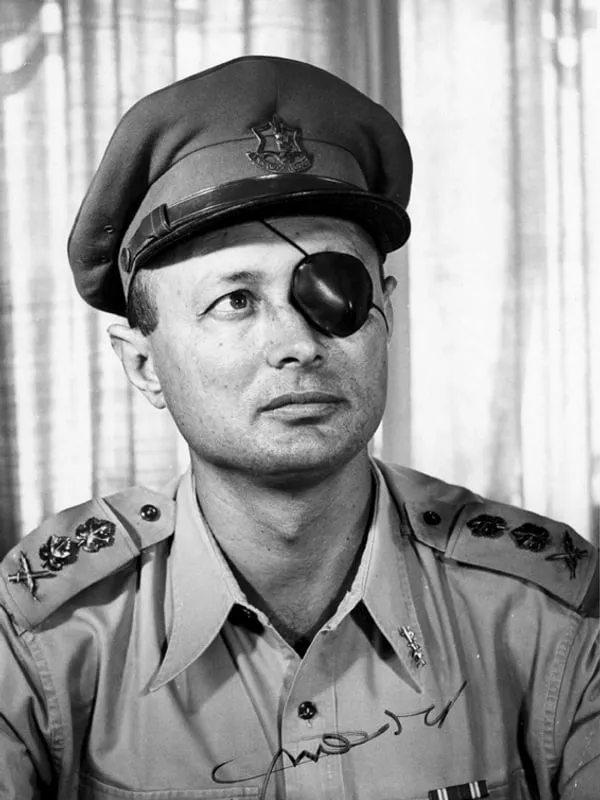
- Born:
- 20 May 1915, Degania (Palestine, Ottoman Empire)
- Died:
- 16 October 1981, Ramat Gan (Israel)
- Author:
- Łukasz
- Photo:
- IDF Spokesperson's Unit photographer, CC BY-SA 3.0, Wikimedia Commons

Moshe Dayan was one of the most recognisable soldiers of the 20th century, and the black patch over his left eye made him a symbol of the Israeli army. He owed the patch to the Second World War: on 8 June 1941, in the first hours of the Allied invasion of Syria and Lebanon, the 26-year-old member of the Jewish armed organisation the Haganah, who had come out of a British prison a few months earlier, was serving as a guide with an Australian patrol when, on the roof of a captured French post, he was hit by a Vichy sniper. The episode shows the tangle in which Jewish Palestine found itself during the war: the British, who in 1939 had sentenced Dayan to ten years in prison for illegal possession of arms, needed him and his comrades in 1941 against the Axis powers and their French allies. After the war Dayan held command in the war of 1948, was Chief of Staff during the Suez Crisis and Minister of Defence in the Six-Day War and the Yom Kippur War, and as Foreign Minister helped to make peace with Egypt.
Childhood in Galilee
He was born on 20 May 1915 at Degania, the first kibbutz, on the Sea of Galilee, in a Palestine that still belonged to the Ottoman Empire. His parents, Shmuel and Devorah, were Jewish immigrants from Russian Ukraine. He was named after Moshe Barsky, the first member of Degania to be killed by Arab attackers, while riding to fetch medicine for Dayan’s father. When he was six the family moved to Nahalal, the first moshav – a cooperative farming village – in the Jezreel Valley. There Dayan attended an agricultural school, learnt Arabic and as a teenager stood guard in the village’s defence. Around 1930 he joined the Haganah, the underground self-defence organisation of the Jewish settlements. In 1935 he married Ruth Schwartz; they had three children: Yael, Ehud and Assaf.
The Arab revolt and prison
When the Arab revolt in Palestine broke out in 1936 – directed against British mandatory rule and Jewish settlement, and led by the Grand Mufti of Jerusalem, Mohammed Amin al-Husseini – the British agreed to the formation of a Jewish settlement police. Dayan joined it in 1936 and took a course under Yitzhak Sadeh, the creator of the Haganah’s new, offensive tactics; in 1938–1939 he served in Sadeh’s field companies and in the Special Night Squads of Captain Orde Wingate, the British officer who taught Jewish volunteers to carry out night raids against Arab guerrillas. Wingate became one of Dayan’s models.
With the suppression of the revolt and the publication in May 1939 of the British White Paper limiting Jewish immigration to Palestine, the cooperation came to an end. At the beginning of October 1939, after war had already broken out in Europe, the British police arrested Dayan and 42 other participants in an illegal Haganah commanders’ course who had been found with weapons. A military court sentenced him to ten years’ imprisonment, which he served in the fortress at Acre. The war, however, changed the situation. In 1940 and 1941 Britain was losing one position after another in the Mediterranean, and in Palestine it needed the help of the Jewish community. After intervention by Zionist leaders, among them Chaim Weizmann in London, “the 43” were released in mid-February 1941.
The Palmach and Lebanon (1941)
In the spring of 1941 the threat to Palestine became real. The Germans had occupied Greece and Crete, in Iraq the pro-German Rashid Ali al-Gaylani had seized power, and French Syria and Lebanon, obedient to the Vichy government, had opened their airfields to the Luftwaffe. In May the Haganah, with the knowledge and help of the British services, formed permanent strike companies – the Palmach – which were to fight behind enemy lines in the event of a German invasion. Sadeh gave Dayan command of one of the first companies; another was commanded by Yigal Allon. Dayan’s men, who knew Arabic and the terrain, went on reconnaissance into southern Lebanon from Kibbutz Hanita disguised as Arabs, preparing the way for the advance of the 7th Australian Division.
On the night of 7–8 June 1941, before the start of the operation that the British called Exporter, Palmach members went out with Australian patrols as guides. Their task was to cut telephone lines, secure bridges and culverts against demolition and lead the columns. A comparison of his own account with the Australian official history shows that Dayan went with a section of the 2/14th Battalion under Lieutenant P. J. Kyffin, which crossed the hills to the coast road near Iskandaroun. At around five in the morning the group stormed a stone French post and then held it for several hours against approaching Vichy troops, taking several dozen prisoners. As Dayan was observing the French positions through binoculars from the roof, a sniper’s bullet struck the binoculars. Fragments of glass and metal destroyed his left eye. He waited several hours to be evacuated. The eye could not be saved, and the damage to the socket made it impossible to fit a prosthesis – hence the black patch. The widespread version according to which Dayan “commanded an Australian unit” and lost his eye at the Litani River on 9 June does not match the sources: he was a guide and the leader of a Palmach group, and he was wounded the day before the battle at the Litani, a few kilometres over the border.
He left hospital at the beginning of August 1941. By then the campaign in Syria and Lebanon had ended in an armistice, and Dayan himself recalled that for a long time he felt like a cripple without a profession and avoided people, because the patch drew stares. He went back to Nahalal and remained active in the Haganah. The war, in which the Jews of Palestine were once again fighting alongside the British, gave him and a whole generation of Palmach commanders experience that a few years later would prove decisive in the war for Palestine.
The war of 1948
In December 1946 Dayan was a delegate to the Zionist Congress in Basel, and in February 1947 the Haganah’s chief of staff, Yaakov Dori, appointed him adviser on Arab affairs. In April 1948, a few days after the death of his younger brother Zohar, who was killed fighting the Druze, he held talks with Druze officers that marked the start of Druze cooperation with the Jewish state. After the proclamation of Israel on 14 May 1948 and the outbreak of war with the Arab states, he commanded the defence of the Jordan Valley, where the Syrian advance was halted at his native Degania. He then took over the mechanised 89th Battalion, with which on 11 July, during Operation Danny, he carried out a raid through the Arab town of Lod. In the summer he became commander of the Israeli forces in Jerusalem; his night attacks were unsuccessful, but he held talks with the Jordanian commander of East Jerusalem and met King Abdullah I, and in 1949 he took part in the armistice negotiations on Rhodes.
Chief of Staff
In October 1949 Dayan, now a general, took over Southern Command, and in 1952 Northern Command. In the south he pursued a hard line towards Arabs crossing the new borders, including the expulsion of Bedouin, and as an advocate of reprisal raids he was one of the authors of the night attack on the village of Qibya in the West Bank in October 1953, in which 69 civilians were killed and which provoked international condemnation. In December 1953 David Ben-Gurion appointed him Chief of the General Staff of the Israel Defense Forces. Dayan reorganised the army, slimmed down its administration, put the emphasis on the air force, armour and paratroopers, and together with Shimon Peres negotiated large deliveries of French arms. In the autumn of 1956 he personally directed Operation Kadesh, Israel’s part in the Suez Crisis: within a week of 29 October Israeli forces occupied Sinai and the Gaza Strip. Under pressure from the United States and the USSR, Israel had to withdraw from them. In January 1958 Dayan left the army.
Politician and Minister of Defence
In 1959 he entered the Knesset on the list of Ben-Gurion’s Mapai party and served as Minister of Agriculture until 1964. In 1965 he followed Ben-Gurion into the new Rafi party, and in 1966 he observed the Vietnam War as a newspaper correspondent. When tension with Egypt mounted in the spring of 1967, Prime Minister Levi Eshkol, under pressure from public opinion, handed him the defence portfolio on 1 June. Four days later the Six-Day War began, in which Israel took Sinai, the Gaza Strip, the West Bank with East Jerusalem, and the Golan Heights. On 7 June Dayan entered the captured Old City, and at the same time decided that the Temple Mount would remain under the administration of the Muslim religious trust. In the years that followed he directed policy towards the occupied territories, opening the Jordan bridges to the movement of people and goods.
His legend collapsed in October 1973. Egypt and Syria attacked on the holy day of Yom Kippur, and Israel, which had disregarded the warnings, suffered heavy losses at the outset. According to witnesses, in the first days Dayan was close to breakdown and spoke of a threat to the “Third Temple”, meaning the state itself. The commission of inquiry chaired by the President of the Supreme Court, Shimon Agranat, did not hold him personally responsible, but public opinion considered him jointly to blame, and in 1974 he left office with the government of Golda Meir.
Peace with Egypt and the last years
In 1977, to the outrage of his former comrades in the Labour Party, he accepted the foreign affairs portfolio from Prime Minister Menachem Begin of the right-wing Likud. In September 1977 he met an envoy of President Anwar Sadat secretly in Morocco, which prepared the ground for Sadat’s visit to Jerusalem, and in September 1978 he was one of the chief negotiators of the Camp David Accords. The peace treaty was signed in March 1979. In October 1979 Dayan resigned, dissatisfied with the government’s policy on Palestinian autonomy. In 1981 he founded his own list, Telem, which won two seats. He died of a heart attack on 16 October 1981 at the Sheba hospital at Tel HaShomer, on the outskirts of Tel Aviv, and was buried at Nahalal. His passion for archaeology was also controversial: for years he collected ancient artefacts, often dug up without a permit.
Significance
Dayan belonged to the generation of Palestine-born Jews who within twenty years went from defending settlements to building one of the most effective armies in the world. The Second World War was a turning point on that road. The British, who as late as 1939 had been imprisoning members of the Haganah, in 1941 armed and trained the Palmach, counting on its help against the Germans and the Vichy French. It produced many of the commanders of the 1948 war, Dayan and Allon among them. To the world, after 1967 Dayan became the face of Israeli victory, and his eye patch, a memento of the first day of the Syrian campaign, the symbol of a soldier who leads from the front line. He remained a contested figure: to some a national hero and co-architect of peace with Egypt, to others jointly responsible for the reprisal raids and for the disaster of the first days of the Yom Kippur War.
Sources
Mentioned in battles
(01)Often appears with
People who appear in the same events.