1941: The Middle East campaign
Operation Exporter
- Dates:
- 8 June – 14 July 1941
- Front:
- Middle East
- Location:
- Syria and Lebanon (French mandated territories): the coast from the mouth of the Litani through Tyre, Sidon and Damour to Beirut, the Litani valley with Merdjayoun and the mountains around Jezzine, the roads from Deraa and Quneitra to Damascus, the desert with Palmyra, the Euphrates valley with Deir ez-Zor and Raqqa; the armistice was signed at Acre in PalestineOn the battle map →
- Sides:
- United Kingdom and Free France (with troops from Australia, British India and Transjordan)Henry Maitland Wilson, John Lavarack, Paul LegentilhommeVichy FranceHenri Dentz
- Result:
- Allied victory. After five weeks of fighting in which Damascus, Palmyra, Deir ez-Zor and Damour fell, General Dentz asked for a ceasefire; the fighting stopped at midnight on 12 July, and on 14 July an armistice convention was signed at Acre. Syria and Lebanon passed under British and Free French control, and of almost 38,000 Vichy soldiers and officials fewer than 6,000 went over to de Gaulle; the rest were shipped back to France.
- Author:
- Łukasz
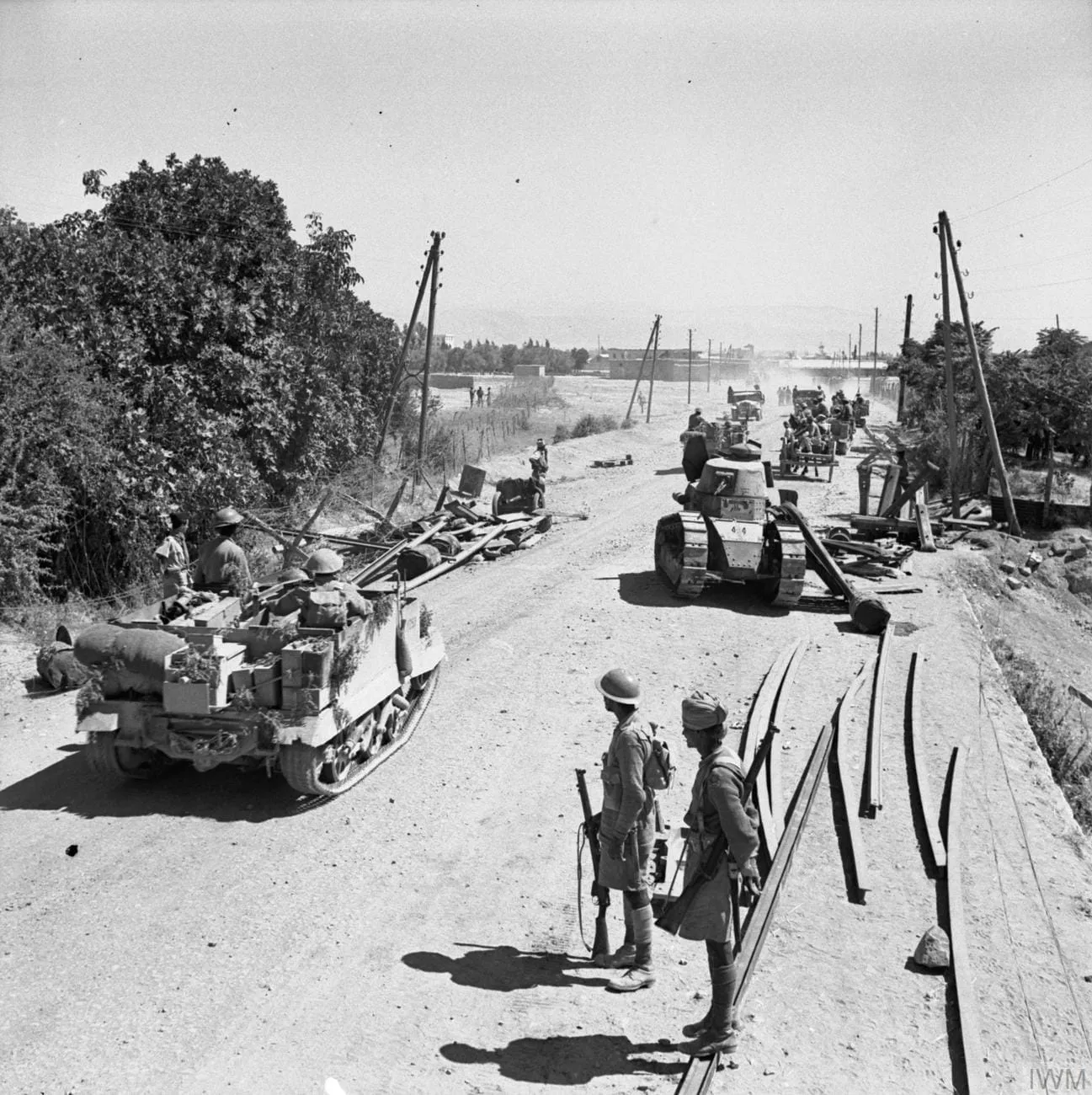
Operation Exporter, the Syria–Lebanon campaign of 1941, was a campaign into which the British Commander-in-Chief in the Middle East had to be pushed and which proved much harder than expected. On 8 June 1941 British, Australian, Indian and Free French troops advanced from Palestine and Transjordan into Syria and Lebanon, League of Nations mandated territories ruled by a France subordinate to the Vichy government. The British wanted to close the road to the Middle East that Vichy had opened to the Germans during the Anglo-Iraqi War. They expected only token resistance, perhaps even the defection of part of the French forces to General Charles de Gaulle. Instead General Henri Dentz’s Army of the Levant defended itself with determination for five weeks and in several places went over to counter-attacks that shook the whole British plan.
The campaign was fought on several fronts at once: on the Lebanese coast, where the 7th Australian Division advanced on Beirut; in the mountains above the Litani valley; on the road to Damascus, along which Indian and Free French troops attacked; and from the end of June also in the desert and on the Euphrates, where British and Indian columns came in from Iraq. Damascus fell on 21 June, and after the last line of defence on the Damour river had been broken, General Dentz asked for a ceasefire. The armistice signed at Acre on 14 July ended a fight in which Frenchmen had fired on Frenchmen and legionnaires of the Foreign Legion on fellow legionnaires.
Name and dates
Exporter was the British code name for the whole operation, given in the second half of May 1941, when the Chiefs of Staff instructed General Archibald Wavell to prepare an advance into Syria. English-language literature speaks of the Syria–Lebanon campaign or the Syrian campaign, French literature of the “Syrian campaign” (campagne de Syrie), and from Vichy’s perspective it was the defence of the Levant. It is also widely known simply as Operation Exporter.
The starting date is certain: in the first hours of 8 June the leading units crossed the frontier, and in the morning proclamations by General Georges Catroux announced to the people of Syria and Lebanon that Free France had come to abolish the mandate and proclaim their independence. The end has three dates. On the evening of 11 July General Dentz asked by radio for a cessation of hostilities; the ceasefire came into force at one minute past midnight on 12 July; that evening the terms were initialled at Acre; and on 14 July – the French national holiday – the armistice convention, known as the Convention of Acre (Saint-Jean-d’Acre), was signed. According to the British official history the campaign falls into three phases: the advance from 8 to 13 June, the period of French counter-attacks from 14 to 22 June, and the final phase from 23 June to 12 July, when the initiative returned to the British.
Background
After the defeat of France in June 1940 the French authorities in the Levant submitted to Marshal Philippe Pétain. Only a handful of Frenchmen crossed into Palestine, together with the Polish Independent Carpathian Rifle Brigade, which had been formed in Syria. In the months that followed London hoped that the Army of the Levant would go over to de Gaulle of its own accord, but after Mers-el-Kébir and Dakar French officers were hostile to the British, and at the turn of 1940 and 1941 the post of High Commissioner in Beirut and commander of the troops went to General Henri Dentz, a soldier loyal to Vichy who in June 1940, as military governor, had handed Paris over to the Germans.
In the spring of 1941 Syria suddenly became important. When war broke out in Iraq between the British and the government of Rashid Ali al-Gaylani, Vichy’s Deputy Prime Minister, Admiral François Darlan, agreed that Luftwaffe aircraft flying to Iraq could land at Syrian airfields and that the Iraqis could have weapons from French depots. The orders from Vichy were passed to Dentz by the Minister of War, General Charles Huntziger. From mid-May the aircraft of the small Fliegerführer Irak group passed through Aleppo, Damascus, Palmyra and Rayak, and on 14 May London authorised the RAF to attack them on French airfields. On 27–28 May Darlan and the Reich’s ambassador Otto Abetz signed the so-called Paris Protocols in Paris, which confirmed that Syrian airfields and railways were available to the Germans and also promised them the port of Bizerta and a base at Dakar. Vichy never ratified them, but their Syrian part was already being carried out. On 28 May French fighters shot down a British Blenheim.
The British feared that after taking Crete the Germans would land in Syria from the air, and, as the British official history observed, German aircraft at Damascus would be closer to the Suez Canal than if they were based at Mersa Matruh. Wavell, who was fighting in Iraq, on Crete and in the Western Desert at the same time, did not want a new campaign conducted with forces that were too weak. General Catroux, de Gaulle’s delegate in the Middle East, meanwhile assured him that the Army of the Levant would readily go over to Free France if only it were shown force, and on 18 May even claimed that the French were handing Syria to the Germans and withdrawing into Lebanon. The report proved false, but the dispute between Wavell and London, in which Churchill threatened to dismiss the Commander-in-Chief, settled the matter. On 16 May, after news of Turkish troop movements towards the Syrian frontier, the Chiefs of Staff ordered forces to be assembled for an advance into Syria, and on 25 May Wavell sent London an outline plan. He himself believed that two divisions and an armoured brigade were needed to occupy the country, and just before the start he called the operation a gamble in a report to London. On 2 June the Turkish government declined to occupy the airfields of northern Syria.
The paradox was that the Germans were just leaving Syria. After the fall of Rashid Ali, the surrender of Baghdad and the heavy losses of the paratroops on Crete, Hitler, absorbed in preparations for the attack on the Soviet Union, had no intention of defending the Levant. According to the British official history the Germans withdrew their aircraft so as not to give the British a pretext for invasion. When Wilson’s troops crossed the frontier on 8 June, there was no one left to fight but the French. The test of whether the Army of the Levant would have defended Syria against the Germans never came; instead there was what the official historian called an “unhappy” clash of Frenchmen with Frenchmen and with the British.
Forces and plans
The Army of the Levant (Armée du Levant) was larger and better prepared than the forces the British could put into the field against it. Estimates of its strength range from 35,000 to about 45,000 men; French studies give as many as 50,000, of whom some 8,000–12,000 were Frenchmen and the rest soldiers from North Africa and Senegal and Syrian and Lebanese “special troops” (troupes spéciales). Its core consisted of four battalions of the 6th Infantry Regiment of the Foreign Legion, the 24th Colonial Infantry Regiment, regiments of Algerian, Tunisian and Senegalese tirailleurs and about 90 tanks, mainly Renault R35s. The air force had about 30 bombers and 60 fighters at the outset, including modern Dewoitine D.520s, and during the campaign it almost doubled in strength thanks to aircraft sent from North Africa; the Germans agreed to let them fly over Axis territory and refuel in Greece. The navy had two large destroyers at Beirut, Guépard and Valmy, three submarines and several smaller vessels. General Dentz, as High Commissioner and Commander-in-Chief, had General Joseph de Verdilhac as his deputy, and the defenders knew the ground and had had several weeks to prepare their positions.
The Allied forces, commanded by General Henry Maitland Wilson, commander in Palestine and Transjordan, numbered about 34,000 men at the outset: some 18,000 Australians, 9,000 British, 2,000 Indian troops and 5,000 Free French. The main force was Major General John Lavarack’s 7th Australian Division, without its 18th Brigade, which was fighting in besieged Tobruk; its place at Mersa Matruh had been taken by a South African brigade and the Polish Carpathian Brigade. Alongside the Australians went Brigadier Wilfrid Lloyd’s 5th Indian Brigade, experienced from Eritrea, which had fought at Keren in March. The Free French, grouped in the 1st Free French Division (at that time a light division), were led by General Paul Legentilhomme, who in June 1940, as commander in French Somaliland, had rejected the armistice; his chief of staff was Marie-Pierre Kœnig. They had six battalions, including two battalions of the 13th Demi-Brigade of the Foreign Legion and a battalion of marines, one battery and a few tanks, as well as the Circassian cavalry of Colonel Philibert Collet, which had crossed from the Vichy army into Transjordan in May. In reserve stood the British 6th Infantry Division, one of whose brigades was still forming, and the Australian 17th Brigade.
At sea the operation was supported by Vice Admiral E. L. S. King with two cruisers, an anti-aircraft cruiser, the landing ship HMS Glengyle and eight destroyers; his force later grew to five cruisers. A commando battalion, No. 11 (Scottish) Commando, was to land from Cyprus. Air power was the Allies’ weakest point: Air Commodore L. O. Brown had about 50 front-line aircraft, including Hurricane squadrons in the middle of re-equipping and an Australian squadron of Tomahawks. Members of the Jewish Palmach also crossed the border, guiding Australian units as scouts and guides. One of them was Moshe Dayan, who on the first day of the campaign, while defending a captured police post south of the Litani, lost his left eye to a French marksman’s bullet.
General Wilson was to take Beirut, Dentz’s seat, the airfield at Rayak and Damascus, and then advance on Palmyra, Homs and Tripoli. The lie of the land dictated the plan: parallel to the coast run the ranges of the Lebanon and Anti-Lebanon with the massif of Mount Hermon, and between them the valley of the Litani, which near Merdjayoun turns west and cuts through the mountains to reach the sea between Tyre and Sidon. Wilson decided to attack along three roads: the main Australian thrust went up the coast road to Beirut, a second Australian column through Merdjayoun towards Rayak, and on the right flank the 5th Indian Brigade was to take Deraa and let the Free French through to Damascus. Later, once forces were freed in Iraq, columns of General Edward Quinan’s Iraq command were to enter Syria from the desert: Habforce, that is the 4th Cavalry Brigade with John Glubb’s Arab Legion, and General William Slim’s 10th Indian Division.
Course of the campaign: the advance (8–13 June)
Catroux’s proclamation, scattered in leaflets and broadcast by radio on 8 June, was endorsed on behalf of the British government by the ambassador in Egypt. Some officers, both British and Free French, believed that the French would fire a few shots for honour’s sake and give way. It quickly became clear that this was an illusion. Free French envoys who tried to talk to their former comrades were greeted with abuse or with gunfire. The British official history records cases of misuse of the white flag and ill-treatment of prisoners.
On the right flank the 5th Indian Brigade quickly took Deraa and by evening had reached Sheikh Meskine, where resistance stopped it. During the night the French abandoned Quneitra, which was occupied by a battalion of the Royal Fusiliers. On 9 June the Free French took over the lead and reached a strongly held position at Kissoué, only a dozen or so kilometres from Damascus. Their attacks on 11 and 12 June failed. Wilson placed the Indian brigade under Legentilhomme as well, and the group was named Gentforce after its commander. Legentilhomme was soon wounded and command in this sector passed to Brigadier Lloyd, who judged that a more carefully prepared attack was needed and fixed it for 15 June.
In the centre the 25th Australian Brigade took Merdjayoun on the afternoon of 11 June, but the cavalry sent towards Rayak ran into stiff resistance. Lavarack concluded that progress in this direction would be very slow and decided to send most of the brigade over the mountains to Jezzine in order to outflank the positions defending the coast. A cavalry detachment, an infantry battalion and a battery were left at Merdjayoun. Once the sappers had bridged the Litani, on the evening of 13 June the brigade set off on a night march without lights along unknown, winding tracks over steep slopes. The Australians took Jezzine in mid-June; the sources differ by a day over the date.
On the coast the 21st Australian Brigade was attacking. The key was the road bridge over the Litani, which commandos from Cyprus were to seize from the sea at dawn on 8 June. HMS Glengyle arrived on time, but the surf was so high that the landing was called off. The following night, with a calmer sea, the commandos and the Australians were unsure of each other’s positions, surprise was not achieved, and the bridge had already been blown. Some of the commandos came ashore on the wrong side of the river mouth. In the day-long fighting of 9 June, known as the Battle of the Litani River, the battalion commander, Lieutenant Colonel Richard Pedder, was killed and command of his group passed to Major Geoffrey Keyes, son of Admiral Roger Keyes. The commandos lost almost half their strength, but together with the Australians, who crossed in boats under fire, they forced a passage. That day the destroyers Guépard and Valmy shelled the Australian positions from the sea; the British then lifted their ban on attacking French warships, and in an engagement with them the destroyer HMS Janus was badly damaged. On the morning of 10 June the brigade crossed by a pontoon bridge and moved up the coast, brushing aside French rearguards every few kilometres. On the evening of 12 June it stood before Sidon, and an attack on 13 June failed.
The balance of the first week was unfavourable. Some progress had been made on the right flank, almost none in the centre, and on the coast resistance was stiffening. Losses had passed 500 men, and the French showed no inclination whatever to change sides. Wavell decided to send the British 6th Division from Egypt, whose headquarters was to take over the Damascus sector.
Vichy counter-attacks and the capture of Damascus (14–22 June)
The second phase coincided with the days in which the British were losing Operation Battleaxe in the Western Desert, and it was a period of violent blows on both sides. At dawn on 15 June Brigadier Lloyd struck at Kissoué. The attack came at a moment when the French were relieving their forward units; the village was taken before noon and two counter-attacks were beaten off, and a night attack consolidated the Indians’ position. That same day, however, General Dentz went over to a counter-offensive on the flanks. A detachment came down from the Jebel Druze and drove a weak garrison of the Transjordan Frontier Force out of Ezraa, threatening the Free French supply line. On 16 June a strong group with tanks, guns and armoured cars surrounded three companies of the Royal Fusiliers at Quneitra, which held out until evening; 13 officers and 164 men surrendered. Both Vichy successes proved short-lived: on 17 June a hastily assembled detachment under Major John Hackett retook Ezraa and captured more than 160 Tunisians, and that evening a battalion of the Queen’s from the British 16th Brigade, arriving from Egypt, entered Quneitra without a fight.
More dangerous was the blow in the Litani valley. On 15 June, when most of the 25th Brigade was on its way to Jezzine, the commander of the weak Merdjayoun garrison sent part of his force on an outflanking move through the foothills of Mount Hermon, and the French attacked from the north and retook the town. For a moment it seemed that nothing would stop them from entering Palestine. They halted, however, and a hastily assembled group under Brigadier Frank Berryman, the division’s artillery commander, though it twice attacked Merdjayoun without success, checked any further Vichy advance. In this fighting Lieutenant Roden Cutler of the 2nd/5th Field Regiment distinguished himself, engaging French tanks and positions with a field gun, an anti-tank rifle and a machine gun; at the beginning of July, in the fighting on the Damour river, he lost a leg, and for both actions he was awarded the Victoria Cross. Part of the brigade had to be turned back from Jezzine, and the 2nd/31st Battalion left there beat off attacks from 15 to 18 June, taking many Senegalese prisoners. On the coast the Australians, after renewing their attack on 14 June with the support of naval gunfire, outflanked the positions at Sidon; during the night the French withdrew, and Sidon was occupied on 15 June.
At sea on 15 June German Ju 88 bombers from the Dodecanese – the only Axis support to join the fighting – badly damaged the destroyers HMS Isis and Ilex. Admiral Andrew Cunningham ordered Admiral King to withdraw his force to Haifa by day, but the ships went on shelling the French positions every morning, because fire from the sea along the transverse valleys was exceptionally effective. On 16 June torpedo aircraft from Cyprus sank the large destroyer Chevalier Paul, which was sailing from Toulon with ammunition.
Outside Damascus Brigadier Lloyd, despite the threat to his rear, decided to strike straight at Mezzeh, where there was an airfield and where the road from Damascus to Beirut enters the gorge of the Barada river. The Indian brigade moved off after dark on 18 June and before 5 a.m. took the village in hand-to-hand fighting, but the column carrying supplies and anti-tank guns became separated under fire and got stuck in the orchards to the south-east. Through 19 and 20 June the cut-off Indians, without food, ammunition or dressings, beat off attacks by French tanks against which they had no effective weapon. At about 1.30 p.m. on 20 June they tried under a white flag to obtain a truce to evacuate the wounded; the French took this as a surrender and broke into their positions. The relief force, supported by the Australian 2nd/3rd Battalion, entered Mezzeh in the evening, when the defenders were already prisoners. During the night the Australians surprised the French in the Barada gorge and cut the road to Beirut. At the same time the Free French, after a failed and costly attack the previous night, took the village of Kadem on the southern edge of the city on the morning of 21 June. According to French accounts, in the fighting on the approaches to Damascus legionnaires of the 13th Demi-Brigade clashed with legionnaires of the 6th Legion Regiment, their former comrades in arms.
Before noon on 21 June the defence collapsed. The Free French, preceded by a company of Australian machine-gunners, were met in the suburbs by civil officials ready to surrender the city, and in the afternoon General Legentilhomme – who despite his wound had returned to his headquarters on 16 June – drove into Damascus with Catroux as military governor. The Vichy troops fell back along the Beirut road. The British official history gives the credit for this success above all to the Indian soldiers: two battalions of the 5th Brigade lost 738 men, and according to French figures about 300 of them were taken prisoner, many of them wounded. The brigade was exhausted and could not exploit its victory with a thrust westwards.
The command arrangements were also changed. On 18 June Lavarack, with the staff of the Australian I Corps, took over the whole front from Damascus to the sea. The corps had been commanded until April by General Thomas Blamey, appointed Deputy Commander-in-Chief in the Middle East on 23 April, and Lavarack had been chosen as his successor. The 7th Australian Division was taken over by Major General Arthur Allen, while the commander of the 6th Division, Major General John Evetts, commanded under Lavarack all the troops, apart from the Free French, in the Damascus, Deraa and Quneitra area.
Palmyra, the Euphrates and Damour (23 June – 12 July)
In the final phase the initiative returned to the Allies. On 21 June Major General John Clark’s Habforce set out from Iraq for Palmyra. The oasis garrison, two Legion companies and a light desert company, held out for twelve days, and the cavalry, without fighter cover, suffered heavily from French bombers. The Arab Legion forced the outpost at Seba’ Biyar to surrender, and on 1 July at Sukhna it routed a French desert company with a charge in its vehicles. Early on the morning of 3 July Palmyra capitulated; 187 men were taken prisoner. From 27 June Slim’s 10th Indian Division advanced up the Euphrates valley through Abu Kamal. On 3 July its columns attacked Deir ez-Zor frontally and with a wide outflanking move and captured the bridges intact, and on 5 July they took Raqqa; Aleppo, and with it the railway to Turkey, was now threatened. On the Vichy side, bands under Fawzi al-Qawuqji operated in the Allied rear.
Near Damascus attempts to break through to Beirut across the heights of Jebel Mazar from 24 to 27 June failed, and Wilson returned to the original plan: the main blow was to go along the coast. On 24 June the Australians reoccupied Merdjayoun, abandoned by the French, and the 7th Division, brought back up to three brigades, concentrated by the sea. Vichy tried to send reinforcements from France via Salonika, but Turkey refused to allow troops to be carried across its territory, and on 4 July a British torpedo aircraft sank the transport Saint-Didier, carrying weapons, in the Gulf of Antalya. On 25 June the British submarine Parthian sank the French submarine Souffleur.
The decisive battle was fought on the Damour river, some 20 kilometres from Beirut, where at least five French battalions held positions on steep ridges and in mined banana groves. On the night of 5–6 July, after a bombardment by sixty guns, the Australian battalions crossed the river. The frontal attack at El Atika stalled, but the outflanking move through the mountains succeeded, and counter-attacks from the direction of Abey were beaten off. On the morning of 9 July the defence of Damour fell apart and the French began to withdraw; on 10 July the Australians broke the last resistance at Khalde, eight kilometres from Beirut. That night, north of Jezzine, Private Jim Gordon won the second Australian Victoria Cross of the campaign.
The Armistice of Acre
Dentz’s position was hopeless: the battle for Beirut was lost, his air force bled white, Aleppo and Homs threatened, and there were no reinforcements. On the evening of 11 July he asked by radio for a cessation of hostilities at midnight, stipulating that he could negotiate only with the British, not with the Free French. The ceasefire came into force at one minute past midnight on 12 July, that evening the terms were initialled in barracks near Acre, and on 14 July the convention was signed by General Wilson and General de Verdilhac. Catroux, with whom Vichy refused to deal, gave his assent in a separate letter. The convention placed the country under Allied occupation, required ships, aircraft and installations to be handed over undamaged, and provided for the release of prisoners. Against de Gaulle’s wishes, the British agreed that every Vichy soldier should choose for himself between repatriation and joining Free France. When it emerged that some British prisoners had been taken out of Syria, Dentz and about 30 senior officers were held as hostages until the prisoners were returned.
Losses
The British official history puts British, Australian and Indian losses, including prisoners, at about 3,300 men, Free French losses at about 1,300, and RAF losses at 27 aircraft. According to their own official history the Australians lost 416 killed and 1,136 wounded. Vichy losses were estimated at more than 6,000 men, including about a thousand killed; in August the Vichy authorities announced 521 killed, 1,790 wounded, 1,037 missing and 3,004 taken prisoner, and after the war Dentz spoke of 1,092 dead. According to the study by Christopher Shores and Christian-Jacques Ehrengardt, the Vichy air force lost 179 of the 289 aircraft sent to the Levant. Of 37,736 soldiers and officials only 5,668 went over to Free France; the rest were shipped back to France in the summer of 1941.
Significance
The campaign ended in success, but not in the way that had been expected. The Germans were no longer in Syria, so five weeks of fighting the French forestalled no German invasion. The British did, however, gain air and naval bases far to the north of the Suez Canal, secured the Basra–Baghdad–Haifa route and for the first time obtained a direct link with Turkey. Troops for Syria had to be taken from the Western Desert, which weakened Operation Battleaxe; Wavell, regarded in London as a tired man, handed over command to General Claude Auchinleck on 5 July.
For the French it was a fratricidal war. Vichy presented it as a defence of honour against the “hereditary enemy”, while de Gaulle could not reconcile himself to the fact that some 32,000 soldiers preferred to return to Pétain. In the autumn of 1941 Catroux proclaimed the independence of Syria and Lebanon on behalf of Free France, but the French were slow to make it a reality. The dispute with the British over the Levant dragged on until the Levant Crisis of 1945; Lebanon gained full independence in 1943, and the last French troops left both countries in 1946. In 1945 General Dentz was sentenced to death for collaboration with the enemy; de Gaulle commuted the sentence to life imprisonment, and Dentz died in Fresnes prison in December 1945.