Palestine
Mohammed Amin al-Husseini
Mufti of Jerusalem (1921–1937), President of the Supreme Muslim Council (1922–1937) and of the Arab Higher Committee (from 1936)
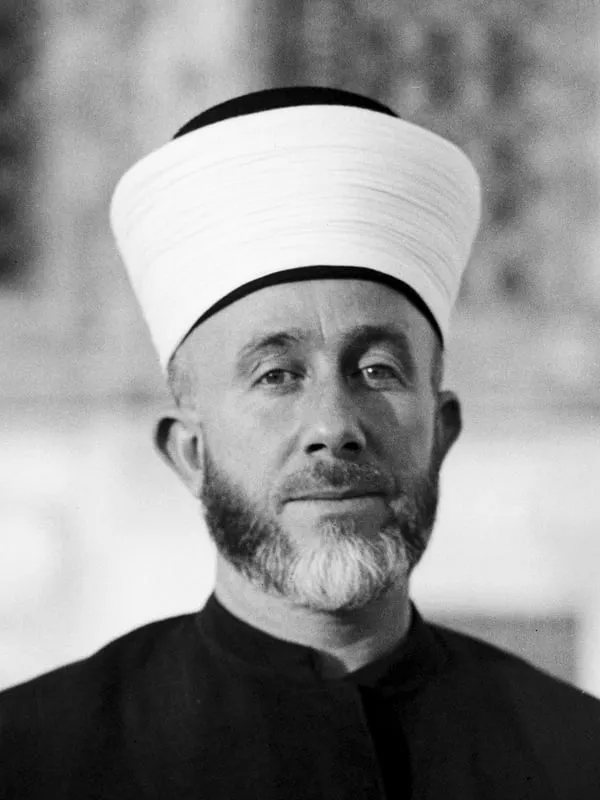
- Born:
- 1895, Jerusalem (Ottoman Empire)
- Died:
- 4 July 1974, Beirut (Lebanon)
- Author:
- Łukasz
- Photo:
- American Colony (Jerusalem), Photo Dept., photographer, domena publiczna, Wikimedia Commons

Mohammed Amin al-Husseini, known as Hajj Amin and in Europe above all as the Grand Mufti of Jerusalem, was the most important leader of the Palestinian Arabs in the era of the British Mandate. The British made him Mufti of Jerusalem in 1921, expecting him to keep the peace. Some fifteen years later he led an Arab revolt against their rule and against Jewish settlement, and after fleeing Palestine he sought the backing of Mussolini and Hitler. In 1941, in Baghdad, he called for a holy war against Britain, and from the autumn of that year until the end of the war he lived in Rome and Berlin, broadcasting Axis propaganda to the Arab world, recruiting Muslims into Waffen-SS formations and working to prevent Jewish children from leaving Europe for Palestine. He remains one of the most contested figures of the twentieth century: to some a fighter for Palestinian independence, to others a Nazi collaborator and antisemite. The documented record of his life shows that he was both.
The Husseini family
He was born in Jerusalem, then part of the Ottoman Empire, in 1895 or 1897; sources give both dates. He came from the Husseini family, one of the richest and most influential in the city, which claimed descent from the Prophet. Members of the family had served as mayors of Jerusalem and had held the office of mufti – a scholar authorised to issue opinions on matters of Islamic law – since the late eighteenth century. His father, Tahir al-Husseini, one of the first Arab opponents of Zionism, was mufti, and after him Amin’s half-brother Kamil.
Amin was educated at a Koranic school, at a state Ottoman school, where he learnt Turkish, and at a school run by French Catholic brothers. He also attended classes at the Alliance Israélite Universelle school directed by Albert Antébi. In 1912 he studied briefly in Cairo, at Al-Azhar university and at the school of the Islamic reformer Rashid Rida, who remained his mentor until his death in 1935. In 1913 he made the pilgrimage to Mecca with his mother, earning the title of hajji, and then studied at the school of administration in Istanbul. After the outbreak of the First World War he became an artillery officer in the Ottoman army and served near Izmir. At the end of 1916 he was granted sick leave and returned to Jerusalem, where he was when the British entered the city in December 1917. He went over to the Allies and recruited volunteers for the army of Emir Faisal, which fought the Turks alongside the British.
From Damascus to Jerusalem
After the war al-Husseini was a pan-Arab nationalist. He headed the Arab Club in Jerusalem, which demanded the union of Palestine with Syria under Faisal’s rule and a halt to Jewish immigration – for Britain’s Balfour Declaration of 1917 had promised the establishment of a “national home for the Jewish people” in Palestine. On 4 April 1920, during the Nabi Musa festival, after speeches that included one of his, a crowd attacked the Jewish quarter of the Old City. In the riots five Jews and four Arabs were killed and more than two hundred people were wounded. Al-Husseini fled to Syria, and a British military court sentenced him in absentia to ten years’ imprisonment. A few months later the French crushed Faisal’s army and occupied Damascus, and the idea of a Greater Syria collapsed. Al-Husseini, like many of his generation, then turned to a specifically Palestinian nationalism centred on Jerusalem.
The first British High Commissioner for Palestine, Herbert Samuel, pardoned him, and when Kamil al-Husseini died in March 1921 he allowed Amin to stand in the election for the office of mufti. Al-Husseini came last, but Samuel wanted to keep a balance between the Husseinis and the rival Nashashibi family, from which the new mayor of Jerusalem, Raghib al-Nashashibi, came. After one of the candidates withdrew, Samuel appointed al-Husseini Mufti of Jerusalem; according to the Holocaust Encyclopedia, this happened on 8 May 1921. The British later gave him the title of Grand Mufti. In January 1922 he became head of the Supreme Muslim Council, which controlled the sharia courts and the funds of the religious endowments (waqfs). This gave him money, posts to hand out and a standing unmatched by any other Arab politician in the country.
Grand Mufti
In the 1920s al-Husseini was a partner to the British. He assured them of his willingness to cooperate and kept the peace, since his power depended on their support. At the same time he built up his position as defender of the holy places of Islam: he raised money across the Muslim world for the restoration of the Al-Aqsa Mosque and the Dome of the Rock, and he presented the dispute over Jewish rights of prayer at the Western Wall as an assault on the Temple Mount. In August 1929 the dispute erupted into bloody riots in which 133 Jews and 116 Arabs were killed, among them the victims of the Hebron massacre. The British Shaw Commission concluded that the Mufti was not directly responsible for the outbreak of violence, although he bore “a share in the responsibility” for the tension that led to it. Historians still argue over whether he stoked it or merely failed to do enough to prevent it.
In December 1931 he convened the World Islamic Congress in Jerusalem, which elected him its president, and he became known throughout the Muslim world. At home his authority was challenged by moderate notables linked to the Nashashibis, who sought an accommodation with the Mandate authorities. When Hitler came to power in Germany in 1933, al-Husseini was among the Arab leaders who greeted the new regime with hope. On 31 March 1933, on the eve of the boycott of Jewish shops in Germany, he met the German consul general in Jerusalem, Heinrich Wolff, and assured him of Muslim sympathy for the Reich. Berlin did not take up the offer. For years afterwards German diplomacy was unwilling to spoil relations with Britain, and the Reich Ministry of Economics operated the Haavara Agreement with the Zionists, which made it easier for German Jews to emigrate – to Palestine, of all places. This emigration, together with the influx of refugees from other countries, raised the Jewish share of Palestine’s population from about 17 to almost 30 per cent within a few years.
Revolt and flight
In April 1936 the tension exploded. Arab leaders proclaimed a general strike, and al-Husseini, cautious at first, took the lead of the newly formed Arab Higher Committee, which demanded a halt to Jewish immigration, a ban on land sales to Jews and the creation of an Arab national government. The strike grew into the Arab revolt, directed against the British administration and Jewish settlements. The Mufti financed his men’s operations from the funds he controlled and with money supplied by Fascist Italy. Before the British commission headed by Lord Peel he was the principal witness for the Arab side. When the commission proposed in July 1937 that Palestine be partitioned into a Jewish and an Arab state, the revolt flared up again.
In July 1937 the Mufti, forewarned of a planned arrest, took refuge in the sacred precinct of the Haram al-Sharif, which the British police did not enter. After the murder of the British district commissioner for Galilee on 26 September 1937, the Mandate authorities dissolved the Arab Higher Committee and stripped al-Husseini of the presidency of the Supreme Muslim Council and of control of the waqfs. On the night of 13–14 October he let himself down from the walls of the Haram on a rope, reached Jaffa and sailed to Lebanon. There he lived under French surveillance at Zouk Mikael and directed the continuing struggle. The revolt was crushed in 1939. According to figures compiled by the Holocaust Encyclopedia, 206 Jewish and 454 Arab civilians and 175 members of the Mandate security forces and administration died in it, and the British army killed 1,138 Arab insurgents. Many Arabs also died at the hands of the insurgents themselves: the Mufti’s men killed political opponents and suspected collaborators, which alienated some of his compatriots. In May 1939 the British published a White Paper that announced a limit of 75,000 Jewish immigrants over five years and the creation within ten years of a state with an Arab majority. Al-Husseini persuaded the Arab Higher Committee to reject it.
Baghdad
After the outbreak of war the French demanded that he declare his support for the Allies. On 14 October 1939 the Mufti secretly left Beirut and two days later was in Baghdad. Iraq had just broken off relations with Germany, but feeling in the army and among nationalists was anti-British, and the visitor from Jerusalem was received with honours. A secret Arab Committee formed around him, bringing together Iraqi politicians, the four colonels of the “Golden Square” and émigrés from Palestine and Syria. In the summer of 1940 the Mufti briefly supported a compromise on Palestine negotiated by the British Colonel Stewart Newcombe, but when London backed away from it at the end of August, he finally staked everything on the Axis. His secretary, Uthman Kamal Haddad, travelled to Berlin with drafts of a declaration in which Germany and Italy were to recognise the independence of the Arab states and their right to settle the “Jewish question” in Palestine in the way it had been settled in the Axis countries. In January 1941 the Mufti wrote to Hitler on the matter.
In the first days of April 1941 the colonels carried out a coup d’état and handed power to Rashid Ali al-Gaylani. Al-Husseini did not join the government but was its chief link with Germany and Italy. When the British landed troops at Basra and the Iraqi army surrounded the base at Habbaniya, the Anglo-Iraqi War broke out. On 9 May 1941 the Mufti proclaimed over the radio a fatwa calling on Muslims throughout the world to wage holy war against Britain. The call provoked no uprising, in Palestine or anywhere else, and German help proved belated and meagre. On 29 and 30 May the leaders of the coup fled to Iran. On 1 and 2 June a pogrom of Jews known as the Farhud broke out in Baghdad. The Mufti later blamed the Jews for Iraq’s defeat, but the documents do not link him directly to the pogrom.
In Rome and Berlin
In Iran al-Husseini enjoyed the protection of the Japanese and Italian legations. After the Anglo-Soviet invasion of Iran in August 1941, Italian military intelligence smuggled him through Turkey and the Balkans to Italy. He was in Rome on 11 October, and on 27 October he was received by Benito Mussolini. On 6 November he arrived in Berlin, on 20 November he held talks with Joachim von Ribbentrop, and on 28 November 1941 Adolf Hitler received him at the Reich Chancellery. The Mufti insisted that the Arabs were Germany’s natural friends because they had the same enemies: the English, the Jews and the Communists. He asked for a public declaration of support for Arab independence and unity and for the removal of the Jewish national home in Palestine. Hitler refused, citing considerations for Vichy France, but assured him that once the Wehrmacht had broken through the Caucasus, Germany’s sole aim in the Middle East would be the destruction of the Jews living there under British protection. Historians reject the claim that it was the Mufti who gave Hitler the idea of the Holocaust: the mass murder of Jews had been under way in the occupied territories of the Soviet Union since the summer of 1941.
The Germans kept him in style. He lived in a villa in the Berlin district of Zehlendorf and received a generous monthly allowance. For the Reich he was above all a voice of propaganda: in German radio’s Arabic broadcasts he called for an uprising against the British, portrayed the Jews as the enemies of Islam and the instigators of the war, and presented Germany as the only power that was “solving” the Jewish question. In December 1942 he opened the Central Islamic Institute in Berlin, and on 1 March 1944, in a radio speech attributed to him, he urged: “Kill the Jews wherever you find them.” He came into closer contact with Heinrich Himmler in 1943. In his memoirs he wrote that in the summer of that year Himmler told him that more than three million Jews had been murdered. Al-Husseini never denied the Holocaust.
In the spring of 1943 the SS began forming a Waffen-SS division from Bosnian Muslims and asked the Mufti for help. At the turn of March and April he toured Bosnia, then part of the Independent State of Croatia, and his visit, as the SS reported, substantially increased the number of volunteers. The result was the 13th SS Mountain Division “Handschar”, which fought the partisans in north-eastern Bosnia and committed crimes against the Serb population. At the same time the Mufti wrote to Ribbentrop, to Himmler and to the governments of Hungary, Romania, Bulgaria and Italy, demanding that they not let Jews, and especially Jewish children, leave for Palestine. On 25 July 1944 he suggested to the Hungarian foreign minister that if Jews had to be sent anywhere, they should rather be directed to countries where they would be under “active control”, for example Poland. According to the Holocaust Encyclopedia, the Germans would have thwarted these rescue efforts even without his involvement, and his letters did not change the fate of those concerned, but the Mufti’s intent is beyond doubt. On the other hand, most historians regard as unreliable the testimony of Dieter Wisliceny, deputy to Adolf Eichmann, who claimed that the Mufti had been one of the instigators of the Holocaust.
In October 1944 the SS parachuted a German–Arab sabotage team into the Jordan Valley; its members later testified that the Mufti had briefed them personally before departure. The British quickly rounded up most of them. The German intelligence services, which for years had paid for al-Husseini and his entourage, complained that he provided them with little of value.
After the war
On 7 May 1945 he flew to Switzerland, but was refused asylum and handed over to the French. France, hoping to improve its standing in the Arab world, kept him under comfortable house arrest near Paris and refused to extradite him to Britain or Yugoslavia, although he appeared on lists of war criminals. On 29 May 1946, with the tacit consent of the French, he flew to Egypt on false papers. His arrival in Cairo was announced on 20 June 1946; crowds hailed him as a hero. The Arab League made him chairman of the body representing the Palestinian Arabs, which was once again the Arab Higher Committee.
Al-Husseini rejected the partition plan for Palestine adopted by the United Nations in November 1947 and created his own Army of the Holy War, commanded by his kinsman Abd al-Qadir al-Husseini, who was killed in April 1948. The Arab states, however, gave him no command in the war with Israel. In September 1948 the so-called All-Palestine Government was set up in Egyptian-occupied Gaza, and the Mufti presided over the national council convened there, which proclaimed Palestinian independence on 1 October. The government remained a tool of Egypt against King Abdullah of Transjordan, who had taken the West Bank and East Jerusalem, appointed his own mufti and in 1951 was shot dead in the Al-Aqsa Mosque. No evidence of al-Husseini’s involvement in the assassination has been found.
The defeat of 1948 and the Nakba – the flight and expulsion of hundreds of thousands of Palestinian Arabs – destroyed his position. He lived in Egypt and later in Lebanon, still presided over the World Islamic Congress and attended international conferences, including Bandung in 1955, but real leadership passed to the Palestine Liberation Organization, founded in 1964. He died in Beirut on 4 July 1974. The Israeli authorities refused permission for burial in Jerusalem, so he was buried in Beirut.
Significance
Al-Husseini was the first leader of the Palestinian national movement to win renown throughout the Muslim world, and at the same time the politician who bound that movement to the worst possible ally. Historians debate how far he was driven by nationalism and by the calculation that “the enemy of my enemy is my friend”, and how far by antisemitism. His wartime speeches and letters show, however, that by 1945 the two motives had merged into one: the struggle against Britain and against Zionism had become for him a struggle against the Jews as such, and the Reich that was murdering them was his ally. For the history of the Second World War he matters above all as a symbol of the hopes that Hitler and Mussolini placed in the anti-British mood of the Arab world, and of how little those hopes achieved: neither the fatwa of May 1941 nor the later broadcasts from Berlin sparked an uprising in the Middle East, and far more Arabs served in the Allied armies during the war than in Axis formations.
Sources
Mentioned in battles
(02)Often appears with
People who appear in the same events.