United Kingdom
Orde Wingate
Commander of the Special Night Squads (1938), Gideon Force (1941), the 77th Brigade – the Chindits (1942–1943) and Special Force (1943–1944), major general
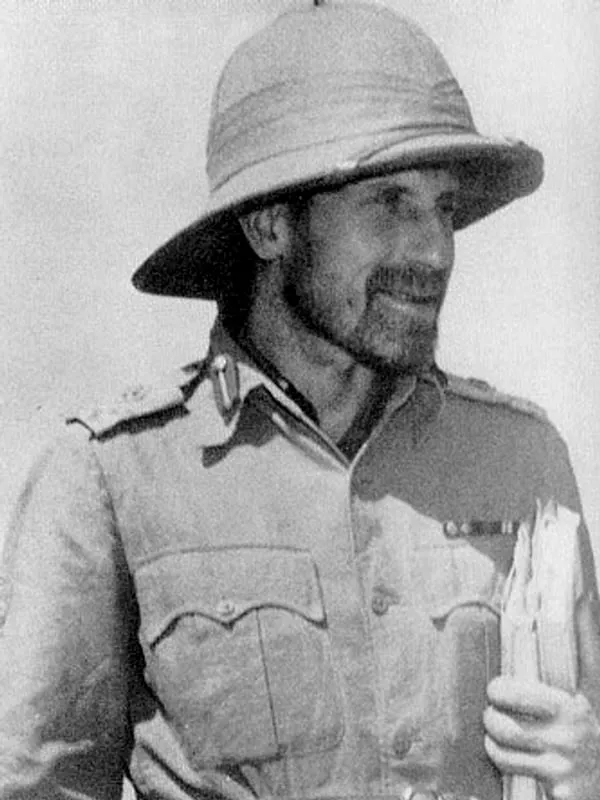
- Born:
- 26 February 1903, Naini Tal (British India)
- Died:
- 24 March 1944, near Bishnupur, Manipur (British India)
- Author:
- Natalia
- Photo:
- U.S. military photo, domena publiczna, Wikimedia Commons

Orde Charles Wingate was one of the most extraordinary and most controversial British commanders of the Second World War. An artillery officer, an Arabist and a deeply religious Christian Zionist, in Palestine in the late 1930s he created the joint Jewish–British Special Night Squads; in 1941 he led Gideon Force in Ethiopia, which cleared the way to the capital for Emperor Haile Selassie; and in Burma he created the Chindits – columns that operated for weeks behind Japanese lines, supplied from the air. To some he was a genius of irregular warfare, whom Churchill after his death called “a man of genius”; to others he was an eccentric who squandered his soldiers’ lives. He was killed at the age of 41, before he could find out whether his grand concept would succeed.
Childhood and youth
He was born on 26 February 1903 in Naini Tal, a hill station in northern India, the third of seven children of Colonel George Wingate, an officer of the Indian Army. His father, like his mother Ethel, of the Orde Browne family, belonged to the strict evangelical community of the Plymouth Brethren. The children were brought up in isolation from their peers, under a regime of daily reading and memorising of Scripture. The Bible, especially the Old Testament, remained Wingate’s chief point of reference for the rest of his life – in politics and in war alike.
He spent his childhood mainly in England. From 1916 he attended Charterhouse in Godalming as a day boy, and in 1921 he entered the Royal Military Academy at Woolwich, which trained officers for the artillery and the engineers. Even there he made a name for himself as someone who would not conform: according to an often-repeated anecdote, when made to run a gauntlet of senior cadets lashing “offenders” with towels, he walked up to each of them in turn and calmly waited for the blow until they all gave up. In 1923 he was commissioned into the Royal Artillery. He rode a great deal, and his knack for finding fords earned him the nickname “Otter”.
Sudan and the desert
His future course was decided by a relative of his father, General Sir Reginald Wingate, a former Governor-General of the Sudan and High Commissioner in Egypt. On his advice Orde learned Arabic at the School of Oriental Studies in London, and in 1927 he set off – largely by bicycle – across Europe to Egypt and the Sudan. From 1928 to 1933 he served with the Sudan Defence Force on the Ethiopian border, pursuing slave traders and poachers. Instead of routine patrols he used ambushes – the first sign of his later passion for unconventional warfare. At the end of his tour, in early 1933, he organised an expedition into the Libyan Desert in search of the legendary oasis of Zerzura and the lost army of the Persian king Cambyses.
On his way back to England he met the sixteen-year-old Lorna Paterson; they married in January 1935. He spent the following years with artillery units at home, among other things as adjutant of a Territorial field brigade. In 1936 he became a captain.
Palestine and the Special Night Squads
In September 1936 Wingate was posted as an intelligence officer to the staff in Palestine, where an Arab revolt against British rule and Jewish settlement had just broken out. There he became an ardent Zionist: he regarded the rebuilding of a Jewish state as the fulfilment of biblical prophecy, learned Hebrew and made friends with leaders of the Zionist movement, among them Chaim Weizmann, and with commanders of the underground Haganah.
Wingate persuaded his superiors – first General Archibald Wavell and then his successor, Robert Haining – to form the Special Night Squads in June 1938, made up of British soldiers and Jewish volunteers from the Haganah. They were to protect the Iraq Petroleum Company’s oil pipeline running to Haifa and to carry the fight to where the rebels felt safe: at night, in their villages. Wingate personally trained the volunteers and led them into action. Among his men was the young Moshe Dayan, who said years later that Wingate had taught them everything they knew; his methods influenced the tactics of the Haganah and, indirectly, of the later Israeli army.
The squads were effective but also brutal. Historians, among them Tom Segev, describe the collective punishments they inflicted on Arab villages: beating and humiliating the inhabitants, destroying property and, in some cases, killing people who had nothing to do with the attacks. After an attack in September 1938 in which Chaim Sturman, a leader of the kibbutz of Ein Harod, was killed, Wingate led a reprisal raid on the Arab part of Beisan (Beit She’an). These methods drew objections from some British officers. Wingate was awarded the Distinguished Service Order for his service in Palestine, but his open political commitment – he publicly advocated a Jewish state – led his superiors to regard him as compromised as an intelligence officer. In May 1939, as London was restricting Jewish immigration to Palestine in a new White Paper, he was recalled to England.
Ethiopia and Gideon Force
The outbreak of war found him in England, in a post in air defence. After Italy entered the war, Wavell, now Commander-in-Chief Middle East, brought him to Khartoum in the autumn of 1940. Wingate was to support Mission 101 – a British operation fomenting the revolt of the Ethiopian “Patriots” against the Italians, who had ruled the country since the war of 1935–1936. From General William Platt and from Cairo he extracted the means to form a small regular force, which he named Gideon Force after the biblical judge who defeated the great army of the Midianites with a handful of men.
On 20 January 1941 Wingate crossed the Sudanese–Ethiopian border together with Emperor Haile Selassie I, in parallel with the great British offensive in East Africa. Gideon Force – some 1,700 Sudanese and Ethiopian soldiers with a handful of British officers, supported by thousands of camels, most of which died in the mountains – advanced through the province of Gojjam. With night raids, bluff and propaganda Wingate convinced the Italians that he had forces many times larger behind him, and he drove much larger garrisons out of their forts. On 5 May 1941 he rode a white horse at the head of the column that brought the Emperor into Addis Ababa. At the end of May, through bluff and night attacks, he forced the surrender at Agibar of Colonel Saverio Maraventano’s column, which according to British figures numbered several thousand men.
After the East African campaign Gideon Force was disbanded and Wingate reverted to the rank of major. Embittered that his men had been passed over for decorations and that the British were trying to curb Ethiopia’s independence, he wrote a report in Cairo full of attacks on his superiors. Ill with malaria, which he was treating himself with large doses of Atebrin, and in deep depression, he tried to take his own life in July 1941. Saved by an officer in the next room, he returned to England to convalesce. He still had influential friends, however; an abridged version of his report reached Winston Churchill, and the Secretary of State for India, Leo Amery, suggested to Wavell that he find him employment in the Far East.
Burma and the Chindits
He arrived in India in March 1942, as the Japanese were conquering Burma. Wavell, then Commander-in-Chief India, restored his rank of colonel and instructed him to organise operations behind enemy lines, but the swift collapse of the defence at the end of the Burma campaign put paid to the plan. Wingate used a few weeks in Burma to observe and returned to Delhi with a concept of “long-range penetration”: strong columns of regular soldiers, marching through the jungle with mules and radio sets, supplied exclusively from the air and supported by aircraft instead of artillery, were to strike Japanese lines of communication deep behind the front.
Wavell gave him the 77th Indian Infantry Brigade, which Wingate trained in the jungles of central India in the summer of 1942. He called his men Chindits, after the “chinthe”, the mythical lion that guards Burmese pagodas. Training during the monsoon left the brigade with many sick, and the commander himself alienated his officers with his brusqueness and eccentricities: he ate raw onions, scrubbed himself with a brush instead of bathing, received visitors naked in his tent and wore an alarm clock on his wrist. At the same time he impressed with his personal courage and endurance.
When the offensive that the raid was meant to accompany was called off at the turn of 1942 and 1943, Wingate persuaded Wavell to send the brigade in regardless. On 8 February 1943 about three thousand Chindits set out from Imphal, crossed the Chindwin and in early March cut the Mandalay–Myitkyina railway in several places. Wingate then led the columns across the Irrawaddy into dry country criss-crossed by roads, where the Japanese began to close in on them. At the end of March he ordered a withdrawal in small groups. About a third of those who took part did not return, and many of those who did were no longer fit for service.
Quebec and Special Force
The military results of the expedition were modest, but its propaganda value was enormous: after a series of defeats, the press announced that the British had beaten the Japanese in the jungle. Wingate’s report, again full of attacks on other officers, reached Churchill. The Prime Minister summoned him to London and in August 1943 took him to the Quebec Conference, where Wingate presented his concept to the Combined Chiefs of Staff. He won the support of the Americans, who gave him his own air force – Colonel Philip Cochran’s 1st Air Commando Group, with aircraft, gliders and light planes for evacuating the wounded. In September 1943 he was promoted to acting major general and given Special Force – formally the 3rd Indian Division – comprising six brigades. It was formed partly by breaking up the experienced British 70th Infantry Division, to the displeasure of General William Slim and other commanders. On his way back from Quebec Wingate fell ill with typhoid, reportedly after drinking water from a flower vase in a Cairo hotel.
The second expedition, Operation Thursday, began on the night of 5–6 March 1944. Some of the brigades were flown in by glider and aircraft to improvised landing strips deep inside Burma; others went in on foot. Behind Japanese lines the Chindits set up fortified bases with airstrips and attacked the supply lines of the Japanese 18th Division, which was fighting Stilwell’s Chinese and Americans in northern Burma. At almost the same time the Japanese launched their offensive against India, which led to the Battle of Imphal and the Battle of Kohima.
Death
On 24 March 1944 Wingate visited three Chindit bases in Burma and in the evening flew from Imphal to Lalaghat. The American B-25 Mitchell bomber of the 1st Air Commando Group crashed in the wooded hills of Manipur, near Bishnupur. Nine people were killed: five American airmen, Wingate, his aide-de-camp and two British war correspondents. The cause of the crash has never been conclusively established. Command of Special Force passed to Brigadier Walter Lentaigne, and the Chindits fought on until August 1944, increasingly as ordinary infantry and with heavy losses.
The remains of the victims could not be separated. They were buried first in a common grave at the crash site, then in the military cemetery at Imphal, and, since most of the dead were Americans, under an Anglo-American agreement they were moved in 1950 to Arlington National Cemetery. Wingate’s son, Orde Jonathan, was born a few weeks after his father’s death.
Assessment and memory
Churchill called Wingate “a man of genius who might well have become also a man of destiny”. Many of his colleagues took a different view. Slim believed that special forces deprived the army of its best soldiers and that their results did not justify the cost; the British official history of the war against Japan, written under the direction of Stanley Woodburn Kirby, portrayed Wingate as an unbalanced man who had risen beyond his competence, which provoked a long dispute with his defenders, among them his former officers Bernard Fergusson and Michael Calvert. The British historian Simon Anglim called him the most controversial British general of the Second World War. The Japanese commander Renya Mutaguchi acknowledged after the war that in 1944 the Chindits had tied down forces he lacked at Kohima. Historians still argue over whether Wingate was a visionary of air–land warfare ahead of his time or a gifted leader of small units whose concept outstripped the means of his day.
In Israel Wingate is remembered as a friend of the Zionist movement and one of the fathers of its armed forces: among other things, the national institute of physical education and sport (the Wingate Institute), the youth village of Yemin Orde and many streets bear his name. For Palestinians he remains a symbol of the brutal repression of 1938–1939. In Ethiopia a school in Addis Ababa is named after him, and in London, on the Thames Embankment near the Ministry of Defence, stands the Chindit Memorial, the rear of which is dedicated to Wingate.
Sources
Mentioned in battles
(03)Often appears with
People who appear in the same events.