Thailand
Plaek Phibunsongkhram
Prime Minister of Thailand (1938–1944, 1948–1957), Field Marshal (from 1941)
- Born:
- 14 July 1897, Nonthaburi (Siam)
- Died:
- 11 June 1964, Sagamihara (Japan)
- Author:
- Łukasz
- Photo:
- autor nieznany, domena publiczna, Wikimedia Commons

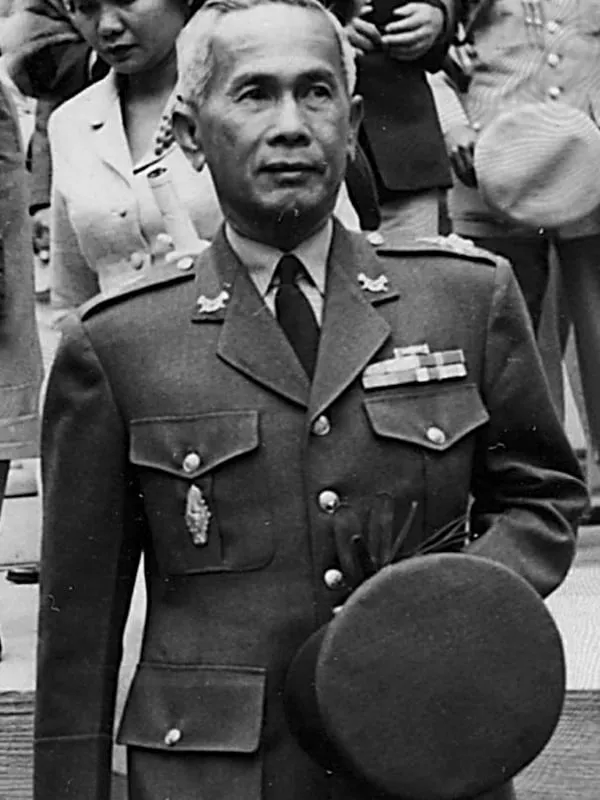
Plaek Phibunsongkhram (also spelt Pibulsongkram), usually known in Western literature simply as Phibun, was an artillery officer who grew into the most important Thai politician of the mid-20th century. As one of the leaders of the 1932 coup he overthrew the absolute monarchy in Siam, and in December 1938 he became prime minister and ruled the country like a dictator. He took Mussolini as his model, built up a personality cult, renamed the state Thailand and imposed new customs on his compatriots. He exploited the fall of France in 1940 to recover territory in Laos and Cambodia in a short war with Vichy France, and in December 1941, after the Japanese invasion, he bound Thailand in alliance with Japan and declared war on Britain and the United States. Removed from power in 1944, he returned to it after the war as an ally of the Americans and ruled until 1957. He died in exile in Japan.
The son of orchard growers from Nonthaburi
He was born on 14 July 1897 in Nonthaburi, near Bangkok, into a family that owned a durian orchard, as Plaek Khittasangkha (the family took the surname after the surname act of 1913). His paternal grandfather was an immigrant from southern China, but the family was fully assimilated. The name Plaek means “strange” in Thai; according to his biographers he was given it because of the unusual shape of the infant’s ears. He attended a temple school and then the Chulachomklao Royal Military Academy. On graduating he was commissioned as a second lieutenant of artillery and served with a regiment at Phitsanulok. He married a teacher, La-iad Bhandukravi, with whom he had six children.
An able and hard-working, if unprepossessing, officer, he won a scholarship for military studies in France. In 1924–1927 he attended the artillery schools at Poitiers and Fontainebleau. In Paris he met young Siamese from middle-class families who were studying at French universities, among them the lawyer Pridi Banomyong. Under the influence of republican France they criticised the absolute monarchy, in which all the important offices were held by princes. Their conversations gave birth to the People’s Party (Khana Ratsadon), a clandestine group of officials and officers. After his return Plaek was promoted to captain, and in 1928 King Prajadhipok granted him the title of Luang Pibulsongkram, which by custom replaced his surname. When noble titles were abolished in 1942, he kept Pibulsongkram as his surname.
Revolution and the road to the top
On 24 June 1932 the People’s Party carried out a bloodless coup that forced Prajadhipok to accept a constitution. Major Phibun was one of the organisers of the coup within the army. In June 1933 he helped General Phraya Phahon seize power in a second coup, directed against the conservative government, and in October of that year he commanded the troops that crushed the royalist rebellion of Prince Boworadet. The victory gave him great prestige in the army. In 1934 he became Minister of Defence, the second man in the state. He survived several assassination attempts: in 1934 he was shot at after a football match, and in 1938 there were attempts to shoot and to poison him.
As Minister of Defence he spread nationalist and militarist propaganda in schools, in film and on the stage. His closest collaborator was Luang Wichitwathakan, an author of plays about the heroic past of the Thais, whom a British diplomat called a “pocket Goebbels”. On 16 December 1938, after a scandal had brought down Phahon’s government, parliament entrusted Phibun with the premiership. He also kept the defence portfolio and the command of the army.
The Leader
Phibun came to power legally, but at once dealt with the opposition. In early 1939 several dozen royalists, opponents from within the People’s Party and members of parliament were arrested and accused of conspiring on behalf of the former king, Prajadhipok. A special court, in a trial that historians regard as lacking any legal basis, sentenced 18 of them to death and dozens of others to prison. Prajadhipok, in exile in England since 1935, became persona non grata, and his portraits disappeared from government offices. Their place was taken by photographs of the prime minister.
The government issued a series of “cultural mandates” (ratthaniyom) designed to turn the Thais into a modern nation. On 24 June 1939 Siam took the name Thailand. Subsequent decrees required respect for the flag and the new anthem, the use of the standard language instead of dialects, the wearing of European clothes and hats, and eating with cutlery. From 1941 the year began on 1 January rather than in April. Economic policy was aimed at the Chinese, who dominated trade: Chinese schools and newspapers were closed, they were barred from certain occupations, and Wichitwathakan publicly compared them to the Jews in Germany. A leader cult grew up around the prime minister. His birthday became a national holiday, cinemas had to show his portrait, and from 1942 propaganda called him phu nam, “the Leader”, under the slogan: “Believe in the Leader and the nation will be safe.”
War with France
The aim of Phibun’s foreign policy was to recover the territories that Siam had ceded to France in 1893–1907 and, in the longer term, to unite all the Tai peoples. The fall of France in June 1940 and the Japanese entry into Tonkin in September convinced him that Vichy France would be unable to defend itself. When Marshal Pétain’s government rejected demands for the return of the lands on the right bank of the Mekong and in western Cambodia, Phibun organised mass demonstrations in Bangkok, and from November 1940 an undeclared war was fought on the border. In January 1941 the Thai army occupied the disputed territory in Laos and advanced into western Cambodia.
The Governor-General of Indochina, Admiral Jean Decoux, struck back at sea. On 17 January 1941, at the Battle of Ko Chang, a French squadron sank two Thai torpedo boats and disabled the coastal defence ship Thonburi. The outcome of the war, however, was decided by Japan, which imposed on both sides an armistice signed on 31 January aboard the cruiser Natori off Saigon, and then dictated the peace terms. The Treaty of Tokyo of 9 May 1941 gave Thailand the Laotian lands on the right bank of the Mekong, together with the province of Battambang and most of Siem Reap in Cambodia. Bangkok celebrated a victory, the Victory Monument was erected in the capital, and one of the new provinces was named after the prime minister. In July 1941 Phibun made himself field marshal, admiral of the fleet and air chief marshal, skipping several ranks.
Japan’s ally
Japanese “mediation” came at a price. According to some historians, Phibun gave the Japanese a verbal promise of support should they go to war with the British. At the same time he feared that Japan, already established in Indochina, would swallow Thailand too, and in 1941 he sought British and American guarantees while trying to remain neutral. On 8 December 1941, in the same hours as the attack on Pearl Harbor and the landings in Malaya, Japanese troops landed on the Thai coast and crossed the border from Indochina. After a few hours of fighting the government agreed to let them pass through to Malaya and Burma. As the Japanese advanced rapidly through Malaya, Phibun concluded that they would win the war. On 21 December 1941 he concluded an alliance with Japan, and on 25 January 1942 Thailand declared war on Britain and the United States.
The opponents of this policy left the government. Pridi Banomyong became regent on behalf of the young King Ananda Mahidol, who was living in Switzerland, and became one of the leaders of the underground Seri Thai (“Free Thai”) movement, which worked with the Allies. The Thai minister in Washington, Seni Pramoj, refused to deliver the declaration of war, and the United States did not declare war on Thailand. In 1942 Thai troops occupied part of the Burmese Shan States together with the Japanese, and in 1943 Prime Minister Hideki Tōjō handed over to Thailand four sultanates of northern Malaya. The alliance, however, proved costly. The Japanese army behaved like an occupier, requisitioning rice and cattle, and forced tens of thousands of Asian labourers and Allied prisoners of war, many of whom died, to build the Burma Railway. Inflation and shortages undermined the prime minister’s popularity.
In July 1944, as Japan’s defeat was becoming obvious, parliament rejected his plans to move the capital to Phetchabun in the jungle and to build a “Buddhist city”. On 24 July Phibun resigned, counting on being asked to stay. Instead, parliament chose as prime minister Khuang Aphaiwong, who kept up the appearance of cooperation with Japan while in reality favouring the Free Thai. Soon afterwards the marshal also lost command of the army and left for Lop Buri.
The comeback
After Japan’s surrender Phibun was arrested and put on trial as a war criminal – in practice for collaborating with Japan. In March 1946 the Supreme Court ruled that the war crimes act, passed after the fact, could not be applied retroactively, and the marshal regained his freedom. A brief period of civilian rule ended after the unexplained death of King Ananda in June 1946. In November 1947 officers linked to Phibun staged a coup, Pridi had to flee the country, and on 8 April 1948 Phibun became prime minister once again.
His second dictatorship differed from the first. He abandoned fascist rhetoric and relied on the United States as a Cold War ally. He sent Thai troops to the Korean War, and in 1954 Thailand became a founding member of SEATO, receiving generous military and economic aid in return. He had, however, to share power with the generals who had restored him, especially the army commander Sarit Thanarat and the police chief Phao Siyanon. He survived several coup attempts. In June 1951 mutinous naval officers abducted him aboard the ship Sri Ayutthaya – the same vessel that had missed the Battle of Ko Chang in 1941. The air force bombed the ship, and the prime minister saved himself by swimming ashore.
After a journey to the United States and Europe in 1955 Phibun announced a programme of democratisation: he allowed political parties to be formed, declared an amnesty for political opponents and set up a “speakers’ corner” in Bangkok modelled on London’s Hyde Park. His party nevertheless won the elections of February 1957 by blatant fraud, and King Bhumibol Adulyadej made no secret of his dislike for a prime minister who regarded the monarchy as a relic. On 16 September 1957 Sarit overthrew him in a military coup.
Exile and assessment
Phibun fled to Cambodia and then settled in Japan, as the new authorities would not let him return. In 1960 he lived for a time as a Buddhist monk at Bodh Gaya in India. He died of a heart attack on 11 June 1964 in Sagamihara near Tokyo (some sources give Tokyo as the place of death). His ashes were brought back to Bangkok.
The verdict on his rule remains contested. For many Thai intellectuals he was an opportunistic dictator who stifled a fledgling democracy and, during the war, tied the country to Japan. Historians emphasise the fascist models of his first government: the leader cult, the irredentism of a “Greater Thailand”, the discrimination against the Chinese. More sympathetic biographers point out that in 1941 he chose submission to Japan in a situation with no way out, that in his last year in power he shielded the Free Thai operating inside the country, and that Thailand, thanks to the American attitude, escaped the fate of a defeated state after the war. Many of his reforms have survived: the name Thailand, the greeting sawatdi, European dress and the dish pad thai, which became widespread in his time. For the history of the Second World War, what matters most is that his war with France at the turn of 1940 and 1941 allowed Japan to act for the first time as an arbiter in South-East Asia and to build up the influence on which it drew in December 1941.
Sources
Mentioned in battles
(01)Often appears with
People who appear in the same events.