United States
Cordell Hull
Congressman from Tennessee (1907–1921, 1923–1931), senator (1931–1933), US Secretary of State (1933–1944)
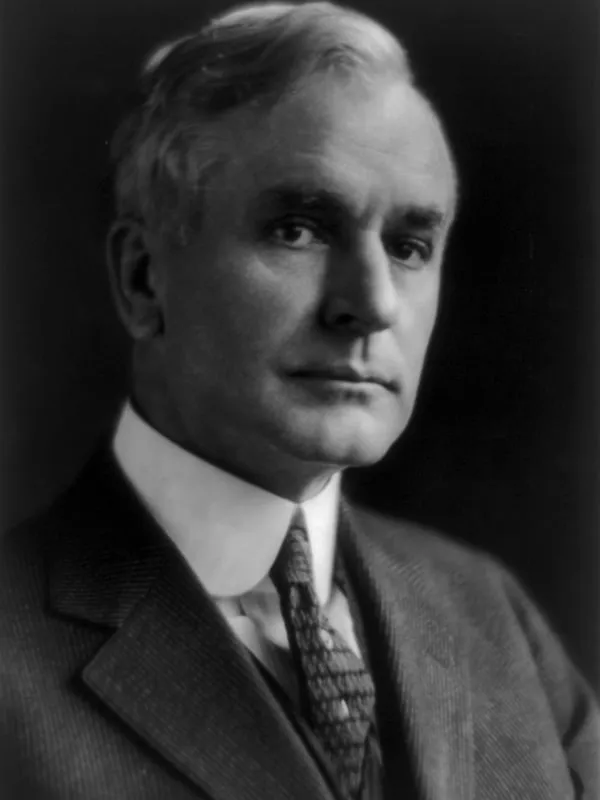
- Born:
- 2 October 1871, Olympus, Overton County, Tennessee (United States)
- Died:
- 23 July 1955, Washington, D.C. (United States)
- Author:
- Natalia
- Photo:
- Underwood & Underwood, domena publiczna, Wikimedia Commons

For almost twelve years, from March 1933 to November 1944, Cordell Hull directed American diplomacy. No other Secretary of State has held the office for so long. A plain-spoken politician from the Tennessee hills who talked slowly and with a Southern drawl, he believed that tariffs and trade barriers were the root of wars and that free trade between nations was the best guarantee of peace. Franklin Delano Roosevelt often handled the most important foreign questions himself or through other advisers, but Hull remained the face of the State Department in the years when America moved from neutrality to war. It was he who conducted the talks with Japan in 1941 that ended with the attack on Pearl Harbor, and he who laid the groundwork for the United Nations, for which he received the Nobel Peace Prize.
From a Tennessee log cabin to Congress
He was born on 2 October 1871 in a log cabin in Olympus, in what was then Overton County (today Pickett County) in Middle Tennessee, not far from the Kentucky border. He was the third of five sons of William Paschal Hull, a farmer who made his money floating timber down the Cumberland River to Nashville. In a district that still remembered the Civil War, everyone kept to their own church and their own party, and the Hulls had voted Democratic for generations. Young Cordell began speaking at rallies early, and at nineteen he became chairman of the Democratic Party committee in Clay County. He took Thomas Jefferson as his model and all his life described himself as a “Jeffersonian Democrat”.
He graduated in law from the Cumberland School of Law in Lebanon and became a lawyer in the early 1890s. From 1893 to 1897 he sat in the lower house of the state legislature. During the Spanish–American War of 1898 he served in Cuba as a captain in the 4th Tennessee Volunteer Infantry Regiment, although he arrived too late to see any fighting. In 1903 he became a circuit judge, and the title “Judge” stayed with him for the rest of his life.
In 1906 he was elected to the House of Representatives, where he sat from 1907 to 1921 and from 1923 to 1931. On the Ways and Means Committee, which was responsible for taxes and tariffs, he was the leading opponent of high tariffs, which in his view weighed on poor farmers and bred international conflict. In 1913, when the Democrats under President Woodrow Wilson lowered tariffs, he drafted the bill introducing a federal income tax to make up the lost revenue. The World War strengthened his conviction that protectionism and trade wars led to real wars. He supported American membership of the League of Nations. In 1917 he married Rose Frances Whitney, née Witz, a widow from a family of Jewish origin. The marriage was childless.
In 1920, amid a sweeping Republican victory, he lost his seat. For three years he chaired the Democratic National Committee, at a time when the party was in debt and divided over Prohibition, and he left it in better shape. In 1922 he returned to the House, and in 1930 he was elected to the Senate. In 1932 he backed Roosevelt in the contest for the presidential nomination. The new president, who needed the support of conservative Southern Democrats, entrusted him with the State Department.
Secretary of State
Hull took office on 4 March 1933. A few months later he suffered a humiliation that foreshadowed his relations with the president. He led the American delegation to the World Economic Conference in London, and in July Roosevelt, with a single telegram, wrecked the plans for currency stabilisation under discussion there, and the conference collapsed. Likewise, in the talks on recognising the USSR in the autumn of 1933, the president took over personally when the negotiations under Hull stalled. In December 1933, at the conference of American states in Montevideo, Hull – the first Secretary of State to attend such a gathering – announced that the United States would not interfere in the internal affairs of its neighbours. The “Good Neighbour” policy towards Latin America became his domain.
Hull’s greatest achievement of the 1930s was the Reciprocal Trade Agreements Act of June 1934, which allowed the president to lower tariffs in return for concessions from other countries. By 1939 the United States had concluded agreements under it with some twenty countries. Hull believed that economic cooperation among the democracies would in time draw in Germany, Italy and Japan as well, once they understood that autarky and territorial conquest would not bring them prosperity. On this he clashed with Treasury Secretary Henry Morgenthau and Interior Secretary Harold Ickes, who wanted a tougher line towards the fascist states.
Hull was cautious in the face of the wars in Ethiopia, Spain and China. He opposed the Neutrality Acts, which from 1935 tied the government’s hands, arguing that rigid legislation treating aggressor and victim alike would weaken the countries that were attacked. When Japan attacked China in 1937, he set out the principles the United States would defend: the peaceful settlement of disputes, non-interference, respect for treaties and equality of commercial opportunity. In October 1937 he would have preferred more general language than Roosevelt used in his Quarantine Speech, and he later complained that the hostile reaction had set his efforts back by six months. After the sinking of the gunboat Panay in December 1937 he conveyed the president’s anger to the Japanese, and on 26 July 1939, during the Tientsin crisis, he handed the Japanese ambassador notice of the termination of the 1911 commercial treaty. This later made it possible to restrict exports to Japan.
On refugees from Germany, Hull’s State Department was cautious and, in the view of many historians, callous. Hull did initiate the Évian Conference in 1938, but the consulates kept strictly to the immigration quotas, and in June 1939 the United States refused to admit the Jews aboard the St. Louis, which had to return to Europe.
Neutrality and hemisphere defence
After war broke out in Europe, Hull and Roosevelt persuaded Congress to amend the Neutrality Act, which from November 1939 allowed Britain and France to buy arms for cash. At the same time he worked for a common front of the American republics. At his request the foreign ministers met in Panama in September 1939 and, after the fall of France, in Havana in July 1940, where Hull personally won over the reluctant Argentines to an act providing for joint administration of European colonies in the Americas. In 1940 he declined Roosevelt’s offer of the vice-presidential nomination. He liked neither the post nor the president’s intention to seek a third term.
Hull resented the fact that Roosevelt often bypassed him and dealt directly with Under Secretary of State Sumner Welles, his trusted expert on Latin American and European affairs. The rivalry between the two dragged on for years. In 1943 Hull forced Welles’s resignation, making use of rumours about his private life. In the negotiations with Britain in 1940–1941 over destroyers and Lend-Lease, Hull played a smaller part than Roosevelt and his advisers, although in January 1941 he was the first witness to defend the Lend-Lease bill before a congressional committee.
Negotiations with Japan
Hull’s most important task in 1941 was his talks with the Japanese ambassador Kichisaburō Nomura, held from the spring onwards, often in his apartment at the Wardman Park Hotel. The Americans, who had broken the Japanese diplomatic cipher, were reading Tokyo’s telegrams to the embassy, so Hull knew his interlocutors’ position better than they suspected. He demanded that Japan accept four principles: the territorial integrity of all states, non-interference, equality of commercial opportunity, and no change in the status quo in the Pacific except by peaceful means. The sticking point was the withdrawal of Japanese troops from China. When Japanese forces entered southern Indochina in July 1941, the United States froze Japanese assets and halted oil deliveries. Prime Minister Fumimaro Konoe proposed a personal meeting with Roosevelt, but Hull feared that without concrete prior commitments from Tokyo it would end either in a vague declaration or in a deal at China’s expense.
In October 1941 General Hideki Tōjō became Prime Minister of Japan. In late November Hull considered a temporary arrangement that would have eased the embargo in return for the withdrawal of some troops from Indochina. He dropped it after Chinese protests and in view of reports of Japanese troop transports moving south. On 26 November he handed Nomura and the special envoy Saburō Kurusu the document later known as the “Hull note”: an outline settlement under which Japan was to withdraw all its forces from China and Indochina, recognise the government of Chiang Kai-shek and in effect leave the Tripartite Pact, while the United States would lift its sanctions and conclude a new commercial treaty. The note set no deadline and was marked as tentative, but in Tokyo it was regarded as an ultimatum. Hull did not believe the Japanese would accept it. On 27 November he told Secretary of War Henry Stimson that he had washed his hands of it and that the matter was now in the hands of the Army and the Navy.
On the afternoon of 7 December 1941 Nomura and Kurusu brought Hull the Japanese reply, when he already knew of the attack on Pearl Harbor. Having read it, he told them that in fifty years of public service he had never seen a document so crowded with “infamous falsehoods and distortions”, and showed them the door.
The war and the United Nations
During the war Hull was increasingly left out of strategic decisions. He did not take part in Roosevelt’s meetings with Winston Churchill and Joseph Stalin. He was among the most implacable opponents of Charles de Gaulle. When in December 1941 Free French ships seized the Vichy-held islands of Saint-Pierre and Miquelon off Newfoundland, he protested against the action of the “so-called Free French”, drawing ridicule from the press. He defended maintaining relations with Vichy, which, he argued, made it easier to prepare the landings in North Africa in 1942.
He made preparing the post-war order his main task. From 1942 he directed work on plans for an international organisation that was to remedy the failings of the League of Nations. In October 1943, at the age of 72, he flew to the conference of foreign ministers in Moscow, where the United States, Britain, the USSR and China undertook to create a general security organisation. In the autumn of 1944 its outline was agreed at the Dumbarton Oaks Conference. Hull made sure that the project had the support of both parties in Congress, mindful of how in 1919 the Senate had rejected Wilson’s League of Nations. In September 1944 he opposed the Morgenthau Plan, which envisaged turning Germany into an agricultural country.
Seriously ill with a recurrent lung disease that his doctors described as tuberculosis and later studies as sarcoidosis, he resigned at the end of November 1944. His term ended on 30 November. He was succeeded by Edward Stettinius. Roosevelt called him the “father of the United Nations”. In 1945 Hull received the Nobel Peace Prize for his contribution to the founding of the United Nations, for the Good Neighbour policy and for the trade agreements. In 1948 he published his memoirs in two volumes. His wife died in 1954. Hull died in Washington on 23 July 1955 and was laid to rest in Washington National Cathedral.
Significance
Hull was no great strategist, and it was not he who decided the most important turns of American policy, but throughout the era from Hitler’s rise to power to the last year of the war he was its fixed point. His faith in free trade as a cure for war seemed naive in the 1930s in the face of dictators who wanted to conquer rather than trade. Yet it survived the war: the post-war agreements on tariff reduction grew out of his ideas, and the UN out of the work of his officials.
In the history of the road to the Pacific War, Hull remains a contested figure. Japanese nationalists portrayed his note of 26 November 1941 as an ultimatum that forced Japan into war. Most historians point out that Tokyo had decided to prepare for war as early as September and that the note restated principles Hull had been proclaiming since 1937. Critics on the other side accused him of appeasing Japan for too long by selling it oil and scrap metal, and of presiding over a State Department that shut the door on many refugees from Europe.
Sources
Mentioned in battles
(01)Often appears with
People who appear in the same events.
On the timeline
(73)The 40 most important of 73 events. All tagged “Cordell Hull” (4) →
1933
1934
1935
1937
1938
1939
April
June
September
October
November
- 04
- The United States adopts cash and carryOn 4 November 1939 Roosevelt signed a new Neutrality Act. It lifted the arms embargo: belligerents could buy arms for cash and carry them in their own ships.
- The end of the City of Flint affairOn 3 November 1939 the Germans brought the captured City of Flint into Haugesund. That night Norway returned her to the Americans and interned the prize crew.