Japan
Hideki Tōjō
Chief of Staff of the Kwantung Army (1937–1938), War Minister (1940–1944), Prime Minister of Japan (1941–1944), Chief of the Army General Staff (1944)
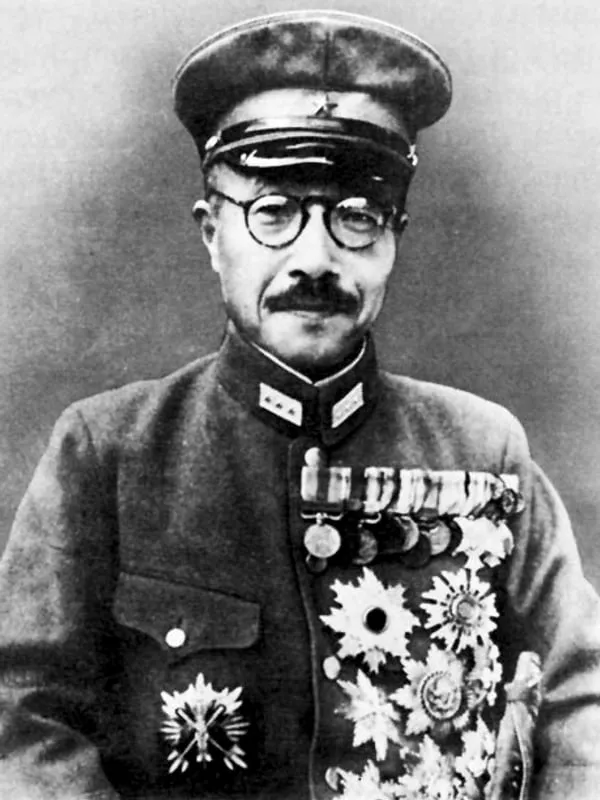
- Born:
- 30 December 1884, Kōjimachi district, Tokyo (Japan)
- Died:
- 23 December 1948, Sugamo Prison, Tokyo (Japan)
- Author:
- Łukasz
- Photo:
- autor nieznany, domena publiczna, Wikimedia Commons

To its enemies in the Second World War, Hideki Tōjō was the face of Japan. A professional officer and a conscientious bureaucrat nicknamed “the Razor” (カミソリ, Kamisori), in the 1930s he rose to lead the faction that wanted to turn Japan into a state organised for total war. As chief of staff of the Kwantung Army in 1937 he led troops deep into China; as War Minister in 1940–1941 he pressed for the alliance with Germany and refused to withdraw troops from China, the price at which the Americans were prepared to lift their embargo; and as Prime Minister from October 1941 he took the decision for war with the United States, Britain and the Netherlands. Removed from power after the loss of Saipan in 1944, he tried to shoot himself after the defeat, and in 1948, sentenced by the International Military Tribunal for the Far East, he was hanged.
A general’s son
He was born in Tokyo, in the Kōjimachi district. Most sources give his date of birth as 30 December 1884, though some Japanese works give 30 July of that year. He was the third son of Hidenori Tōjō, an officer from an impoverished samurai family in the service of the lords of Morioka, who as one of the first graduates of the Army Staff College rose to the rank of lieutenant general. His two elder brothers died in childhood, so Hideki was brought up as heir to the family. To the end of his life his father believed that his career had been blocked because he did not belong to the clique from the former Chōshū domain that was so powerful in the army. The son inherited from him a dislike of that clique and the conviction that everything had to be achieved through hard work.
He went through the cadet schools and in March 1905, towards the end of the Russo-Japanese War, graduated from the Army Academy; in April he was commissioned as a second lieutenant in the Guards infantry. Like most Japanese, he regarded the Treaty of Portsmouth as a humiliation, for which the American mediator was partly blamed. In 1909 he married Katsuko Itō, with whom he had three sons and four daughters. He twice failed to gain admission to the Army Staff College. He was accepted at the third attempt, in 1912, and graduated in 1915, eleventh in his class. His fellow officers remembered him as not the most gifted of men, but a tireless one. It was said that he had learnt a thick volume of army regulations by heart.
Baden-Baden and the army reformers
In 1919 he went to Switzerland as military attaché, and in 1921 to Germany, where he saw at close quarters the consequences of a lost war. On 27 October 1921 in Baden-Baden three young majors, Tetsuzan Nagata, Toshishirō Obata and Yasuji Okamura, made an informal pact: they resolved to renew the army, break the influence of the Chōshū clique and prepare Japan for a future total war. Tōjō joined them and became Nagata’s closest associate. On his way home in 1922 he crossed the United States by train. It was his only contact with America. Like many officers, he took the American legislation of 1924, which closed the door to immigrants from Japan, as proof that white people would never accept Asians as equals.
In the 1920s he lectured at the Army Staff College and worked in the War Ministry. He belonged to the circles of young officers that in 1929 merged into the Isseki-kai association. Its members, among them Seishirō Itagaki and Kanji Ishiwara, wanted to reshape the army’s officer corps and to “solve the problem of Manchuria and Mongolia”. In 1929 Tōjō commanded the 1st Infantry Regiment, and from 1931 he headed the organisation and mobilisation section of the General Staff. In 1933 he became a major general.
In the mid-1930s the army was torn by a dispute between two factions. The radical Kōdō-ha, the “Imperial Way Faction”, pinned its hopes on a coup d’état and war with the USSR. The Tōsei-ha, the “Control Faction”, centred on Nagata, wanted to change the state from within, through the ministries, and to build a “national defence state” capable of mobilising the whole economy and society for a long war. In 1934 Tōjō, regarded as Nagata’s man, was moved to command a brigade at Kurume, which many historians see as his rivals sidelining him. On 12 August 1935 Nagata was cut down with a sword in his office by Lieutenant Colonel Saburō Aizawa, a supporter of the Kōdō-ha. From then on Tōjō was one of the leaders of the Control Faction.
Manchuria and China
In September 1935 he took command of the military police, the Kempeitai, in the Kwantung Army, and of the police of the Kwantung Leased Territory. When the coup of 26 February 1936 broke out in Tokyo, he had officers in Manchuria suspected of sympathising with the rebels arrested. After the coup collapsed, the Control Faction purged the Kōdō-ha leaders from the army. In December 1936 Tōjō became a lieutenant general, and on 1 March 1937 chief of staff of the Kwantung Army. He saw his first task as preparing for war with the USSR, but he also supported expansion in northern China. At this time he grew close to Yōsuke Matsuoka, president of the South Manchuria Railway, and to Nobusuke Kishi, who ran the economy of Manchukuo.
After the clash at the Marco Polo Bridge in July 1937, Tōjō was among those who demanded a strike rather than a local settlement. In August he personally led a Kwantung Army force in an operation in Chahar Province. On 27 August his troops took Zhangjiakou, and later they reached Datong and Suiyuan. It was his only command in the field. On the occupied territory the Japanese soon set up the puppet state of Mengjiang.
In May 1938 he returned to Tokyo as Vice-Minister of War under Itagaki. On 28 November 1938, speaking to industrialists, he said that the war in China was dragging on because the Chinese were supported by Britain, the United States and the USSR, and that Japan must therefore prepare for a war on two fronts: against the USSR in the north and against the English-speaking powers in the south. The newspapers reported that the vice-minister was calling for preparations for two wars, and a scandal broke out. In December 1938 Tōjō was moved to the post of Inspector General of Army Aviation.
War Minister
When the army brought down Admiral Mitsumasa Yonai’s cabinet in July 1940, Prince Fumimaro Konoe accepted Tōjō as the army’s candidate for War Minister. On 19 July, at a meeting at Konoe’s villa in Ogikubo, Tōjō, Konoe, Matsuoka and Admiral Zengo Yoshida agreed on the new government’s programme, and on 22 July 1940 Tōjō joined the second Konoe cabinet. Konoe hoped that a tough general with an impeccable reputation in the army would secure him its support. Tōjō, however, proved to be one of the strongest voices in favour of the alliance with Germany. In September 1940 Japanese troops entered northern French Indochina, and on 27 September Japan signed the Tripartite Pact with Germany and Italy.
On 8 January 1941 the War Minister issued the “Field Service Code” (戦陣訓, Senjinkun), a set of rules of conduct for soldiers. Its most famous sentence commanded: “Do not live to suffer the shame of capture.” The code contributed to the fact that in the following years Japanese soldiers rarely surrendered and died in hopeless attacks, and in some places civilians also committed suicide. Contempt for captivity also shaped the way the Japanese military treated Allied prisoners of war.
In the summer of 1941, after the German attack on the USSR and the entry of Japanese troops into southern Indochina, the United States froze Japanese assets and halted oil deliveries. In the negotiations with Secretary of State Cordell Hull the key issue became the withdrawal of troops from China. Tōjō was implacably opposed. At cabinet meetings in October 1941 he argued that a concession to America would throw away the fruits of the war in China and endanger Manchukuo and Korea, and he is said to have told the wavering Konoe that sometimes one must close one’s eyes and jump from the veranda of the Kiyomizu temple. On 16 October Konoe resigned.
Wartime Prime Minister
It was Tōjō whom the Lord Keeper of the Privy Seal, Kōichi Kido, proposed as prime minister. His reasoning was that only a general so loyal to the emperor could restrain the army, should the emperor demand it. On 18 October 1941 Tōjō became Prime Minister, keeping the War Ministry and also taking over the Home Ministry. On this occasion he was promoted to full general. Emperor Hirohito instructed him to reconsider the decision of 6 September on preparations for war. The review changed nothing. On 26 November Hull presented the Japanese diplomats with a plan for a settlement that provided for the withdrawal of Japanese troops from China and Indochina. In Tokyo, including within Tōjō’s government, it was presented as an ultimatum, although the note set no deadline and was described as tentative. On 1 December a conference held in the emperor’s presence approved the war. On 7 December 1941, Hawaiian time, Japan attacked Pearl Harbor, Malaya, Hong Kong and the Philippines.
The first months of the war brought Japan conquests from Burma to the Solomon Islands. Tōjō concentrated more offices in his hands than any previous prime minister. For a time he was also Minister of Foreign Affairs, of Education and of Commerce, and in November 1943 he took over the new Munitions Ministry. In the election of April 1942 the state backed the candidates recommended by the government, and critics were hounded by the military police. In November 1943 he presided in Tokyo over the Greater East Asia Conference, at which the leaders of governments dependent on Japan, among them Wang Jingwei, proclaimed a joint declaration. Contrary to the propaganda, the Greater East Asia Co-Prosperity Sphere meant for the occupied countries the plunder of raw materials and food, forced labour and terror. Allied prisoners of war and Asian labourers died in their tens of thousands building the Burma Railway. Tōjō’s government recommended that prisoners be put to work for the war effort.
Tōjō’s power nevertheless had its limits. As Prime Minister and War Minister he did not direct operations, which were the responsibility of the army and navy general staffs, independent of the government. After the defeat at Midway in June 1942 and the fighting on Guadalcanal, the initiative passed to the Americans. In February 1944, after the destruction of the base at Truk, Tōjō broke with tradition and also took the post of Chief of the Army General Staff, which critics saw as an assault on the independence of the high command. In June 1944 the fleet was defeated in the Philippine Sea, and on 9 July the Americans captured Saipan, from which their bombers could strike Japan. Former prime ministers, Konoe among them, and the court had for months been looking for a way to get rid of him. On 18 July 1944 Tōjō’s government resigned. He was replaced by General Kuniaki Koiso, and Tōjō retired from active service.
Defeat, trial and death
Until the end of the war Tōjō sat among the former prime ministers who advised the emperor. As late as February 1945 he assured Hirohito that the situation was “fifty-fifty” and opposed seeking peace. On 11 September 1945, when American soldiers came to arrest him at his house in Setagaya, he shot himself in the chest. The bullet missed his heart, and on the orders of General Douglas MacArthur the Americans saved his life in a military hospital. The suicide attempt, botched and made so late, damaged him in the eyes of many Japanese.
Before the International Military Tribunal for the Far East in Tokyo he was the most important of the defendants. He accepted responsibility for the government’s decisions, arguing that Japan had waged a defensive war, but he took care not to incriminate the emperor. When at the end of 1947 he said that no Japanese would act against the emperor’s will – which could have pointed to Hirohito’s responsibility – the prosecution and people from the emperor’s circle persuaded him to testify at the next hearing that the emperor had agreed to the war reluctantly. On 12 November 1948 the tribunal found him guilty of waging wars of aggression and of ordering and permitting war crimes, including the inhumane treatment of prisoners of war, and sentenced him to death. He was hanged in Sugamo Prison in Tokyo in the early hours of 23 December 1948, together with six other condemned men, among them Itagaki and Iwane Matsui. The Americans scattered the ashes of the executed men over the Pacific.
Significance
To the Allies, Tōjō was Japan’s counterpart to Hitler and Mussolini. Historians point out that he was not a dictator in their sense. He came to power in accordance with procedure, left office when he lost the support of the court and the former prime ministers, and until 1944 had no influence over the conduct of the war. He was the executor and spokesman of a policy that the army and much of the elite had been preparing since the 1930s: building a state mobilised for war, conquering China and expanding southwards. Yet it was he who, as War Minister, blocked in 1941 the one concession that might have averted war with America, and it was his government that began it.
In 1978 Tōjō, together with thirteen other Class A war criminals, sentenced at the Tokyo trial or who had died in the course of it, was secretly enshrined among the guardian deities of the Yasukuni shrine, where those who died for the emperor are venerated. Visits by Japanese politicians to the shrine still provoke protests in China and Korea.
Sources
Mentioned in battles
(07)Often appears with
People who appear in the same events.
On the timeline
(41)The 40 most important of 41 events. All tagged “Hideki Tōjō” (5) →