France
Philippe Pétain
Commander-in-Chief of the French Army (1917–1918), Marshal of France (from 1918), Minister of War (1934), Deputy Prime Minister (1940), Head of the French State (1940–1944)
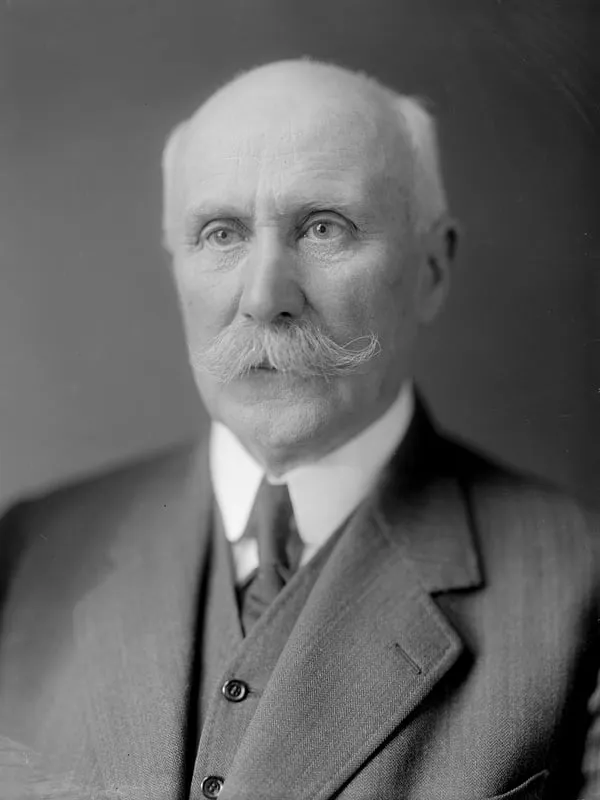
- Born:
- 24 April 1856, Cauchy-à-la-Tour (France)
- Died:
- 23 July 1951, Port-Joinville, Île d’Yeu (France)
- Author:
- Natalia
- Photo:
- Harris & Ewing, domena publiczna, Wikimedia Commons

Philippe Pétain lived two careers that France still finds hard to reconcile. In the First World War he was the defender of Verdun and the commander who in 1917 saved the French Army from disintegration, and in 1918 he received a marshal’s baton. Throughout the interwar years he was the country’s most respected soldier, an authority for the veterans and the patron of the defensive doctrine with which France entered 1939. In May 1940 Prime Minister Paul Reynaud brought him into the government in the hope that his fame would lift the nation’s spirits. A month later the 84-year-old marshal asked the Germans for an armistice, and in July he took charge of an authoritarian state based at Vichy which embarked on collaboration with the Third Reich of its own free will and took part in the deportation of the Jews. In 1945 he was sentenced to death for treason, and the sentence was commuted to life imprisonment.
An officer without prospects
Henri Philippe Benoni Omer Pétain was born on 24 April 1856 into a peasant family at Cauchy-à-la-Tour in the Pas-de-Calais department. His mother died when he was a small child, and he was brought up by relatives. He was educated at Catholic schools, and in 1876 he entered the military academy of Saint-Cyr. For many years he served in battalions of chasseurs à pied (light infantry), and then alternately on staffs and with regiments. He never fought in the colonies, and promotion came slowly.
As an instructor at the musketry school at Châlons, and later as a lecturer in infantry tactics at the École de Guerre, he opposed the doctrine of the all-out offensive that prevailed before 1914. He liked to repeat that “fire kills” and that infantry could not cross the fire of machine guns and cannon until the artillery had destroyed the target. This did not endear him to his superiors. In 1911 he took command of the 33rd Infantry Regiment at Arras, in which a young second lieutenant, Charles de Gaulle, began his service in 1912. In the summer of 1914 the 58-year-old colonel was commanding a brigade and preparing for retirement.
Verdun and the mutinies of 1917
The war changed everything. Pétain’s brigade fought in Belgium in August 1914 and during the retreat, while the Commander-in-Chief, Joseph Joffre, who ruthlessly removed incompetent generals, was looking for new ones. At the turn of August and September Pétain was given a division, with which he fought on the Marne; in October he received a corps in Artois, and in June 1915 the Second Army. The offensives of 1915 convinced him that breaking through the front with a single blow was an illusion, and that an attack had to be carefully prepared and broken off once it ceased to yield results.
On 21 February 1916 the Germans attacked at Verdun. During the night of 25–26 February Pétain took command of the defence. He divided the front into sectors, had the forts re-garrisoned, concentrated the artillery on both banks of the Meuse and organised a ceaseless flow of lorries along the only road linking Verdun with the rear, later called the Voie Sacrée (Sacred Way). He also introduced the rotation of divisions, relieving them after a short spell of fighting instead of keeping them under fire until they had bled to death. In this way most of the French Army passed through Verdun, and the soldiers remembered Pétain as a commander who did not send them to their deaths needlessly. His order of the day of 10 April ended with the words: “Courage! We’ll get them!” In May 1916 he took over Army Group Centre, and from then on the battle was directed by Generals Robert Nivelle and Charles Mangin.
When the Nivelle Offensive on the Aisne ended in April 1917 with enormous losses and no breakthrough, Pétain became Chief of the General Staff at the end of April and Commander-in-Chief of the French Army on 15 May. Mutinies then broke out in dozens of divisions: the soldiers were willing to hold the trenches but refused to take part in further pointless attacks. Pétain improved leave, food and billets, toured the divisions and promised only attacks with limited objectives, properly prepared by the artillery. At the same time he did not shrink from severity. According to the research of the French historian Guy Pedroncini, courts martial convicted more than 3,400 soldiers, 554 of them to death, and some 50 sentences were carried out. By August the army had calmed down. Pétain was waiting, as the saying went, “for the tanks and the Americans”, and in the autumn he launched two successful attacks at Verdun and at La Malmaison that restored the army’s faith in itself.
In March 1918, during the great German offensive in Picardy, Pétain thought above all of covering Paris, and Prime Minister Georges Clemenceau judged his pessimism dangerous. Supreme Allied command went to Ferdinand Foch, and from then on Pétain carried out his directives. In the summer his method of defence in depth helped to defeat the last German offensive in Champagne. On 21 November 1918 he was made a Marshal of France, and on 8 December at Metz President Raymond Poincaré presented him with his baton.
Marshal of the interwar years
From 1920 to 1931 Pétain was vice-president of the Supreme War Council, which made him Commander-in-Chief designate in the event of war, and from 1922 he was also Inspector General of the Army. After Foch’s death in 1929 he had no military rival in France. In 1920, at the age of 64, he married Eugénie Hardon. In 1925–1926 he commanded the French forces in the Rif War in Morocco, where, together with the Spanish, he defeated the rising of Abd el-Krim. In doing so he displaced Marshal Lyautey, who soon resigned. In 1929 he was elected to the Académie française in Foch’s seat. During these years de Gaulle worked on his staff, and the marshal commissioned him to write a book on the history of the French soldier. When de Gaulle published it under his own name in 1938, the two men fell out.
Pétain bears part of the responsibility for the shape of the army with which France entered the Second World War. He favoured a battlefield prepared in advance and a continuous defensive front, an idea embodied in the Maginot Line. He saw tanks chiefly as infantry support, and he regarded the Ardennes as terrain through which large enemy forces could not pass quickly. In 1931 he handed over the highest post in the army to General Maxime Weygand and became Inspector of the country’s Air Defence.
After the bloody riots in Paris of 6 February 1934 he joined Gaston Doumergue’s government of national unity as Minister of War. He held the post until November 1934, at a time when Louis Barthou was Foreign Minister and military spending was being cut in the name of economy. The right-wing press increasingly saw in him a providential man, and in 1935 a pamphlet appeared under the title “C’est Pétain qu’il nous faut” (“Pétain is the man we need”). The marshal himself kept out of party politics, but he made no secret of his dislike of parliamentary government and of the left.
In March 1939, after Franco’s victory in the Spanish Civil War, Pétain became ambassador to the government of General Francisco Franco. His task was to secure Spain’s neutrality in the coming war, and he oversaw the implementation of the Bérard–Jordana agreement, under which France handed over Republican gold and property to Spain. In September 1939 he declined to join Édouard Daladier’s government.
May and June 1940
On 10 May 1940 the Germans launched their offensive in the West, and on 13 May they broke through the front at Sedan. Prime Minister Paul Reynaud, who had headed the government since March, was looking for names that would reassure the country. On 18 May, having earlier refused, Pétain joined the government as Deputy Prime Minister, and the next day Weygand assumed supreme command. Reynaud saw the old marshal as a symbol and did not expect him to play a role of his own.
Pétain quickly concluded that the war was lost. In a note to the Prime Minister on 26 May he attributed the defeat not to the mistakes of the high command but to a “love of the easy life” and the abandonment of effort by the whole nation. In conversations with the American ambassador, William Bullitt, he accused Britain of failing to give France enough help. He opposed the government’s departure from Paris and the idea of carrying on the fight from North Africa, declaring that he would not leave France. From 12 June, together with Weygand, he openly demanded an armistice, and on 13 June he read to the cabinet a memorandum stating that France’s renewal would be the fruit of suffering endured at home, not of flight. Despite the pledge of 28 March that neither ally would conclude a separate armistice, he held that France’s interest came before England’s.
On the evening of 16 June in Bordeaux Reynaud resigned, and President Albert Lebrun asked Pétain to form a government. That night the government asked the Germans, through Spain, for armistice terms. On 17 June the marshal announced on the radio: “It is with a heavy heart that I tell you today that we must stop fighting.” The words were spoken before any negotiations had begun, and many soldiers took them as an order to lay down their arms. On 22 June General Charles Huntziger’s delegation signed the armistice at Compiègne: the Germans occupied the north and the western coast of France, the army was disarmed and demobilised, and more than one and a half million prisoners remained in captivity. De Gaulle, who had flown to London on 17 June, called on the French the next day to fight on, and a military court of Pétain’s government sentenced him to death in absentia.
The French State
On 10 July 1940 in Vichy, a joint assembly of both houses of parliament voted by 569 to 80, with 20 abstentions, to grant the government “under the authority and signature of Marshal Pétain” full powers and the task of drawing up a new constitution. The next day Pétain proclaimed himself Head of the French State. He concentrated executive and legislative power in his own hands, adjourned parliament indefinitely and ruled by decree. The republican motto “Liberty, Equality, Fraternity” was replaced by “Work, Family, Fatherland”. The so-called National Revolution was to regenerate France through a return to the land, the Church, hierarchy and discipline, while the blame for the defeat was laid on the Republic, the Popular Front, Freemasons, communists and Jews.
The Vichy government did not wait for the occupier’s demands. On 3 October 1940 Pétain and his ministers adopted the first Statute on Jews, which excluded them from the civil service, the army, teaching, the press and many professions, and on 4 October a law allowing foreign Jews to be interned in camps. According to a draft of the statute discovered in 2010, Pétain tightened its wording in his own hand, although some historians question whether the amendments are his. On 24 October 1940 he met Adolf Hitler at Montoire-sur-le-Loir, and on 30 October he announced on the radio: “I enter today upon the path of collaboration.” Historians, above all the American Robert Paxton, have shown that Vichy itself sought cooperation with Germany in the hope of a better place in a German-dominated Europe, and that the Germans often treated these approaches with reserve.
On 13 December 1940 Pétain dismissed Pierre Laval from the government, not because of his policies but because he considered him too independent. The government was then led by Pierre-Étienne Flandin and Admiral François Darlan. In April 1942, under German pressure, Laval returned as head of government. On 16 and 17 July 1942, in the Vel’ d’Hiv roundup, the French police arrested some 13,000 Jews in Paris, more than four thousand of them children. About 76,000 Jews were deported from France to the extermination camps, of whom only about 2,500 survived. Pétain covered this policy with his authority. At home his cult was sustained by propaganda and by a legion of veterans, and for a long time many French people saw him as a shield protecting them from a worse fate.
After the Allied landings in North Africa in November 1942 (Operation Torch) the Germans occupied the whole of France (Operation Anton), and the French fleet scuttled itself at Toulon. Pétain did not leave for Algiers, although he was urged to do so, and became even more dependent on the occupier. In 1943 the Milice was formed, which hunted the Resistance alongside the Germans. On 20 August 1944, as the Allies approached Paris, the Germans removed the marshal from Vichy against his will, first to Belfort and then to the castle at Sigmaringen, where he refused to exercise any functions.
Trial and imprisonment
In April 1945 Pétain obtained German consent to go to Switzerland, and from there he asked to return to France. On 26 April at Vallorbe he gave himself up to the French authorities. His trial before the High Court of Justice lasted from 23 July to 15 August 1945. On the first day the marshal declared that he answered only to the French people, and he refused to answer questions. The defence argued that he had been the shield protecting the French while de Gaulle had been the sword. The court found him guilty of treason and of intelligence with the enemy and sentenced him to death, national degradation and the confiscation of his property, but expressed the wish that the sentence should not be carried out. On 17 August de Gaulle, as head of the Provisional Government, commuted it to life imprisonment.
Pétain was held first at the Fort du Portalet in the Pyrenees and, from November 1945, in a fort on the Île d’Yeu off the coast of the Vendée. He died on 23 July 1951 at Port-Joinville, where he had been moved a few weeks earlier, at the age of 95. He was buried in the local cemetery, and not, as he had wished, among the fallen of Verdun.
Assessment
Historians of the First World War rank Pétain among the most outstanding French commanders: he understood the importance of artillery, supply, defence in depth and the soldiers’ morale better than most generals of his generation. The same caution and the same pessimism that saved soldiers’ lives in 1916 and 1917 alarmed Clemenceau in 1918, and in 1940 led him to accept defeat as final before Britain had lost the war. Between the wars he helped shape the defensive doctrine that proved helpless in May 1940 against the German panzer divisions advancing through the Ardennes.
For the history of the Second World War, Pétain is above all the man of the armistice and of collaboration. His authority ensured that in July 1940 parliament handed him power without resistance, and that millions of French people believed for years that the marshal was protecting them. The legend of the “shield and the sword” and of the “two Vichys” – the good Pétain and the bad Laval – long outlived the war. Only the research of the 1970s showed that collaboration was a policy Vichy had chosen for itself, and in 1995 President Jacques Chirac acknowledged the responsibility of the French state for the deportation of the Jews. De Gaulle, his former subordinate and greatest adversary, wrote that old age is a shipwreck, and summed up the marshal’s life as successively banal, then glorious, then deplorable, but never mediocre.
Sources
Mentioned in battles
(10)Often appears with
People who appear in the same events.
On the timeline
(72)The 40 most important of 72 events. All tagged “Philippe Pétain” (8) →
1934
1939
1940
March
May
June
- 14
- Key eventThe Germans enter ParisOn 14 June 1940 German troops entered Paris, declared an open city, without a fight. A swastika flag was hoisted over the Eiffel Tower.
- The French Navy against ItalyOn 14 June 1940 French cruisers from Toulon shelled Vado, Savona and the outskirts of Genoa. Until 21 June the French fleet fought the Italians at sea.