1943–1944: Operation Cartwheel
Admiralty Islands campaign
- Dates:
- 29 February – 18 May 1944
- Front:
- Pacific
- Location:
- The Admiralty Islands in the Bismarck Archipelago: Los Negros island (Hyane Harbour, Momote airfield, Salami plantation, Papitalai mission), Seeadler Harbour with the islets of Hauwei, Ndrilo and Pityilu, Manus island (Lugos, Lorengau, Rossum) and Rambutyo islandOn the battle map →
- Sides:
- United States and AustraliaDouglas MacArthur, Walter Krueger, Innis P. Swift, William C. Chase, Thomas KinkaidJapanYoshio Ezaki
- Result:
- Allied victory. The Americans took Los Negros, Manus and the smaller islands, destroying a garrison of about 4,000 men. Rabaul and Kavieng were finally cut off, and Seeadler Harbour and the Momote and Mokerang airfields became one of the largest Allied bases in the Pacific.
- Author:
- Łukasz
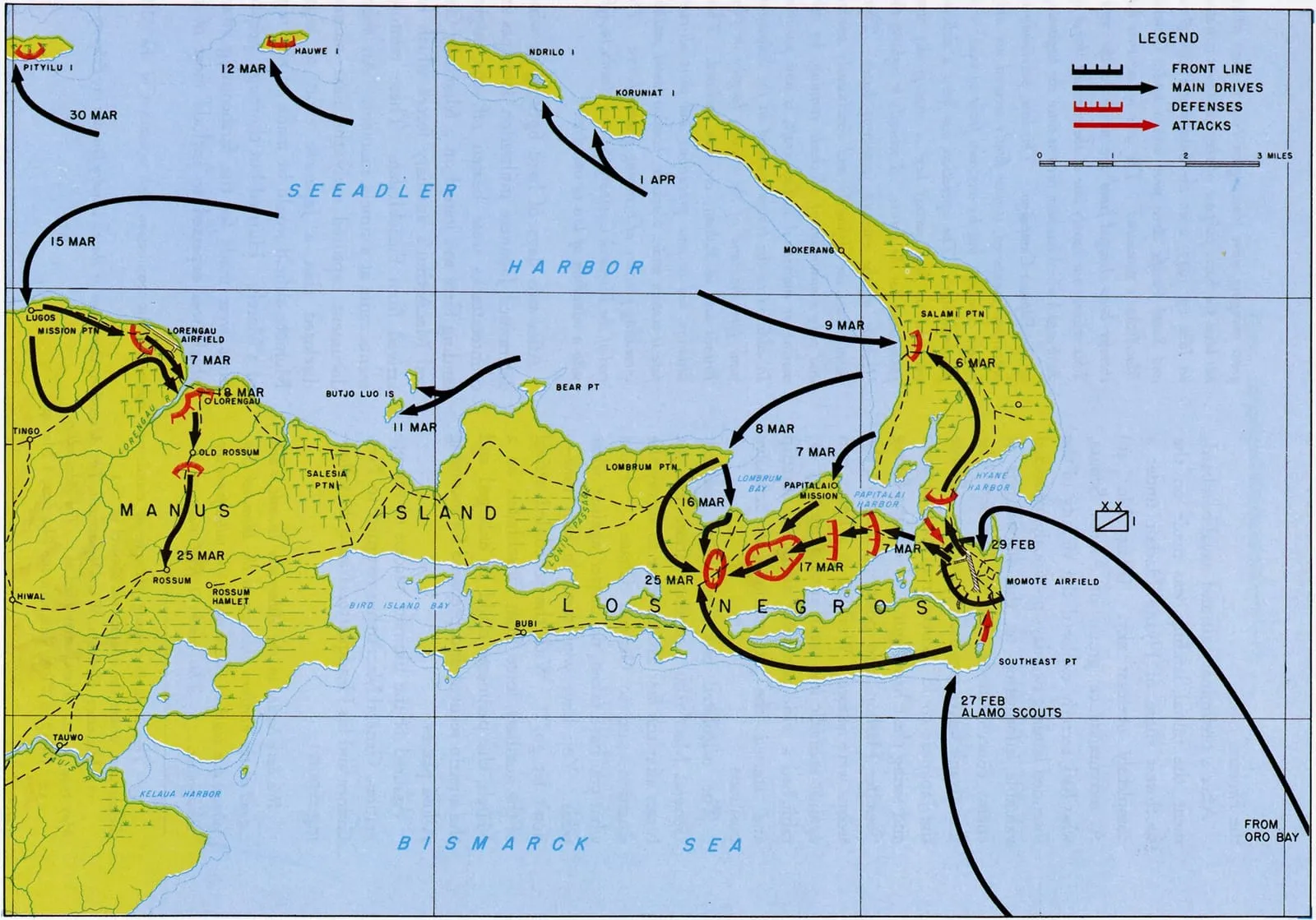
Name and dates
The Admiralty Islands campaign (code name Operation Brewer) is the name given to the fighting in which the US 1st Cavalry Division – supported by the American and Australian navies and the air forces of both countries – took the Admiralty Islands, the north-westernmost group of the Bismarck Archipelago, from the Japanese. The islands lie about 320 kilometres north-east of New Guinea and about 580 kilometres west of Rabaul, only two degrees south of the equator. The largest of them, Manus, is about 80 kilometres long and 25 wide; its mountainous interior, covered in rainforest, rises to more than 900 metres, and its shores are fringed by reefs and mangroves. Adjoining it to the north-east is the smaller, horseshoe-shaped island of Los Negros, separated from it by the narrow Loniu Passage. Together with a chain of islets the two islands enclose Seeadler Harbour – a body of water some 30 kilometres long, nearly 10 wide and in places more than 35 metres deep, in which an entire fleet could anchor. About 13,000 people lived on the islands at the time.
In line with the US official history and most studies, the campaign is taken to have begun on 29 February 1944, the day a reconnaissance force landed on Los Negros. It ended on 18 May 1944, when General Walter Krueger, commander of the US Sixth Army (operating as Alamo Force), officially declared the operation over and responsibility for developing the bases passed to the Allied Naval Forces of Vice Admiral Thomas Kinkaid. Heavy fighting went on only during the first four weeks: organised resistance on Los Negros ceased on 24 March, and on Manus – after the capture of Lorengau on 18 March – at the end of March. April and May were taken up with occupying the smaller islands and hunting down scattered groups of Japanese soldiers in the jungle. The campaign was the final chord of Operation Cartwheel – the plan to encircle and neutralise Rabaul.
Background
The Japanese had occupied the Admiralty Islands without a fight in April 1942, during their expansion along the north coast of New Guinea: the small Australian post at Lorengau withdrew into the interior of Manus. The occupiers laid out an airstrip at Lorengau and began building a second airfield on Los Negros, on the Momote coconut plantation. The islands served as a staging post for aircraft flying from Rabaul to the airfields of New Guinea; their importance grew as Allied advances in New Guinea and New Britain cut other air routes.
For the Allies, the Admiralty Islands had been part of the plan to capture Rabaul from the start. In 1943, however, the American chiefs of staff decided that Rabaul itself – defended by nearly 100,000 troops – did not need to be stormed: it would be enough to surround it with air bases and cut off its supplies. The fleet nevertheless needed a forward base, and the Admiralty Islands had flat ground for airfields and Seeadler Harbour, which could accommodate an entire task force. On 6 August 1943 the Combined Chiefs of Staff adopted the plan to neutralise rather than capture Rabaul and set the invasion of the islands for 1 June 1944.
Around the turn of 1943 and 1944 the ring around Rabaul was tightening fast. After the landing on Bougainville, Allied aircraft from the Solomon Islands mounted incessant raids on Rabaul; in December the Americans landed at Cape Gloucester on the western tip of New Britain, and in January at Saidor in New Guinea. On 15 February 1944 the New Zealanders took the Green Islands, little more than 160 kilometres from Rabaul. On 17 and 18 February the carriers of the American Task Force 58 devastated Truk, the Japanese fleet’s main base in the Carolines. The Japanese then withdrew their last fighter aircraft from Rabaul to defend Truk; on 19 February Japanese fighters made their last serious interception of Allied bombers over Rabaul.
Meanwhile, on 13 February, General Douglas MacArthur, commander of the South West Pacific Area, issued orders for the invasion of the Admiralty Islands under the code name Brewer, bringing it forward to 1 April. A stroke of intelligence luck helped him: in January Australian soldiers had found a trunk of Japanese army codes at Sio on the Huon Peninsula, which made it possible to read Japanese signals far more widely. Assigned to the operation were the 1st Cavalry Division (fighting dismounted), the Australian No. 73 Wing, amphibious engineers, a battalion of American amphibian tractors and naval construction battalions (Seabees) – some 45,000 men in all.
The plan changed suddenly on 23 February. The crews of three B-25 bombers of the Fifth Air Force that had flown low over Los Negros reported that they had seen no sign of the enemy and that the islands looked deserted. General George Kenney, commander of the Allied air forces in the South West Pacific, proposed to MacArthur that they be seized at once by a small force. According to Kenney’s memoirs, MacArthur replied that “that will put the cork in the bottle”.
Plans and forces
On 24 February orders went out to land a reinforced squadron of the 1st Cavalry Division on Los Negros within a mere five days as a “reconnaissance in force”. If the islands proved empty, the cavalrymen were to occupy them and begin building a base; if the enemy proved strong, they were to be evacuated. The decision on the spot was reserved for MacArthur and Vice Admiral Kinkaid, commander of the area’s Allied Naval Forces and of the US Seventh Fleet, who sailed with the landing force aboard the cruiser USS Phoenix. Command of the attack group was given to Rear Admiral William Fechteler of Daniel Barbey’s VII Amphibious Force. Because the tank landing ships were too slow, the troops – 1,026 men – were embarked on three high-speed transports converted from destroyers and on nine destroyers.
The reconnaissance force was commanded by Brigadier General William C. Chase, commander of the division’s 1st Brigade. It consisted of the 2nd Squadron of the 5th Cavalry Regiment, an artillery platoon with two 75 mm pack howitzers, an anti-aircraft machine-gun battery and 29 Australians from ANGAU – the military administration of New Guinea – who were to gather information and keep in touch with the inhabitants. Behind them a second echelon was to set out from Finschhafen: the rest of the 5th Cavalry, artillery, the 40th Naval Construction Battalion and supplies, in six tank landing ships. When a staff officer voiced concern that so dangerous a task was being given to a unit without combat experience, MacArthur recalled that the 5th Cavalry had fought alongside his father’s soldiers against Geronimo: “They fought then and they will fight now.”
MacArthur’s staff intelligence, headed by General Charles Willoughby, did not share the airmen’s optimism. On the basis of intercepted signals and the accounts of local people it estimated on 15 February that there were some 3,000 Japanese on the islands, and on 24 February some 4,000; it explained the absence of anti-aircraft fire by a desire to save ammunition. General Walter Krueger, commander of the Sixth Army, later recalled that no one on his staff believed the islands were deserted. On 27 February a six-man team of Alamo Scouts, put ashore from a flying boat, reported that the south coast of Los Negros was “swarming with Japanese”.
And indeed, at that time the islands were defended – by American estimates – by some 4,000 troops. They came under the 8th Area Army in Rabaul, commanded by General Hitoshi Imamura, which Imperial General Headquarters had ordered to hold for as long as possible a new, withdrawn defence line running from the Banda Sea to the Carolines. Imamura had been asking for reinforcements since the autumn of 1943, but the transport carrying the 66th Regiment was sunk in January by an American submarine; he managed to send only two battalions: the 2nd Battalion of the 1st Independent Mixed Regiment (about 750 men, most of them called-up reservists) and the experienced 1st Battalion of the 229th Infantry Regiment from the 38th Division (about 530 men, with no artillery of its own). The core of the garrison was Colonel Yoshio Ezaki’s 51st Transport Regiment – Ezaki was also in command of the whole defence – and in addition there were units of the 14th Naval Base. Both airfields were out of action in February, the anti-aircraft guns were silent, and Ezaki had forbidden his men to move about or fire in daylight – hence the airmen’s impression that the islands were empty. The Japanese expected a landing on the beaches of Seeadler Harbour and concentrated their main forces there.
Course of operations: the landing on Los Negros (29 February – 1 March 1944)
The landing site chosen was a small beach on the southern shore of Hyane Harbour, on the east coast of Los Negros, right next to Momote airfield. The airfield could be seized quickly, but the entrance to the harbour was only about 700 metres wide and surrounded by mangroves. “Since the whole operation was a gamble anyway,” the US naval historian Samuel Eliot Morison later remarked, “one might as well be consistent.” The gamble paid off: the Japanese had not expected a landing there.
On the morning of 29 February low cloud meant that only three B-24 and nine B-25 bombers reached the target, so the destroyers prolonged their bombardment. The first wave of unarmoured landing craft came ashore at 8.17 a.m. without loss, but when the bombardment lifted the Japanese emerged from their shelters and caught the returning boats in crossfire from machine guns on both shores of the harbour. The second wave had to turn back until the destroyers silenced the positions; later waves also came under fire. Four of the twelve boats were damaged. By 12.50 p.m. all the troops had been landed; the navy lost two killed and three wounded.
Paradoxically, it was safer on land. Meeting only light resistance, the cavalrymen seized the airfield, set up their anti-aircraft guns and sent patrols inland, losing two killed and three wounded. At 4 p.m. MacArthur came ashore with Kinkaid. When a lieutenant warned him that a Japanese sniper had been shot nearby a few minutes earlier, MacArthur replied that “that’s the best thing to do with them”. Having inspected the positions, he decided that the force would stay and ordered Chase to hold on until reinforcements arrived. In the evening Fechteler’s group sailed away, leaving two destroyers off the island for fire support.
Chase pulled his men back into a tight perimeter around the airfield. There was no barbed wire, and the hard coral ground made it difficult to dig in. All night small groups of Japanese tried to infiltrate the lines. Colonel Ezaki ordered Captain Baba, commander of the 1st Battalion of the 229th Regiment, to attack the beachhead, but, suspecting that the landing at Hyane Harbour was only a diversion, he kept the second battalion back at Seeadler Harbour. The Japanese therefore attacked piecemeal. On the morning of 1 March bombers dropped ammunition, blood plasma and barbed wire to the cavalrymen. In the afternoon a group of Japanese soldiers crept in daylight to within about 30 metres of Chase’s command post; when a party sent by the intelligence officer surrounded them, several of the Japanese killed themselves. Among the fifteen officers and NCOs killed was Captain Baba himself. Another attack that evening collapsed under American fire.
Course of operations: holding the beachhead (2–4 March 1944)
On the morning of 2 March the second echelon entered Hyane Harbour: six tank landing ships with the rest of the 5th Cavalry, artillery and Seabees, escorted by American destroyers and the Australian HMAS Warramunga. Unloading under mortar fire took seven hours. In the afternoon both squadrons of the 5th Cavalry widened the perimeter, and the 40th Construction Battalion, which had come to build the airfield, was given a sector of the front of its own: with bulldozers and a ditch-digger it dug foxholes and a second-line trench, and the aircraft revetments on the airfield were turned into heavy machine-gun nests. Destroyers tried to sweep the entrance to Seeadler Harbour for mines, but fire from Japanese guns on Hauwei islet drove them off. Krueger, concerned by the situation, brought forward the dispatch of the rest of the 1st Cavalry Division by several days.
Ezaki, meanwhile, decided to strike the beachhead with all his forces. The terrain and the fire of American artillery and ships forced him to put the attack off until the night of 3–4 March. At 9 p.m. a lone Japanese aircraft dropped bombs, cutting the telephone lines; then yellow flares went up and the attack began. The main blow was delivered by the 2nd Battalion of the 1st Independent Mixed Regiment from the direction of the skid way linking Hyane Harbour with Seeadler Harbour, across which the local people hauled their canoes; it fell on the 2nd Squadron of the 5th Cavalry. The Americans noticed a change of tactics: instead of creeping forward in silence, the Japanese came across open ground talking, and some of them singing. They walked straight into mines and booby traps and then into the fields of fire of the machine guns, but they kept pressing on. The artillery fired all night; after midnight Japanese barges tried to cross the harbour but were stopped by the fire of anti-aircraft guns. The Japanese captured a Bofors gun position, which the Seabees retook. At one position Sergeant Troy McGill, after all his men but one had been killed or wounded, kept firing until his rifle jammed and then fought on with it as a club until he was killed; he was posthumously awarded the Medal of Honor.
At dawn the attack petered out. More than 750 Japanese dead were counted around the American positions; no prisoners were taken. The Americans lost 61 killed and 244 wounded, including 9 killed and 38 wounded from the construction battalion. That night decided the battle for Los Negros: Ezaki had lost most of the forces capable of attacking, and Allied command of the sea and air allowed them to bring in more and more troops. Commenting later on the support of the ships, Chase is said to have remarked: “They didn’t support us – they saved us.”
Course of operations: Seeadler Harbour (4–10 March 1944)
On 4 March the 2nd Squadron of the 7th Cavalry arrived, and the next day the division commander, Major General Innis P. Swift, took command on the island. The advance north across the skid way to Seeadler Harbour was delayed by a Japanese daylight counter-attack and a minefield. On 6 March another convoy arrived with the 12th Cavalry, 105 mm howitzers, three light tanks and amphibian tractors. Guided by an Australian NCO from ANGAU who knew the ground, the 12th Cavalry pushed along a muddy road to the Salami plantation on the western shore of Los Negros and took it after more than an hour’s fighting, in which the tanks fired straight into the embrasures of bunkers. On 7 March the cavalrymen crossed the harbour in amphibian tractors to Papitalai mission and held on there despite heavy fire. Ezaki reported the attack to Rabaul and announced a night counter-attack, which was never carried out. According to the Japanese official history (the Senshi Sōsho series, which other accounts follow), the colonel ignored an order from the 8th Area Army to throw the remnants of his forces into a last, suicidal attack and decided to hold out as long as possible: judging that Los Negros could not be held, he ordered the survivors to gather on Manus, where he counted on the navy’s stores. The Americans received no further reports from him, and his subsequent fate is not known exactly.
The entrance to the harbour was still covered by Japanese guns on the islets. A naval force under Rear Admiral Victor Crutchley – the Australian heavy cruiser HMAS Shropshire, the American light cruisers Phoenix and Nashville and destroyers – bombarded Hauwei, Ndrilo, Pityilu and northern Los Negros on 7 March, firing more than 1,300 shells. The next day minesweepers and supply barges entered the harbour without loss, and on 9 March the division’s 2nd Brigade landed at Salami. The Seabees had made Momote airfield ready for flying as early as 7 March, and on 9 and 10 March P-40 fighters of the Australian No. 76 Squadron landed there; they were followed by the rest of No. 73 Wing RAAF, including Spitfires. From then on the troops on the islands had air support only minutes away. The ANGAU Australians established that the Japanese had not deliberately mistreated the inhabitants but had stripped their gardens of food as they withdrew; the Americans therefore took over the supply of the villages.
Course of operations: the capture of Manus (11–25 March 1944)
The fighting on Los Negros moved into a mopping-up phase, but on Manus there remained, by American estimates, some 2,700 Japanese. Swift wanted to land General Verne Mudge’s 2nd Brigade near Lugos mission, west of heavily fortified Lorengau, and first sent out patrols to look for artillery positions. On 11 March a patrol that had landed on Hauwei ran into an ambush: a landing craft and a PT boat came under fire, eight Americans were killed and fifteen wounded. On 12 March the 2nd Squadron of the 7th Cavalry assaulted Hauwei from amphibian tractors, supported by destroyers, rockets, artillery and Australian aircraft. The islet was defended by well-concealed bunkers with mutually supporting fields of fire; only a medium tank brought in the following day broke the resistance. The Americans lost eight killed and 46 wounded; 43 dead Japanese sailors were counted. Artillery was set up on Hauwei and the neighbouring Butjo Luo islets, from where it could now shell Manus.
On 15 March, after a bombardment by destroyers, rockets and artillery and a raid by 18 B-25 bombers, the 8th Cavalry landed near Lugos, about 4 kilometres west of Lorengau. Once again the Japanese had not expected a landing there, and their positions quickly fell. The advance east, however, was halted by a complex of bunkers on the edge of Lorengau airfield; only a second attack, on 17 March, supported by tanks and the 1st Squadron of the 7th Cavalry, made headway, and on 18 March the cavalrymen took Lorengau. The main Japanese forces on Manus had not, however, been destroyed at that point. On 20 March the 7th Cavalry ran into them inland, near the village of Rossum; only after six days of fighting did the 7th and 8th Cavalry take the log-and-earth bunkers there, which were proof against artillery fire. On 24 March a last group of about 50 Japanese held out in the hills at Papitalai on Los Negros – this marked the end of organised resistance on that island. According to Japanese sources, between 25 and 29 March some 800 soldiers from Los Negros crossed to Manus on makeshift rafts, but there too the garrison had already been shattered and the navy’s stores had fallen into American hands.
Course of operations: the smaller islands and the end of the campaign (April – May 1944)
After organised resistance on Los Negros and Manus had collapsed, the Japanese still held several smaller islands. The ANGAU Australians had earlier quietly evacuated their inhabitants to spare them casualties. On 30 March the 1st Squadron of the 7th Cavalry landed on Pityilu, defended by about 60 Japanese; after a fight involving artillery and tanks, 59 Japanese dead were counted, while the Americans lost eight killed and six wounded. On 1 April the cavalrymen occupied the empty islands of Ndrilo and Koruniat – some of them travelled in the inhabitants’ dugout canoes, the only American landing operation of its kind in the war. The last landing, on Rambutyo on 3 April, met no opposition, but the Japanese hiding in the interior of the island then had to be tracked down. Through April and May cavalry patrols, increasingly acting on tip-offs from the inhabitants, rounded up scattered soldiers; on Manus alone 586 were counted dead and 47 taken prisoner during this period.
Without food or ammunition, the Japanese wandered through the mountains. Entries in a diary found on one of the dead describe how at the end of March a band of 300 men, exhausted by hunger, discarded weapons and equipment along the way, finally concluding that “there is nothing left but to live like the natives”. According to Japanese sources, by the end of April the garrison had ceased to exist as an organised whole, and on 1 May the last radio report reached headquarters: some 1,050 army soldiers and 500 sailors remained on the islands, without equipment or food, asking for orders. On 18 May 1944 Krueger officially declared the operation over, and on 31 May the Japanese command declared the whole garrison dead. The last soldiers hiding in the mountains of Manus, living on sago palm starch, were killed in sweeps or died of disease and hunger; two of them, unaware that the war had ended, were found by local people only in March 1949.
Losses
In his final report Krueger stated that 3,280 Japanese dead had been counted and 75 prisoners taken; perhaps another 1,100 or so disappeared without trace – which agrees with the Japanese estimate that the garrison numbered about 3,800 men before the battle. American losses according to the same report were 326 killed, 1,189 wounded and four missing; 1,625 men were evacuated for various reasons, including sickness. One Australian was wounded. ANGAU recorded that one islander was killed in the fighting, three were killed by the Japanese, and 20 were killed and 34 wounded by accident – by Allied bombs, artillery and naval gunfire.
Significance
The capture of the Admiralty Islands closed the ring around Rabaul. On 20 March 1944 marines from Admiral William Halsey’s area occupied the island of Emirau, north of New Ireland, without a fight, and the planned landing at Kavieng was cancelled. Some 100,000 Japanese soldiers and sailors at Rabaul and on New Ireland were cut off and played no further part in the war. The American chiefs of staff were able to allow MacArthur to bypass the strong Japanese positions at Hansa Bay and Wewak and strike far to the west – at Hollandia (today Jayapura) in New Guinea, in April 1944. For the Japanese, the loss of the islands meant the collapse of their forward defence line in the south-east; Imperial General Headquarters ordered a new one to be built in western New Guinea.
The base proved even more important. The Seabees enlarged Momote airfield, built a new one at Mokerang and bases for carrier aircraft on the islets of Ponam and Pityilu; as early as April B-24 bombers were flying from Momote and Mokerang against Woleai, and in May they supported the fighting for Biak. Around Seeadler Harbour rose fuel depots, ship repair facilities, floating docks, a hospital and a recreation centre for 10,000 sailors. A dispute over who should control the base – Admiral Chester Nimitz wanted to move the boundary of the South Pacific Area to include it, which MacArthur took as an assault on his command – ended in a compromise worked out by Halsey in Brisbane. Seeadler Harbour was used both by Kinkaid’s Seventh Fleet and by Nimitz’s fleets; in the autumn of 1944 part of the force for the invasion of Leyte in the Philippines assembled there, and in 1945 the British Pacific Fleet. On 10 November 1944 the ammunition ship USS Mount Hood blew up in the harbour: the entire crew on board was killed, and 22 smaller vessels nearby were sunk or badly damaged.
Historians and participants still argue over whether the campaign was the bold stroke of a great commander or a reckless gamble. At the start of the fighting on Los Negros the balance of forces was roughly one to four against the attackers. “We were damned lucky we weren’t pushed off the island,” Admiral Fechteler said, and Barbey believed the original plan would have brought a quicker victory with fewer losses. Morison wrote that the Americans won “because the United States and Australia controlled that patch of ocean and the air above it”. Defenders of MacArthur’s decision stress that an assault on the well-defended beaches of Seeadler Harbour would probably not have cost less blood, and that speeding up the advance of both MacArthur and Nimitz shortened the war – on this view – by at least a month. Both Chase and MacArthur received the Bronze Star for it. The Admiralty Islands remained an important base after the war too: in 1950 the Australian navy established the base HMAS Tarangau at Lombrum on Manus, which was later taken over by the armed forces of independent Papua New Guinea.