1943–1944: Operation Cartwheel
Bougainville campaign
- Dates:
- 1 November 1943 – 21 August 1945
- Front:
- Pacific
- Location:
- Bougainville Island in the northern Solomon Islands (Cape Torokina and Empress Augusta Bay, the Piva and Torokina river valleys, the Bonis Peninsula, the Buin area) and the surrounding waters and islands: the Treasury Islands, Choiseul, Buka and the ShortlandsOn the battle map →
- Sides:
- United States, Australia, New Zealand and FijiWilliam Halsey, Theodore Wilkinson, Alexander Vandegrift, Roy Geiger, Allen Turnage, Oscar Griswold, Stanley SavigeJapanHarukichi Hyakutake, Masatane Kanda
- Result:
- Allied victory. The Americans held the beachhead at Torokina, built three airfields on it and repulsed the Japanese counter-offensive of March 1944; the Australians drove the remnants of the 17th Army back towards Buin and the Bonis Peninsula. The Japanese ceased fighting after the Empire’s capitulation and formally surrendered on 8 September 1945.
- Author:
- Natalia
Name and dates
The Bougainville campaign is the name given to the fighting between American, Australian, New Zealand and Fijian forces and the Japanese for Bougainville Island – the largest island of the Solomon archipelago, lying only some 400 kilometres from the great Japanese base at Rabaul. It was the last and northernmost part of Operation Cartwheel, the Allied plan to encircle and neutralise Rabaul, and at the same time the closing stage of the Solomon Islands campaign, which had begun on Guadalcanal in August 1942. Because before the war Bougainville belonged administratively to the Australian Territory of New Guinea, although geographically it lies in the Solomons chain, historians assign the fighting sometimes to the Solomons campaign and sometimes to the New Guinea campaign.
The landing at Cape Torokina in Empress Augusta Bay was code-named Cherryblossom (written Cherry Blossom in some sources). It was preceded by two subsidiary operations: on 27 October 1943 New Zealanders and Americans seized the Treasury Islands (Operation Goodtime), and from 28 October a Marine parachute battalion staged a diversionary landing on Choiseul (Operation Blissful). Almost all accounts take 1 November 1943, the day the 3rd Marine Division landed at Torokina, as the start of the campaign.
Its end is dated to 21 August 1945, which some sources give as the end of the fighting on the island: after Emperor Hirohito announced the decision to surrender, the Japanese on Bougainville ceased operations and the Australians confined themselves to patrolling. General Masatane Kanda signed the formal surrender of the 17th Army before General Stanley Savige only on 8 September 1945 at Torokina, several days after Japan’s surrender in Tokyo Bay (2 September). The campaign thus lasted almost two years – longer than any other in the Solomons – and falls into two distinct phases: the American phase (November 1943 – November 1944), whose purpose was to hold a beachhead with airfields, and the Australian phase (November 1944 – August 1945), in which the Australians went over to the offensive against the isolated Japanese forces.
Background
The Japanese occupied Bougainville in the spring of 1942, during their expansion into the northern Solomon Islands. The small Australian garrison – some 20 men of the 1st Independent Company – was mostly evacuated, leaving only a few coastwatchers on the island. The Japanese built airfields on the islet of Buka and on the Bonis Peninsula in the north, at Kahili and Kara in the south and at Kieta on the east coast, and set up a fleet anchorage in Tonolei Harbour near Buin, supplemented by bases on the nearby Shortland Islands. Bougainville became Rabaul’s forward bulwark, and from it flew the aircraft that attacked the Americans on Guadalcanal in 1942. It was over southern Bougainville, on 18 April 1943, that Admiral Isoroku Yamamoto was killed, shot down by American P-38 fighters on his way to Ballale airfield.
After the fighting on Guadalcanal and the capture of the New Georgia group by Admiral William Halsey’s forces – the New Georgia campaign, the fighting on Vella Lavella and the end of the fighting for New Georgia in September 1943 – Bougainville was the next and last rung of the ladder leading to Rabaul. Meanwhile, in New Guinea, General Douglas MacArthur’s forces had taken Lae, and from 12 October General George Kenney’s airmen were conducting raids on Rabaul. The Joint Chiefs of Staff had already abandoned the idea of storming Rabaul itself: the fortress, with some 100,000 troops, was to be cut off and neutralised from the air. That required airfields closer than those on New Georgia – airfields from which escort fighters and light bombers could reach Rabaul.
There was therefore no need to conquer the whole island. The American naval historian Samuel Eliot Morison wrote that the only reason the Joint Chiefs of Staff allowed Halsey to take part of Bougainville was to establish forward airfields for attacks on Rabaul. The choice fell on Cape Torokina on the west coast, in Empress Augusta Bay. The Japanese did not expect a landing there and had no airfield nearby; their main forces were in the south, around Buin, and in the north, near Buka. The ground was swampy, but beyond a narrow strip of flat coast rose jungle-covered mountains with the active volcano Bagana, and the mountain range would make it hard for the Japanese to bring up forces for a counter-attack for many weeks. The Americans would have time to dig in and build airfields before the enemy could strike.
The island was defended by the 17th Army of General Harukichi Hyakutake – the same man who had lost the Guadalcanal campaign – which was subordinate to General Hitoshi Imamura’s Eighth Area Army at Rabaul; the naval forces at Rabaul were commanded by Vice Admiral Jin’ichi Kusaka. Allied estimates of the Japanese garrison ranged from 45,000 to 65,000 soldiers, sailors and labourers; Morison later gives some 40,000 army troops and 20,000 naval personnel. The strongest formation was General Masatane Kanda’s 6th Division, reputed to be one of the toughest in the Japanese army. In view of the expected offensive, the commander of the Combined Fleet, Admiral Mineichi Koga, sent carrier aircraft to Rabaul at the turn of October and November (Operation Ro) to strike at Allied bases and convoys.
Formally, Bougainville lay within MacArthur’s South West Pacific Area, but he entrusted planning and command to Halsey, who in mid-October set the date of the landing for 1 November. The amphibious force was commanded by Rear Admiral Theodore Wilkinson from the command ship George Clymer. The landing was to be made by General Alexander Vandegrift’s I Marine Amphibious Corps – the victor of Guadalcanal: General Allen Turnage’s 3rd Marine Division, two raider battalions and support units, and in later echelons General Robert Beightler’s 37th Infantry Division of the Army. Close air support was provided by Aircraft Solomons (AirSols) from airfields on New Georgia and Vella Lavella.
Course: diversions and the landing at Torokina (27 October – 3 November 1943)
To mislead the Japanese about their real objective, the Americans first carried out two smaller actions. On 27 October the 8th Brigade of Brigadier Robert Row’s 3rd New Zealand Division landed on the Treasury Islands – on Mono and Stirling – where a radar station and a PT boat base were later built. The following night some 650–725 men of Lieutenant Colonel Victor Krulak’s 2nd Marine Parachute Battalion landed on Choiseul. Krulak sent an uncoded message reporting the landing of 20,000 troops, and for a week his men attacked Japanese posts on a wide front, posing as a much larger force. On 2 November some of his men, including wounded, were extricated from a tight spot by the torpedo boat PT-59 under Lieutenant John F. Kennedy; on the night of 3–4 November the whole battalion was evacuated to Vella Lavella.
Three transport groups, which had embarked troops at Espiritu Santo, Guadalcanal and Efate, joined up at sea on 31 October and, to deceive the enemy, feinted towards the Shortland Islands. On the morning of 1 November 1943 they entered Empress Augusta Bay. Their charts of the coast were based on German Admiralty charts from around 1890 and were wrong about the longitude. Minesweepers ran onto uncharted shoals, and one of the transports grounded on a reef.
At 7.10 a.m. the first wave began to climb down into the landing craft, and before 7.30 a.m. some 7,500 Marines had landed on twelve beach sectors spread over more than seven kilometres, from Cape Torokina to the Koromokina Lagoon. The 9th Marines took the north-western beaches, the 3rd Marines the cape and the beaches to the south-east, and the 3rd Raider Battalion seized Puruata islet. The shore was defended by only about 270 Japanese of the 23rd Infantry Regiment, but they were well dug in: in eighteen machine-gun bunkers, with mortars and a single 75 mm gun concealed in a log emplacement. That gun destroyed four landing craft and damaged ten more before Sergeant Robert Owens forced his way into the position through the embrasure and drove out the crew – he was killed in the process and posthumously awarded the Medal of Honor. Heavy surf wrecked many boats, but by around 11 a.m. the Marines held the lightly defended shore, and they eliminated the isolated pockets of resistance by nightfall. The cost was 78 killed and 104 wounded; most of the defenders were killed.
Japanese aircraft from Rabaul reacted quickly: in the morning 44 fighters and 9 dive bombers appeared over the bay, followed by another large wave in the afternoon. AirSols fighters and destroyer fire shot down several dozen aircraft, and the attacks, though they halted unloading for a few hours, sank no ships. Rear Admiral Wilkinson, having learnt the lessons of Guadalcanal and New Georgia, had loaded the transports to only a quarter or half of their capacity and detailed some of the infantry to help with unloading; within eight hours some 14,000 men and 6,200 tons of supplies were put ashore, and in the evening the ships sailed away. On 1 and 2 November the carriers Saratoga and Princeton of Rear Admiral Frederick C. Sherman bombed the airfields in the Buka area.
The Japanese navy tried to destroy the beachhead from the sea. Vice Admiral Sentarō Ōmori sailed from Rabaul with two heavy and two light cruisers and six destroyers, covering transports carrying a thousand troops for a counter-landing. On the night of 1–2 November they were intercepted by Rear Admiral Aaron S. Merrill’s force of four light cruisers and eight destroyers. In the Battle of Empress Augusta Bay the Japanese lost the light cruiser Sendai and the destroyer Hatsukaze and turned back, and the counter-landing was postponed by several days. On 3 November the Marines occupied Torokina islet unopposed. Admiral Koga then sent Vice Admiral Takeo Kurita’s seven heavy cruisers from Truk to Rabaul. Halsey, who had no ships capable of facing them, risked a carrier strike on the harbour: the raid of 5 November damaged several cruisers and forced Koga to withdraw them, and a repeat strike on 11 November – with Essex, Bunker Hill and Independence also taking part – sealed the end of Rabaul as a fleet base. The Japanese carrier aircraft thrown into Rabaul under Operation Ro suffered such losses that their remnants were withdrawn to Truk in mid-November.
Course: expanding the beachhead (November – December 1943)
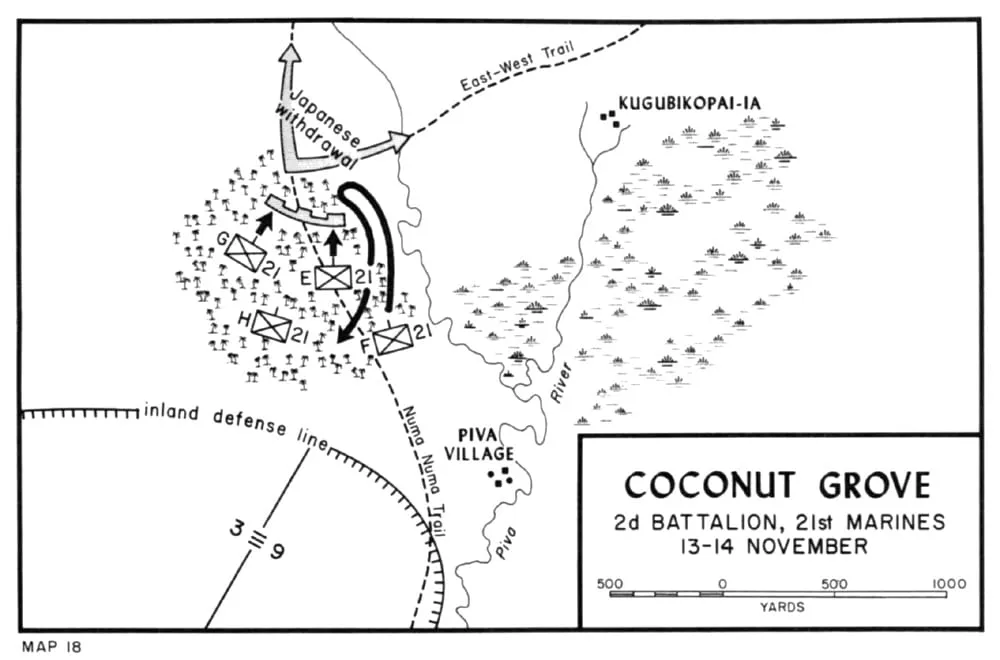
The Japanese command was long unconvinced that Torokina was the Americans’ main objective. General Imamura regarded the landing as a springboard for the real blow against Buka and sent reinforcements there; he did not commit the strong forces in the south of the island to a counter-attack. The beachhead was therefore attacked only by individual regiments. Before dawn on 7 November, at the third attempt, destroyers landed several hundred troops just beyond the Americans’ western flank; the Marines destroyed them the next day by the Koromokina Lagoon. At the same time the 23rd Infantry Regiment of the 6th Division attacked from the east. In the Battle of Piva Trail (8–9 November) the raiders threw back the Japanese blocking a branch of the Numa-Numa Trail, which crossed the island, and on 13–14 November the 21st Marines won the trail junction in the Coconut Grove.
Reinforcements arrived echelon by echelon: between 6 and 19 November the last regiment of the 3rd Marine Division and the whole 37th Infantry Division came ashore. On 9 November Vandegrift, appointed Commandant of the Marine Corps, handed over command of I Marine Amphibious Corps to General Roy Geiger, who on 13 November took over responsibility for the whole beachhead from Wilkinson. The defensive perimeter – known simply as “the Perimeter” – then had a beach frontage of about 6.4 kilometres and a circumference of about 14.6 kilometres, and it was gradually pushed inland until its edge lay 8–10 kilometres from the shore.
The heaviest fighting of November took place along the Piva River. In the Battle of Piva Forks (also called the Battle of the Numa-Numa Trail, 18–25 November) the 3rd Marines, supported by heavy fire from the 12th Marines’ artillery, broke through the fortified positions of the 23rd Infantry Regiment; the Marines lost more than a hundred killed and wounded, and the Japanese, by American count, at least 1,071 killed – in effect the whole regiment. This was the last important ground west of the Torokina River. The beachhead was still not secure, however: on 26 November Japanese artillery shelled the ships of the sixth echelon as they unloaded. On the night of 24–25 November, as the fighting on the Piva was drawing to a close, five destroyers under Captain Arleigh Burke smashed a Japanese force carrying reinforcements to Buka in the waters between Buka and New Ireland, sinking three destroyers without loss to themselves (the Battle of Cape St. George). The raid by the 1st Parachute Battalion on Koiari, some 15 kilometres east of the beachhead (29 November), ended in failure: attacked by superior forces, the paratroopers had to be evacuated from the beach on the third attempt by the boats, losing 15 killed, 99 wounded and 7 missing.
In November and December the Japanese hauled guns onto the hills above the Torokina River and shelled the airfields and supply dumps. From 9 to 27 December the 3rd Marine Division fought to take these hills. The hardest objective proved to be Hellzapoppin Ridge – a narrow, steep ridge with well-camouflaged positions on its reverse slope. The 21st Marines were thrown back from it on 12 December, and several air strikes missed the narrow target; only a coordinated attack by aircraft, artillery and infantry took it on 18 December, and by 24 December the Marines had also captured Hill 600A. Meanwhile American Seabees and New Zealand engineers were building airfields in the swamps: the coastal fighter strip at Torokina received its first aircraft on 10 December, the inland Piva Uncle bomber strip on Christmas Day, and the Piva Yoke fighter strip on 22 January 1944. The AirSols headquarters of General Ralph Mitchell moved from Munda to Bougainville, from where Rabaul was attacked daily.
On 15 December I Marine Amphibious Corps and General Geiger were replaced by the Army’s XIV Corps under General Oscar Griswold, the victor of New Georgia, and on 28 December the exhausted 3rd Marine Division was relieved by the Army’s Americal Division under General John R. Hodge. According to Marine Corps figures, I Marine Amphibious Corps lost 423 killed and 1,418 wounded on Bougainville between November and December 1943; cases of malaria and other tropical diseases were also numerous.
Course: airfields over Rabaul and the Japanese counter-offensive (January – March 1944)
The airfields at Torokina fulfilled the role for which they had been built. AirSols dive bombers, torpedo bombers and fighters attacked Rabaul almost daily, and the Japanese fighter force, bled white in an aerial war of attrition, was withdrawn from Rabaul to Truk in February 1944. At the end of January Admiral Kusaka banned all vessels except barges from entering Simpson Harbour. On 15 February 1944 General Harold Barrowclough’s New Zealanders occupied the Green Islands, less than 200 kilometres from Rabaul, almost without a fight; the airfield built there also brought the base at Kavieng on New Ireland within range. Morison concluded that the harbour, which in October 1943 had held some 300,000 tons of Japanese shipping and powerful fleet squadrons, had been reduced to “a third-rate barge depot”. Together with MacArthur’s seizure of the Admiralty Islands, this closed the ring around Rabaul – a fortress the Allies never had to storm.
Meanwhile General Hyakutake, finally convinced that the Americans meant to stay on Bougainville for good, had been preparing a great assault on the beachhead since December 1943. Through jungle and mountains the Japanese dragged the largest concentration of field artillery they had yet assembled in the Pacific and emplaced it on the ridges overlooking the perimeter. Three assault groups were earmarked for the attack, drawn mainly from General Kanda’s 6th Division (the groups of General Shun Iwasa, Colonel Isaoshi Magata and Colonel Toyoharei Muda); according to the American official historian John Miller they numbered 15,400 or 19,000 men, while the Japanese historian Hiroyuki Shindō puts the number who actually went into action at about 9,500. Hyakutake was so sure of success that he intended to accept Griswold’s surrender at the Torokina airfield on 17 March. XIV Corps intelligence detected the preparations early, and Griswold – who had learnt on New Georgia that in the jungle it was better to wait for the Japanese to attack than to attack them – had some 62,000 troops in all, entrenched in bunkers behind minefields and barbed wire.
The offensive, which the Japanese simply called “the counter-attack” and the Americans the Second Battle of Torokina, began on 8 March 1944. Iwasa’s group took part of Hill 700 in the 37th Division’s sector, and Muda’s group part of Hill 260 in the Americal Division’s sector; the Americans retook Hill 700 within a few days, while the fighting for Hill 260 dragged on until 27 March. On 12 March the Japanese broke through along a ravine close to the Piva Yoke airfield, but were thrown back by General Beightler’s infantry and tanks, and their artillery was silenced by aircraft. Further attacks on 15 and 17 March and a final night assault on 23–24 March collapsed under American artillery fire and destroyer bombardment. Towards the end of the fighting sub-units of the 93rd Infantry Division, made up of Black soldiers, also joined in – according to some accounts the first such American infantry unit to go into combat in this war. On 25 March the Japanese called off the offensive.
The defeat was a heavy one. The Americans lost 263 killed. Figures for Japanese losses vary: the Americans counted some 5,000 dead, Japanese estimates cited by historians speak of about 3,500 killed and 5,500 wounded, and Shindō gives 5,400 killed and 7,100 wounded, including units fighting at the same time in other sectors. The last great Japanese offensive of the Solomon Islands campaign came to nothing, and the remnants of the 17th Army withdrew into the interior of the island and to its northern and southern ends.
Course: the Australian phase (November 1944 – August 1945)
After the March defeat the Japanese on Bougainville concentrated on survival. Cut off from supplies, they laid out gardens and fields in the interior, which American aircraft bombed with napalm. According to the American historian Harry Gailey, the daily rice ration was cut in April 1944 from 750 to 250 grams, and from September no rice was issued at all; the Japanese admiral Takeda recalled theft, insubordination and even mutinies and desertions. According to Australian estimates, about 8,200 Japanese were killed in action during the American period and a further 16,600 died of disease and malnutrition. On the beachhead the Americans conducted limited operations and patrols, some of them with soldiers from Fiji; Corporal Sefanaia Sukanaivalu was posthumously awarded the Victoria Cross for rescuing wounded men at Mawaraka on 23 June 1944.
In the summer of 1944 MacArthur brought forward the invasion of the Philippines and needed XIV Corps for it. On Bougainville it was replaced by Lieutenant General Stanley Savige’s Australian II Corps – just over 30,000 men: General William Bridgeford’s 3rd Division, the 11th and 23rd Brigades and an infantry battalion from Fiji. On 22 November 1944 Savige took over command from Griswold, and by 1 February 1945 almost all the Americans had left the island. The Australian government and the Commander-in-Chief, General Thomas Blamey, decided that the Australians would not, like the Americans, defend the beachhead but would destroy the Japanese garrison. They wanted to finish the campaign and free the troops for other tasks, to liberate the Australian mandated territory and its inhabitants, and to show that Australia was still actively fighting. There were still some 40,000 Japanese on the island, in organised units, with Kanda’s tough 6th Division in the south.
On 23 December 1944 Savige ordered an advance along three axes. In the centre a single battalion took Pearl Ridge on 30–31 December, a ridge from which both coasts of the island can be seen; it turned out to have been held not by a detachment of 80–90 men, as had been thought, but by some 500 troops, which testified to the decline in their strength and morale. In the north the 11th Brigade advanced along the coast, by 9 February 1945 had driven the Japanese from the fortified Tsimba Ridge, and pushed about 1,800 of them back towards the neck of the Bonis Peninsula. An attempt to outflank them with a landing at Porton Plantation (8–10 June) failed – the encircled force had to be evacuated with heavy losses – and in this sector the Australians went over to the defensive.
At the beginning of 1945 General Hyakutake suffered a stroke and Kanda took over command of the 17th Army. The main thrust, by the 3rd Division, went south towards Buin, where the main Japanese forces stood. Outflanking the enemy by barge, the Australians took Mosigetta and Barara in February, and in the Battle of Slater’s Knoll (28 March – 6 April 1945) they repulsed a heavy attack by Kanda with heavy Japanese losses; Gailey called this offensive “a disaster”. Corporal Reg Rattey won the Victoria Cross here. In the Battle of the Hongorai River (17 April – 22 May) the Australians again broke the resistance, crossed the Hari and Mobai rivers and reached the Mivo River. There downpours and floods washed away bridges and roads, halting major operations for almost a month. Before Savige could prepare the decisive assault on Buin, news came of the atomic bombs and Japan’s surrender. The last Victoria Cross awarded to an Australian in this war went to Private Frank Partridge for fighting on the Ratsua front on 24 July 1945. The fighting stopped in mid-August; 21 August is taken as the end of the campaign, and on 8 September at Torokina General Kanda surrendered his forces to Savige.
Losses
Casualty figures come from different periods and sources and are therefore incomplete. I Marine Amphibious Corps lost 423 killed and 1,418 wounded in November and December 1943 (figures from the Marine Corps casualty section, cited by John Rentz); 78 Americans were killed in the landing on 1 November alone. XIV Corps lost 263 killed in repelling the March 1944 counter-offensive. In the 1944–1945 phase the Australians lost 516 killed and 1,572 wounded.
Japanese losses were many times higher, and the great majority of them were victims of hunger and disease. According to estimates cited in Australian historiography, about 8,200 Japanese were killed in action in the American phase and 16,600 died of disease and malnutrition; in the Australian phase about 8,500 were killed and 9,800 died of disease and starvation. At the end of the war some 23,500 soldiers and labourers went into captivity out of a garrison that had once numbered 65,000. The war also struck the island’s inhabitants: according to the Australian historian Hank Nelson, the population of Bougainville fell from over 52,000 in 1943 to under 40,000 in 1946.
Significance
The Bougainville campaign was the last and longest stage of the struggle for the Solomon Islands. Its first phase achieved its aim quickly and, by Pacific standards, cheaply: choosing the weakly defended Cape Torokina rather than fortified Buin allowed Halsey to build airfields within range of Rabaul without assaulting the main Japanese forces. The landing and the fighting for the beachhead drew Japanese carrier aircraft to Rabaul, where they bled to death in Operation Ro; as a result, when the Americans landed in the Gilbert and Marshall Islands, the Japanese had nothing with which to respond from the air. The night battles of Empress Augusta Bay and Cape St. George showed that American cruisers and destroyers, using radar and new tactics, had won command of the night-time waters of the Solomons, where only a year earlier the Japanese navy had reigned. Rabaul, with its hundred thousand troops, was cut off and neutralised from the air – and played no further part until the end of the war. It was one of the first and largest examples of the strategy of bypassing strongpoints (“leapfrogging”), which MacArthur and Chester Nimitz went on to apply all the way to the Philippines and Okinawa.
The second, Australian phase remains controversial to this day. The Americans considered it enough to keep watch over the isolated garrison, and critics – in 1945 part of the Australian press and some politicians, later Gailey among others – wrote of costly fighting for an island whose possession after March 1944 no longer had any bearing on the outcome of the war; in Gailey’s view, the fact that the Australian soldiers fought so well, although they must have known that their effort was, in the wider perspective, unnecessary and unappreciated at home, testifies to their courage and discipline. Defenders of the decision, such as the Australian historian Karl James, reply that in 1944 no one could have known that Japan would surrender as early as August 1945, and that liberating the inhabitants of Australian territory and freeing troops for other tasks were legitimate aims. Bougainville became one of the symbols of the “forgotten campaigns” of the last year of the Pacific war – alongside the fighting on New Britain and in the Aitape–Wewak area, which the Australians waged at the same time, while the main weight of the war had shifted far to the north.