- Category:
- Military operations
- Front:
- Pacific
- Date:
- 18 February 1944
- Author:
- Łukasz
- Tags:
- United States, Japan, US Navy, Raymond Spruance
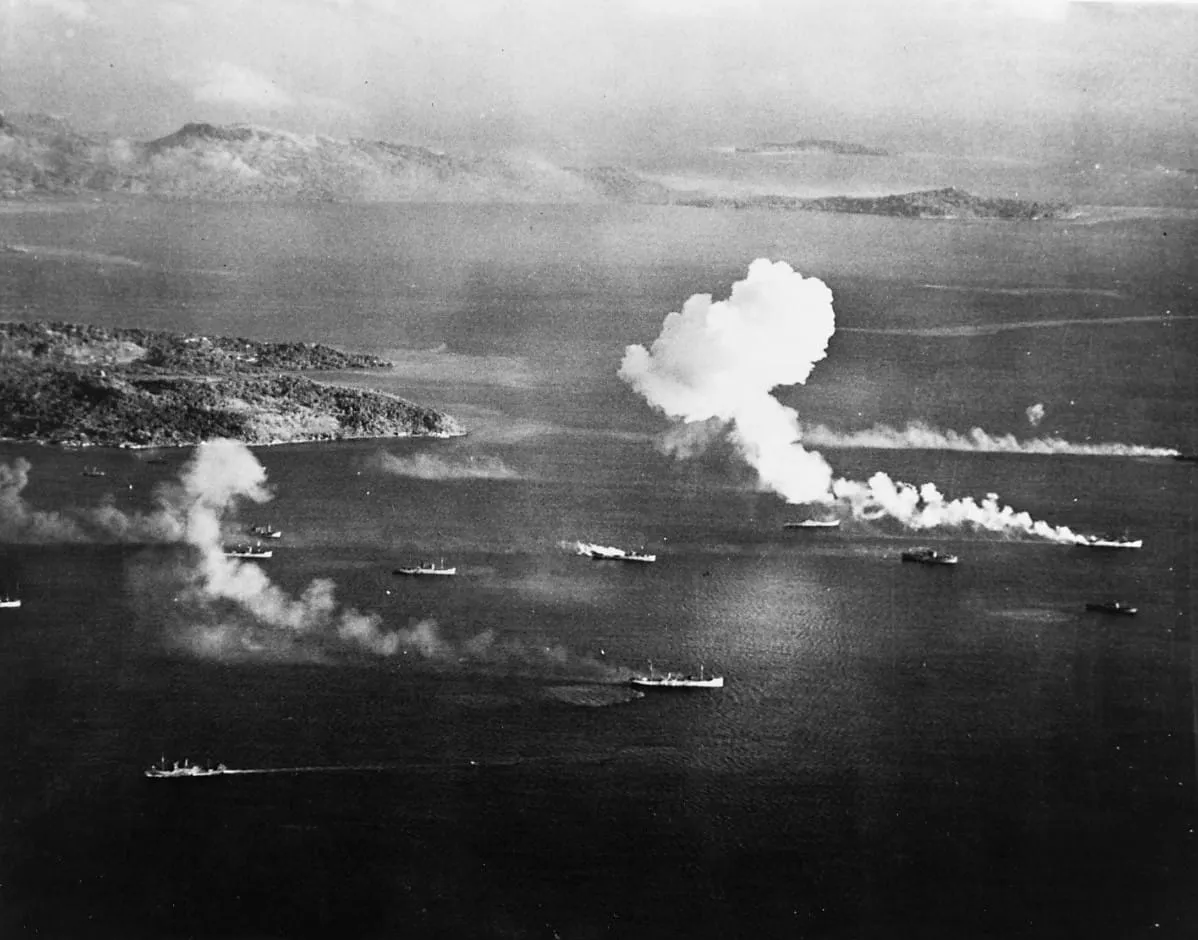
On 17 and 18 February 1944 aircraft from nine American carriers under Rear Admiral Marc Mitscher spent two days attacking Truk in the Caroline Islands – the base that for two years the Americans had called “Japan’s Pearl Harbor” or “the Gibraltar of the Pacific”. Operation Hailstone did not find the main forces of the Combined Fleet in the lagoon, as they had sailed a week earlier, but it destroyed several dozen auxiliary vessels and merchant ships, including valuable tankers, and more than 250 aircraft. Little was left of the base around which the myth of an impregnable fortress had grown up. The Americans no longer needed to capture it: Truk became one of the Japanese strongholds that the Pacific offensive simply bypassed and left on the sidelines until the end of the war.
Some war chronologies place the raid under 18 February. The operation lasted from dawn on 17 February until midday on 18 February, local time. Some American studies from the 1940s, which reckoned dates by the time on the eastern side of the International Date Line, give 16–17 February – the same two days.
A Japanese fortress in mid-ocean
Truk is a large lagoon enclosed by a ring of coral reef, with a dozen or so high volcanic islands inside it. Japan seized the Carolines from Germany in 1914 and after the First World War ruled them as a League of Nations mandate. The lagoon was a natural harbour for an entire fleet: ships entered through several passages in the reef, and inside battleships, carriers and dozens of merchant ships could anchor in safety. From the late 1930s the 4th Fleet was based here, and after the outbreak of war with the United States Truk became the forward base of the Combined Fleet. Aboard the battleship Yamato, anchored in the lagoon, Admiral Isoroku Yamamoto planned the battles for Guadalcanal and the Solomon Islands in 1942–1943.
Five airfields and a seaplane base were built on the islands, along with workshops and fuel and ammunition dumps. Truk was also a transit hub: aircraft and supplies for Rabaul and the Marshall Islands passed through it, and ships carried oil from the Dutch East Indies to the fleet’s units. The Americans, who since 1942 had had almost no reconnaissance of the lagoon, imagined mighty fortifications. In reality – as historians emphasise – Japan could not afford both a large fleet and expensive permanent fortifications. A serious build-up of the land defences began only at the end of 1943: runways were lengthened, coastal batteries emplaced and ground troops sent in. Anti-aircraft guns were few, and the radars could not detect low-flying aircraft.
The decision to strike and the departure of the Japanese fleet
The swift capture of Kwajalein Atoll at the turn of January and February 1944, at a far lower cost than expected, made it possible to bring forward the next step. The landing on Eniwetok Atoll at the western edge of the Marshall Islands was moved from May to 17 February. Eniwetok, however, lay within range of aircraft from Truk, and Japanese air units were being ferried to Rabaul via Truk. Admiral Raymond Spruance, commander of the Fifth Fleet, therefore decided that during the landing the fast carriers would strike at the base itself. The plan was approved by Admiral Chester Nimitz.
On 12 February three of the four groups of Mitscher’s Task Force 58 left the lagoon at Majuro. They had five large carriers – Enterprise, Yorktown, Essex, Intrepid and Bunker Hill – and four light carriers: Belleau Wood, Cabot, Monterey and Cowpens, with more than 500 aircraft in all. They were screened by new fast battleships, cruisers and destroyers, and submarines lay in wait around the atoll. Spruance sailed in the battleship New Jersey. Little was known about the target; participants recalled that they headed for Truk with apprehension.
The Japanese knew that Truk was no longer safe. The withdrawal of large warships had begun as early as the autumn of 1943, when the American offensive in the Gilbert and Solomon Islands drew closer to the Carolines. On 4 February 1944 a photographic reconnaissance flight – four-engined Marine Corps PB4Y-1 Liberators from Bougainville – passed over the lagoon and photographed, among other things, the battleship Musashi, cruisers and many merchant ships. The commander of the Combined Fleet, Admiral Mineichi Koga, took this as a sign of an impending attack. On 10 February he sailed for Japan in Musashi, and most of the remaining combat ships moved to the Palau Islands, several hundred miles to the west. Left in the lagoon were auxiliary vessels, damaged ships under repair, transports and tankers – and more than 300 aircraft, of which, by American estimates, roughly half were serviceable.
The first blow fell even before the raid. On the evening of 16 February the submarine Skate torpedoed, north of Truk, the new light cruiser Agano (Agano class), which was on its way to Japan for repairs to damage sustained off Rabaul. The cruiser sank after midnight; most of the crew were picked up by the destroyer Oite and a submarine chaser, which turned back to Truk.
17 February: fighters, bombs and torpedoes
An hour and a half before dawn on 17 February about 70 F6F Hellcat fighters took off from the carriers. Surprise was complete: after weeks of alerts caused by the Liberator overflights, the Japanese air units had no patrols aloft, and some aircrew were on leave. Pilots scrambled to take off literally in the last few minutes. In the fighting over the lagoon the Hellcats had the advantage over the A6M Zero fighters in speed, ceiling, armour and numbers. According to an American tally of 1946, 56 Japanese aircraft were shot down and about 70 destroyed on the ground for the loss of four American planes; more recent studies speak more cautiously of about 30 Zeros shot down. Either way, after a few hours Japanese air power over Truk had practically ceased to exist. Further waves of Avenger torpedo bombers and dive-bombers smothered the runways on Eten, Param and Moen with fragmentation and incendiary bombs and destroyed the hangars and the seaplane base.
Then the ships became the target. Without fighter cover, the vessels at anchor could defend themselves only with anti-aircraft fire. One of the first victims was the ammunition transport Aikoku Maru (a former armed merchant cruiser), hit by a torpedo off Dublon island: the explosion of her cargo tore the ship apart and she went to the bottom within moments, according to some studies with more than 900 men aboard. By the next morning the losses included the submarine tender Heian Maru, the aircraft transport Fujikawa Maru, the transports Rio de Janeiro Maru and San Francisco Maru, and tankers, which Japan was shortest of. Clouds of black smoke from burning oil hung over the waters of the lagoon.
Some ships tried to escape through the north passage. In the morning a group consisting of the training cruiser Katori (Katori class), the destroyers Maikaze and Nowaki, the armed merchant cruiser Akagi Maru and a minesweeper left the lagoon. Aircraft sank Akagi Maru and badly damaged Katori. At that point Spruance – to the surprise of some of his staff, who considered it an unnecessary risk – halted air attacks on this group and personally led a surface force in pursuit: the battleships New Jersey and Iowa, the heavy cruisers Minneapolis and New Orleans, and destroyers. These ships circled the atoll, firing on the escaping vessels. Katori, Maikaze and the minesweeper sank several dozen kilometres north-west of Truk, leaving almost no survivors; Maikaze still managed to fire torpedoes, which missed New Jersey. Only Nowaki escaped, straddled at record range by 16-inch (406 mm) shells. It was the only time that Iowa and New Jersey fired their main armament at Japanese warships. That same day aircraft from Bunker Hill and Cowpens sank the light cruiser Naka (Sendai class) west of the atoll.
The night and the second day
The Japanese struck back only after dark. From about 9 p.m. until midnight single aircraft and small groups, taking off from Truk and other bases, tried to break through the screen to the carriers. One torpedo bomber succeeded: at about 10.10 p.m. its torpedo hit Intrepid in the stern, killing 11 sailors and damaging her steering gear. The carrier, steering with her engines, had to withdraw for repairs and returned to action only in the second half of the year.
That same night the Americans tried out a new method. Twelve radar-equipped Avengers from Enterprise attacked the ships in the lagoon in the dark, from low altitude, finding their targets on their screens. It was the first night attack on ships by American carrier aircraft using radar and, by American assessments, one of the most effective episodes of the whole operation: these aircraft hit several ships, among them the fleet oiler Shinkoku Maru.
On the morning of 18 February the attacks resumed, although few targets remained. An Avenger sank, at the entrance to the lagoon, the destroyer Oite, which was returning with survivors from Agano; according to Japanese records about 20 of the destroyer’s crew survived and none of the cruiser’s sailors rescued earlier. Also sunk were the destroyers Fumizuki and Tachikaze, damaged the day before, and more merchant ships. Around midday Mitscher’s force ended the operation and withdrew; two carrier groups, reorganised after the torpedoing of Intrepid, headed north-west towards the Marianas, while the rest escorted the damaged ship and returned to the Marshall Islands.
The balance sheet
The Fifth Fleet commander’s report spoke of 41 out of 55 vessels sunk or damaged. According to post-war tallies based on Japanese documents, two light cruisers (Agano and Naka), the training cruiser Katori, four destroyers (Oite, Fumizuki, Maikaze and Tachikaze), several smaller warships and about 30 transports, merchant ships and tankers went to the bottom in the lagoon and its approaches – roughly 200,000 tons in all. Some 17,000 tons of stored fuel also went up in flames. More than 250 aircraft were destroyed on the ground or shot down, some of them still in crates awaiting assembly and transfer to other islands. The number of Japanese killed is not known precisely; some studies give more than 4,500, most of them sailors and soldiers being carried in the ships. According to Samuel Eliot Morison’s American official history, the attackers lost 25 aircraft and 40 men killed – 29 airmen and 11 sailors from Intrepid.
The Japanese command placed the blame on Vice Admiral Masami Kobayashi, commander of the 4th Fleet, who had failed to prepare the defences despite warnings; he was relieved of his post a few days later. The consequences for the front as a whole mattered more. Without cover from Truk it was no longer possible to keep air units at Rabaul: on 19 February, the day after the raid, between 70 and 120 of the last Japanese aircraft at Rabaul flew off to Truk. Since the autumn they had been fighting an unequal battle against Allied air power – from the great raids on Rabaul in October 1943 and the strikes by American carriers in November. Rabaul, still defended – according to most estimates – by nearly 100,000 soldiers and sailors, became a cut-off fortress with neither aircraft nor fleet.
“Revenge for Pearl Harbor”
In the United States the raid was hailed as revenge for Pearl Harbor. The parallel was plain to see: just as the Japanese in December 1941 had not found the American carriers in port, so in February 1944 the Americans did not find Koga’s battleships and carriers at Truk. The pilots were disappointed that of the warships only cruisers and destroyers had been left for them. Historians point, however, to a difference that told against Japan. At Pearl Harbor the fuel tanks and the dockyards survived, and American industry more than made good the losses within a year. At Truk the depots burned and the tankers sank, and the Japanese merchant fleet, already thinned out by American submarines, had nothing to replace them with. According to some estimates, the ships sunk at Truk accounted for almost a tenth of all the tonnage Japan lost between November 1943 and June 1944.
The raid also had psychological significance. The myth of an impregnable fortress was shattered in a single day, and the Americans learned that fast carriers could strike deep into the Japanese defensive system, smash land-based air power and withdraw almost without loss. Until then carriers had covered landings; from now on they became an independent force capable of neutralising a base without a landing.
The bypassed fortress
In staff plans Truk had long figured as the target of a landing that would have cost thousands of lives. The outcome of Operation Hailstone settled the decision to abandon that plan. In March 1944 the Combined Chiefs of Staff in Washington decided that Nimitz’s forces would bypass Truk and strike at the Marianas, while Truk would merely be neutralised from the air. At the end of April Mitscher’s carriers attacked it again, destroying aircraft moved there from Rabaul; after that the base was regularly bombed by land-based aircraft, including – for crew training – B-29 bombers from the Marianas, and in June 1945 also by British carriers and cruisers. No major Japanese fleet formation ever called there again.
The garrison, some 24,000 men strong by the end of the war and cut off from supplies, was occupied mainly in growing food and suffered from hunger and disease. Truk surrendered on 2 September 1945, the day Japan signed its surrender, aboard the cruiser Portland. On the floor of the lagoon lay dozens of wrecks with cargoes of aircraft, lorries, tanks and ammunition, as well as the remains of people who died aboard the ships. Today Chuuk Lagoon is one of the most famous wreck-diving sites in the world and at the same time a maritime war grave; in recent years there has been growing concern about the danger posed by oil leaking from the rusting hulls.
Operation Hailstone covered the last stage of the fighting for the Marshall Islands, ensuring that the Marines and soldiers landing on Eniwetok were left undisturbed, and it opened the way to the Marianas. Mitscher’s carriers carried out the first reconnaissance of those islands only a few days later, and in June 1944 came the landing there that led to the Battle of the Philippine Sea and gave the Americans bases for bombers capable of reaching Japan.
Sources
Meanwhile
(04)Elsewhere, within a week.
- 16 February 1944 · ScandinaviaFinnish peace feelersOn 16 February 1944 Juho Kusti Paasikivi met Alexandra Kollontai in Stockholm to learn the Soviet peace terms. No armistice was signed at that stage.
- 16 February 1944 · Eastern FrontThe breakout from the Korsun pocketOn the night of 16/17 February 1944 the German corps trapped at Korsun broke out of the pocket. About two-thirds of the men escaped; their equipment was lost.
- 16 February 1944 · MediterraneanOperation FischfangOn 16 February 1944 the German Fourteenth Army struck down the Albano road at the Anzio beachhead. After five days the Allies held and the attack collapsed.
- 15 February 1944 · MediterraneanThe destruction of the Abbey of Monte CassinoOn 15 February 1944 Allied bombers destroyed the Benedictine abbey on Monte Cassino. Civilians died, the Germans took over the ruins, and the attack failed.
Related events
(04)The same battle, people or subject.
- 17 February 1944 · PacificThe landing on EniwetokOn 17 February 1944 the Americans began Operation Catchpole – the landing on Eniwetok, at the western end of the Marshall Islands, taken in a week of fighting.
- 23 February 1944 · PacificThe first raid on the MarianasOn 23 February 1944 aircraft from six of Mitscher's carriers attacked Saipan, Tinian, Rota and Guam, destroying Japanese aircraft and photographing the islands.
- 4 February 1944 · PacificThe capture of Kwajalein AtollBy 4 February 1944 the Americans had taken Roi-Namur and Kwajalein Island in the heart of the Marshalls; the whole atoll was declared secure a few days later.
- 31 January 1944 · PacificThe landing on KwajaleinOn 31 January 1944, after three days of air strikes and shelling, the Americans launched Operation Flintlock: they took Majuro and islets of Kwajalein atoll.