United States
William Halsey
Commander of the Enterprise carrier task force (1941–1942), Commander, South Pacific Area (1942–1944), Commander, Third Fleet (1944–1945), fleet admiral (1945)
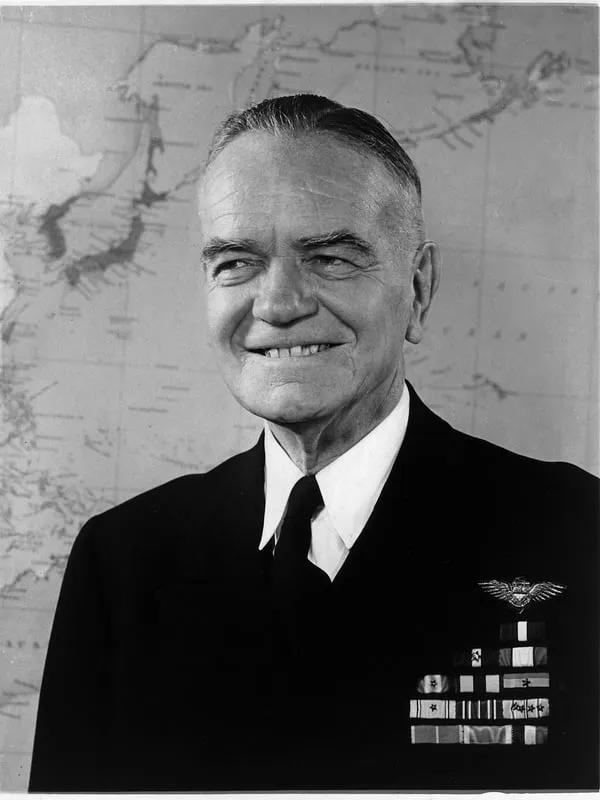
- Born:
- 30 October 1882, Elizabeth, New Jersey (United States)
- Died:
- 16 August 1959, Fishers Island, New York (United States)
- Author:
- Łukasz
- Photo:
- Harry Warnecke and Robert F. Cranston, CC0, Wikimedia Commons

William Frederick Halsey Jr., called “Bull” by the press and simply Bill by his friends, was the best-known and most controversial American admiral of the Pacific War. In the first months after Pearl Harbor he led the carrier raids that kept up American spirits; in October 1942 he took command at the most critical moment of the struggle for Guadalcanal and carried it through to victory; and in 1944–1945 he commanded the Third Fleet, which he took to the very shores of Japan. His aggressiveness, invaluable in 1942, nearly led to disaster off Leyte in October 1944. He was one of only four US Navy officers ever to be made fleet admiral.
A sailor’s son
He was born on 30 October 1882 in Elizabeth, New Jersey, the son of William F. Halsey, a naval officer, and Anna Masters Brewster. Among his ancestors were colonial New England seafarers, something he was proud of all his life. He waited two years for a place at the Naval Academy in Annapolis, and in the meantime studied medicine at the University of Virginia, reasoning that at worst he could join the Navy as a doctor. In 1900 he entered the Academy on a presidential appointment from William McKinley. He was no outstanding student, but he played fullback for the football team and was universally liked. He graduated on 2 February 1904.
He spent his first years of service on battleships. In April 1904 he was aboard the battleship Missouri when a powder explosion in a gun turret killed more than 30 men – he said afterwards that from then on he disliked the thirteenth day of the month. In 1907–1909 he sailed round the world in the battleship Kansas with President Theodore Roosevelt’s Great White Fleet. In 1909, promoted to lieutenant over the intermediate grade, he married Frances Grandy of Norfolk; his groomsmen were Academy classmates, among them the future commander of the Pacific Fleet, Husband Kimmel. The couple had a daughter and a son.
Torpedo boats and destroyers
For the next fifteen years or so Halsey was an officer of the “small navy”: he commanded torpedo boats and destroyers, and in 1912–1913 a group of the Atlantic Fleet’s torpedo flotilla. Torpedo tactics, night attacks and quick decisions on the bridge shaped his style of command. During the First World War he operated from Queenstown in Ireland in command of the destroyers Benham and Shaw, escorting convoys through waters where German U-boats operated. For this he received the Navy Cross.
Between the wars: attaché and aviator
From 1922 to 1925 he was naval attaché in Berlin, with additional accreditation to Copenhagen, Christiania (Oslo) and Stockholm, which gave him a close view of Weimar Germany in the years of hyperinflation. He then again commanded destroyers in European waters, served as executive officer of the battleship Wyoming and commanded the Academy’s station ship at Annapolis. In 1932–1934 he completed courses at the Naval War College and the Army War College.
The turning point came in 1934. The chief of the Bureau of Aeronautics, Rear Admiral Ernest King, offered him command of the aircraft carrier Saratoga on condition that he complete the course for naval aviation observers. Halsey chose full pilot training instead because, as he put it, he would rather be able to fly himself than be at the mercy of a pilot. On 15 May 1935, at the age of 52, he received his naval aviator’s wings, the oldest man in the history of the US Navy to complete the course. He commanded Saratoga from 1935 to 1937 and then the naval air station at Pensacola. In 1938, as a rear admiral, he took over a carrier division, and in June 1940, by then a vice admiral, he became commander of the Battle Force’s aircraft, based at Pearl Harbor. He was one of the few admirals who saw the carrier above all as an offensive weapon rather than as cover for the battleships.
Pearl Harbor and the raids of 1942
At the end of November 1941 Admiral Kimmel sent him with the carrier Enterprise to deliver fighters to the Marines on Wake. Halsey then gave orders to sink any ship and shoot down any aircraft encountered; when his operations officer asked who would take responsibility for a private war, he replied that he would. A storm delayed the force’s return, and on 7 December Enterprise was still some 200 miles from Oahu; some of her aircraft, sent on ahead, flew straight into the Japanese attack and were shot down by the Japanese or by American anti-aircraft fire. Halsey searched in vain for the Japanese carriers, and on the evening of 8 December, steaming in among the wrecks of the Pacific Fleet, he is said to have remarked that before they were through with the Japanese, their language would be spoken only in hell.
When Chester Nimitz took command after the disaster at Pearl Harbor, Halsey became his most aggressive subordinate. On 1 February 1942 his Enterprise force and that of Frank Jack Fletcher carried out the raids on the Marshall and Gilbert Islands; at the end of February he struck Wake, and early in March Marcus Island. In April his Task Force 16, with Enterprise and Hornet, carried Jimmy Doolittle’s bombers within range of Japan, and on 18 April they made the raid on Tokyo. Militarily these raids achieved little, but at a time when Singapore, Java and Bataan were falling they were the only good news from the Pacific. Halsey’s slogan “Hit hard, hit fast, hit often” became a press favourite.
The price was extreme strain. For half a year Halsey hardly left the bridge; at the end of May 1942 he returned to Pearl Harbor emaciated and suffering from a severe skin complaint, probably psoriasis, which kept him from sleeping. The doctors sent him to hospital in the very midst of the preparations for the Battle of Midway. As his successor in command of Task Force 16 he recommended the commander of his cruisers, Rear Admiral Raymond Spruance, and handed over his own staff. Spruance won the Battle of Midway, and Halsey, under treatment in California, later called missing it the greatest disappointment of his career.
Guadalcanal
In September 1942, after his convalescence, Halsey was to take over a carrier task force in the South Pacific. On 18 October, when he flew into Nouméa on a familiarisation tour, he received orders from Nimitz to relieve the exhausted Vice Admiral Robert Ghormley immediately and take command of the whole South Pacific Area. The Guadalcanal campaign was then on the brink of defeat: Japanese battleships had just wrecked Henderson Field, and reinforcements for a great offensive were pouring onto the island. The news of his appointment lifted the Marines’ morale, and at a conference in Nouméa on 23 October Halsey promised General Alexander Vandegrift “everything I have”.
He kept his word, though it meant risking his last ships. A few days later he sent both his carriers into the Battle of the Santa Cruz Islands, in which he lost Hornet, but Japanese carrier aviation suffered losses from which it never recovered. In mid-November, when the Japanese made their last great attempt to run reinforcements through, he committed to the fighting in the narrow waters between the islands not only cruisers but also Rear Admiral Willis Lee’s two new battleships. The Naval Battle of Guadalcanal (12–15 November) cost the lives of Rear Admirals Daniel Callaghan and Norman Scott, but it decided the fate of the island. In November Halsey received his fourth star as a full admiral and sent his old vice admiral’s stars to the widows of the two fallen men. In February 1943 the Japanese evacuated the island, bringing the Guadalcanal campaign to an end.
Up the Solomons
In 1943 Halsey directed the advance up the Solomon Islands, as part of a strategy in which his forces operated in concert with General Douglas MacArthur’s troops in New Guinea. Despite the rivalry between the Army and the Navy, the two men worked well together. In April 1943, in his area, Army airmen shot down Admiral Isoroku Yamamoto’s aircraft in Operation Vengeance. After the fighting on New Georgia, Halsey began to bypass the most strongly defended bases instead of attacking them: in August he landed on lightly held Vella Lavella, and on 1 November 1943 on the shore of Empress Augusta Bay on Bougainville, where the Americans built their own airfields. When a powerful force of Japanese heavy cruisers gathered at Rabaul, he risked a strike by the carriers Saratoga and Princeton on that heavily defended base (5 November) and put the cruisers out of action; he later called it the gravest crisis of his time in command. Under Operation Cartwheel, Rabaul was surrounded and cut off rather than captured.
The Third Fleet and Leyte
In 1944 operations moved to the central and western Pacific. Nimitz now adopted an unusual arrangement: the same fast carriers served alternately as Spruance’s Fifth Fleet and Halsey’s Third Fleet. While one admiral fought, the other and his staff – which its own members called the “dirty tricks department” – planned the next operation. Halsey took over the Third Fleet at the end of August 1944. His carriers struck Palau, the Philippines, Okinawa and Formosa, destroying hundreds of Japanese aircraft.
In October 1944 the Third Fleet covered MacArthur’s landing on Leyte. The Japanese responded with Operation Shō-Gō, which led to the Battle of Leyte Gulf, the largest naval battle of the war. On 24 October Halsey’s aircraft sank the super-battleship Musashi and forced Vice Admiral Takeo Kurita’s force to turn back. When Vice Admiral Jisaburō Ozawa’s Japanese carriers were detected to the north that evening, Halsey led his entire fleet against them, leaving no guard at the San Bernardino Strait. Ozawa’s carriers, almost without aircraft, were in fact a decoy. On the morning of 25 October Kurita, who had turned about once more, passed through the strait and fell upon a weak group of Seventh Fleet escort carriers off the island of Samar. For more than two hours Halsey ignored the calls for help, until he received a query from Nimitz: “Where is, repeat, where is Task Force Thirty Four? The world wonders.” The last words were merely cipher padding that had mistakenly been left in, but Halsey read them as a public rebuke. He turned his battleships south too late. Ozawa’s carriers were sunk off Cape Engaño, and Kurita, convinced that he faced larger forces, withdrew of his own accord – but the “run to the north”, which the historian Samuel Eliot Morison called “Halsey’s blunder”, remained a matter of dispute over his reputation for the rest of his life.
Typhoons and the end of the war
On 18 December 1944, wanting to finish refuelling and keep to the operational timetable, Halsey led his fleet straight into Typhoon Cobra. Three destroyers sank, 146 aircraft were destroyed and some 790–800 sailors were killed – more than in many battles. A naval court of inquiry found that the admiral had committed an error of judgement but recommended no punishment. In January 1945 his carriers broke into the South China Sea, after which he handed the fleet over to Spruance. In May 1945 he resumed command, and at the beginning of June his fleet ran into a typhoon for the second time; this time no ship was lost, but the board of inquiry recommended that Halsey be relieved. Nimitz, mindful of his services, refused.
In July and August 1945 the aircraft and battleships of the Third Fleet attacked the Japanese home islands themselves: Tokyo, the naval base at Kure, Hokkaido and industrial cities along the coast. After the surrender was announced, he ordered his airmen to shoot down any Japanese aircraft that still appeared “in a friendly sort of way”. On 2 September 1945, aboard his flagship, the battleship Missouri, in Tokyo Bay, the Japanese Instrument of Surrender was signed.
After the war
At the end of October 1945 Halsey brought part of the Third Fleet to San Francisco for the Navy Day celebrations. He gave up his command in November, and on 11 December 1945 he was promoted to fleet admiral – the fourth and last US Navy officer to hold the rank, after William Leahy, Ernest King and Nimitz. Whether the fifth star should have gone to him or to Spruance was argued over in Congress and within the Navy itself. In 1947 he retired, although as a fleet admiral he formally remained on active duty; in the same year he published his memoirs, Admiral Halsey’s Story, in which he defended his decisions at Leyte. He later sat on the boards of telecommunications companies and campaigned unsuccessfully for Enterprise to be preserved as a museum ship. He died of a heart attack on 16 August 1959 on Fishers Island, New York, and was buried in Arlington National Cemetery.
Assessment
Halsey was a commander for a time of crisis. In the first year of the war, when America had few ships and even fewer victories, his will to fight, his popularity with the sailors and his readiness to take risks had a value that cannot be measured in ships sunk. On Guadalcanal he restored the faith of men who felt abandoned, and it was largely his decisions that kept the Americans from withdrawing from the island. Ordinary sailors preferred to serve under him; many senior officers preferred the cool, precise Spruance. In 1944, when the American fleet already enjoyed crushing superiority, the same qualities – haste, a gambler’s streak, a reluctance to listen to others – cost it needless losses at Leyte and in the typhoons.
Historians also draw attention to his rhetoric. Halsey was among the Allied commanders who used racist language about the Japanese most blatantly in public; his slogan “Kill Japs, kill Japs, kill more Japs” stood on a huge billboard at the base on Tulagi and was repeated in the press, and Japanese propaganda used it as evidence of American brutality. Despite these shadows, Halsey has remained in American memory a symbol of the Navy’s courage in the darkest months of the war; among other things, a US Navy guided-missile destroyer bears his name. After the war he himself liked to say that there are no great men, only great challenges that ordinary men are forced to meet.
Sources
Commanded in battles
(07)- 7 August 1942 – 9 February 1943Guadalcanal campaignPacific
- 12–15 November 1942Naval Battle of GuadalcanalPacific
- 21 June – 25 August 1943New Georgia campaignPacific
- 15 August – 7 October 1943Battle of Vella LavellaPacific
- 1 November 1943 – 21 August 1945Bougainville campaignPacific
- 15 September – 27 November 1944Battle of PeleliuPacific
- 23–26 October 1944Battle of Leyte GulfPacific
Mentioned in battles
(11)Often appears with
People who appear in the same events.
On the timeline
(72)The 40 most important of 72 events. All tagged “William Halsey” (26) →