United States
Chester Nimitz
Commander-in-Chief, Pacific Fleet (1941–1945), Commander-in-Chief, Pacific Ocean Areas (1942–1945), Chief of Naval Operations (1945–1947), fleet admiral
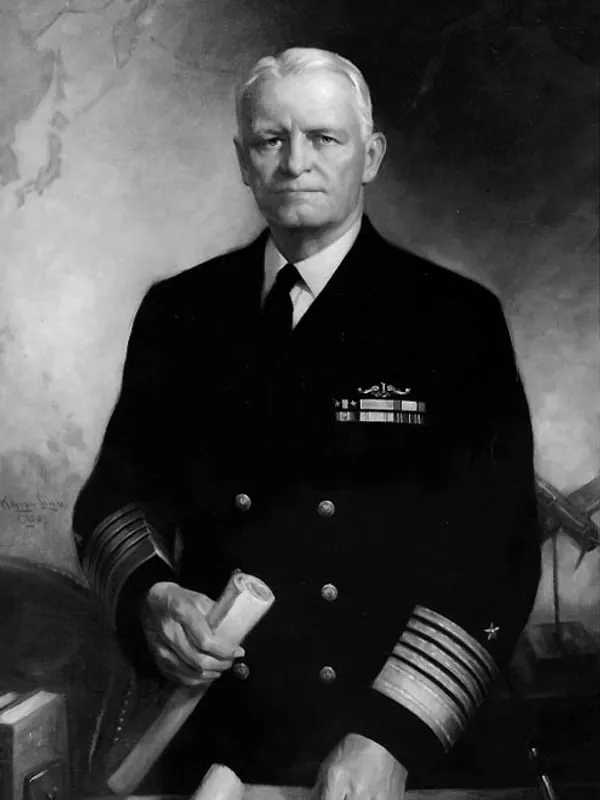
- Born:
- 24 February 1885, Fredericksburg, Texas (United States)
- Died:
- 20 February 1966, Yerba Buena Island, San Francisco (United States)
- Author:
- Natalia
- Photo:
- United States Navy released by original artist, Adrian Lamb, domena publiczna, Wikimedia Commons

Chester Nimitz took command of the US Pacific Fleet on the last day of 1941, three weeks after Japanese carriers had destroyed its battleships at Pearl Harbor. He inherited a beaten fleet, weaker than the Japanese in every class of ship and with no confidence in itself. Six months later, in June 1942, his carriers – placed, thanks to the work of the cryptanalysts, exactly where the enemy did not expect them – sank four of Chūichi Nagumo’s carriers off Midway. For the next three years Nimitz directed the war across an immense area from the Aleutians to the Solomon Islands and from Hawaii to Okinawa, and on 2 September 1945 he signed Japan’s instrument of surrender on behalf of the United States. He was a different kind of commander from his more celebrated contemporaries: a calm organiser who listened carefully to his subordinates and was loyal to them, who chose his men, gave them a free hand and took upon himself the risk of their decisions.
A Texan grandson of a German seaman
Chester William Nimitz was born on 24 February 1885 in Fredericksburg, Texas, a small town founded by German settlers. His father, Chester Bernhard, died a few months before he was born. The boy was brought up by his mother, who a few years later married her late husband’s brother, and above all by his grandfather, Charles Henry (Carl Heinrich) Nimitz, a former seaman in the German merchant marine who ran a ship-shaped hotel in Fredericksburg. German was spoken at home, and Nimitz remained bilingual all his life. He credited his grandfather with advice he would repeat as an admiral: the sea, like life itself, is a stern taskmaster, and the best way to deal with both is to learn all you can, do your best and not worry about what you cannot control.
He wanted to become an army officer, but there were no vacancies at West Point. His district’s congressman did, however, have a place at the Naval Academy in Annapolis and promised it to the best candidate. Nimitz won the examination and in 1901 entered the Academy, graduating in January 1905 seventh out of 114.
Submarines and diesel engines
He spent his first years of service in the Far East. Aboard the battleship USS Ohio he sailed to Japan, where in 1905, after the victorious war with Russia, he was among the young American officers invited to a reception held in honour of the victors of Tsushima; there he met Admiral Heihachirō Tōgō, whom he respected for the rest of his life. In 1908, as a twenty-three-year-old ensign in the Philippines, he commanded the destroyer Decatur and ran her aground. A court-martial reprimanded him, which did not hold back his career, and Nimitz himself later regarded it as an important lesson.
From 1909 he served in submarines, commanding several in turn, and became one of the navy’s leading experts on propulsion. He was among those who advocated replacing the dangerous petrol engines in submarines with diesels. In 1913 he was sent to Germany and Belgium to study diesel engine production at the MAN works, and on his return he supervised the construction of the propulsion plant of the oiler Maumee. During one of the trials he lost part of a finger. In the same year he married Catherine Vance Freeman, with whom he had four children.
The First World War and the interwar years
When the United States entered the First World War in 1917, Nimitz was executive officer and chief engineer of the Maumee. The ship refuelled American destroyers crossing the Atlantic, and it was aboard her that some of the US Navy’s first trials of refuelling ships under way on the open sea were carried out. This skill, developed further throughout the interwar years, would enable American fleets in the Pacific War to operate for weeks far from their bases. In 1918 Nimitz was chief of staff to the commander of the Atlantic Fleet’s submarine force.
After the war he built the submarine base at Pearl Harbor almost from scratch, and in 1922–1923 he studied at the Naval War College, where, like all its students, he repeatedly fought a war with Japan on the map. He is credited with a share in developing the circular formation, in which escorts surrounded the main units in several rings; during the war it became the standard formation of American carrier task forces. In 1926 he set up one of the first Naval Reserve Officers Training Corps units at the University of California, Berkeley. In the 1930s he commanded the cruiser Augusta, flagship of the Asiatic Fleet, was assistant chief of the Bureau of Navigation, which was responsible for naval personnel, and commanded cruiser and battleship divisions. In June 1939 he became Chief of the Bureau of Navigation. In this post he came to know Washington, Congress and President Franklin Delano Roosevelt well, and the President thought highly of him. At the beginning of 1941 Roosevelt offered him command of the United States Fleet, but Nimitz declined, considering himself too junior compared with many more senior admirals. The post went instead to Husband Kimmel.
Commander of the Pacific Fleet
After the attack on Pearl Harbor on 7 December 1941 Roosevelt and the Secretary of the Navy, Frank Knox, decided to remove Kimmel. According to a frequently quoted account, the President told Knox to tell Nimitz to get out to Pearl Harbor and stay there until the war was won. Nimitz flew to Hawaii on Christmas Day and on 31 December 1941 took command aboard the submarine Grayling – every battleship in the harbour was either sunk or damaged. He was promoted straight from rear admiral to full admiral.
He found the base in shock: Wake Island had just fallen after the relief expedition was called off, and Kimmel’s staff officers were expecting to be dismissed. Nimitz sacked no one. He kept his predecessor’s staff, including the intelligence officer, Lieutenant Commander Edwin Layton, and declared that he had full confidence in them. From the very first weeks he had to steer between the pressure of his superior in Washington, Admiral Ernest King, who demanded offensive action, and the weakness of his own forces. He sent his carriers on raids on the Marshall and Gilbert Islands and other Japanese outposts, which raised morale and taught the navy the new kind of war, and in April he prepared Doolittle’s raid on Tokyo.
On 30 March 1942 the American Joint Chiefs of Staff divided the Pacific between him and General Douglas MacArthur. As Commander-in-Chief, Pacific Ocean Areas, Nimitz commanded all Allied forces – sea, land and air – in the Central, North and South Pacific, while MacArthur commanded in the South West Pacific. This division lasted until the end of the war, and with it the rivalry between the two commands over resources and the direction of the main thrust.
The Coral Sea and Midway
In the spring of 1942 Nimitz staked everything on radio intelligence. The cryptanalysts of Station Hypo under Lieutenant Commander Joseph Rochefort were reading an ever larger part of Japanese signals traffic, and Nimitz, unlike many officers in Washington, trusted their assessments. When in April they established that the Japanese were preparing a landing at Port Moresby, he sent two carriers under Frank Jack Fletcher to the Coral Sea. The Battle of the Coral Sea cost the Americans the Lexington, but it stopped the Japanese landing and put two Japanese carriers out of the next operation.
The next target, as Rochefort established, was Midway. Nimitz believed it before Washington was convinced, and staked everything he had on a single card. Within a few days he prepared the defence: he reinforced the atoll’s garrison and aircraft, had the damaged Yorktown repaired in three days, and in place of the sick Halsey appointed Raymond Spruance. In his instructions to his commanders he told them to be governed by the “principle of calculated risk”. The Battle of Midway, which began on 3 June, brought on 4 June the destruction of three of Nagumo’s carriers within a few minutes, and in the afternoon of a fourth, the Hiryū. By the end of the battle the Americans had lost the Yorktown and the destroyer Hammann. In his communiqué of 6 June Nimitz wrote that Pearl Harbor had now been “partially avenged”, adding that the Americans were about “midway” to their objective.
Guadalcanal and the long campaign
After Midway Nimitz and King pushed through the first American offensive: in August 1942 the Marines landed on Guadalcanal. The fighting for the island lasted six months and cost the fleet dozens of ships. In October, when the situation seemed critical, Nimitz relieved the dispirited and exhausted Vice Admiral Robert Ghormley and gave command in the South Pacific to William Halsey, which at once lifted the troops’ spirits. In April 1943, when the cryptanalysts read the itinerary of an inspection tour by Admiral Isoroku Yamamoto, Nimitz approved an attempt to shoot down his aircraft; on 18 April American fighters killed Yamamoto over Bougainville.
From the autumn of 1943, as new carriers began to flow from American shipyards, Nimitz led the offensive across the Central Pacific. In November 1943 his forces took the Gilbert Islands, including Tarawa, captured at a heavy cost in blood; at the beginning of 1944 the atolls of the Marshall Islands; and in February his carriers destroyed the Japanese base at Truk in Operation Hailstone. In the summer of 1944 came the turn of the Marianas – Saipan, Guam and Tinian – and in the Battle of the Philippine Sea in June 1944 Japanese naval aviation suffered a defeat from which it never recovered. The “island-hopping” strategy consisted of seizing selected islands and bypassing many strongly defended bases, which, cut off from supplies, lost their value. In October 1944 Nimitz’s fleet supported MacArthur’s landing in the Philippines and in the Battle of Leyte Gulf destroyed what was left of the Japanese fleet as a fighting force.
In December 1944 Congress created the rank of fleet admiral, and Nimitz received it as one of the first three naval officers, together with William Leahy and King. In January 1945 he moved his headquarters from Pearl Harbor to Guam, closer to the front. His forces took Iwo Jima and Okinawa in the bloodiest battles of the Pacific War, while American submarines, which from the first day of the war had waged unrestricted warfare against Japanese shipping, sank a large part of the Japanese merchant fleet. On 2 September 1945 in Tokyo Bay, aboard the battleship Missouri, Nimitz signed the instrument of Japan’s surrender on behalf of the United States.
Command style
Nimitz did not seek publicity and seldom appeared before the press. He avoided the hasty dismissals King pressed for and gave his subordinates a great deal of freedom, while demanding results. He could work with men as different as the cautious, cool-headed Spruance and the impetuous Halsey, and despite their rivalry he maintained correct relations with MacArthur. He also took hard decisions: he took upon himself the risk of Midway, and when in December 1944 Halsey’s fleet ran into a typhoon and lost three destroyers and several hundred men, he concurred with the court of inquiry, which found Halsey guilty of an error of judgement, but did not relieve him. Historians, including those critical of other admirals of the war, agree in ranking him among the finest Allied commanders.
After the war
On 15 December 1945 Nimitz succeeded King as Chief of Naval Operations, the highest post in the US Navy. For two years he oversaw the demobilisation of the wartime fleet and defended the navy’s position in the disputes over the unification of the armed forces. He backed Captain Hyman Rickover’s project for a nuclear-powered submarine, which led to the Nautilus. In 1946 he provided the Nuremberg tribunal with a statement confirming that from the first day of the war with Japan the US Navy had waged unrestricted submarine warfare in the Pacific. This helped the defence of Grand Admiral Karl Dönitz: the tribunal did find that Dönitz had violated the law of submarine warfare, but in view of Allied practice it did not take this into account in sentencing him. Dönitz was sentenced to ten years’ imprisonment for other acts.
In December 1947 Nimitz stepped down, but as a fleet admiral he formally remained on active duty until his death. He settled with his wife in Berkeley. In 1949–1953 he was the UN-appointed administrator of the planned plebiscite in Jammu and Kashmir; the plebiscite never took place, because India and Pakistan could not agree on its terms. He supported reconciliation with Japan, including fund-raising for the restoration of the battleship Mikasa, Tōgō’s flagship at Tsushima. Together with the historian Elmer B. Potter he produced the naval history Sea Power.
At the end of 1965 he suffered a stroke, complicated by pneumonia. He died on 20 February 1966 at his residence on Yerba Buena Island in San Francisco Bay, four days before his 81st birthday. He was buried in Golden Gate National Cemetery in San Bruno, beside his wife and his wartime friends, Admirals Spruance, Richmond Turner and Charles Lockwood, as they had agreed among themselves in their lifetimes.
Significance
Nimitz was the man who led the United States from defeat at Pearl Harbor to Japan’s surrender. He did not win the war alone: it was won by American industry, by cryptanalysts, airmen and sailors, but it was he who in the most difficult months of 1942 took the decisions on which it depended whether industrial superiority would have time to tell. His trust in intelligence, his readiness to take a calculated risk at Midway and his skill in choosing men made him one of the most effective commanders of the Second World War. The first of the American nuclear-powered carriers bears his name, and his grandfather’s hotel in Fredericksburg now houses the National Museum of the Pacific War.
Sources
Commanded in battles
(03)Mentioned in battles
(20)- Battle of the Atlantic
- Attack on Pearl Harbor
- Battle of Wake Island
- Battle of the Coral Sea
- Guadalcanal campaign
- New Georgia campaign
- Battle of Vella Lavella
- Bougainville campaign
- New Britain campaign
- Admiralty Islands campaign
- Landings at Hollandia and Aitape
- Battle of Biak
- Battle of Saipan
- Battle of the Philippine Sea
- Battle of Guam (1944)
- Battle of Peleliu
- Battle of Leyte
- Battle of Leyte Gulf
- Battle of Iwo Jima
- The Battle of Okinawa
Often appears with
People who appear in the same events.
On the timeline
(89)The 40 most important of 89 events. All tagged “Chester Nimitz” (17) →
1939
1941
1942
January
February
March
April
May
June
- 03
- The attack on Dutch HarborOn 3 and 4 June 1942 aircraft from Ryūjō and Jun'yō bombed Dutch Harbor in the Aleutians, opening the Aleutian campaign alongside Midway.
- The Battle of Midway beginsOn 3 June 1942 a Catalina sighted Japanese transports heading for Midway. B-17s hit no ship, and Nagumo's carriers were still hidden in the fog.