1944: The advance along New Guinea
Battle of Biak
- Dates:
- 27 May – 17 August 1944
- Front:
- Pacific
- Location:
- Biak Island in the Schouten Islands, at the entrance to Geelvink Bay (today Cenderawasih Bay) in Dutch New Guinea – the beaches near the village of Bosnek, the south coast with the Mokmer, Borokoe and Sorido airfields, the hills and caves above them, and the nearby islet of OwiOn the battle map →
- Sides:
- United States and AustraliaDouglas MacArthur, Walter Krueger, Horace Fuller, Robert EichelbergerJapanNaoyuki Kuzume
- Result:
- Allied victory. The Americans took the island and its three airfields, but instead of the expected week the fighting lasted almost three months, and the first airfield became operational only on 22 June. The Japanese garrison of more than 11,000 men was almost entirely destroyed; the attempts to relieve it (Operation Kon) dispersed Japanese forces just before the Battle of the Philippine Sea.
- Author:
- Łukasz
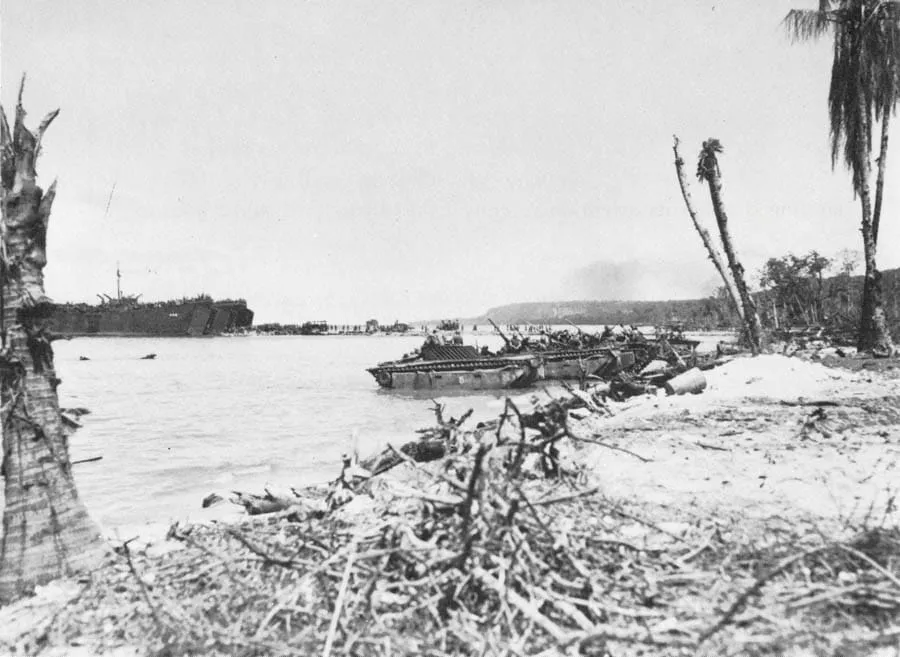
For General Douglas MacArthur the Battle of Biak was the hardest battle of the New Guinea campaign. The Americans, who expected to take the island’s three airfields in about a week, ran into a Japanese garrison of more than 11,000 men under Colonel Naoyuki Kuzume, hidden in caves on the coral terraces above the coast. The fighting lasted almost three months, and the first airfield became operational only on 22 June 1944 – too late for aircraft from Biak to support the landings in the Marianas.
Name and dates
The Battle of Biak is the name given to the fighting for the island of Biak, the largest of the Schouten Islands, which lies at the entrance to Geelvink Bay – today Cenderawasih Bay – off the north-western coast of New Guinea. In 1944 the island belonged to Dutch New Guinea; today it is part of Indonesia. The Americans gave the operation the codename Horlicks, and the landing force was called the Hurricane Task Force.
The battle began on 27 May 1944 with the landing of the US 41st Infantry Division near the village of Bosnek. Its end is dated in different ways. English-language accounts usually give 17 August 1944, when the last organised groups of Japanese still attempting to counter-attack were broken up; Japanese accounts take 20 August, when the American command declared the operation over. The fighting for the airfields proper had ended by 22 June, and the last large centre of resistance – the so-called Ibdi Pocket – was eliminated in the second half of July. Scattered Japanese soldiers went on hiding in the jungle long afterwards; some of them surrendered only after Japan’s capitulation.
Biak was the first major instance of the Japanese deliberately giving up the defence of the beaches and handing them to the enemy without a fight, so as to defend themselves inland, in caves and on ridges overlooking the objective of the landing. This way of fighting was later repeated on Peleliu, Iwo Jima and Okinawa.
Background
In the spring of 1944 General Douglas MacArthur, commander of the Allied South West Pacific Area, quickened his advance along the north coast of New Guinea towards the Philippines. His method became the long amphibious leap, bypassing strong Japanese garrisons and aimed at places suitable for airfields. The largest of these was the landing at Hollandia and Aitape on 22 April 1944, which cut off the Japanese 18th Army at Wewak and gave the Americans a great base at Hollandia. The Hollandia airfields, however, proved too waterlogged to take heavy bombers, and the Philippines were still a long way off.
Biak lies some 520 kilometres west of Hollandia. On the flat strip of the south-east coast the Japanese had built three airfields – Mokmer, Borokoe and Sorido – and the coral subsoil was suitable for runways for heavy aircraft. Bombers flying from Biak could reach western New Guinea, the Moluccas, the southern Philippines and Palau. MacArthur’s staff also planned for aircraft from Biak to support from the south the Central Pacific offensive of Admiral Chester Nimitz, who was to strike at the Marianas in June.
On the Japanese side, Biak lay within the “absolute national defence zone” drawn up in the autumn of 1943. The island came under the 2nd Army of General Fusatarō Teshima, which was subordinate to the Second Area Army of General Korechika Anami. The Japanese command judged Biak’s airfields to be the key to the defence of western New Guinea and the approaches to the Philippines, but after the defeat at Hollandia it no longer had anything with which to reinforce the garrison.
The first step towards Biak was the landing on the islet of Wakde and on the nearby New Guinea coast at Sarmi on 17–18 May 1944. Wakde, taken by the 41st Division’s 163rd Infantry Regiment within two days, gave the Americans an airfield from which fighters and bombers could cover the landing on Biak. The fighting on the coast near Sarmi against the Japanese 36th Division of General Hachirō Tagami went on through the whole summer and tied down further American forces.
Plans and forces
The operation was prepared by Alamo Force – in effect the Sixth Army of General Walter Krueger. The landing was entrusted to the 41st Infantry Division of Major General Horace Fuller, a veteran of the fighting at Buna and Sanananda and of the landing at Hollandia. Its 162nd and 186th Infantry Regiments were to go to Biak with artillery, M4 Sherman tanks, engineers and construction units; the 163rd Regiment, tied down by the fighting on Wakde, was to follow later. Allied intelligence estimated the island’s garrison very variously – at anything from about 2,000 to more than 4,000 men – and a signal intercepted in April that spoke of almost 11,000 rations was taken to refer to a planned rather than an actual strength. The staff expected the island to be taken in about a week, and the first airfield to be ready by mid-June.
The naval forces, Task Group 77.2 under Rear Admiral William Fechteler, came under the Seventh Fleet of Vice Admiral Thomas Kinkaid. The attack transports, tank landing ships (LSTs) and landing craft were covered by two heavy cruisers, three light cruisers and more than twenty destroyers. Some of these were Australian, including the cruisers HMAS Australia and Shropshire. Air support came from General George Kenney’s Fifth Air Force, operating from Hollandia and Wakde, while the Thirteenth Air Force and Australian and Dutch squadrons from northern Australia also struck more distant targets.
The island was defended by a force called the Biak Detachment. It was commanded by Colonel Naoyuki Kuzume, commander of the 222nd Infantry Regiment of the 36th Division – a unit experienced in the fighting in China and, by Japanese standards, well equipped: it had its own mortars, artillery, light guns and a company of nine Type 95 Ha-Go light tanks. According to Japanese returns, the regiment numbered about 3,500 men on the island. The rest of the garrison, which together with the navy came to more than 11,000 men, was made up of an anti-aircraft artillery company, airfield construction units, rear services and labourers – among them about 3,000 forced labourers from Taiwan and Indonesia. The navy had the 19th Guard Unit and anti-aircraft units on the island; from 15 May Rear Admiral Sadatoshi Senda, commander of the newly formed 28th Special Base Force, was also there. By chance Lieutenant General Takazō Numata, chief of staff of the Second Area Army, was on Biak as well; he had come on an inspection and in the first days of the battle personally directed part of the fighting.
Kuzume knew that he could not defend the long coastline. He decided to give up the beaches without a fight and to defend what the enemy really needed – the airfields. Above the narrow coastal strip along which ran the only road from Bosnek to Mokmer rose steep coral terraces full of natural caves. The Japanese turned them into a system of positions for machine guns, mortars and guns, linked by passages and stocked with food and ammunition. There were three main centres: the West Caves above Mokmer airfield – a huge, multi-level cavern able to hold up to 2,000 men, in which Kuzume placed his headquarters; the East Caves above the village of Mokmer; and the fortifications on the ridges near the village of Ibdi, which the Americans later called the Ibdi Pocket. The weakness of the defence was the lack of water: there was very little of it on the karst island, which plagued defenders and attackers alike.
Course: the landing at Bosnek (27 May 1944)
The convoy left Humboldt Bay at Hollandia on the evening of 25 May, after very brief rehearsals. On the morning of 27 May, after air attacks and a naval bombardment lasting some three-quarters of an hour, the first waves of the 162nd Regiment came in over the coral reef in amphibian tractors towards the beaches near the village of Bosnek. A sea current and smoke over the shore caused confusion – some of the first units landed several kilometres west of the designated beaches, among mangroves, and had to be regrouped. The Japanese, however, did not fire: in accordance with Kuzume’s plan, the beaches were empty.
By late afternoon some 12,000 men, 12 Sherman tanks, 29 field guns, about 500 vehicles and 3,000 tons of supplies were ashore. The first few Japanese aircraft appeared that same day; in the afternoon two waves of bombers attacked the landing ships at the western jetty, but the bombs missed or failed to explode, and anti-aircraft fire shot down several of the aircraft. The 186th Regiment secured the beachhead at Bosnek, while the 162nd Regiment set off west along the coast road towards Mokmer airfield, a dozen or so kilometres away. The first day looked like an easy victory.
Course: the ambush at Mokmer and the tank battle (28–31 May 1944)
On 28 May the 162nd Regiment passed through the narrow defile at Parai, where a coral cliff comes down almost to the water’s edge, and approached the village of Mokmer. Then machine-gun, mortar and artillery fire came down on it from the terraces above the road and from the East Caves. Japanese infantry supported by tanks attacked and cut off the forward 3rd Battalion. The men who could not withdraw by land were evacuated in the evening by amphibian tractors and landing craft. That same day a communiqué from MacArthur’s headquarters announced that the capture of Biak meant, for all practical purposes, the end of the New Guinea campaign – a statement that weighed on the commanders in the field for weeks to come.
On 29 May the Japanese, directed according to Japanese sources by General Numata, renewed their attack on the 162nd Regiment’s positions near Parai. It was led by several Ha-Go tanks with infantry. Shermans went out to meet them. The clash is regarded as the first tank-versus-tank action of the New Guinea campaign. The light Japanese vehicles, armed with 37 mm guns, stood no chance against the American medium tanks: according to Japanese accounts, seven of the nine Ha-Gos were destroyed and the company commander, Lieutenant Iwasa, was killed; the Americans lost or had damaged two Shermans. Even so, the pressure of the Japanese infantry was so strong that the 162nd Regiment had to fall back east, beyond the Parai defile.
Fuller realised that the garrison was far stronger than had been assumed and asked Krueger for reinforcements. On 31 May elements of the 163rd Regiment arrived on the island. An advance along the road under fire from the cliffs proved impossible; the terraces dominating the coast would have to be taken first.
Operation Kon (29 May – 13 June 1944)
The American landing caught the Japanese navy just as it was preparing for a decisive battle with Nimitz’s fleet. Plan A-Go, drawn up by the new commander of the Combined Fleet, Admiral Soemu Toyoda, envisaged luring the Americans into the area of Palau and the western Carolines, where the Japanese fleet could be supported by land-based aircraft. Biak, which lay not far from that area, seemed to the Japanese both a threat – from its airfields the Americans could observe and bomb the area of the intended battle – and an opportunity to provoke the American fleet into battle. On 29 May planning began for Operation Kon, the transport of reinforcements to the island under the cover of warships.
Naval aviation moved more than a hundred aircraft to western New Guinea, mainly to the area of Sorong, drawing them from Japan, the Carolines and the Marianas. On 2 and 3 June Japanese aircraft made heavy attacks on the ships off Biak, losing more than 20 aircraft for little result.
The first relief attempt set out from Davao on Mindanao on 2 June: some 2,500 men of the 2nd Amphibious Brigade were to sail under the cover of Rear Admiral Naomasa Sakonju’s force, with the battleship Fusō, the heavy cruisers Aoba, Myōkō and Haguro, a light cruiser and destroyers. When the force was spotted, and Japanese reconnaissance wrongly reported an American aircraft carrier near Biak, the operation was called off on 3 June and the troops were diverted to Sorong.
The second attempt was more modest: six destroyers with troops on board and barges in tow left Sorong and on 8 June headed for Biak. While it was still daylight American B-25 bombers sank the destroyer Harusame. During the night of 8–9 June, near the island, the Japanese ran into an Allied force of cruisers and destroyers under Rear Admiral Victor Crutchley, including HMAS Australia. The Japanese cast off the barges and turned back; the pursuit was inconclusive, but the reinforcements did not get through.
The third attempt was meant to be decisive. Vice Admiral Matome Ugaki assembled the most powerful ships of the fleet off the island of Bacan near Halmahera: the super-battleships Yamato and Musashi, which could have crushed Kinkaid’s weak force and shelled the beachhead. On 11 June, however, American carriers began air attacks on the Marianas that heralded a landing on Saipan. Toyoda called off Operation Kon and set Plan A-Go in motion; Ugaki’s ships sailed north to join the fleet of Vice Admiral Jisaburō Ozawa.
Although Operation Kon failed, some reinforcements reached the island by another route. In June, by barge from Manokwari by way of the island of Numfoor to Biak’s north coast, some 1,100–1,200 men – the estimates vary – were brought in, among them battalions of the 219th and 221st Infantry Regiments of the 35th Division. This was enough to prolong the fighting, but not to turn it around.
Course: Mokmer airfield and stalemate (1–14 June 1944)
At the beginning of June Fuller changed his plan. The 186th Regiment was to cross the jungle-covered plateau inland, outflank the terraces from the north and come down on Mokmer airfield from the rear, while the 162nd Regiment advanced along the coast. The march through waterless, densely overgrown country was utterly exhausting; water had to be carried up, and the men suffered from the heat. On 2 June the Americans occupied the nearby islet of Owi without a fight, and engineers immediately began building an airfield there – with Mokmer still out of reach, the Fifth Air Force was looking for an alternative site for its aircraft.
On 7 June the 186th Regiment came down from the plateau and took Mokmer airfield almost without loss, and the coastal beachhead below the airfield was supplied from the sea. It soon became clear that the prize was useless. The runway lay under artillery, mortar and machine-gun fire from the West Caves and from the ridges north of the airfield; the engineers who tried to repair it had to withdraw. A Japanese night counter-attack on 8–9 June was beaten off, but the defenders held their positions above the airfield, and attempts to take them over the following days ended in losses without a decision. There was also fighting for the East Caves and the ridges near Ibdi, which blocked the road from Bosnek.
Pressure from above mounted. The landing on Saipan was planned for 15 June, and the airfield on Biak was still not working, even though MacArthur’s communiqué had announced the island to be practically taken at the end of May. MacArthur pressed Krueger, and Krueger pressed Fuller. Fuller, convinced that he was facing a garrison much stronger than a single division could quickly overcome, asked for further reinforcements. Krueger sent the 34th Infantry Regiment of the 24th Infantry Division from Hollandia, but decided that the command on the island had to be changed.
Course: Eichelberger, the West Caves and the airfields (15–27 June 1944)
On 14 June Krueger ordered General Robert Eichelberger, commander of I Corps, to take command of the Hurricane Task Force. Eichelberger flew to Biak on 15 June. Fuller, embittered at being deprived of the direction of the operation, asked to be relieved of command of his division as well; the 41st Division was taken over by his deputy, Brigadier General Jens Doe, and Fuller later became deputy chief of staff at South East Asia Command. Historians still judge this change differently: many believe that Fuller paid for faulty intelligence and the over-optimistic announcements of MacArthur’s staff rather than for any mistakes of his own.
Eichelberger spent two days touring the front and preparing a new attack. His aim was no longer to assault every cave, but to deprive the Japanese of all the positions from which they could fire on Mokmer airfield. On 18 June the 34th Regiment landed. On 19 and 20 June the 186th and 162nd Regiments took the ridges north of the airfield and surrounded the West Caves, while the 34th Regiment, advancing west, took the Borokoe and Sorido airfields almost unopposed. During the night of 20–21 June a Japanese seaplane took General Numata off the island.
The siege of the West Caves was one of the hardest episodes of the battle. Hundreds of soldiers and wounded were crammed into the multi-level cavern; food and water were short, and dysentery was spreading. The Americans threw explosive charges and grenades into the entrances, poured in petrol and set it alight, and used flamethrowers. On 21 June Kuzume burned the regimental colour. The sources present the order of what followed differently. According to the US official history and the accounts based on it, Kuzume then committed suicide in the cave. According to Japanese sources, among them the biographical dictionary edited by Ikuhiko Hata, during the night of 21–22 June he led some of his men out of the caves into the hills inland and committed suicide only on 2 July; this version is better documented. About 160 seriously wounded and sick men remained in the caves and, according to Japanese accounts, took their own lives. A Japanese night counter-attack on the American positions was smashed.
On 22 June the first American fighters landed at Mokmer airfield. On 25 June General Anami called off further attempts to send in reinforcements and ordered the remnants of the garrison to switch to a defence aimed at prolonging the fighting. On 27 June the Americans cleared the West Caves, where they found hundreds of bodies; that same day the sailors in the East Caves abandoned their positions and fled inland.
Course: the Ibdi Pocket and the end of the fighting (July – August 1944)
After the fall of the West Caves the island was effectively lost to the Japanese, but the fighting went on. The men on the ridges near Ibdi, between Bosnek and Mokmer, held out longest. For many weeks the Americans shelled the Ibdi Pocket – a few hundred metres of coral terraces full of caves and bunkers – with artillery and mortars and bombed it from the air before the infantry managed to take it. According to the US official history, the last resistance in the pocket was broken around 22 July.
After Kuzume’s death on 2 July, command of the remnants of the garrison passed to Major Masao Ōmori. In mid-July an order from the 2nd Army reached him over the navy’s radio, telling him to disperse and fight on for as long as possible. According to Japanese sources, a little over 1,600 men were left at that point. Broken groups hid in the jungle in the north and west of the island, still tried to counter-attack and raided American dumps in search of food, while more and more of them died of starvation, malaria and dysentery. The last supply flight reached Biak at the beginning of July, and in the second half of the month contact with the rest of the Japanese forces ceased. American patrols went on clearing the island throughout July and August; on 17 August the last organised groups were broken up, and on 20 August the command declared the operation over.
Meanwhile the front had moved on. On 2 July the Americans landed on the island of Numfoor, west of Biak, where they took more airfields, and on 30 July at Sansapor, at the very western tip of New Guinea.
Losses
According to American figures, the ground forces lost 438 killed and 2,361 wounded on Biak; Japanese sources, drawing on different returns, give 471 killed and 2,443 wounded. Far more men were put out of action by disease: according to American figures, non-battle casualties amounted to 7,234 men, mostly from scrub typhus (tsutsugamushi fever) carried by mites, but also from exhaustion, malaria and combat neurosis. The navy lost 22 killed, 14 missing and 68 wounded.
Japanese losses were almost total. The Americans counted about 4,700 killed and some 200 prisoners, but these figures cover only the period of organised fighting. Of the more than 11,000 men of the garrison and its reinforcements, according to Japanese returns, only about 520 survived the war – 434 taken prisoner by August 1945 and 86 who came out of the jungle after Japan’s capitulation. The rest were killed or died of starvation and disease. Many of the dead were forced labourers; about 600 Indian (prisoners of war from the British Indian Army) and Javanese labourers were freed by the Americans after the fighting. Rear Admiral Senda probably died in December 1944.
Significance
Biak did not fulfil the hopes that MacArthur’s staff had placed in it. The first airfield became operational only on 22 June, when the Battle of the Philippine Sea had already been decided, and the remaining strips at Mokmer only in August. So aircraft from Biak did not support the landing in the Marianas. The island did, however, become a great base: on Biak and Owi airfields for heavy B-24 bombers were built, together with wharves for landing ships, roads, depots and a hospital. From there, in the autumn of 1944, aircraft attacked Mindanao, the Dutch East Indies and Palau, supporting the landings on Peleliu and Morotai in September and in the Philippines in October.
Indirectly, Biak affected the course of the war at sea more than anyone had intended. Operation Kon drew a considerable part of the land-based aircraft of the Japanese First Air Fleet away from the Marianas and the Carolines. Many of them were destroyed over Biak, and others, together with crews sick with malaria, were stranded in western New Guinea. When the Battle of the Philippine Sea was fought on 19 and 20 June, these aircraft were not there to support Ozawa’s carriers, as Plan A-Go had explicitly counted on. The Japanese fleet suffered a defeat there that opened the way for the Americans to the Marianas and then to the Philippines.
The battle also foreshadowed a new Japanese way of fighting. Instead of defending the beaches and dying in night charges, the defenders of Biak gave up the shore without a fight and defended themselves from prepared caves, forcing the enemy into the slow and costly clearing of each one. The experience of Biak, and soon afterwards of Saipan, influenced the instructions issued by Imperial General Headquarters in the summer of 1944, which advised island garrisons to abandon the defence of the shoreline in favour of defence in depth. This was how the fighting went on Peleliu, Iwo Jima and Okinawa, where American losses were incomparably higher.
For MacArthur, Biak was the hardest battle of the New Guinea campaign and a lesson that a report of victory is no substitute for ground actually taken. For the Japanese it was one of many examples of garrisons left to their fate, which fought almost to the last man, delaying the American advance towards the Philippines but not stopping it.