1944: The advance along New Guinea
Landings at Hollandia and Aitape
- Dates:
- 22 April – 6 June 1944
- Front:
- Pacific
- Location:
- The north coast of New Guinea: Hollandia (today Jayapura) in Dutch New Guinea – Tanahmerah Bay and Humboldt Bay, and the plain between the Cyclops Mountains and Lake Sentani with the Hollandia, Sentani and Cyclops airfields – and Aitape with Tadji airfield in the Territory of New GuineaOn the battle map →
- Sides:
- United States and AustraliaDouglas MacArthur, Walter Krueger, Robert Eichelberger, Daniel Barbey, Marc MitscherJapanHatazō Adachi, Fusatarō Teshima
- Result:
- Allied victory. Without heavy losses the Americans took the airfields at Hollandia and Aitape, shattering and scattering the Hollandia garrison of some 11,000 men. The Japanese 18th Army at Wewak was cut off, and Hollandia became MacArthur's main springboard for the Philippines.
- Author:
- Łukasz
Name and dates
The landings at Hollandia and Aitape were two simultaneous amphibious operations by which American forces – supported by the Australian navy and air force – leapt several hundred kilometres along the north coast of New Guinea in the spring of 1944. The main force, under the code name Reckless, landed in two bays on either side of Hollandia – the capital of Dutch New Guinea, today’s Jayapura in Indonesia. The subsidiary force, under the code name Persecution, took Aitape and the nearby Tadji airfield in the Australian-administered Territory of New Guinea, some 200 kilometres east of Hollandia. English-language literature speaks of the Battle of Hollandia and the landing at Aitape; the two operations were planned, prepared and carried out as a single whole, and so they are treated together.
The start is taken to be 22 April 1944 – the day on which all three assault groups put their troops ashore at dawn. The earlier air raids on Hollandia, from 30 March onwards, were preparation for the operation. The end is dated to 6 June 1944, when the Americans finished clearing the Hollandia area of shattered Japanese units. The fighting at Aitape lasted longer: after several weeks of relative quiet, the Japanese 18th Army attacked there in July, and the battle of the Driniumor River belongs to the next stage of the war in New Guinea.
The landings at Hollandia and Aitape opened the last phase of the fighting in New Guinea: the offensive along its north coast which, between April and September 1944, carried the forces of General Douglas MacArthur from the Huon Gulf to the Moluccas, on the threshold of the Philippines.
Background
The Japanese had taken Hollandia in April 1942, in the last phase of the Dutch East Indies campaign and of their expansion along the north coast of New Guinea. The small town lay on Humboldt Bay, the only good natural harbour between Wewak and Geelvink Bay. Behind it rose the steep Cyclops Mountains, reaching more than 2,000 metres, and between the mountains and the broad Lake Sentani stretched a flat plain – a rarity on that coast. By the spring of 1944 the Japanese had built three airfields on it and started a fourth.
For two years Hollandia lay far from the front. The fighting took place in the east: on the Kokoda Track, at Buna and Gona, and in 1943 on the Huon Peninsula, where the Australians and Americans took Lae and landed at Finschhafen. On 2 January 1944 the Americans landed at Saidor, and in February and March – during the Admiralty Islands campaign – they closed the ring around Rabaul, the great Japanese base on New Britain, which it had been decided not to storm. Seeadler Harbour on Manus now gave the fleet a forward base.
The Japanese 18th Army under General Hatazō Adachi – three exhausted divisions, the 20th, 41st and 51st, some 55,000 men in all – was at this time falling back along the coast towards Madang, Hansa Bay and Wewak. It was still a substantial force in eastern New Guinea, and its main bases and airfields lay in the Wewak area. Further west, beyond the Sepik River and the border of the Dutch part of the island, defence was the responsibility of General Fusatarō Teshima’s 2nd Army, which – like the 18th Army from March 1944 – came under General Korechika Anami’s 2nd Area Army (Dai-2 Hōmengun).
In the autumn of 1943 the Japanese high command had decided that the defence perimeter must be pulled back westwards. The new “absolute national defence sphere” was to run through the western part of New Guinea; Hollandia, at first intended as the main base of this line, became in November 1943 merely an outpost of it. The main defensive positions were to be built further west, in the Wakde and Sarmi area, on Biak and on the Vogelkop Peninsula. In March 1944 the 2nd Area Army command ordered Adachi to move forces from the Madang and Hansa Bay area to Hollandia and to send one division there at once. Adachi dragged his feet: he was convinced that the next Allied objective would be Hansa Bay or Wewak, and he concentrated his troops there. Only when the chief of staff of the 2nd Area Army came to Wewak with orders did Adachi set the 66th Infantry Regiment on its way, due to reach Hollandia in mid-June. By then it was too late.
Plans and forces
The Allies had long had Hollandia in their plans, but only as an objective for 1944, to follow the capture of Hansa Bay. Intelligence changed everything. At the beginning of 1944 Australian soldiers had found a trunk containing the cipher keys of the Japanese 20th Division at Sio on the Huon Peninsula, and cryptanalysts in Brisbane and Washington began reading the signals of the Japanese army on a large scale. These made it clear that the Japanese expected a landing at Hansa Bay or Wewak and were drawing troops there, while Hollandia was defended almost entirely by air units, rear services and anti-aircraft gunners.
MacArthur decided to take advantage of this. On 8 March 1944 he asked the Joint Chiefs of Staff for permission to bypass Hansa Bay and Wewak and leap straight to Hollandia – some 700 kilometres from the American positions at Saidor and more than 600 kilometres from the Australians advancing on Madang. On 12 March a directive from Washington approved the plan and ordered Admiral Chester Nimitz’s Pacific Fleet to support the landing with carriers. Since Hollandia lay beyond the range of Allied fighters in New Guinea, the operation would have been impossible without carrier cover; the risk was so great that it was named Reckless.
At a conference in Brisbane on 25–27 March, Nimitz agreed that Vice Admiral Marc Mitscher’s fast carriers (Task Force 58) would cover the landing, but only for two days after the assault – not for eight, as MacArthur had wanted. To fill the gap before the captured airfields at Hollandia became operational, it was decided to take Aitape at the same time, as Tadji airfield there could quickly be made ready for fighters. Thus Operation Persecution was born. Nimitz added eight escort carriers, which were to support both landings until the airfields ashore were in operation. Because of shipping shortages and the fleet’s other commitments, the date was put back from 15 to 22 April.
The land forces as a whole were commanded by General Walter Krueger, commander of the Sixth Army, operating as Alamo Force. The Hollandia landing (Reckless Task Force) was led by General Robert Eichelberger, commander of I Corps and the victor of Buna. He had at his disposal General Frederick Irving’s 24th Infantry Division, for which this was its first action, and General Horace Fuller’s 41st Infantry Division, veterans of the fighting of 1942–1943. At Aitape (Persecution Task Force) the reinforced 163rd Infantry Regiment of the 41st Division under Brigadier General Jens Doe was to land, followed by regiments of the 32nd Division. In all the operation involved more than 80,000 men, including some 52,000 combat troops – nearly 30,000 for Hollandia and 22,500 for Aitape – and 217 warships and other vessels. The amphibious force (Task Force 77 of Vice Admiral Thomas Kinkaid’s Seventh Fleet) was commanded by Rear Admiral Daniel Barbey; fire support was provided by, among others, a squadron of the Australian cruisers HMAS Australia and Shropshire under the British Rear Admiral Victor Crutchley, and by the American cruisers of Rear Admiral Russell Berkey.
On the Japanese side there were some 11,000 men at Hollandia – personnel of the 6th Air Division, supply, airfield construction and transport units, sailors of Rear Admiral Yoshikazu Endō’s 9th Fleet, and soldiers in transit further west. Of these, according to the US official history, only about 500 were men of combat units, mostly from anti-aircraft batteries. The command changed every few weeks: the most senior officers – General Masazumi Inada, who had only just taken over the 6th Air Division, and Major General Toyozō Kitazono – had been on the spot for a few weeks, and no one had prepared a plan of defence. The Aitape garrison numbered about 1,000 men, of whom at most a few hundred were combat troops. The Allies, lacking certainty, estimated the Japanese forces at around 14,000 at Hollandia and 3,500 at Aitape.
Preparations: air raids and deception (30 March – 21 April 1944)
The first condition for success was the destruction of the Japanese air force at Hollandia. The Japanese considered the airfields there safe, because they lay beyond the range of Allied fighters, and had assembled several hundred aircraft of the 6th Air Division on them. They did not know that General George Kenney’s US Fifth Air Force had received P-38 Lightning fighters with extra fuel tanks, able to escort bombers all the way to Hollandia. Kenney deliberately kept them away from the area so as not to give away their range.
On 30 and 31 March, and then on 3 April 1944, B-24 heavy bombers and B-25 and A-20 medium bombers escorted by P-38s fell on the airfields by Lake Sentani, taking the enemy by surprise. The attack bombers showered the closely parked aircraft with parachute fragmentation bombs. According to American reports some 340 aircraft were destroyed on the ground in those few days, and several dozen more in the air; these figures were probably inflated, but in practice the Japanese air force in New Guinea ceased to exist. The commander of the 6th Air Division was relieved. In the following days the raids were repeated, and American and Australian aircraft also attacked Wewak, Aitape, Wakde, Biak and the Vogelkop Peninsula. The heaviest blow to the Fifth Air Force was dealt by the weather: on 16 April, a day later called “Black Sunday”, formations returning from Hollandia ran into a violent storm front and lost some thirty aircraft – more than in combat during the whole of this period.
At the same time, from 30 March to 1 April, Mitscher’s carriers – a month after the raid on Truk – attacked Palau, Yap and Woleai in the Carolines to destroy the aircraft there and drive the Japanese fleet out of Palau. The aircraft in which the Commander-in-Chief of the Combined Fleet, Admiral Mineichi Koga, was leaving Palau on 31 March disappeared in a storm. On 19 April a British-American force of Admiral James Somerville’s Eastern Fleet, including the American carrier Saratoga, attacked the port of Sabang in Sumatra (Operation Cockpit) at the request of Admiral Ernest King, in order to pin down Japanese air power in the west.
The Allies tried to confirm the Japanese in their belief that the target would be Hansa Bay. Aircraft and destroyers shelled Wewak and Hansa Bay, and patrols were put ashore to simulate pre-landing reconnaissance. The ruse worked: Adachi waited for a blow in the east to the very end. Reconnaissance of Hollandia itself was less fortunate – an Australian party landed from a submarine at the end of March was detected and broken up, and aerial photographs of the terrain reached the staffs too late to change the plan.
Between 16 and 18 April convoys left Finschhafen, Cape Cretin and Goodenough Island, joined the group from Seeadler Harbour and on 20 April met the escort carriers north of Manus. Taking a roundabout route west of the Admiralty Islands, they covered some 1,600 kilometres in all. During the night of 21–22 April, about 130 kilometres from the coast, the eastern group broke away towards Aitape, and a little later the other two separated off Hollandia. From 21 April aircraft of Task Force 58 and the escort carriers bombed Hollandia, Wakde, Sawar and Sarmi.
Course of operations: the landings in Tanahmerah and Humboldt Bays (22 April 1944)
At dawn on 22 April 1944, after a short naval bombardment and strikes by carrier aircraft, the Americans landed in two places some 40 kilometres apart. Surprise was complete.
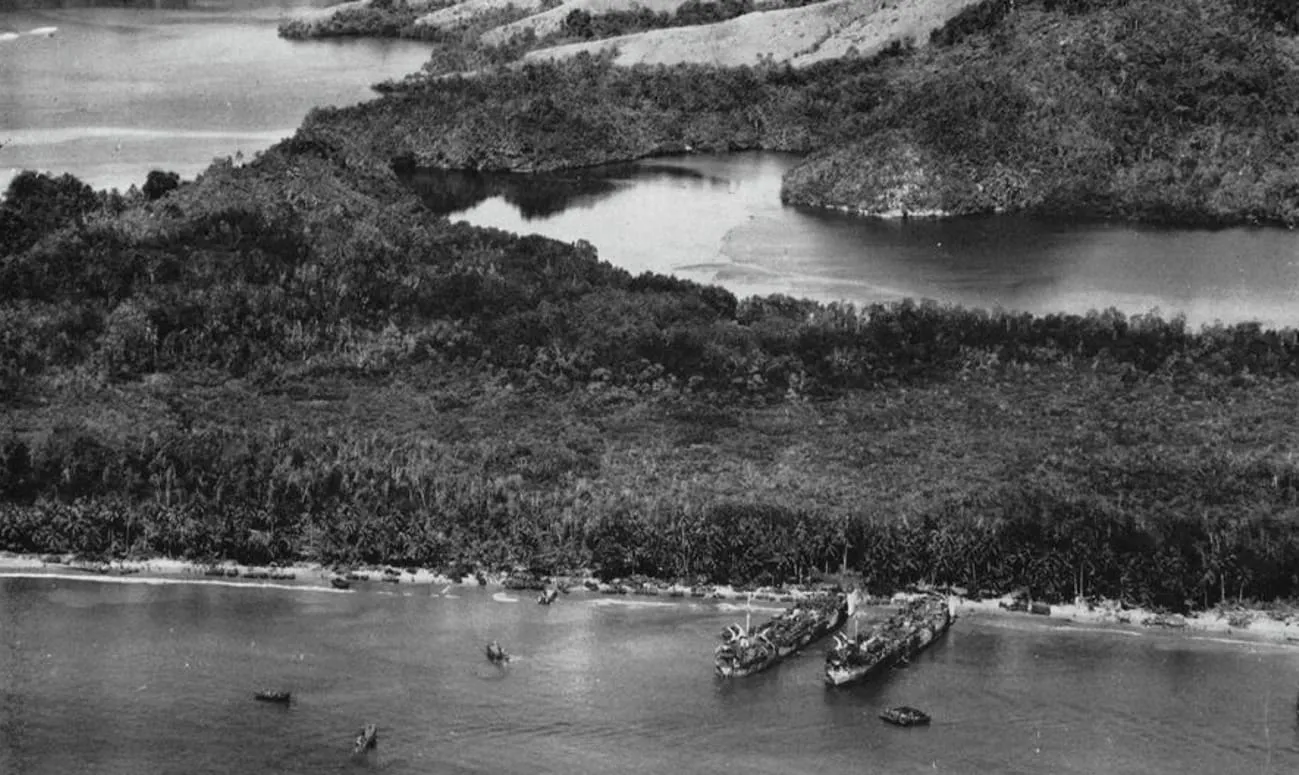
In the west, in Tanahmerah Bay, two regiments of the 24th Division (the 19th and 21st Infantry) went ashore from American and Australian transports (among them HMAS Kanimbla and Manoora) on two beaches: Red 1 by Depapre inlet and Red 2 on the eastern side of the bay. The Japanese fired only scattered shots. The terrain proved a worse enemy. Beach Red 2 ended after a few dozen metres in a swamp, and the road which the planners believed linked the beaches and led inland to Lake Sentani did not exist – there was only a narrow track, impassable to vehicles. The beaches quickly became jammed with equipment, and the large LSTs had to transfer their cargo to amphibians far from the shore. Eichelberger judged Tanahmerah Bay to be useless and diverted the rest of the 24th Division and the corps headquarters to Humboldt Bay. The infantry already ashore set off along the narrow track through the mountains towards the airfields, supplied with difficulty by porters.
In the east, in Humboldt Bay – right next to Hollandia itself – two regiments of the 41st Division (the 162nd and 186th Infantry) landed, brought in by Rear Admiral William Fechteler’s group. The main beach, White 1, lay a few kilometres south of the town; a second detachment seized in amphibians a sandy spit by Cape Tjeweri, at the entrance to Jautefa Bay, the shortest route to Lake Sentani. The hill above White 1, on which Japanese anti-aircraft guns stood, was taken within an hour – the defenders, contrary to Japanese custom, abandoned their positions and fled inland. On the first day some 4,200 tons of supplies and more than 300 vehicles were unloaded on White 1.
MacArthur watched the landing from the deck of the cruiser Nashville and went ashore the same day to inspect the beachheads. Losses on the first day were negligible; a command that had braced itself for bloody fighting for the beaches found an almost empty shore, and the real obstacles turned out to be the swamps, the mountains and logistics.
Course of operations: the advance on the Lake Sentani airfields (23–26 April 1944)
On 23 April the 162nd Infantry took Hollandia itself and the surrounding hills, while the 186th Infantry advanced along the road towards Lake Sentani, wiping out a few pockets of resistance on the way. Before the landing, however, beach White 1 had been a Japanese supply dump, and a fire started by Allied bombs had been smouldering there for several days. Late in the evening of 23 April a single Japanese bomber, guided by the fire, dropped its bombs on the crowded beach. Ammunition from Japanese and American stacks exploded; 24 people were killed and about 100 wounded. The fires raged until 27 April and consumed – by American estimates – some 60 per cent of the rations and ammunition that had been unloaded. The forward units felt the resulting shortages keenly.
On 24 April the first units of the 186th Infantry reached Lake Sentani and met there the first organised, though weak, resistance. Engineers ferried the infantry across the lake in amphibians, bypassing the Japanese positions, and on 26 April units of the 41st Division took the Sentani and Cyclops airfields. The same day the regiments of the 24th Division, which had made their way from Tanahmerah Bay after a four-day march through the mountains in rain and mud, reached Hollandia airfield from the west. On the afternoon of 26 April the two divisions met on the plain. All three airfields were in American hands – wrecked and littered with the remains of several hundred Japanese aircraft, but ready to be rebuilt.
Supply remained the most serious problem. The only road from Humboldt Bay to the lake, churned up by lorries and washed out by rain, could not keep up with demand, and the soldiers at the front lived for several days on meagre rations. Airdrops helped, and on 30 April LCTs, which could be taken into Jautefa Bay, arrived in Humboldt Bay. The situation improved only on 3 May, when transport aircraft began landing on an airstrip hastily built by engineers.
The collapse of the defence was not due solely to American superiority. The Japanese commanders at Hollandia had neither a plan nor troops to fight with: most of the garrison consisted of airmen without aircraft, drivers, labourers and hospital staff. The British official historian Stanley Woodburn Kirby noted that the Allies had overestimated the enemy and gone into the operation with a superiority many times greater than was needed. The American historian Edward Drea called Hollandia “MacArthur’s finest hour of the Second World War” and the greatest contribution of signals intelligence and codebreaking to his strategy in the Pacific.
Course of operations: Aitape (22 April – 4 May 1944)
Captain Albert Noble’s eastern group arrived off Aitape at dawn on 22 April. The shore was shrouded in smoke from fires started by the bombardment, and the boat crews lost their bearings and put the troops ashore a little off the designated Blue Beach, near the village of Wapil. This turned out not to matter: two battalions of the 163rd Infantry came ashore in nine waves, meeting only scattered shots. Most of the Japanese garrison – chiefly anti-aircraft gunners and rear-service troops – fled into the mountains.
The main Tadji airstrip was taken by 1 p.m. on the first day, and the second, unfinished strip the next day. Behind the infantry came the men of the Australian No. 62 Works Wing RAAF, who, working without a break for two days and nights, made the strip ready for fighters. On 24 April 25 P-40 fighters of the Australian No. 78 Wing landed on it, and the rest of the wing the following day – exactly as foreseen by the plan, which relied on this airfield to cover both landings after Task Force 58 had left.
On 23 April the second echelon arrived – the 127th Infantry Regiment of the 32nd Division. On 24 April infantry and tanks crossed the Raihu River and took Aitape itself, which the Japanese had abandoned. Patrols pushed inland and along the coast, rounding up stragglers trying to get through east to Wewak or west to Vanimo. The only organised resistance was met on 28 and 29 April near the village of Kamti, where some 200 Japanese repeatedly attacked a battalion of the 163rd Infantry, losing about 90 killed. On 27 April Japanese torpedo bombers hit the transport Etamin, which caught fire but was saved and towed to Finschhafen.
By 4 May, when the area was considered secure, the Americans had lost 19 killed and 40 wounded at Aitape; the Japanese – by American estimates – some 525 killed and 25 prisoners. In early May the 163rd Infantry was relieved by units of the 32nd Division and itself sailed away to take part in the next landing to the west. The ground at Aitape, however, proved less useful for aviation than had been thought: the second strip was fit for bombers only in July.
The quiet at Aitape was deceptive. Adachi’s 18th Army, cut off from the west, still numbered several tens of thousands of men. In May its 20th Division began digging in east of Aitape, and patrols of the 127th Infantry pushed out towards Babiang and Nyaparake met increasingly stiff resistance. Between mid-May and early June, after a series of skirmishes, the Americans withdrew to the line of the Driniumor River, about 30 kilometres east of Aitape, and on 5 June the last units pushed forward to Yakamul were evacuated by sea.
Course of operations: mopping up and the march to Sarmi (April – June 1944)
After the loss of the airfields the shattered Hollandia garrison ceased to exist as a fighting force. Scattered groups of Japanese soldiers, sailors and airmen gathered in the area of the village of Genjem, west of Lake Sentani – according to the US official history, some 7,200 men. The 2nd Army command ordered them to break through overland to Sarmi, some 200 kilometres to the west, where the 36th Division was stationed. At the end of April the columns set off through jungle, swamps and mountains, almost without food or medicine, abandoning the wounded and sick along the way. According to the same estimates, only about 1,000 men reached Sarmi; the rest died of hunger, disease and exhaustion, were killed in clashes with American patrols or vanished in the jungle. It was one of many starvation marches with which Japanese defeats in New Guinea ended – the victims cannot be counted precisely.
The Americans, meanwhile, were combing the surroundings of Hollandia. Patrols of the 24th and 41st Divisions, and later of the units that relieved them, rounded up stragglers around Lake Sentani, in the Cyclops Mountains and along the coast. More Japanese than usual were taken prisoner – exhausted and leaderless. Operations in the Hollandia area officially ended on 6 June 1944. The next leaps had already begun: on 17 May the 163rd Infantry, brought from Aitape, landed at Arare opposite Wakde island, and on 27 May the 41st Division, sailing from Hollandia, landed on Biak.
Losses
According to the US official history, some 3,300 Japanese were killed in the Hollandia area up to 6 June 1944 and 611 were taken prisoner; by the end of September more than 1,000 more had been killed or died in the vicinity. To this must be added the thousands who died on the march to Sarmi. American losses at Hollandia amounted to about 150 killed (sources give 152 or 157) and about 1,050 wounded. At Aitape up to 4 May 19 Americans were killed and 40 wounded; the Japanese lost some 525 killed and 25 prisoners there. At Hollandia the Japanese air force lost several hundred aircraft – in the raids preceding the landing and on the captured airfields; American reports spoke of some 340 destroyed on the ground and several dozen in the air.
The disproportion in losses – a few hundred dead on the Allied side against several thousand on the Japanese side – became the model for the strategy of “leapfrogging”: instead of storming strong garrisons, strike where the enemy is weak and leave strong concentrations cut off and without supplies.
Hollandia as a base
As soon as the airfields had been taken, American and Australian engineers began rebuilding and enlarging them. As early as May bombers from the plain by Lake Sentani were attacking Wakde, Biak and the Vogelkop Peninsula, and the Japanese airfields in western New Guinea became useless. Around Humboldt and Tanahmerah Bays rose the vast Base G: a port with wharves, fuel and ammunition dumps, repair workshops, hospitals, and kilometres of roads cut through the jungle and the mountainsides. Within a few months several hundred thousand troops passed through it.
The headquarters of the Sixth and Eighth Armies, the Fifth Air Force and the Seventh Fleet moved to Hollandia, and in September 1944 so did MacArthur’s general headquarters, which was housed in a sprawling building on a hill above Lake Sentani. Its construction in the middle of the war drew criticism and rumours about the general’s “palace”. In October 1944 the convoys for the landing on Leyte, which began the American return to the Philippines, sailed from Hollandia and Seeadler Harbour.
Significance
The landings at Hollandia and Aitape were the largest and boldest amphibious operation in the South West Pacific up to that time and one of the clearest examples of the strategy of bypassing strong points of resistance. In a single leap MacArthur moved the front several hundred kilometres forward, leaving the entire Japanese 18th Army behind him in the jungle between Wewak and Aitape. The loss of Hollandia forced the Japanese to abandon their plan to defend the Wakde–Sarmi line and to pull the defence back to Biak and Manokwari. The whole of eastern New Guinea was lost to them. The operation was also the first time that the fast carriers of Nimitz’s Pacific Fleet supported a MacArthur landing – a foretaste of the cooperation between the two theatres on the road to the Philippines.
The success was owed in very large measure to intelligence: decrypted Japanese signals showed where the enemy was weak, and MacArthur had the courage to base a risky plan on them. At the same time the operation revealed the limits of that advantage – the planners did not know the ground at Tanahmerah Bay, and the course of the campaign was decided as much by engineering, logistics and the jungle as by fighting.
For the Japanese the consequences proved catastrophic. The cut-off 18th Army was first ordered to fight its way west, past Hollandia and Aitape, to the 2nd Army; Adachi, however, decided to attack Aitape. During the night of 10–11 July 1944 some 20,000 of his troops attacked the American positions on the Driniumor River. In heavy fighting that lasted until 25 August the Japanese lost – by various estimates – between 8,000 and 10,000 men, many of them to hunger and disease, and the Americans about 440 killed. The remnants of the 18th Army then fought the Australians in the Aitape and Wewak area until Japan’s surrender; Adachi surrendered in September 1945.
Meanwhile the Allies pressed on westwards: Wakde (17 May) and Biak (27 May) were followed by Noemfoor (July), Sansapor on the Vogelkop Peninsula (30 July) and Morotai (15 September 1944). Less than five months after the landings at Hollandia, MacArthur’s forces stood within reach of the Philippines.