Japan
Jisaburō Ozawa
Commander of the Southern Expeditionary Fleet (1941–1942), the Third Fleet (1942–1944) and the Mobile Fleet (1944), last commander of the Combined Fleet (1945), vice admiral
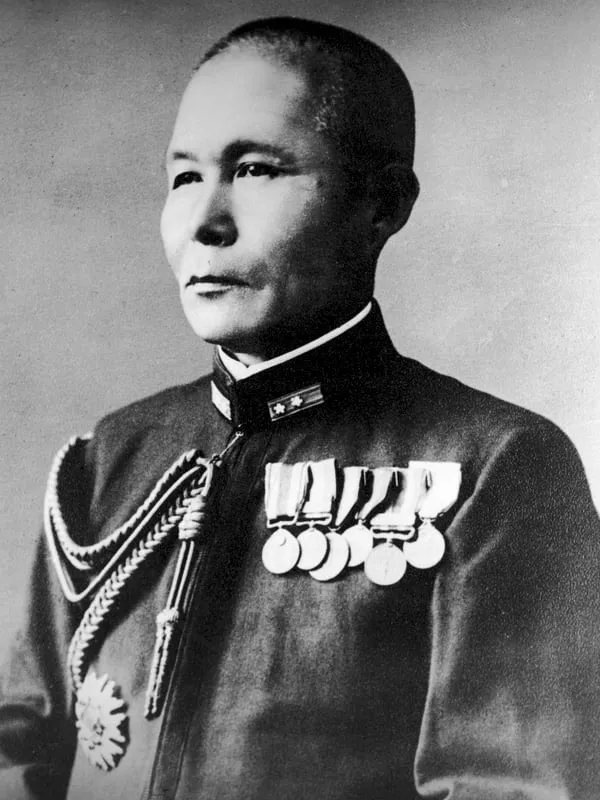
- Born:
- 2 October 1886, Takanabe, Miyazaki Prefecture (Japan)
- Died:
- 9 November 1966
- Author:
- Natalia
- Photo:
- autor nieznany, domena publiczna, Wikimedia Commons

Jisaburō Ozawa was one of the few Japanese admirals who understood before the war that the outcome of the war at sea would be decided not by battleships but by aircraft carriers operating together. It was he who proposed concentrating the carriers in a single air fleet – the idea from which grew the force that attacked Pearl Harbor. Yet he himself commanded Japan’s carriers only when the war was already lost: in June 1944 he lost the Battle of the Philippine Sea, in October he played the decoy with the remnants of the carrier force in the Battle of Leyte Gulf, and in the last months of the war he was the final commander of the Combined Fleet. He stood out for his height – reportedly over 180 cm (about 5 ft 11 in) – and among his subordinates he was regarded as a brave commander who cared for his men; the American officers who interrogated him after the war found him calm, sharp and well informed.
Youth and career
He was born on 2 October 1886 in Takanabe in Miyazaki Prefecture on the island of Kyushu, the second son of a former samurai of the local domain. According to Japanese biographers, he was expelled from middle school in Miyazaki after a fight in which he threw the local bully with a judo hold; on the advice of an officer who was his elder brother’s superior, he went to Tokyo and finished his schooling elsewhere. In 1909 he graduated from the Imperial Japanese Naval Academy at Etajima (37th class), ranked 45th out of 179.
For the first two decades of his service he was a torpedo specialist: he served on destroyers, battleships and cruisers, in 1921 graduated from the Naval War College (Kaigun Daigakkō), the school for staff officers, and later taught at the torpedo and gunnery schools. In 1930 he travelled to the United States and Europe and was promoted to captain. He commanded destroyer flotillas, taught at the Naval War College and, in 1934–1936, commanded the heavy cruiser Maya and the battleship Haruna. On 1 December 1936 he became a rear admiral, and in February 1937 chief of staff of the Combined Fleet.
Advocate of the air fleet
As chief of staff of the Combined Fleet, Ozawa drew up new principles of fleet combat, based on two ideas to which he returned throughout his career. The first was to strike first, and from a range at which the enemy could not reply – what the Japanese navy later called “outranging” tactics. The second was concentration: the carriers should not be divided among the battleship forces but should operate together, under a single commander, training together and striking together. At the end of 1937 he took command of a cruiser division, and in 1939 of the 1st Carrier Division, with Akagi and Kaga.
On 9 June 1940 he submitted a memorandum to the Navy Minister proposing the creation of an air fleet: all the carriers and their aircraft were to be placed under unified command, with common communications and common training. The idea was put into effect on 10 April 1941 with the formation of the First Air Fleet – the future Kidō Butai. The commander of the Combined Fleet, Admiral Isoroku Yamamoto, is said to have wanted Ozawa himself at its head, but the Navy Ministry, guided by seniority, appointed Vice Admiral Chūichi Nagumo, a torpedo officer with no aviation experience. Ozawa, a vice admiral since 15 November 1940, became president of the Naval War College in 1941.
Malaya, Java and the Indian Ocean
On 18 October 1941 he took command of the Southern Expeditionary Fleet, responsible for the South China Sea. It was his ships that covered the landings with which the Malayan campaign began on 8 December 1941: at Kota Bharu in Malaya and at Songkhla in Thailand. When a Japanese submarine sighted the British Force Z on 9 December, Ozawa went out with his cruisers to meet it, hoping for a night action; none took place, and on 10 December both British capital ships were sunk by land-based aircraft. In the first months of 1942 his fleet covered the landings on Sumatra and Java during the Dutch East Indies campaign. The Japanese general Hitoshi Imamura, commander of the troops landing on Java, became Ozawa’s lifelong friend at that time.
In April 1942, while Nagumo’s carriers were attacking Ceylon, Ozawa – on his own initiative, with his superiors’ approval – led a separate force, with the light carrier Ryūjō and cruisers, deep into the Bay of Bengal. Within a few days he sank, depending on the tally, between 20 and 23 merchant ships sailing unescorted along India’s east coast, and his aircraft bombed the ports of Kakinada and Vizagapatam.
Carrier commander
On 11 November 1942 Ozawa succeeded Nagumo as commander of the Third Fleet – the carrier force that had to be rebuilt after the defeat at Midway and the battles around Guadalcanal. There were fewer carriers than before and ever fewer experienced airmen, so the fleet was husbanded; it covered the evacuation of troops from Guadalcanal early in 1943. In April 1943, on Yamamoto’s orders, the Third Fleet’s aircraft were moved to land airfields around Rabaul for Operation I-Go – a series of air raids on Guadalcanal and New Guinea – in which Japanese carrier aviation suffered heavy losses. A few days after it ended, Yamamoto was shot down and killed over Bougainville. In late autumn 1943 Ozawa once again had to give up some of his airmen for the defence of Rabaul, and once again lost many of them.
On 1 March 1944 he took command of the newly created Mobile Fleet, which brought together almost all the carriers and most of the battleships of the Japanese navy; his flagship was the new armoured carrier Taihō. For the first time he could lead into battle what he had argued for before the war: nine carriers operating together. What he lacked, however, was the one thing that could not quickly be replaced – trained airmen.
The Philippine Sea
When the Americans attacked the Marianas, Ozawa led the Mobile Fleet into the Battle of the Philippine Sea on 19–20 June 1944. His plan was logical: to exploit the greater range of the Japanese aircraft, strike the American carriers from beyond their reach and land on Guam. It foundered on American superiority in fighters, radar and training. In four waves the Japanese lost about two-thirds of their aircraft, submarines sank Taihō and Shōkaku, and the next day American aircraft sank Hiyō. After the battle Ozawa was left with a few dozen serviceable aircraft. Admiral Raymond Spruance, who defeated him, was criticised for his caution, but this battle marked the end of Japanese carrier aviation.
Ozawa took the blame upon himself and offered his resignation, which Admiral Soemu Toyoda refused. Years later he recalled that he had known he could not meet the enemy on equal terms and had therefore adopted the tactic of striking from a distance – “there was no other way”. As his greatest mistakes he named his failure to send staff officers to check whether there was an airfield near Tawi-Tawi where his airmen could train, and his failure, after Taihō was torpedoed, to hand over command in time to Vice Admiral Takeo Kurita.
The decoy off Engaño
In the autumn of 1944 the Japanese plan for the defence of the Philippines (Shō-Gō) assigned Ozawa’s carriers a role no fleet commander would wish to accept. Ozawa himself concluded that his few, poorly trained airmen could not protect Kurita’s battleships, and proposed that the two forces operate separately. When the Americans landed on Leyte in October, his “Northern Force” – the carrier Zuikaku, three light carriers, two hybrid battleship-carriers and light warships, with only about a hundred aircraft – was to draw Admiral William Halsey’s carriers away to the north so that Kurita’s battleships could reach the landing area.
In the Battle of Leyte Gulf the decoy worked. Ozawa deliberately broke radio silence, and when the Americans finally found him, Halsey set off north with his entire force. On 25 October 1944, off Cape Engaño north of Luzon, American aircraft sank all four of Ozawa’s carriers, including Zuikaku, the last of the six carriers that had attacked Pearl Harbor. Ozawa transferred his flag to the cruiser Ōyodo and returned to Japan with the rest of his ships. Kurita, however, unaware of his success, turned back off Samar, and the Japanese plan failed. According to some accounts, Ozawa contemplated suicide after the battle; one of his officers dissuaded him by telling him that he was the only Japanese admiral at Leyte who had accomplished his mission.
Last commander of the Combined Fleet
In November 1944 the Mobile Fleet was disbanded, and Ozawa became vice chief of the Naval General Staff and president of the Naval War College. During this period – on his initiative, according to Japanese sources – the navy, together with the army and General Shirō Ishii’s Unit 731, prepared a plan for a biological attack on the west coast of the United States using aircraft launched from I-400-class submarines; the plan, approved in March 1945, was never carried out. Ozawa also took part in planning the suicidal sortie of the battleship Yamato in Operation Ten-Gō in April 1945.
On 29 May 1945, when Toyoda became Chief of the Naval General Staff, Ozawa succeeded him as commander of the Combined Fleet. He declined the promotion to full admiral that was offered to him – he was the only wartime commander of the Combined Fleet who never became an admiral. By now he commanded mainly aircraft: he continued the kamikaze attacks off Okinawa and prepared suicide raids on the B-29 airfields in the Marianas and the anchorage at Ulithi, which the surrender cut short.
In the last days of the war, so it is reported, when Vice Admiral Takijirō Ōnishi argued that Japan would win if it sacrificed 20 million people, Ozawa asked him who would rebuild the country if 20 million men were killed. After Emperor Hirohito announced the surrender, he condemned Vice Admiral Matome Ugaki’s suicide flight of 15 August as a breach of orders, forbade his officers to commit suicide and prepared to put down a mutiny at the Atsugi air base, whose commander refused to surrender. He told his officers that he had fought in the front line as much as he could and bore responsibility for the defeat, but not for starting the war.
After the war
On 10 October 1945 Ozawa was transferred to the reserve. That autumn he gave evidence to the United States Strategic Bombing Survey; from his testimony historians learned, among other things, of the changes made to the Shō-Gō plan on the eve of the Battle of Leyte Gulf. He was never tried for war crimes. In 1947 he was caught by the purge that barred former military men from public life, and in 1955, according to Japanese sources, he became an adviser to the newly created Defence Agency. He died on 9 November 1966 at the age of 80; he was buried at a temple in Tokyo’s Setagaya ward, and has a second grave in his native Takanabe.
Assessment
Ozawa was one of the most creative minds in the Japanese navy. His concept of concentrating the carriers in a single air fleet became the foundation of Japan’s victories at the start of the war, and Nagumo’s force, which grew out of it, inflicted defeat on the Americans at Pearl Harbor and on the British in the Indian Ocean. His misfortune was that he received command of that fleet only when the advantage had passed to the enemy: the United States was building more carriers and better aircraft and training more pilots. The tactic of striking from a distance, sensible on paper, could not make up the gap in training and technology, as the “Turkey Shoot” over the Marianas showed.
American officers and historians judged him with respect: they acknowledged that in the Philippine Sea he had done all his forces allowed, and that at Leyte he had carried out a thankless and knowingly suicidal mission. His career holds one of the ironies of the Pacific War: the admiral who first foresaw the power of massed carriers closed their story, leading the last of them to destruction as a decoy.
Sources
Commanded in battles
(03)Mentioned in battles
(04)Often appears with
People who appear in the same events.