Battle of Iwo Jima
- Dates:
- 19 February – 26 March 1945
- Front:
- Pacific
- Location:
- Iwo Jima (Iō-tō) in the Volcano (Kazan) Islands, part of the Ogasawara (Bonin) Islands, some 1,200 km south of Tokyo: the beaches of the south-east coast, Mount Suribachi at the southern tip, the Motoyama plateau with Airfields No. 1, 2 and 3, Hill 382, the “Amphitheater” and “Turkey Knob” in the east, and the gorges near Kitano Point in the north-westOn the battle map →
- Sides:
- United StatesRaymond Spruance, Richmond Turner, Holland Smith, Harry SchmidtJapanTadamichi Kuribayashi, Toshinosuke Ichimaru
- Result:
- A United States victory. The island was declared secured on 16 March 1945, and the last organised Japanese attack was repulsed on the night of 25–26 March. According to official figures the Americans lost 6,821 killed and about 19,000 wounded; of the Japanese garrison, estimated at 20,000–23,000 men, between about 18,000 and more than 20,000 were killed according to various estimates, and 216 soldiers were taken prisoner during the battle.
- Author:
- Łukasz
Name and dates
The Battle of Iwo Jima is the name given to the fighting for Iwo Jima, a small volcanic island in the Volcano Islands, between 19 February and 26 March 1945. The Americans gave the operation the codename Detachment. It was the first American invasion of territory that had long belonged to Japan and was administered as part of Tokyo Prefecture – rather than of conquered colonies or mandated territories, as the Marianas had been.
The opening date is marked by the landing of two Marine divisions on the island’s south-eastern beaches on the morning of 19 February. The battle is taken to have ended on 26 March: at dawn that day the last organised Japanese attack, near Airfield No. 2, was repulsed, and at 9 a.m. the command officially declared the island captured. The earlier date, 16 March, marks the moment when General Harry Schmidt announced that organised resistance had ceased – although the 5th Marine Division was then still fighting for another ten days in the gorges at the north-western tip of the island. After 26 March thousands of Japanese soldiers were still hiding on Iwo Jima, and US Army units spent months hunting them down.
Iwo Jima covers about 21 square kilometres: it is some 8 kilometres long and between 800 metres and 4 kilometres wide. At its southern tip rises the extinct volcanic cone of Suribachi (169 m), joined to the rest of the island by a narrow, sandy neck. To the north stretches the rocky Motoyama plateau, cut by gorges and ridges and full of sulphurous vents – the source of the island’s name (“Sulphur Island”). The beaches are covered not with sand but with loose black volcanic ash, in which men and vehicles sank.
The Battle of Iwo Jima is one of the best-known battles of the Pacific War – because of the scale of the losses, the ferocity of the Japanese defence and the photograph of the flag over Suribachi. It was also the only major land battle of that war in which total American casualties (killed, wounded and missing) exceeded Japanese ones, even though nearly three times as many Japanese were killed.
Background
After taking the Marianas in the summer of 1944, the Americans built bases for B-29 strategic bombers on Saipan, Tinian and Guam. From November the aircraft of XXI Bomber Command attacked Japan (the first raid on Tokyo took place on 24 November), but the results were meagre and the losses painful. Iwo Jima lay roughly halfway between the Marianas and Tokyo. A Japanese radar station there warned the home islands of approaching bombers, and fighters from the island’s two airfields intercepted them en route and attacked the bases in the Marianas.
American planners saw three benefits in capturing the island: the elimination of a Japanese early-warning post and fighter base, an emergency airfield for damaged or fuel-starved B-29s, and a base for P-51 Mustang escort fighters, which could not reach Japan from the Marianas. General Henry Arnold, head of the Army Air Forces, strongly backed the operation. The decision was taken in the autumn of 1944, when the Joint Chiefs of Staff abandoned the invasion of Formosa in favour of Luzon, Iwo Jima and Okinawa – the outcome of the dispute over the road to Japan. Admiral Chester Nimitz was given the task of taking Iwo Jima, originally in January 1945; the protracted fighting in the Philippines pushed the date back to February.
The Japanese knew that the island would be a target. Iwo Jima belonged to the inner defence line manned from the spring of 1944 by the newly formed 31st Army, and after the fall of the Marianas it became one of its last links; its loss would open the way to further islands on Japan’s very doorstep. In June 1944 command of the garrison passed to Lieutenant General Tadamichi Kuribayashi, commander of the 109th Division – a cavalryman who had served as military attaché in the United States in 1928–1930 and knew America’s industrial potential well. In the summer of 1944 more than a thousand of the island’s civilian inhabitants were evacuated to Honshu, so that – unlike on Saipan – no civilians died in the battle.
From 8 December 1944 American aircraft from the Marianas bombed Iwo Jima almost daily, and cruisers shelled the island several times. The raids hampered the use of the airfields but did little damage to the fortifications, which the defenders were building ever deeper underground.
Forces and plans
Kuribayashi broke with previous Japanese practice in island defence. The experience of Tarawa, Saipan and Guam had shown that beach fortifications were destroyed by naval gunfire and that night-time banzai charges ended in the slaughter of the attackers. Kuribayashi therefore decided not to defend the shoreline but to let the Americans onto the beaches and strike them from the depths of the island with artillery, mortar and machine-gun fire from carefully camouflaged positions. Some naval officers demanded a traditional defence of the shoreline and secured the construction of a number of bunkers by the beaches, but the basic plan remained unchanged. The Japanese had already used similar tactics of defence in depth, from caves and bunkers, in the autumn of 1944 on Peleliu, where it had cost the Americans unexpectedly dearly.
The island was divided into sectors. Suribachi formed a separate, self-contained fortress, while the main defensive position covered the Motoyama plateau in the north. The soldiers carved hundreds of bunkers, firing positions and shelters into the soft volcanic rock, linked by a network of tunnels whose length is estimated at well over ten kilometres (an even longer network was planned). They worked in heat of several tens of degrees and amid sulphur fumes. Some 21,000 Army and Navy troops were assigned to the defence (estimates range from 20,000 to 23,000), including the 145th Infantry Regiment, the 26th Tank Regiment of Baron Takeichi Nishi – the 1932 Olympic equestrian champion – and strong artillery. The naval units were commanded by Rear Admiral Toshinosuke Ichimaru.
Kuribayashi issued his soldiers with the “Courageous Battle Vows”: each man was to defend his position to the death and, before dying, kill ten of the enemy. He forbade suicide charges. His aim was not to hold the island, which he considered impossible, but to inflict such heavy losses on the Americans that they would think twice about invading Japan.
On the American side the operation was directed by Admiral Raymond Spruance, commander of the Fifth Fleet. The amphibious forces were commanded by Vice Admiral Richmond Turner, and the ground forces as a whole by Lieutenant General Holland Smith, who on Iwo Jima performed a supervisory role. The fighting itself was directed by Major General Harry Schmidt, commander of V Amphibious Corps: the 4th Marine Division (Major General Clifton Cates) and the 5th Marine Division (Major General Keller Rockey) were to land on the first day, while the 3rd Division (Major General Graves Erskine) stayed in reserve. In all some 70,000 Marines were committed to the island; the whole force, including sailors and airmen, numbered more than 100,000 men. The planners, unaware of the scale of the underground fortifications, expected to take the island in a few days – an estimate of five days is often quoted.
The dispute over the preliminary bombardment (16–18 February)
Mindful of Tarawa, the Marine commanders demanded ten days of naval bombardment before the landing. The Navy agreed to three. Spruance cited ammunition stocks, the need to preserve surprise and the fact that Vice Admiral Marc Mitscher’s Task Force 58 was to carry out a carrier strike on the Tokyo area at the same time, which tied down some of the battleships. Holland Smith regarded the decision as a costly mistake and after the war accused the Navy of saving shells at the expense of Marines’ lives; historians still argue over whether a longer bombardment would have destroyed fortifications hidden deep underground.
The bombardment began on 16 February, but bad weather limited its effectiveness. On 17 February frogmen from the underwater demolition teams reconnoitred the beaches under cover of infantry landing craft gunboats. Japanese gunners, taking this for the start of the landing, opened fire, hit a dozen or so gunboats and in doing so revealed some of their positions, which the warships destroyed the following day. Even so, most of the Japanese guns survived the preliminary bombardment intact.
The landing (19 February)
On the morning of 19 February ships and aircraft delivered the heaviest bombardment of the Pacific War to date. At 9 a.m. the first waves of the 4th and 5th Marine Divisions reached the beaches on the south-east coast, along a stretch of about three kilometres between Suribachi and a quarry to the east. At first resistance was light. The Marines toiled through the ash, climbing steep terraces, while the beaches became jammed with vehicles, equipment and further waves of infantry. About an hour later, when the beaches had filled up, the Japanese artillery and mortars opened fire in accordance with Kuribayashi’s plan.
The beaches turned into a trap. Shells fell on crowds of men, boats and vehicles, while bunkers on the slopes of Suribachi and in the quarry on the right flank fired along the shore. The heaviest losses were suffered by the 3rd Battalion, 25th Marines, which attacked the quarry: according to accounts, of some 900 men only about 150 were still fit for combat by evening. Nevertheless, at around 10.30 a.m. units of the 28th Marines crossed the narrow neck, about 800 metres wide, and reached the west coast, cutting Suribachi off from the rest of the island. Among those killed that day was Gunnery Sergeant John Basilone, a Medal of Honor recipient from Guadalcanal.
By evening some 30,000 Marines had come ashore. Losses on the first day are put at about 2,400 killed and wounded (including, depending on the tally, from about 500 to more than 550 killed). In the centre the Marines had reached the southern edge of Airfield No. 1 before noon and held on there until nightfall. During the night the Japanese did not launch the expected major counter-attack, confining themselves to shelling and infiltration.
Suribachi and the flag (20–23 February)
Over the following days Colonel Harry Liversedge’s 28th Marines assaulted Suribachi while the rest of the corps pushed north. Airfield No. 1 was taken on 20 February. Below Suribachi the Marines advanced from bunker to bunker, destroying them with flamethrowers, demolition charges and tank fire; time and again a cleared position would open fire once more because the Japanese had returned to it through a tunnel. The mountain’s garrison of some two thousand men was, however, cut off from the rest of Kuribayashi’s forces.
On 21 February Japanese kamikaze aircraft attacked the fleet off the island. The escort carrier USS Bismarck Sea was sunk, the carrier USS Saratoga was badly damaged and several other ships suffered lighter damage. Several hundred sailors were killed. It was the only massed kamikaze attack of the battle.
On the morning of 23 February a patrol from the 2nd Battalion, 28th Marines, under First Lieutenant Harold Schrier climbed to the summit of Suribachi, meeting little resistance, and at around 10.20 a.m. raised a small flag there, which was photographed by Louis Lowery. The sight of the flag set off cheering on the beaches and aboard the ships; according to an often-repeated account, Secretary of the Navy James Forrestal, who had just come ashore, told Holland Smith that the raising of that flag meant there would be a Marine Corps for the next five hundred years. Around noon a larger flag was carried to the summit and the first one taken down. The raising of the second flag by six men was captured by the Associated Press photographer Joe Rosenthal. His photograph, “Raising the Flag on Iwo Jima”, became the most famous image of the Pacific War and won him the Pulitzer Prize.
The identity of the men in the photograph was in doubt for decades. The Marine Corps corrected it twice: in 2016 it established that the picture showed Private First Class Harold Schultz rather than Navy corpsman John Bradley, and in 2019 that it showed Corporal Harold Keller rather than Rene Gagnon. The men raising the second flag are therefore now identified as Michael Strank, Harlon Block, Franklin Sousley, Ira Hayes, Harold Schultz and Harold Keller. Strank, Block and Sousley were killed in the later fighting on the island. The capture of Suribachi did not end the battle: Kuribayashi’s main defensive position still awaited the Marines in the north.
The Meat Grinder (24 February – 16 March)
Kuribayashi held his strongest positions in the north of the island. The terrain of the Motoyama plateau – rocky ridges, gorges, rubble and caves – favoured the defenders even more than the slopes of Suribachi, and the naval guns had less scope here. Holland Smith committed the 3rd Marine Division, which attacked in the centre along Airfield No. 2; the 4th Division attacked on the right, eastern side and the 5th Division on the left, along the west coast. All three divisions advanced by a few dozen, at most a few hundred, metres a day.
The heaviest fighting fell to the 4th Division in the east, in a complex of fortifications that the Marines called the “Meat Grinder”. It consisted of Hill 382 – the highest point in the northern part of the island – a natural bowl known as the “Amphitheater”, the rocky summit of “Turkey Knob” with a concrete command post, and the ruined village of Minami. Every position was covered by fire from several others, and tanks that drove in among the hills fell victim to mines and anti-tank guns. Hill 382 changed hands repeatedly for several days before the Marines managed to hold it at the beginning of March; Turkey Knob and the Amphitheater were cleared only after another week of fighting.
In the centre the 3rd Division had taken Airfield No. 2 and the village of Motoyama by the end of February, and then attacked Hill 362 and the unfinished Airfield No. 3. Having noticed that the Japanese took cover during bombardments and returned to their positions when the artillery fell silent, General Graves Erskine ordered a pre-dawn attack without artillery preparation on 7 March. The assault took the defenders by surprise and opened the way north; on 9 March a 3rd Division patrol reached the north-east coast, splitting the Japanese defence into pieces. In the west the 5th Division took Hill 362A on 1 March and bled itself white on the ridges and gorges beyond.
On the night of 8–9 March came the only major banzai-style counter-attack: in defiance of Kuribayashi’s ban, Captain Samaji Inouye led about a thousand sailors against the positions of the 4th Division. The attack was repulsed, and in the morning the Marines counted more than 780 Japanese dead in front of their lines; they themselves had lost several hundred killed and wounded.
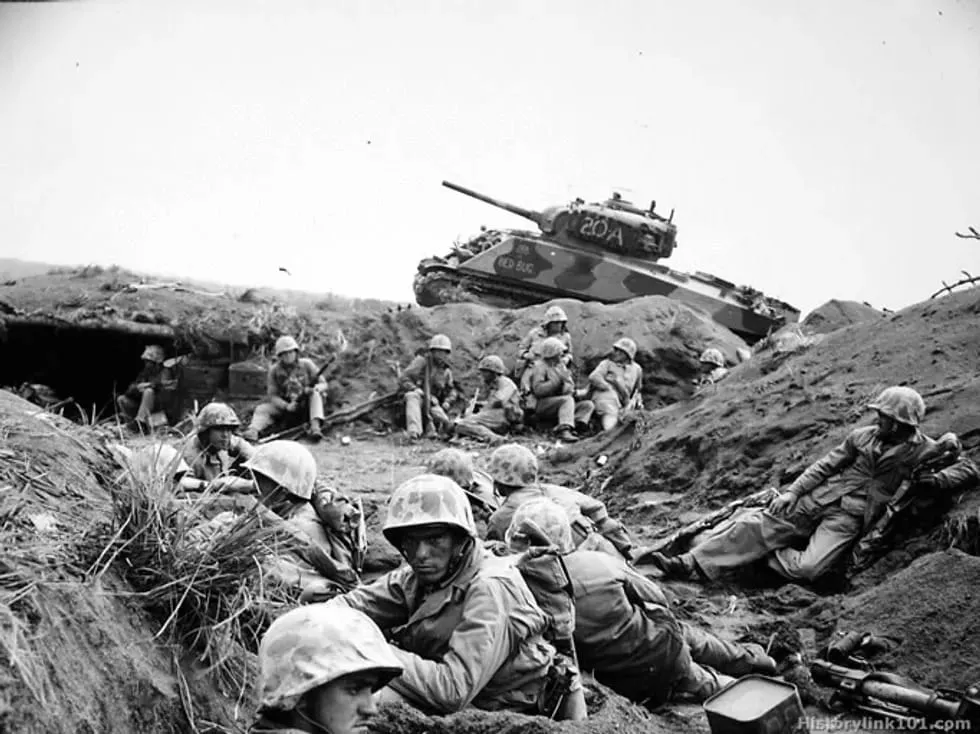
Much of the fighting took place underground and at close quarters. The Marines dealt with bunkers and cave mouths using flamethrowers – including tank-mounted ones – and demolition charges, and some caves were sealed, burying the defenders alive. The Japanese came out at night on raids, infiltrated behind American lines and attacked medical corpsmen. Cases of combat fatigue mounted. On 16 March General Schmidt announced that organised resistance on the island had ceased.
The airfields and the first B-29 (4 March)
While the fighting was still going on, engineers and naval construction battalions (Seabees) repaired and extended the captured Airfield No. 1, which was still being shelled by Japanese artillery from the north. Light observation aircraft were landing there as early as 26 February, and transport aircraft evacuating the wounded soon followed.
On 4 March the first B-29 landed on Airfield No. 1 – Dinah Might of the 9th Bombardment Group, which had developed fuel-feed trouble on its way back from a raid on Tokyo. The aircraft landed under fire, was repaired and refuelled, and then flew back to the Marianas. On 6 March the first P-51 fighters of the 15th Fighter Group, Seventh Air Force, arrived on the island and from then on supported the Marines over the battlefield. According to American figures, 2,251 B-29 landings were recorded on Iwo Jima by the end of the war. Fighters from the island began escorting the bombers over Japan in April 1945.
The end of the fighting (16–26 March)
The announcement of 16 March did not end the fighting. On 17 March Kuribayashi sent Tokyo a farewell message containing a poem in which he apologised for the loss of the island. The last Japanese position was a gorge in the north-western part of the island, near Kitano Point, some 640 metres long, which the Marines called “Bloody Gorge”. It was fought for by the 5th Marine Division. On 21 March the Marines blew up a command post there with four tons of explosives, and on 24 March they sealed the last caves at the northern tip of the island. By then the 4th and 3rd Divisions had begun to leave Iwo Jima.
Before dawn on 26 March some 300 Japanese attacked silently – without the shouts that had accompanied the old banzai charges – a camp near Airfield No. 2 occupied by Seventh Air Force pilots, Seabees and Marines of the 5th Pioneer Battalion and the 28th Marines. The fighting lasted about an hour and a half; on the American side 53 men were killed and 120 wounded, while almost all the attackers died. At 9 a.m. on 26 March the island was officially declared captured, and responsibility for it passed to the Army.
The circumstances of Kuribayashi’s death remain uncertain, and his body was never identified. According to some accounts by Japanese survivors he personally led the final attack of 26 March and was killed in it; according to others he committed seppuku in his command post a few days earlier or on the same day. In recognition of his defence he was promoted in March 1945 to the rank of full general (taishō), a promotion described by most sources as posthumous. Rear Admiral Ichimaru was also killed in the last days of the fighting, leaving a letter to President Roosevelt in which he defended Japan’s cause.
After 26 March some 3,000 Japanese soldiers were still hiding in the caves and tunnels. Over the following months the US Army’s 147th Infantry Regiment hunted them down and killed them; according to the regiment’s figures more than 1,600 were killed and more than 860 taken prisoner. The last two Japanese soldiers from Iwo Jima did not surrender until 1949.
Casualties
According to official American figures, 6,821 Americans were killed or died of wounds in the battle (6,825 in some studies), and about 19,000 were wounded (19,217 is one figure given). Including cases of combat fatigue, total casualties exceeded 26,000 men, most of them suffered by the Marines. In five weeks the three Marine divisions lost about a third of their strength, and in the infantry battalions that went through the “Meat Grinder” losses sometimes reached three-quarters. On top of this came the fleet’s losses, including more than three hundred sailors from the Bismarck Sea.
Japanese losses are known less precisely. Of a garrison estimated at 20,000–23,000 men, between about 18,000 and more than 20,000 were killed according to various estimates; during the battle itself only 216 soldiers were taken prisoner, many of them wounded or unconscious. The bodies of many of the dead, buried in sealed caves and tunnels, were never found. According to most tallies, Iwo Jima was the only major amphibious battle in the Pacific in which total American casualties exceeded Japanese ones – even though roughly three times as many Japanese as Americans were killed.
Twenty-seven Medals of Honor were awarded for actions in the battle – 22 to Marines and five to sailors, four of them medical corpsmen; many were posthumous. This was more than a quarter of all the Medals of Honor awarded to Marines in the Second World War. Admiral Nimitz summed up the battle by saying that among the Americans who served on Iwo Jima “uncommon valor was a common virtue”.
Significance
The capture of Iwo Jima removed a Japanese early-warning post and fighter base from the B-29s’ route, and gave the Americans an airfield halfway between the Marianas and Japan as well as a base for fighters and air–sea rescue aircraft. For many bomber crews the island was their last chance: thousands of airmen landed there in damaged or fuel-starved aircraft. After the war air force and naval commanders often presented this as the main justification for the battle, and the claim that Iwo Jima saved the lives of tens of thousands of airmen became firmly established in the literature.
That assessment is, however, disputed. The historian Robert Burrell has shown that only some of the 2,251 B-29 landings on Iwo Jima were genuine emergencies, and that many were technical or training landings or stops to refuel; in his view the “saving airmen” argument gained prominence only when the heavy losses needed justifying. Fighter escort also proved less necessary than expected: from March 1945 the B-29s switched to night-time incendiary raids, for which fighters were superfluous, and the weather hampered long-range P-51 missions over Japan. As early as April 1945 the retired Admiral William Pratt wrote that the island had not been worth such a sacrifice. Defenders of the decision stress, in turn, that without Iwo Jima the Japanese could have continued to warn the home islands of raids and to attack the bases in the Marianas.
The battle also mattered for the further course of the war. It showed that the Japanese could defend themselves from underground fortifications more effectively than ever before, and that an invasion of the Japanese home islands themselves would be extremely costly. The lessons of Iwo Jima were used in planning the Battle of Okinawa, which began on 1 April 1945 and in which the Japanese used similar tactics. The losses on both islands also weighed in American estimates of the cost of invading Japan, which were later invoked in the debates over the use of the atomic bomb.
Rosenthal’s photograph became a symbol of the American war effort. The three survivors among the six men in the picture (as then identified, an identification later corrected) toured the country promoting the Seventh War Loan, and in 1954 the Marine Corps War Memorial, based on the photograph, was unveiled at Arlington. In Japan Iwo Jima remained a symbol of the defenders’ unconditional sacrifice; the island returned to Japanese administration in 1968, and the search for the remains of the dead continues to this day. In 2006 Clint Eastwood told the story of the battle from both sides in the films Flags of Our Fathers and Letters from Iwo Jima, the latter based largely on Kuribayashi’s letters to his family.