Japan
Tadamichi Kuribayashi
Chief of Staff of the 23rd Army (1941–1943), commander of the 109th Division and the Ogasawara Army Group (1944–1945), lieutenant general, promoted to general in March 1945
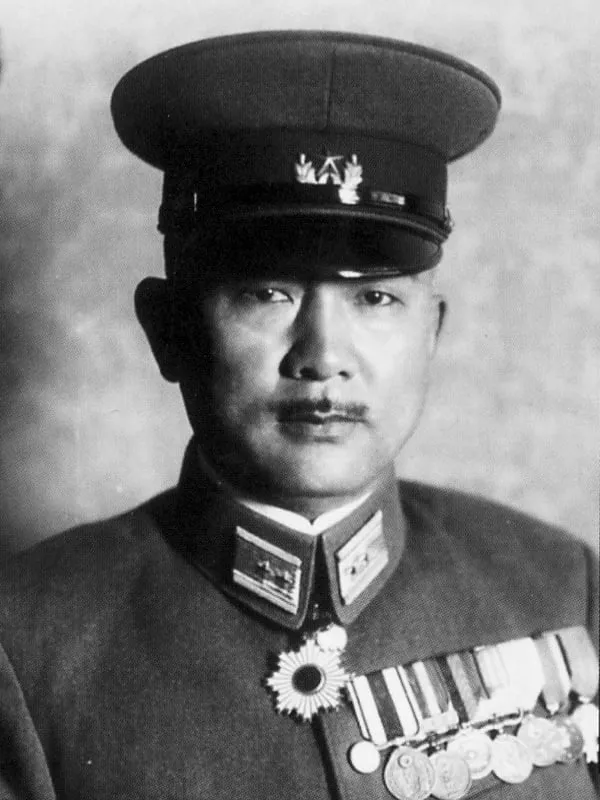
- Born:
- 7 July 1891, Nishijō near Matsushiro, Nagano Prefecture (Japan)
- Died:
- 26 March 1945, Iwo Jima
- Author:
- Łukasz
- Photo:
- autor nieznany, domena publiczna, Wikimedia Commons

Tadamichi Kuribayashi was one of the few Japanese generals who knew the United States from personal experience. In the late 1920s he spent more than two years in America as a cavalry officer attached to the embassy, drove around the country in his own car, toured the factories of Detroit and – as he later recalled – grasped the enormous industrial potential of the country. As Japan moved towards war with America, he is said to have told his family repeatedly that it was the last country in the world Japan should fight. Fate decreed that he would lead one of the most stubborn defences in the history of the Pacific War. On Iwo Jima he built an underground fortress, gave up defending the beaches and forbade suicidal charges. His soldiers held for more than five weeks an island the Americans had expected to take in a few days. The Americans suffered higher total casualties there than the defenders – the only time this happened in the Pacific. Kuribayashi was killed in the last days of the battle, in circumstances that remain uncertain to this day. His letters to his wife and children made him, years later, one of the best-known Japanese commanders of the war.
Youth and early career
Tadamichi Kuribayashi was born on 7 July 1891 in the village of Nishijō in Nagano Prefecture, in what is now the Matsushiro district of the city of Nagano. He came from a samurai family that had served the lords of Matsushiro for centuries but had declined after the Meiji Restoration; his father worked in the timber trade and in construction, while his mother ran the farm. At secondary school in Nagano Kuribayashi excelled in English and literature and dreamt of becoming a foreign correspondent. He passed the entrance examinations for a Japanese college in Shanghai, but chose the Imperial Japanese Army Academy instead.
He graduated from the Academy in May 1914 (26th class), in the cavalry, and in December that year was commissioned as a second lieutenant. He served in the 15th Cavalry Regiment and completed a course at the cavalry school. In 1920 he entered the Army War College (Rikugun Daigakkō), graduating in November 1923 second in his class. For this result he received an honorary sword from the emperor. It also entitled him to study abroad. Most of the officers so distinguished chose Germany or France; Kuribayashi chose the United States. In December 1923 he married Yoshii, more than ten years his junior; they had a son, Tarō, and two daughters, Yōko and Takako.
America and Canada
Kuribayashi went to the United States in 1928 as a cavalry captain, attached to the Japanese embassy as assistant military attaché. At first he lodged with an American family in Buffalo, learnt the language and attended lectures on American history and politics, among other places at Harvard University. He also trained with American cavalry units in Texas and Kansas. He bought a Chevrolet, learnt to drive and travelled the country from Washington and Boston to San Francisco and Los Angeles. What impressed him most was industry. “I have seen the factory district of Detroit. One push of a button and the whole of industry will switch over to war production,” he said years later, according to accounts cited in American studies.
His first famous letters date from this period. To his small son Tarō he wrote in simple characters so that the boy could read them himself, and he decorated them with drawings: here was his father lying on the lawn at Harvard looking up at the clock tower, walking around Buffalo or playing with American children. These “picture letters” (etegami) were published in Japan after the war and became an important source for his biography. They reveal a man curious about the world and well disposed towards Americans.
In March 1930, back in Tokyo, Kuribayashi was promoted to major and posted to the Military Affairs Bureau of the Army Ministry. In August 1931 he went to North America again, this time as military attaché at the Japanese legation in Ottawa. He returned to Japan in 1933. In an army where pro-German sympathies prevailed, he was henceforth regarded as one of the few “America experts”. It did not make him popular.
Cavalryman and staff officer
In August 1933 Kuribayashi became a lieutenant colonel. For the next few years he dealt with matters that still carried great weight in an army largely dependent on the horse: he worked in the horse breeding and remount section of the Army Ministry, in 1936 took command of the 7th Cavalry Regiment and in August 1937, by then a colonel, became head of that section. This was the time when, after the Marco Polo Bridge Incident, Japan was entering a full-scale war with China. In March 1940 he was promoted to major general and commanded in turn the 2nd and 1st Cavalry Brigades.
In September 1941 he became chief of staff of Lieutenant General Takashi Sakai’s 23rd Army, stationed in Canton. In the event of war with Britain, this army was to capture Hong Kong. The assault began on 8 December 1941 local time, simultaneously with the attack on Pearl Harbor, and after eighteen days of fighting the colony surrendered. According to his biographers, Kuribayashi played a secondary role in the Battle of Hong Kong itself: the operation was directed by Sakai and the division commanders. Soldiers of the 23rd Army committed numerous crimes in Hong Kong against prisoners, the wounded, nurses and civilians. Sakai was sentenced by a court in Nanjing for war crimes in China and shot in 1946. Kuribayashi was never charged, but as chief of staff he was part of the army’s command.
In June 1943 Kuribayashi was promoted to lieutenant general and given command of the 2nd Imperial Guards Depot Division in Tokyo, in practice a training formation. In April 1944 he was relieved of it and placed at the disposal of the Eastern Army command. Some Japanese authors regarded this as punishment for a fire in the headquarters kitchen; the historian Ikuhiko Hata believed rather that it was preparation for a new posting.
Iwo Jima: preparations
On 27 May 1944 Kuribayashi was appointed commander of the newly formed 109th Division, intended for the defence of the Ogasawara (Bonin) Islands – a chain lying between the Marianas and the Japanese home islands. Before he left, Emperor Hirohito received him in audience. Yet in his letter to his family he made no mention of this; instead he wrote that he was sorry not to have had time to seal the kitchen window, and enclosed a drawing so that Tarō could finish the repair. He is said to have told his wife that probably not even his ashes would come back from Iwo Jima. The Japanese journalist Kumiko Kakehashi suggested that he was sent there deliberately, because in the circles around Hideki Tōjō’s government he was regarded as a defeatist who believed a war with America could not be won. This is only a hypothesis, but it captures well the reputation Kuribayashi had in the army.
He arrived on Iwo Jima in June 1944 (on 8 June according to Japanese sources, on 19 June according to some American ones) and never left it again. From 1 July he also commanded the Ogasawara Army Group, subordinated directly to Imperial General Headquarters, with all land and naval forces in the islands under him. Some staff officers advised placing the headquarters on the better-equipped Chichi-jima. Kuribayashi refused, remembering the fate of the commander of the 31st Army, who had been on Palau during the Battle of Saipan and was unable to get back to his troops.
The island battles so far had shown that defending the beaches and mounting night charges led to the rapid destruction of a garrison under the guns of American warships. Kuribayashi drew the lessons. He decided to let the landing force ashore and to fight in the depths of the island, from concealed positions linked by underground passages. He had to push this plan through against some army officers, attached to the doctrine of “destroying the enemy at the water’s edge”, and against the navy, which wanted to defend the airfield and had built its own bunkers on the beaches. Several recalcitrant commanders were removed. By February 1945 the soldiers had dug some 18 kilometres of tunnels and hundreds of shelters, bunkers and firing positions into the volcanic rock. Similar tactics, with equally costly results for the Americans, had been used a few months earlier in the Battle of Peleliu.
Kuribayashi toured the island himself, checking the camouflage of positions and the siting of machine guns. He forbade officers to eat better than the men and himself shared their starvation rations and lack of water. He wrote to his wife about the flies and mosquitoes, about rainwater instead of spring water and about a “living hell”. In September 1944 he asked her to accept his death as the family’s destiny. He issued his soldiers with the “Courageous Battle Vows”: every man was to fight to the end; retreat, banzai charges and suicide were forbidden, and each was to kill ten of the enemy before he died. Throughout this time American bombs fell on Iwo Jima – from the December air raids to the bombardment of January 1945 – but the underground defences remained largely intact.
Battle and death
On the morning of 19 February 1945 the 4th and 5th Marine Divisions landed on Iwo Jima. The defenders let the beaches fill up with men and equipment and only then opened fire from the interior of the island. That evening General Holland Smith is said to have told reporters that he did not know who the Japanese commander was, but that he was “a damned clever bastard”. On 23 February the Marines raised the flag on Suribachi. Kuribayashi’s main position in the north of the island, however, held out for several more weeks. He directed the fighting from an underground command post, by candlelight and in stifling heat.
The Americans considered organised resistance broken on 16 March. On 17 March Kuribayashi sent a farewell signal to Imperial General Headquarters: he reported that ammunition and water had run out, apologised for having to give up the island and announced a final attack. He attached three waka poems. The first ended with the words “sorrowfully I depart”. When the Japanese press published it, it changed them to the more soldierly “bitterly I depart”. Kakehashi saw the poem as a quiet protest against a high command that sent men to their deaths so lightly. On the night of 25–26 March some 300 Japanese, without shouting and in silence, attacked a camp of American airmen and engineers near Airfield No. 2. More than 50 Americans were killed, most of them airmen. According to the American official history, this was not a banzai charge but a well-planned attack.
The circumstances of Kuribayashi’s death are uncertain. According to some survivors’ accounts he led this last attack, having first removed his badges of rank, and was killed in it, hit by an artillery or mortar shell. His son Tarō, after talking to survivors, accepted that his father had been killed by shellfire and buried by the soldiers with him. According to another version, recorded in the Japanese official history, Kuribayashi, wounded in the leg, committed seppuku in a nearby cave. There was also a claim that he was killed by his own officers when he wanted to surrender. Kakehashi showed, however, that it rested on a second-hand account, and Japanese historians reject it. His body was never identified. In the Battle of Iwo Jima, according to various estimates, between about 18,000 and more than 20,000 defenders were killed, and 216 were taken prisoner during the fighting. The Americans lost 6,821 killed and some 19,000 wounded. In March 1945 Kuribayashi was promoted to general (taishō), a promotion described in most sources as posthumous.
Memory
His opponents rated him highly. Holland Smith wrote in his memoirs that of all the enemy commanders in the Pacific, Kuribayashi was the most formidable. In Japan he was for decades remembered less well than Admiral Isoroku Yamamoto. In 1967 he was posthumously awarded the Grand Cordon of the Order of the Rising Sun. His grave in Matsushiro is empty. His widow Yoshii (1904–2003) struggled to support the family after the war. In 1985 and 1995 she took part in reunions of veterans of both sides on Iwo Jima.
He became more widely known only in the 21st century. In 2005 Kakehashi published his biography, based on his letters and family accounts. In 2006 Clint Eastwood made the film Letters from Iwo Jima, in which Kuribayashi was played by Ken Watanabe, as a companion piece to the American Flags of Our Fathers. The image of a warm family man and an officer who understood America and did not believe in a war against it is grounded in the sources. Some historians point out, however, that he was also a commander in an army waging a war of aggression, and that his battle for Iwo Jima brought death to tens of thousands of people on both sides. In conducting the defence of Iwo Jima, Kuribayashi sought to inflict such losses on the Americans that they would hesitate to invade Japan. He delayed them by a few weeks, but he did not change the course of the war.
Sources
Commanded in battles
(01)Mentioned in battles
(02)Often appears with
People who appear in the same events.