United States
Raymond Spruance
Commander of Task Force 16 at Midway (1942), commander of the Central Pacific Force and Fifth Fleet (1943–1945), Commander-in-Chief, Pacific Fleet (1945–1946), admiral
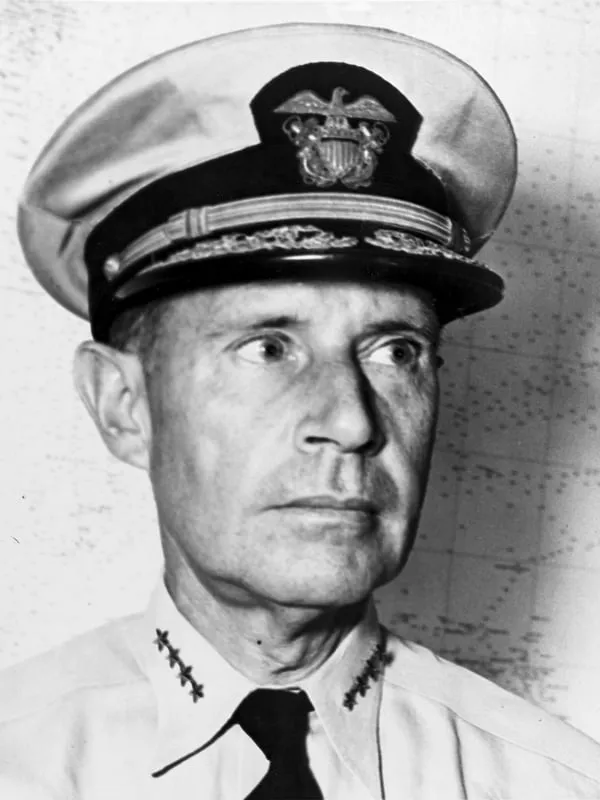
- Born:
- 3 July 1886, Baltimore, Maryland (United States)
- Died:
- 13 December 1969, Pebble Beach, California (United States)
- Author:
- Łukasz
- Photo:
- U.S. Navy, domena publiczna, Wikimedia Commons

Raymond Spruance was a surface officer who had never flown and had never before commanded carriers when, in June 1942, standing in for the sick William Halsey, he led two American carriers into the Battle of Midway. In the course of a single day his airmen, together with those of the Yorktown, sank four carriers that had attacked Pearl Harbor half a year earlier, and turned the tide of the war in the Pacific. Later, as commander of the Fifth Fleet, he directed the greatest amphibious operations in the Central Pacific, from the Gilbert Islands to Okinawa. Calm, taciturn and precise, called an “electric brain” by his contemporaries, he was seen as the opposite of the impetuous Halsey. The official historian of the US Navy, Samuel Eliot Morison, ranked him among the greatest admirals in American history, although Spruance himself never received the highest rank of fleet admiral.
Youth and the Academy
Raymond Ames Spruance was born on 3 July 1886 in Baltimore, the son of Alexander Spruance and Annie Hiss. He spent his childhood between East Orange, New Jersey, where his mother’s family lived, and Indianapolis, where he finished high school. The family was not well off, and a free education was offered above all by the Army and the Navy. In 1903 Spruance entered the Naval Academy at Annapolis. He graduated early, in September 1906, as one of the better students of the class of 1907, and was commissioned as an ensign after the compulsory sea service, in 1908.
He spent his first years in battleships. In the Minnesota he took part in the 1907–1909 voyage round the world of the Great White Fleet, a show of strength that President Theodore Roosevelt also aimed at Japan. He later furthered his education in electrical engineering, among other places at the General Electric works in Schenectady. In 1913, at the age of 26, he took command of the old destroyer Bainbridge in the Philippines. On 30 December 1914 he married Margaret Dean; they had a son, Edward, later a submarine officer, and a daughter, Margaret.
Engineer and staff officer
Spruance spent the First World War mainly ashore and in shipyards. He helped fit out the new battleship Pennsylvania and served in her, and in the last year of the war he was assistant engineer officer of the New York Navy Yard, from where he travelled on duty to London and Edinburgh.
In the 1920s he alternated between commanding destroyers and staff work. He commanded the new destroyers Aaron Ward and Percival, served in the Bureau of Engineering in Washington and, in 1924–1925, on the staff of US Naval Forces in Europe at a time of Greco-Turkish tension. In 1927 he completed the Naval War College at Newport, the school where throughout the interwar years the US Navy played out the coming war with Japan on maps. Spruance returned there twice more as an instructor, in 1931–1933 and 1935–1938, and was also executive officer of the battleship Mississippi and chief of staff of the destroyer forces. From April 1938 to December 1939 he commanded the Mississippi, after which he was promoted to rear admiral.
Even then he was known as a quiet commander of few words. On his bridge nothing but duty was discussed, and orders were to be short and clear. It was said that when a horrified officer reported to him that a depth charge had accidentally been dropped over the stern, Spruance calmly told him to pick it up and put it back.
In February 1940 he took command of the 10th Naval District at San Juan, Puerto Rico, and in the second half of 1941, as commander of Cruiser Division 5, he moved to the Pacific.
With Halsey
On 7 December 1941 Spruance’s cruisers were at sea with Vice Admiral William Halsey’s carrier Enterprise, returning from Wake, and so escaped the Japanese attack on Pearl Harbor. Over the following months, in the heavy cruiser Northampton, Spruance screened Halsey’s carriers on their raids: on 1 February 1942 he shelled Wotje Atoll in the Marshall Islands, in February and March he took part in the strikes on Wake and Marcus, and in April he screened the Hornet, from which James Doolittle’s bombers took off for the raid on Tokyo. Halsey, entirely different in temperament, thought very highly of him, and the two became friends.
Midway
On 26 May 1942, as the Pacific Fleet was preparing for the Japanese attack on Midway, whose date and target it knew from decrypted signals, Halsey was taken to hospital with a severe skin complaint. He recommended Spruance as his replacement, and Admiral Chester Nimitz agreed. Spruance took over Task Force 16, with the carriers Enterprise and Hornet, together with Halsey’s staff and its chief of staff, Captain Miles Browning, an experienced aviator. On 28 May he took the task force out of Pearl Harbor, and on 2 June, north-east of Midway, he joined Task Force 17 with the Yorktown; tactical command of the whole force passed to the more senior Rear Admiral Frank Jack Fletcher.
On the morning of 4 June, after a Catalina reported the Japanese carriers, Fletcher ordered Spruance to strike. Spruance decided to launch full strikes from both carriers at once and at long range, counting on them to catch Chūichi Nagumo at the moment when his carriers were recovering the aircraft returning from the raid on the atoll. The launch took more than an hour, and Spruance, seeing that the circling aircraft were burning fuel, ordered the squadrons to set off for the target without waiting for the rest. As a result the attacks came in piecemeal and the torpedo squadrons were almost wiped out, but the constant pressure prevented the Japanese from preparing a strike of their own. At about 10.20 a.m. dive bombers from the Enterprise and the Yorktown set three Japanese carriers ablaze, and in the afternoon Spruance’s aircraft hit the fourth, the Hiryū. When the Yorktown was put out of action, Fletcher handed Spruance the direction of the rest of the battle.
Spruance’s most important decisions were taken in the evening and at night. Admiral Isoroku Yamamoto sent his battleships and cruisers eastwards, hoping for a night action, in which the Japanese fleet had the advantage. Spruance, not knowing exactly what forces lay ahead of him, withdrew eastwards for the night and turned back west only at midnight. He was later criticised for not pursuing the enemy; today most historians believe that this caution saved his carriers from meeting the Yamato and the Japanese cruisers in the dark. Over the following days his aircraft sank the heavy cruiser Mikuma, after which, with fuel running out and his airmen exhausted, Spruance turned back before coming within range of Japanese aircraft from Wake Island. The battle ended with four Japanese carriers sunk for the loss of one American. Morison wrote that Fletcher had done well but Spruance superbly: he had been “calm, collected, decisive, yet receptive to advice”.
Chief of staff and the Central Pacific Force
A few days after the battle Spruance became Nimitz’s chief of staff, and in September 1942 his deputy. For more than a year he worked at Pearl Harbor on plans for a war that was to be waged quite differently from the first six months: with the ever greater superiority of American industry, with new carriers and an amphibious fleet. Nimitz valued him as his closest collaborator; they lived together and took walks together every day.
In May 1943 Spruance was promoted to vice admiral, and in August he took command of the Central Pacific Force, renamed the Fifth Fleet in April 1944. Under his direction the US Navy and Marine Corps opened the offensive across the Central Pacific. In November 1943 they took the atolls of Tarawa and Makin in the Gilbert Islands, at the cost of heavy losses on Tarawa, and at the turn of January and February 1944 Kwajalein and Eniwetok in the Marshall Islands. Spruance was made a full admiral with effect from 4 February 1944. In mid-February his carriers destroyed the main Japanese base at Truk Atoll in Operation Hailstone; Spruance himself led a force of battleships, cruisers and destroyers that sank Japanese ships fleeing the atoll, including the training cruiser Katori.
In all this he worked with two difficult but outstanding subordinates: the commander of the amphibious forces, Vice Admiral Richmond Kelly Turner, and the commander of the fast carriers, Vice Admiral Marc Mitscher. Spruance planned carefully, issued his orders concisely and left his subordinates a free hand. Nimitz then introduced a system in which the same ships operated alternately as Spruance’s Fifth Fleet and Halsey’s Third Fleet: while one admiral was fighting, the other was planning the next operation with his staff. Ships’ captains said that under Halsey you never knew what would happen in the next five minutes, while under Spruance everything was written down in the orders.
The Philippine Sea
In June 1944 the Fifth Fleet carried out the invasion of the Marianas – Saipan, Guam and Tinian – from which B-29 bombers could reach Japan. The Japanese fleet came out for a decisive battle. On 19 and 20 June, in the Battle of the Philippine Sea, American airmen and anti-aircraft gunners destroyed several hundred Japanese aircraft; the American pilots called the first day the “Great Marianas Turkey Shoot”. Submarines and aircraft sank three Japanese carriers. Spruance, however, would not let Mitscher steam west during the night to meet the Japanese fleet, because his first task was to cover the landing on Saipan and he feared that the Japanese would slip round him and strike at the transports. His critics, especially naval aviators, accused him of letting the rest of the Japanese carriers escape. Spruance himself admitted that an attack would have been better from a tactical point of view, but said that he could not risk a great amphibious operation. Admiral Ernest King told him that his decision had been right, and Japanese naval aviation never recovered from the battle.
Iwo Jima and Okinawa
From January 1945 Spruance again commanded the fleet. In February and March he directed the capture of Iwo Jima, and from 1 April the invasion of Okinawa, the largest amphibious operation of the Pacific War. For almost two months his ships beat off mass attacks by kamikaze aircraft, which sank or damaged hundreds of vessels and killed thousands of sailors. On 31 March a kamikaze hit his flagship, the cruiser Indianapolis, and Spruance moved to the old battleship New Mexico. When that ship too was hit on 12 May, his staff found the admiral manning a fire hose, fighting a fire amidships. At the end of May 1945 he handed over command to Halsey and began preparing the fleet for the planned invasion of Japan. For Iwo Jima and Okinawa he was awarded the Navy Cross.
After the war
Japan surrendered before the invasion began. In November 1945 Spruance succeeded Nimitz as Commander-in-Chief of the Pacific Fleet, and from February 1946 until his retirement in July 1948 he was President of the Naval War College, the institution where before the war he had himself prepared for the fight against Japan.
When Congress created the rank of fleet admiral, the law provided for only four such appointments in the Navy. Three were obvious: William Leahy, Ernest King and Chester Nimitz. Halsey and Spruance competed for the fourth, and the chairman of the House Naval Affairs Committee, Carl Vinson, backed Halsey, who was promoted in December 1945. Spruance, by special exception, kept the full pay of an admiral for the rest of his life. He said that if he could have got his fifth star together with Halsey it would have been fine, but that had he received it instead of Halsey he would have been unhappy.
In 1952 President Harry Truman appointed him ambassador to the Philippines. Spruance held the post until 1955, into the presidency of Dwight Eisenhower, during the government’s struggle against the Hukbalahap guerrillas and the presidency of Ramon Magsaysay. He spent his last years at Pebble Beach, California, gardening and taking long walks. In May 1969 his son was killed in a car accident. Spruance died on 13 December 1969 and was buried at Golden Gate National Cemetery near San Francisco, beside Nimitz, Turner and Admiral Charles Lockwood, as they had agreed during their lifetimes.
The man and the legend
Spruance shunned publicity, seldom gave interviews, wrote no memoirs and was reluctant to talk about himself. He did not smoke, hardly drank, made himself hot chocolate every morning and walked well over ten kilometres every day. He wrote of himself with irony that he was lazy and never did anything himself if he could get someone else to do it, and that his successes came above all from being a good judge of people. When others thought he was silently pondering deep thoughts, he was – so he claimed – thinking about nothing at all.
Beneath this modesty lay one of the coolest command minds of the war. At Midway, in his first carrier battle, Spruance judged correctly when to take a risk and when to hold back; in the Philippine Sea he put the purpose of the operation before the temptation of a spectacular victory. His caution was sometimes criticised, but he never lost a battle, and the operations he directed carried the American fleet from Hawaii to the shores of Japan. Spruance’s name is borne by the destroyer Spruance, the first ship of her class, and by a guided-missile destroyer of the class named after Admiral Arleigh Burke, and the main hall of the Naval War College is called Spruance Hall.
Sources
Commanded in battles
(08)- 3–7 June 1942Battle of MidwayPacific
- 20–23 November 1943Battle of TarawaPacific
- 31 January – 23 February 1944Fighting for the Marshall IslandsPacific
- 15 June – 9 July 1944Battle of SaipanPacific
- 19–20 June 1944Battle of the Philippine SeaPacific
- 21 July – 10 August 1944Battle of Guam (1944)Pacific
- 19 February – 26 March 1945Battle of Iwo JimaPacific
- 1 April – 22 June 1945The Battle of OkinawaPacific
Often appears with
People who appear in the same events.