United States
Henry H. Arnold
Chief of the Air Corps (1938–1941), Chief and Commanding General of the US Army Air Forces (1941–1946), General of the Army (1944), General of the Air Force (1949)
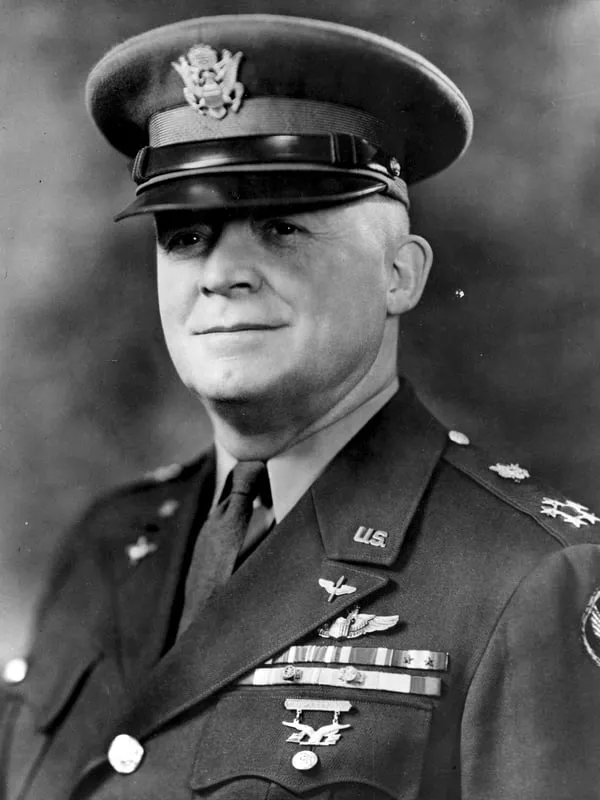
- Born:
- 25 June 1886, Gladwyne (Pennsylvania, United States)
- Died:
- 15 January 1950, Sonoma (California, United States)
- Author:
- Natalia
- Photo:
- autor nieznany, domena publiczna, Wikimedia Commons

Henry Harley Arnold, called “Hap” – short for happy – by his friends and subordinates, learned to fly at the Wright brothers’ school in 1911, when aeroplanes were still contraptions of wood and fabric. Thirty years later, in June 1941, he took charge of the newly created US Army Air Forces, and within four years he turned an air arm that in 1939 had numbered just over 20,000 men and some 800 first-line combat aircraft into the largest air force in the world, with 2.4 million men and almost 80,000 aircraft. He directed the American bombing offensive against Germany and Japan, backed the development of radar, jet aircraft and intercontinental bombers, and after the war became the only General of the Air Force in history, with five stars. He was also one of the most overworked and most impatient figures in the American high command: during the war he suffered four heart attacks.
From the infantry to the Wright brothers’ school
He was born on 25 June 1886 in Gladwyne near Philadelphia, Pennsylvania, the son of a doctor, Herbert Arnold, a descendant of a distinguished family with military and political traditions. He was brought up in a spirit of strict Baptist piety and was preparing to study theology, but when his elder brother refused to enter the Military Academy at West Point, it was Henry who took the examination. He was admitted from the reserve list, because the candidate chosen before him admitted that he was married. At the academy he was a prankster and a sportsman rather than a star pupil: he graduated in June 1907, 66th out of 111, too low to obtain the posting to the cavalry he longed for. As a second lieutenant of infantry he joined the 29th Infantry Regiment in the Philippines, where he volunteered to help map the island of Luzon.
The officer he worked with there later moved to the Signal Corps, which in 1909 had bought the Army’s first aeroplane from the Wright brothers, and was looking for young lieutenants to train as pilots. In April 1911 Arnold was ordered to the Wright school in Dayton, Ohio. He made his first solo flight on 13 May 1911, after less than four hours of instruction, and in July he received pilot’s certificate No. 29 of the Fédération Aéronautique Internationale; a year later he was awarded military aviator’s certificate No. 2. As one of the Army’s first two instructors he taught flying at the school at College Park near Washington, broke the American altitude record several times, flew the first airmail in the United States and in 1912 won the first-ever Mackay Trophy for the year’s best military flight. The accidents that killed his colleagues, and a crash of his own that he narrowly escaped in November 1912, made him give up flying, however. For four years he served in the infantry, including another tour in the Philippines, where he became friends with Lieutenant George Marshall, later Army Chief of Staff. In 1913 he married Eleanor Pool, with whom he had five children, four of them sons. Only in 1916 did he overcome his fear and return to aviation.
A war behind a desk and the Mitchell affair
When the United States entered the First World War in April 1917, Arnold wanted to go to France, but aviation was short of officers in Washington. He was kept on the staff of the Air Service, where he dealt with the production and purchase of aircraft, the building of schools and airfields and the training of thousands of men. In August 1917, at the age of 31, he became the youngest colonel in the Army. He reached France only in the autumn of 1918 and arrived at the front on 11 November, the day of the armistice.
After the war he reverted to the rank of captain, then major, and commanded the air units on the West Coast. At this time he became friends with two younger officers, Carl Spaatz and Ira Eaker, who in the Second World War commanded the American bombers in Europe under him. He was also a supporter of General Billy Mitchell, the chief advocate of an independent air force. When Mitchell was court-martialled in 1925, Arnold testified in his favour, and after the verdict he went on lobbying congressmen for Mitchell’s views through the Air Service’s information office, which he headed. In 1926 he was given a choice: resignation or a court martial. He chose the court martial, so his superiors chose a third way and banished him to Fort Riley, Kansas, far from the centres of aviation.
He was brought back from exile by the new Chief of the Air Corps. Arnold completed the staff school at Fort Leavenworth, commanded bases and an equipment depot, and from 1931 March Field in California. In 1934 he led ten Martin B-10 bombers on a flight from Washington to Alaska and back, covering more than 13,000 kilometres, and won a second Mackay Trophy. In 1935, as a brigadier general, he took command of a wing in the newly created GHQ Air Force, and in December that year he became Assistant Chief of the Air Corps.
Chief of the Air Corps
On 21 September 1938 the Chief of the Air Corps, General Oscar Westover, was killed in an air crash. Arnold’s candidacy met resistance from part of the President’s circle – rumours went round the White House that he drank too much – but on 29 September 1938 Franklin Delano Roosevelt appointed him Chief of the Air Corps with the rank of major general. That same night the Munich Agreement was signed, and the Sudeten crisis convinced Roosevelt that Hitler’s strength rested on air power and that America needed a far larger air force of its own. From then on Arnold directed its expansion. He pressed for long-range bombers, in April 1939 brought Charles Lindbergh back to active duty to assess the state of the air arm and the new aircraft, and established co-operation with scientists, above all Theodore von Kármán of the California Institute of Technology.
The hardest battles for him were those fought in Washington. After the outbreak of war in Europe the United States began selling aircraft to Britain and France, and Arnold feared that his units would be left without machines. In March 1940 he complained publicly, and Roosevelt warned him that officers who did not “play ball” might find themselves sent to Guam; for several months he was not invited to the White House. He was defended by the new Secretary of War, Henry Stimson, and in April 1941, after a three-week trip to Britain that ended with a persuasive report to the President, Arnold regained Roosevelt’s confidence. From the trip he brought back the plans of Frank Whittle’s first British jet engine and a programme for training British pilots in the United States, which was named after him.
The Army Air Forces
In the autumn of 1940 Arnold presented Marshall with a plan to unite all of the Army’s aviation under a single command with its own staff. The General Staff rejected it, and Marshall merely made Arnold acting Deputy Chief of Staff for Air. In the spring of 1941, however, the disputes over the air defence of the country and over who commanded the air units convinced Marshall himself. On 20 June 1941 the War Department created the Army Air Forces, and Arnold became their chief, with authority over both the combat units and the Air Corps. He and Marshall agreed that aviation would receive broad autonomy within the Army and that its commanders would not demand full independence until the end of the war.
Arnold shared the racial views of most white officers of his generation. When the War Department, under pressure from African American activists and a lawsuit, agreed to form the 99th Pursuit Squadron, the first unit of Black airmen, Arnold and his staff insisted that they be trained separately, at Tuskegee, Alabama, because in his view Black officers could not command white enlisted men. When in 1943 the commander of the group to which the squadron had been attached judged its pilots unfit for combat, the air command considered withdrawing the squadron from the front; only a comparison with other units showed that it was fighting no worse than they were.
In August 1941 the new Air War Plans Division on his staff drew up the AWPD-1 plan, which envisaged expanding the air forces to more than 2 million men and some 60,000 aircraft and a strategic bombing offensive against Germany. In August 1941 Arnold accompanied Roosevelt to his meeting with Winston Churchill off the coast of Newfoundland, at which the Atlantic Charter was proclaimed.
The air war, 1942–1945
After the attack on Pearl Harbor Arnold was promoted to lieutenant general, and from 9 March 1942, after the reorganisation of the Army, he was Commanding General of the Army Air Forces, which now ranked equally with the ground forces. He sat on the Joint Chiefs of Staff and on the Anglo-American Combined Chiefs of Staff, although the Navy never accepted him as its equal. In March 1943 he received his fourth star. He sent to Britain the Eighth Air Force, commanded by his former subordinates Spaatz and Eaker. American B-17 and B-24 bombers were to destroy German industry by precision bombing in daylight, but in 1943 the heavy losses on raids deep into Germany without long-range fighter escort showed that the pre-war doctrine had been wrong. Arnold, impatient, blamed the failures on his commanders’ lack of aggressiveness and at the end of 1943 agreed to Eaker’s removal.
He was particularly personally involved in the war against Japan. Against the theatre commanders – Douglas MacArthur, Chester Nimitz and Joseph Stilwell – who wanted to use the new B-29 bombers to support their own operations, in 1944 he persuaded the Joint Chiefs to form them into the Twentieth Air Force, answerable directly to the Joint Chiefs, and took command of it himself. When the raids from China and the Marianas failed to deliver the expected results, he removed one commander after another, and in January 1945 he gave command of the bombers in the Marianas to General Curtis LeMay, who switched to night-time incendiary raids on Japanese cities. The most tragic of them, on the night of 9–10 March 1945, destroyed a large part of Tokyo and killed, by various estimates, between 80,000 and more than 100,000 people. In the summer of 1945 Arnold attended the Potsdam Conference, and his B-29s dropped the atomic bombs on Hiroshima and Nagasaki.
The strain of the war was destroying his health. He suffered his first heart attack in February 1943, after returning from the Casablanca Conference and from China, and further ones in May 1943, May 1944 and January 1945. Under the regulations he should have left the service, but Roosevelt exempted him on condition that he report monthly on his health. On 21 December 1944, as the fourth after Marshall, MacArthur and Dwight Eisenhower, he received the newly created five-star rank of General of the Army.
Last years
In February 1946 Arnold handed over command to Spaatz, and on 30 June 1946 he formally retired. He settled on a ranch near Sonoma, California, and wrote his memoirs, published in 1949 as Global Mission. Before he left he had brought about the creation of Project RAND, from which grew the RAND Corporation, a centre for research on strategy and military technology. In September 1947 aviation became a separate service as the United States Air Force, with Spaatz as its first Chief of Staff. On 7 May 1949 an Act of Congress changed Arnold’s rank to General of the Air Force. To this day he is the only person ever to have held it, and the only officer to have held five-star rank in two services. He died on 15 January 1950 in Sonoma and was buried in Arlington National Cemetery. Robert A. Lovett, the Assistant Secretary of War for Air, with whom he had worked closely during the war, said that Arnold was as much a casualty of the war as if he had been wounded at the front.
Significance
Arnold was neither a great theorist nor an outstanding field commander; he never commanded in battle. He was an organiser who had known aviation since its earliest days and understood that modern air warfare depended on industry, science and training as much as on the courage of pilots. Under his direction the United States trained hundreds of thousands of airmen and built a bomber fleet which, together with the RAF, wrecked Germany’s oil industry and communications and burned the cities of Japan. The bombing he directed was at the same time one of the most contested chapters of the war: it cost the lives of tens of thousands of American airmen and hundreds of thousands of civilians. The Army Air Forces he created became in 1947 the independent air force he had fought for since the days of Billy Mitchell.
Sources
Mentioned in battles
(02)Often appears with
People who appear in the same events.
On the timeline
(44)The 40 most important of 44 events. All tagged “Henry H. Arnold” (17) →