1943–1944: The Central Pacific offensive
Battle of Peleliu
- Dates:
- 15 September – 27 November 1944
- Front:
- Pacific
- Location:
- Peleliu Island in the southern Palau archipelago (western Carolines, a Japanese mandate from 1920): beaches on the south-west coast, the airfield in the south of the island, the coral ridges of the Umurbrogol in its centre and the islet of Ngesebus to the north; in parallel the neighbouring island of AngaurOn the battle map →
- Sides:
- United StatesWilliam Halsey, Roy Geiger, William RupertusJapanKunio Nakagawa, Sadae Inoue
- Result:
- A United States victory. The capture of the island was declared on 27 November 1944. According to American figures about 10,700 Japanese were killed; the Americans lost more than 1,500 dead and more than 6,500 wounded on Peleliu, with several hundred more killed on Angaur.
- Author:
- Natalia
Name and dates
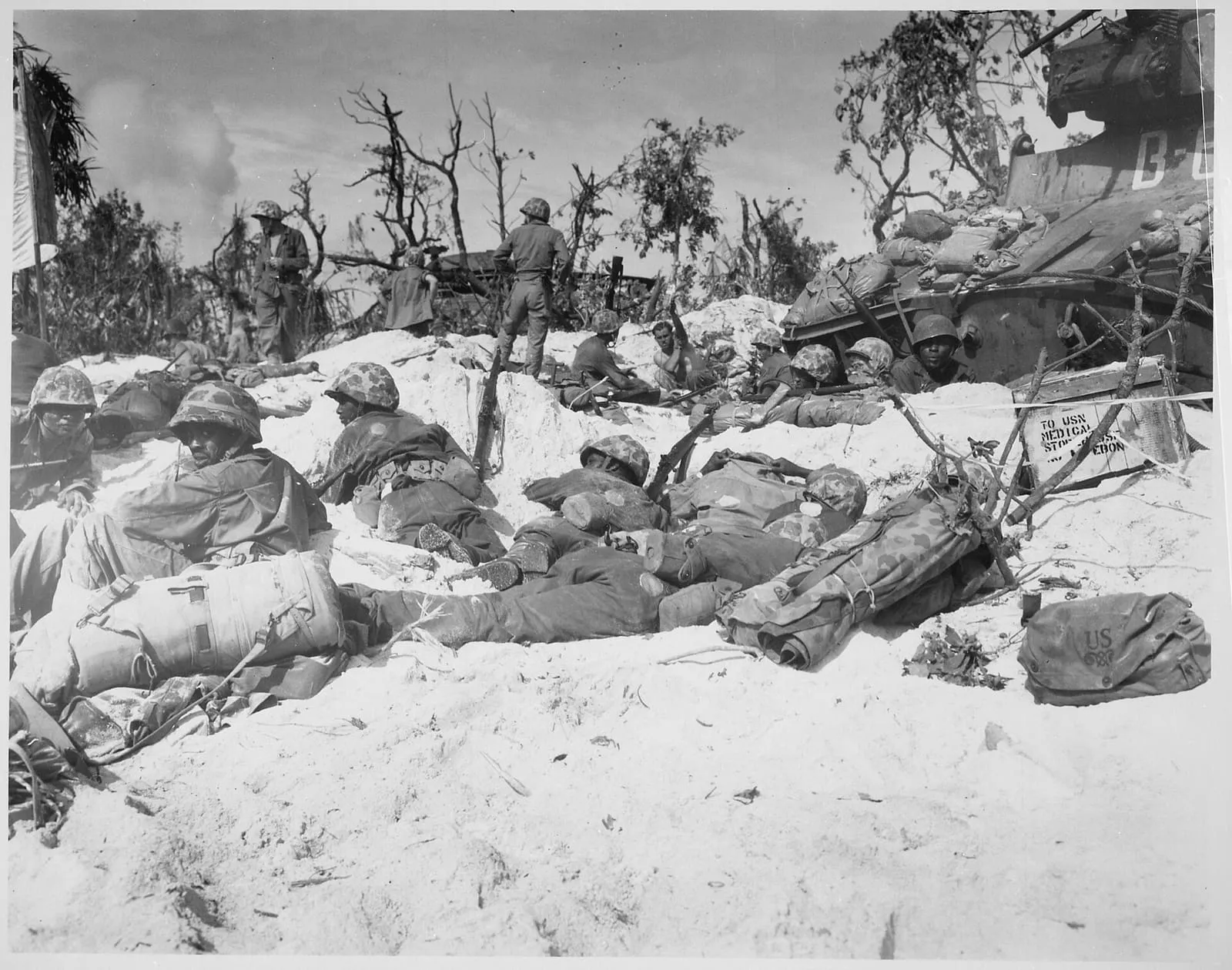
The Battle of Peleliu is the name given to the American capture of Peleliu, a small coral island at the southern end of the Palau archipelago, between 15 September and 27 November 1944. In American plans the operation bore the codename Stalemate II, and it also included the seizure of the neighbouring island of Angaur, where the Army’s 81st Infantry Division fought from 17 September. Peleliu is barely nine kilometres long and a few kilometres wide, yet the fighting for it lasted 73 days and was among the bloodiest of the entire Pacific War.
The battle is taken to have begun on the morning of 15 September, when at 8.32 a.m. the first amphibious tractors carrying men of the 1st Marine Division reached the beaches. The naval bombardment of the island, however, had been under way since 12 September, and carrier aircraft had struck Palau earlier still. Its end is set at 27 November, when the American command announced that organised resistance had ceased – three days after the suicide of the Japanese commander of the defence, Colonel Kunio Nakagawa. This date, too, is a convention: individual groups of Japanese soldiers went on hiding in the caves for many months, and the last of them did not lay down their arms until April 1947.
On the American side the operation was directed by Admiral William Halsey, commander of the Third Fleet, to whom Vice Admiral Theodore Wilkinson’s amphibious forces were subordinated. The ground forces formed Major General Roy Geiger’s III Amphibious Corps, and on Peleliu the fighting was done above all by Major General William Rupertus’s 1st Marine Division, relieved in October by Major General Paul Mueller’s 81st Infantry Division. The islands of southern Palau lay within the sector of the Japanese 14th Division under Lieutenant General Sadae Inoue, whose headquarters was on the northern islands of the archipelago, Koror and Babeldaob; the defence of Peleliu itself, however, was commanded by Colonel Nakagawa, commander of the division’s 2nd Infantry Regiment.
Background
The road to Palau
In the summer of 1944 the United States broke through Japan’s inner defensive ring in the Central Pacific. After the Battle of Saipan and the Battle of Guam, American bombers gained bases from which they could reach the Japanese home islands, and in the Battle of the Philippine Sea the Japanese carrier fleet suffered a defeat from which its air arm never recovered. In Washington, meanwhile, the dispute over the road to Japan continued: General Douglas MacArthur insisted on a return to the Philippines, while part of the naval command, including Admiral Chester Nimitz, considered bypassing the archipelago and striking at Formosa (Taiwan).
Whatever the outcome of that dispute, the planners concluded that the eastern flank of the Philippines had to be secured before they were invaded. The Palau archipelago, lying less than a thousand kilometres east of Mindanao, belonged to the Japanese South Seas Mandate and had airfields and anchorages from which, it was feared, the Japanese could attack convoys bound for the Philippines. The airfield on Peleliu was also to serve aircraft supporting MacArthur’s future operations. The Stalemate II plan provided for the capture of Peleliu and Angaur and, in a second stage, of Ulithi and Yap in the western Carolines.
Halsey’s advice
A few days before the landing, the Third Fleet’s carriers struck Mindanao and the Visayas. Japanese air opposition proved so weak that on 13 September Halsey proposed to Nimitz that the landings on Palau, Yap and Mindanao be cancelled and the troops earmarked for them sent straight to Leyte. Nimitz passed the suggestion concerning Leyte to the Combined Chiefs of Staff, then meeting at the Second Quebec Conference, and on 15 September the Leyte landing was brought forward by two months, to 20 October. The landing on Yap was abandoned, but Nimitz did not call off the Palau operation: the assault forces were already at sea, and he himself believed – according to most historians – that Peleliu and Ulithi were needed as a base to cover future operations. This decision later became the main point of contention in the dispute over the purpose of the whole battle.
A new Japanese defence
The Japanese 14th Division, transferred from Manchuria in the spring of 1944, arrived on Palau in April and May. According to American estimates, Peleliu and the neighbouring islet of Ngesebus held some 10,000–11,000 men: soldiers of the 2nd Infantry Regiment with attached battalions, several thousand sailors of base units and airfield personnel, and construction labourers, Koreans among them. Only part of this force – about 6,500 according to the American study by Moran and Rottman – consisted of trained infantry. Nakagawa also had a dozen or more Type 95 Ha-Go light tanks, mortars and light anti-aircraft guns.
More important than the numbers was a change in the way of fighting. After the defeats in the Gilbert and Marshall Islands and the Marianas, where garrisons had tried to stop the landings on the beach and perished under naval gunfire, losing their remnants in night-time banzai charges, the Japanese staff prescribed defence in depth. The beaches were to be held only long enough to inflict losses on the enemy, while the main forces were to be hidden in the interior of the island, in terrain that naval artillery could not destroy. Counter-attacks were to be made only at a favourable moment, and suicidal charges were deemed a waste of men. The aim was not to hold the island but to bleed the enemy for as long as possible and to gain time.
Peleliu was exceptionally suited to this. The centre of the island was taken up by the Umurbrogol massif – a labyrinth of jagged coral-limestone ridges, ravines and cliffs, covered in jungle that concealed the true shape of the ground on aerial photographs. The limestone held several hundred natural caves and old shafts left by phosphate mining. Japanese engineers linked them with tunnels, widened them, sealed some entrances with steel doors and prepared mutually supporting positions for guns, mortars and machine guns. On the headland closing off the landing beaches to the north, later called “the Point” by the Marines, positions for an anti-tank gun and light guns were cut into the rock to enfilade the beaches. The beaches were mined and obstructed, including with buried artillery shells with exposed fuzes. Neither Nakagawa nor his superiors envisaged an evacuation: the garrison was to fight to the end.
The American plan
The Americans had no idea of the scale of these preparations. The plan called for the three regiments of the 1st Marine Division to land side by side on the beaches of the south-west coast, nearest the airfield: in the north, on the beaches designated White, Colonel Lewis Puller’s 1st Marines; in the centre Colonel Harold Harris’s 5th Marines; and in the south, on the Orange beaches, Colonel Herman Hanneken’s 7th Marines. The 5th Marines were to take the airfield and cut the island in two, the 7th to clear its southern tip, and the 1st to wheel north towards the hills. The division held one battalion in reserve; a further reserve was the 81st Infantry Division, earmarked for Angaur.
The 1st Marine Division was an experienced formation – it had fought on Guadalcanal and in the New Britain campaign – but it had been resting on the islet of Pavuvu in the Russell Islands in poor conditions, and some of its veterans had been sent home and replaced by new men. Rupertus, who had broken an ankle during an exercise before the operation, was confident of quick success. According to accounts cited by historians, he predicted a “short and tough” fight that would last three days, perhaps two; other versions speak of four days. For this reason few war correspondents went to the island, which partly explains why the battle long remained little known to the American public.
Course of the battle
Bombardment and landing (12–15 September)
From 12 September, for three days, battleships, cruisers and carrier aircraft shelled and bombed Peleliu, while frogmen of the underwater demolition teams cleared the approaches to the beaches. The commander of the fire-support ships, Rear Admiral Jesse Oldendorf, is said to have declared that he had run out of targets. In fact the bombardment destroyed the aircraft and buildings around the airfield, but the defenders hidden in the caves came through it almost unscathed, and the positions near the beaches were largely untouched. The Japanese did not return fire, so as not to give away their positions.
On the morning of 15 September, at 8.32 a.m., the first amphibious tractors reached the shore. As the following waves crossed the reef, the Japanese opened fire with guns and mortars hidden in the hills and on both flanks of the beaches. According to American figures, by 9.30 a.m. they had destroyed several dozen amphibious tractors and landing vehicles. It was hardest in the north, on the White beaches, where Puller’s 1st Marines were caught in crossfire from the Point and from the ridges above the shore. K Company of the regiment’s 3rd Battalion under Captain George Hunt took the headland that same day, but for the next twenty-four hours it fought off counter-attacks and, according to American accounts, was reduced in this fighting to a dozen or so men fit for combat.
In the afternoon Nakagawa launched his only large counter-attack involving tanks: a dozen or more light tanks carrying infantry on their hulls drove across the airfield towards the positions of the 5th Marines. The attack collapsed under fire from American Sherman tanks, anti-tank weapons, aircraft and machine guns; almost all the Japanese tanks were destroyed. By evening the Marines held a strip of coast about three kilometres long and at their deepest point had advanced about one and a half kilometres inland. According to American figures, about 200 Marines were killed on the first day and about 900 wounded. During the night small Japanese groups infiltrated between the positions, and hand-to-hand fighting broke out.
The airfield and the south of the island (16–23 September)
On 16 September the 5th Marines crossed the airfield under artillery fire from the Umurbrogol hills and reached the east coast, cutting the island in two. Meanwhile the 7th Marines were clearing its southern tip, where a cut-off Japanese battalion was holding out. As early as 17 September the first American observation aircraft directing artillery fire landed on the airfield, and on 26 September Vought F4U Corsair fighters of squadron VMF-114 arrived there. Their pilots attacked positions only a few hundred metres from the runway, dropping bombs, rockets and tanks of napalm, which was used to burn away the vegetation concealing the cave entrances. The airfield nevertheless remained within range of Japanese fire almost until the end of the battle.
The climate made the fighting harder. The heat was punishing – according to American accounts the perceived temperature reached about 46 degrees Celsius – and many soldiers collapsed from heat exhaustion. Water was delivered in poorly cleaned fuel drums, so it was contaminated and caused vomiting. The hard coral ground made digging foxholes almost impossible, and rock splinters flying from explosions wounded as badly as shell fragments.
Bloody Nose Ridge and the exhaustion of the 1st Marines (16–23 September)
In the north, from the second day, Puller’s 1st Marines attacked the first ridges of the Umurbrogol massif, which the Marines called Bloody Nose Ridge. Every summit taken with enormous effort turned out to be covered by fire from neighbouring ridges and caves, often from behind the attackers. The Japanese held their fire until they could inflict the heaviest losses, their snipers targeted stretcher-bearers, and at night small groups infiltrated the American lines. In a few days of fighting for the height designated Hill 100, the regiment’s 1st Battalion under Major Raymond Davis lost about 70 per cent of its strength, according to American figures. Captain Everett Pope’s company held on through the night on the ridge it had taken, ending up defending itself with stones and fists, and withdrew in the morning with only a handful of men; Pope received the Medal of Honor for this action.
After six days of attacks the 1st Marines had lost about 1,700 killed and wounded according to official American figures – depending on the calculation, from more than half to about 70 per cent of their strength – and ceased to exist as a fighting unit. Puller, himself suffering from an unhealed wound received earlier in the war, was later criticised for his persistent frontal attacks; his defenders point out that he was carrying out the orders of the division command, which pressed for rapid progress. According to accounts cited by historians, it was Geiger who, at a conference at the division command post, judged the regiment to be bled white and, against the reluctance of Rupertus, who wanted the Marines alone to take the island, decided to bring in Army infantry. On 23 September the 321st Infantry Regiment of the 81st Division landed on Peleliu, and the 1st Marines were soon sent back to Pavuvu.
Angaur (17 September – 22 October)
In parallel, on 17 September, two regiments of the 81st Infantry Division landed on Angaur, an island separated from Peleliu by a strait about 10 kilometres wide, with phosphate deposits and flat ground well suited to an airfield. It was defended by about 1,400 soldiers under Major Ushio Gotō. Mueller chose less heavily fortified beaches, so the landing went ahead without serious losses, and on 20 September he declared the island secure. The remnants of the garrison, however, withdrew to the jungle-covered hills in the north-west of the island, which the Americans called “the Bowl”, and held out there in caves. The 322nd Regiment spent the following weeks taking them; Gotō was killed on 19 October, and according to the American official history the last pockets of resistance were eliminated on 22 October. About 1,300 Japanese died on Angaur and fewer than 60 were taken prisoner; the 81st Division lost about 260 killed and more than 1,300 wounded there. A large airfield for bombers was built on the island.
Northern Peleliu and Ngesebus (23 September – 1 October)
At dawn on 23 September the Americans noticed that the Japanese were bringing in reinforcements from the northern islands of the archipelago: on the nights of 22/23 and 23/24 September part of the 2nd Battalion, 15th Infantry Regiment, came over in barges from Babeldaob. Ships and artillery sank some of the barges, but several hundred soldiers reached the island. It was therefore decided to take the whole northern part of Peleliu and cut the Umurbrogol off from the sea. The 321st Infantry and the Marines advanced along the west coast, bypassing the massif, and by 24 September had surrounded it on three sides; from then on it was known as the Pocket. The 5th Marines moved north and took the rest of the island with its caves and the former phosphate works.
On 28 September the 5th Marines crossed in amphibious tractors to the islet of Ngesebus, where the Japanese had been building a fighter airstrip. This time the preparatory fire – guns, howitzers, ships and Corsairs from the airfield on Peleliu – proved effective, and the islet was taken within two days. According to American figures the regiment lost 15 killed and 33 wounded, the Japanese about 470 killed. By 1 October the northern part of Peleliu was in American hands. From then on the Japanese defence was concentrated in the Umurbrogol Pocket, which according to the American monograph measured about 800 metres long and 350 metres wide at the end of September.
The Umurbrogol Pocket (October)
The fighting for the Pocket resembled a siege. Successive ridges and ravines received names from the soldiers – the Horseshoe, the Five Brothers, the Five Sisters, Walt Ridge, Boyd Ridge, the China Wall, Death Valley – and some of them were taken and lost several times. Each cave had to be taken separately, often more than once, because the Japanese returned to it through underground passages. From 29 September the 7th Marines were responsible for the Pocket; by mid-October, according to American figures, they had lost nearly half their strength. They were replaced by the 5th Marines, whose commander, Colonel Harris, switched to siege methods. Instead of assaulting the ridges, Marines and engineers built roads for tanks and bulldozers, used bulldozers to seal cave entrances, and tanks and amphibious tractors fitted with flamethrowers burned out positions at close range.
On 15 October the 321st Infantry took over responsibility for the siege of the Pocket, and the 1st Marine Division began to leave the island. On 20 October, the day of the Leyte landing, General Mueller assumed command of all troops on Peleliu, and Geiger and Rupertus flew off the island. The official US Marine Corps monograph gives this date; some studies and other sources give 30 October as the day the 81st Division took over command.
Six weeks of siege and the end of the defence (October – 27 November)
The 81st Division continued the siege methods: it slowly tightened the ring, built roads into the depths of the massif, set up guns facing the cave entrances directly, and drenched them with burning fuel from flamethrowers fed by long hoses. The defenders’ only permanent source of water, a pool in the valley called the Horseshoe, was lit by searchlights at night and kept under fire. From mid-October the 323rd Infantry Regiment arrived from Ulithi, relieving the exhausted 321st on 26 October. The defenders, ever fewer, hungry and thirsty, ventured out at night for water and supplies, but they made no further large counter-attack. Major General Kenjirō Murai, sent to Peleliu earlier by Inoue as an adviser, remained at Nakagawa’s side to the end.
On 24 November Nakagawa sent his last report to divisional headquarters. According to the accounts cited in the literature, he wrote that “the sword is broken and the spears are exhausted” and reported that he had divided the remaining men – a few dozen soldiers – into small groups, which he had ordered to attack the enemy wherever they could. He then burned the regimental colours and, together with Murai, committed seppuku. On the night of 24/25 November the Americans killed several dozen Japanese trying to break out of the encirclement; from a soldier captured at the time they learned of the deaths of both commanders. Nakagawa was posthumously promoted to lieutenant general.
On the morning of 27 November units of the 323rd Infantry closed the ring around the last caves without meeting any further organised resistance. At 11 a.m. the regimental commander reported to Mueller that the Peleliu operation was over. Seventy-three days had passed since the landing.
The last defenders
The fighting did not stop entirely. For weeks afterwards American patrols kept finding and killing individual Japanese soldiers hiding in the caves; according to English-language studies, the 81st Division was still conducting mopping-up operations in January 1945. The longest holdouts were a group of more than thirty soldiers of the 2nd Infantry Regiment and sailors from base units, led by a lieutenant, who hid in the island’s caves for more than two years, living, according to accounts, partly on supplies stolen from American depots. Only on 22 April 1947, after a former Japanese rear admiral brought to the island convinced them that the war had long since ended, did they lay down their arms.
Losses
Figures for losses vary with the source and the method of counting, so they can only be given approximately. According to American figures about 10,700 Japanese were killed on Peleliu and Ngesebus. Between about 200 and about 300 men were taken prisoner, most of them labourers from construction units, mainly Koreans; there were few soldiers among the prisoners. A further 1,300 or so Japanese died on Angaur. Of the Peleliu garrison, practically the only survivors were the prisoners and the stragglers who hid until 1947.
According to some historians, the American casualty rate was the highest of any amphibious operation of the Pacific War. According to official figures, the 1st Marine Division lost at least 1,250 killed, died of wounds and missing (more than 1,300 in other tallies) and more than 5,000 wounded – in all more than 6,500 men, over a third of the division’s strength. The 81st Infantry Division lost several hundred killed on Peleliu and Angaur combined (from more than 500 to about 600 in various tallies) and about 2,700 wounded. The Navy lost nearly 200 killed in the Palau operation. Many soldiers were taken out of the fighting because of heat exhaustion, disease and psychological breakdown. According to post-war American calculations, more than 1,500 rounds of ammunition were expended for every defender killed.
According to most studies, the Japanese had moved the island’s indigenous inhabitants to the northern islands of the archipelago before the battle, so they were not in the combat zone. Their villages and plantations on the island, however, were completely destroyed.
The dispute over the battle’s purpose
Peleliu has long been one of the most contentious battles of the Pacific War. Critics – among them many veterans and some historians – point out that as early as 13 September Halsey had advised abandoning the operation, and that bringing forward the Leyte landing removed its main justification. The airfield on Peleliu played no significant part in the fighting for the Philippines, and the Japanese garrison, cut off from supplies, would not have been able to threaten American convoys; it could have been bypassed and left to wither, like many other islands. The islands of northern Palau, with the strong garrison of the 14th Division, were indeed bypassed and held out until Japan’s surrender in August 1945.
Defenders of Nimitz’s decision stress that when Halsey gave his advice the troops were already on their way and no one knew the extent of the Japanese defences; that taking southern Palau denied the Japanese a base on the flank of the route to the Philippines; and that Ulithi, seized along the way, became one of the largest anchorages of the US fleet in the war. The dispute therefore concerns not so much the occupation of Palau itself as whether taking Peleliu at such a price was necessary. Veterans’ memories have also helped to keep it alive: With the Old Breed (1981), the memoir of Eugene Sledge, a private in the 5th Marines, became one of the most widely read soldiers’ accounts of the Pacific War.
Significance
The Battle of Peleliu closed the American offensive in the Central Pacific in 1944 and coincided with the beginning of the fighting for the Philippines. A few days before the fighting on Angaur ended, the Americans landed on Leyte, and the Battle of Leyte Gulf, fought over the following days, sealed the fate of the Japanese fleet. Against this background the bloody struggle for a small island in Palau was pushed into the background in the press, overshadowed also by events in Europe, and for many years it remained little known.
More important for the course of the war was the lesson Peleliu taught. Here, for the first time on such a scale, the Japanese used a defence in depth based on caves and tunnels, without suicidal charges, designed to inflict the greatest possible losses on the enemy. The same method, on an even larger scale, awaited the Americans in 1945 at the Battle of Iwo Jima and the Battle of Okinawa, where the defenders likewise allowed the enemy to land and fought from the interior of the islands. American commanders drew some lessons from Peleliu – especially concerning the reduction of fortified caves with tanks, flamethrowers and explosive charges – but according to historians the changes in the way landings were prepared were limited. The mounting losses in the fighting for successive islands ever closer to Japan subsequently influenced American estimates of the cost of invading the home islands.
The 1st Marine Division, withdrawn to Pavuvu, rebuilt its strength over the following months and did not return to combat until Okinawa in April 1945. Its commander, General Rupertus, died of a heart attack in March 1945. Peleliu – after the war part of a UN trust territory administered by the United States, and since 1994 part of the independent Republic of Palau – has preserved many traces of the battle: wrecks of tanks and amphibious tractors, sealed caves, and memorials to both sides.