Battle of Kollaa
- Dates:
- 7 December 1939 – 13 March 1940
- Front:
- Scandinavia
- Location:
- The Kollaa river (Finnish Kollaanjoki) in the municipality of Suistamo in Ladoga Karelia, on the road and railway from Suojärvi to Loimola, several dozen kilometres from the Finnish–Soviet border of the timeOn the battle map →
- Sides:
- FinlandWoldemar Hägglund, Lauri Tiainen, Antero SvenssonSoviet UnionIvan Khabarov, Grigory Shtern, Mikhail Yevstigneyev
- Result:
- Finnish defensive victory. The Soviet divisions never broke the Kollaa line, though in March they drove 0.5–1.5 km into it. The peace treaty nevertheless ceded the area to the USSR.
- Author:
- Łukasz
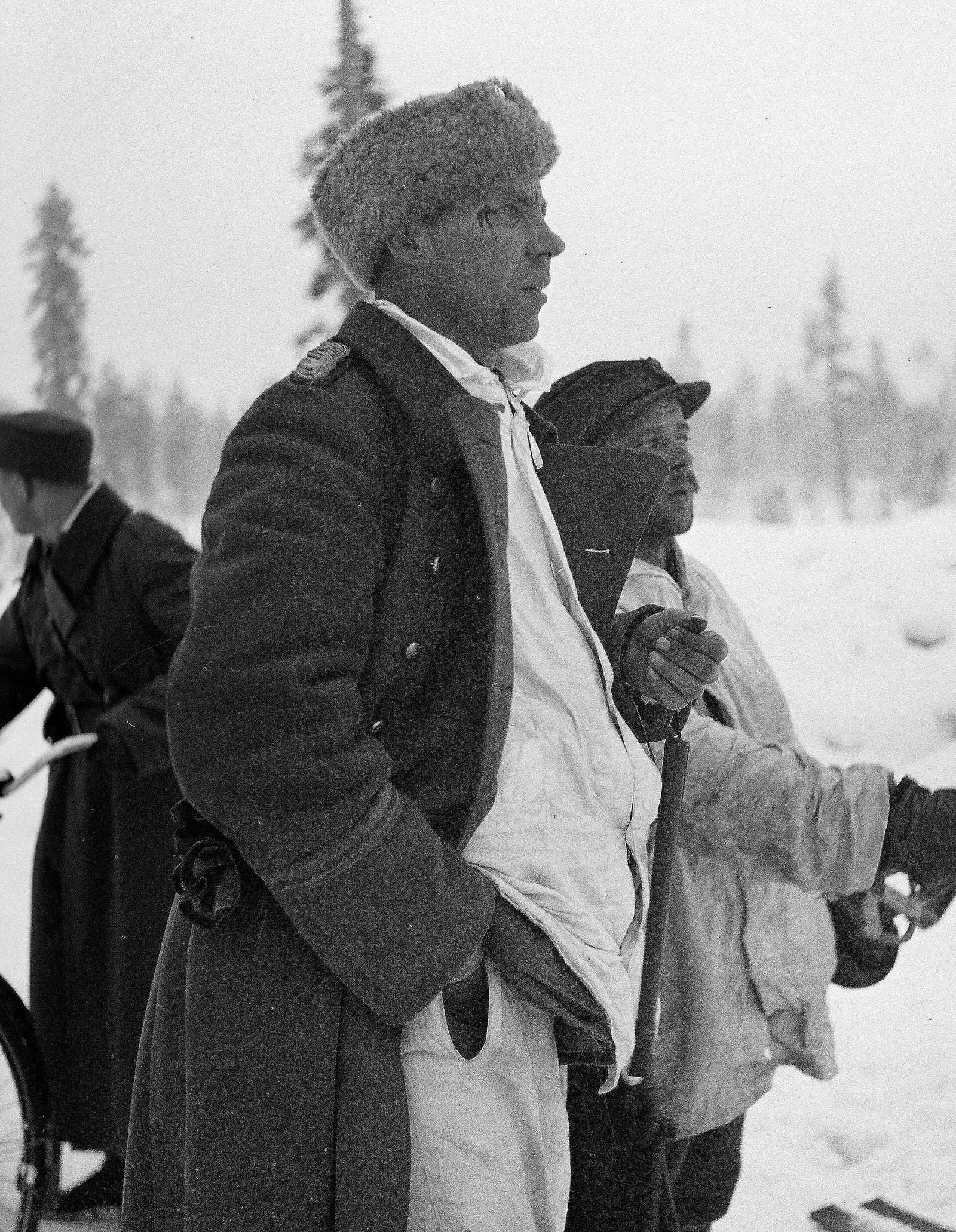
The Battle of Kollaa was the longest continuous defensive battle of the Winter War north of Lake Ladoga. From 7 December 1939 to 13 March 1940, units of the Finnish 12th Division, part of Major General Woldemar Hägglund’s IV Corps, held the line of the small Kollaa river, crossed by the road and railway from Suojärvi to Loimola. They were attacked by the Soviet 56th Rifle Division of the 8th Army and, from January, by further divisions, supported by artillery that in the final weeks of the war outnumbered the Finnish guns several dozen times over. Kollaa had still not been broken when the guns fell silent at 11 a.m. on 13 March. Lieutenant Aarne Juutilainen’s answer to a general who asked whether Kollaa would hold – “It will hold, unless we are ordered to run” – entered the Finnish language as a symbol of stubbornness and of the “spirit of the Winter War”. The marksman Simo Häyhä, the most famous sniper in the history of warfare, also fought on the Kollaa front.
Name and dates
The Kollaa (Finnish Kollaanjoki) is a shallow, narrow river in the former municipality of Suistamo in Ladoga Karelia, flowing from north to south through a wilderness of forest and bog. From the river and the nearby lake of Kollaanjärvi the Finns named the whole sector of the front “Kollaa”, and the fighting there Kollaan taistelut, “the battles of Kollaa”. Soviet and Russian historiography speaks rather of fighting on the Loimola axis (Russian Лоймоловское направление), after the railway station a dozen or so kilometres behind the Finnish line which the 56th Division was supposed to capture.
The battle is taken to have begun on 7 December 1939, when the leading units of the 56th Division reached the eastern bank of the river and, supported by tanks, attacked the Finnish positions straight off the march. Before midnight the two sides were in direct contact. The earlier fighting, from 30 November, had been a Finnish delaying action around Suojärvi. It ended on 13 March 1940, when the armistice ending the Winter War came into force at 11 a.m. Finnish time.
Background
When the Red Army invaded Finland on 30 November 1939, using the staged Mainila incident as a pretext, its main forces struck at the Karelian Isthmus, where the Finnish covering forces fell back to the Mannerheim Line. The plan drawn up under Kirill Meretskov, however, also provided for outflanking that line from the north. The task went to the 8th Army under Komdiv Ivan Khabarov, which was to advance from the Petrozavodsk area through the forests of Ladoga Karelia, reach the northern shore of Ladoga and then strike at the rear of the Finnish army on the Isthmus. Its divisions (the 18th, 56th, 139th, 155th and 168th, with the 75th in reserve, plus the 34th Tank Brigade) advanced along several diverging roads, since there were no others in the area.
The Finns had not expected the Red Army to send such large forces into the roadless wilds north of Ladoga. The sector was held by IV Corps, made up of the 12th and 13th Divisions and several separate battalions. Colonel Lauri Tiainen’s 12th Division, formed in Karelia in October 1939 under cover of “extraordinary reserve exercises”, held a sector some 45 kilometres long from Suojärvi to Varpajärvi. Like the whole Finnish army, it suffered from a shortage of anti-tank weapons, artillery and ammunition. Its soldiers were mostly reservists from Karelia, often from the very districts they were defending.
The first days of the war brought retreat and moments of panic here. Kombrig Mikhail Yevstigneyev’s 56th Division took Suojärvi on 2 December, while the 139th Division advanced from the north, threatening to outflank the Finns. The battle group of Lieutenant Colonel Wilhelm Teittinen, commander of Infantry Regiment 34 (JR 34), had to abandon its delaying positions. On 3 December a failed counter-attack on the Loimola road ended in flight by soldiers who were seeing Soviet tanks for the first time and had nothing to fight them with. On 4 December a rumour of tanks in the rear caused another panic and a disorderly retreat from positions on the Piitsoinoja. That same evening, however, units of the 12th Division occupied positions on the western bank of the Kollaa that had been in preparation since 3 December. On 4 December Marshal Carl Gustaf Emil Mannerheim dismissed the commander of IV Corps, Major General Juho Heiskanen, and replaced him with Major General Woldemar Hägglund, the pre-war commander of the 2nd Division and a veteran of the Finnish Jäger battalion in the German army during the First World War.
Forces and commanders
On the Finnish side, the Kollaa sector was at first held by JR 34 under Lieutenant Colonel Teittinen, known to his men as “Sota-Ville” (“War Ville”). On 8 December the 12th Division formed the units on the Kollaa into Battle Group Teittinen, which besides JR 34 included Infantry Regiment 35 (without the first battalions of both regiments, which were fighting elsewhere), a battalion of Field Artillery Regiment 12 and a company of engineers. In all it amounted to a few thousand men with a dozen or so field guns, most of them old. There were no anti-tank guns anywhere on the line; tanks were destroyed with bundled grenades, mines and petrol bombs. The Finns’ advantages were their skill on skis, their knowledge of the forests and their warm clothing, including white camouflage suits.
Among the company commanders Lieutenant Aarne Juutilainen stood out. A former soldier of the French Foreign Legion, he had fought in Morocco for five years and was therefore known as “the Terror of Morocco” (Marokon Kauhu). Corporal Simo Häyhä served in his 6th Company of JR 34. On 2 February 1940 Colonel Tiainen was replaced as commander of the 12th Division by Colonel Antero Svensson, until then commander of the 2nd Brigade.
On the Soviet side, the attack on the Kollaa was first made by Kombrig Mikhail Yevstigneyev’s 56th Rifle Division, brought up in November from the Estonian border. It was a full-strength division with artillery and tanks, several times stronger in numbers than the Finnish defenders. But it was prepared for marching along roads, not for fighting in deep snow and forest: its soldiers had no skis or white camouflage suits, and its heavy equipment and baggage trains tied it to the only road and railway. The 8th Army was commanded until 13 December by Komdiv Khabarov (according to some Russian studies he was not replaced until 14 December) and then, until the end of the war, by Komandarm 2nd Rank Grigory Shtern, the victor of Khalkhin Gol. From mid-January the 164th Rifle Division also fought on the Kollaa, and in the last weeks of the war elements of the 75th and 128th Divisions joined in on the flanks.
The fighting: December 1939 – “Kollaa will hold”
On 7 December the vanguard of the 56th Division reached the Kollaa and, supported by tanks, attacked straight off the march along the road and the railway. JR 34 had had several days to prepare its positions and threw back the attack, chiefly with artillery fire. Before midnight the Russians began to extend southwards, looking for a way round. 8 December was quiet: the Soviet division was bringing up the rest of its units. On 9 December another attack was repulsed, and the Finns identified units of all the regiments of the 56th Division in the area. From 10 December the attacks became almost daily, always preceded by an artillery bombardment lasting through the whole short day. Their purpose was to pin the Finns down at the front while other units worked round their flanks.
On 11 December about two Soviet battalions crossed the Kollaa a few kilometres south of the railway and set off towards the Finnish rear. The Finns halted them the next day some three kilometres from the railway, caught them in a pincer on the Vesisuo bog on 13 December and cut off their line of retreat on 14 December. One battalion fell apart and withdrew; of the other, a company was surrounded and surrendered on the morning of 16 December. At the same time Finnish patrols discovered, east of Lake Kollaanjärvi, the camp of units of the 56th Division that were to outflank the line from the north. Teittinen had to pull men out of the front to meet the threat on both flanks. On 14 December Juutilainen’s company raided the eastern bank of the river, destroyed five tanks and captured two anti-tank guns and three machine guns. By 18 December the situation was under control: the outflanking units had withdrawn and the Soviet division began to dig in opposite the Finnish line.
It is to these days that the exchange that gave the battle its legend belongs. Major General Hägglund, touring the front line, is said to have asked Juutilainen: “Will Kollaa hold?” (Kestääkö Kollaa?). He replied: “Yes, General. It will hold, unless we are ordered to run.” According to another version, the words “Remember that Kollaa holds” were spoken in the last days of the war by the mortally wounded Lieutenant Martti Uosikkinen, an Olympic medallist in gymnastics. Historians treat both stories as part of the legend of the front rather than as precisely documented utterances. What is certain is that the slogan Kollaa kestää was already circulating among the soldiers during the war, and in 1940 it was popularised by the novel Kollaa kestää by Erkki Palolampi, a signals officer on this front.
At 6 a.m. on 20 December Battle Group Teittinen went over to the attack. One battalion each was to outflank the Russians from north and south and cut their supply road some three kilometres behind the front, near Näätäoja. The attack failed: the Russians defended themselves stubbornly, the frost reached 25 degrees below zero, and one of the outflanking battalions strayed a kilometre and a half too far west. A renewed attack on the same plan on 23 December was also broken off in the evening. On Christmas Eve and Christmas Day Soviet units twice attacked with tanks south of the Loimola–Suojärvi railway and were repulsed. The turn of the year was relatively quiet on the Kollaa front; Finnish ski patrols ranged 10–15 kilometres behind enemy lines.
Meanwhile the course of the war in Ladoga Karelia was being decided elsewhere as well. On 12 December Colonel Paavo Talvela’s group routed the Soviet 139th Division at Tolvajärvi, north of the Kollaa, and on the Ladoga shore, south of the Kollaa, Hägglund’s IV Corps in January cut off the Soviet 18th Division and 34th Tank Brigade and trapped them in pockets (motti) at Kitelä and Lemetti. Kollaa was the hinge of this front. Had the 56th Division taken Loimola, the road and railway would have opened the way for the Russians into the rear of the whole of IV Corps and towards Sortavala.
The fighting: January–February 1940 – a front of four battalions
At the beginning of January the command of IV Corps, preparing a great counter-offensive in the south, took away the last reserve from the Kollaa, Light Detachment 12. On the line itself there remained four battalions and two artillery battalions. The American historian Allen F. Chew wrote that in January the sector between Ladoga and the road through Kollaa was the only major front of the Winter War on which heavy fighting went on without a break. Even so, on 5–6 January the Finns attacked and recovered positions on the eastern bank of the river by the railway and at Lake Koivujärvi, and for the next week beat off attempts to push them back. On 14 January the units on the Kollaa received a new commander, Lieutenant Colonel Harry Kinnunen.
In mid-January the Finns identified a new Soviet formation facing them, the 164th Rifle Division. At 8.50 a.m. on 21 January, after an artillery preparation heavier than any before, an attack went in with the support of about twenty tanks. The Russians took several Finnish strongpoints, but the Finns recaptured them in night counter-attacks. On 24 January they lost another strongpoint in the northern part of the sector and won it back, with heavy losses, only the following afternoon. General Headquarters sent part of the 1st Jäger Battalion from the Karelian Isthmus to help, and to the southern flank the 4th Guerrilla Battalion and a squadron of Light Detachment 12. At the end of January the Russians began building a road through the forest to bypass the Finnish line from the south; an attack by the 1st Jäger Battalion on the men building it on 31 January was stopped by strong covering forces.
February was quieter on the front itself. After beating off another attempt to outflank them from the north at the beginning of the month, the Russians confined themselves to shelling and to building roads through the bogs and forests, which heralded a new offensive. General Headquarters wanted to relieve the exhausted 12th Division, which had been fighting since the first day of the war, with the new 23rd Division. But when the Red Army broke through the Mannerheim Line on the Karelian Isthmus in February, the 23rd Division was sent there, and only its Infantry Regiment 69 (JR 69) and a light detachment remained on the Kollaa. From the night of 17–18 February the battalions of JR 69 began relieving those of JR 34 in the front line. Meanwhile Shtern was concentrating ever more forces against Kollaa: from 21 February the Finns reported units of the 75th Division in the forests north of the line, and from 27 February the 128th Division to the south of it.
On 17 February Colonel Svensson presented Simo Häyhä with an honorary rifle. The corporal of the 6th Company of JR 34, before the war a farmer and hunter from Rautjärvi and a competitor in Civil Guard (Suojeluskunta) shooting contests, fought in a white snowsuit with a Mosin M/28-30 rifle using iron sights rather than a telescopic sight, because its glass could give away his position and misted up in the cold. Finnish propaganda made him a hero, and the nickname “the White Death” spread in the literature only years later. The number of Red Army men he killed is disputed: a Finnish army document and the diary of the chaplain Antti Rantamaa give 259 confirmed hits with the rifle up to 7 March 1940 and a similar number with a sub-machine gun; Häyhä himself, in memoirs found in 2017, put the figure at about 500; and the historian Risto Marjomaa, in the Finnish national biography, cautiously writes of “more than two hundred”. The popular figure of 505 (let alone “more than 700”) is inflated or at least unverifiable.
The fighting: March 1940 – the last offensive
At 6.30 a.m. on 2 March the last great Soviet offensive began. The artillery preparation was fired by some 50 batteries; the Finns estimated that 30,000 to 40,000 shells fell on their positions on the first day, while the Finnish artillery could reply with fewer than a thousand. Immediately after the bombardment the 56th and 164th Divisions attacked frontally along the whole width of the line, while on the flanks the 75th Division advanced through the forests from the north and the 128th Division from the south. For a long time the Finns believed that they faced only ski detachments on their southern flank; only in the last days of the war did it become clear that a whole division was working round them. “The Russians attacked furiously, supported by a crushing superiority in matériel,” wrote Palolampi. “The Finns’ ten or so worn-out field guns could only, in the most urgent cases, put down a feeble barrage in front of the attacking masses.”
On 3 March the Russians broke into the Finnish positions by the road at the southern end of Lake Kollaanjärvi; by evening they had been driven out and destroyed. On the southern flank, where the 164th and 128th Divisions were pushing west along roads cut through the forest, the situation deteriorated rapidly. The division formed Group Silppu there, but the counter-attacks by JR 34 on 4 and 6 March collapsed, and on 7 March a slight withdrawal was necessary. In the fighting for the hill the Finns called Korsukukkula (“Dugout Hill”) the positions changed hands repeatedly. On 6 March Simo Häyhä was badly wounded by a bullet in the face that shattered his jaw. He regained consciousness only on 13 March, the day the peace came into effect.
On 9 March the Russians broke through the line on both sides of the railway. Once again the Finns recovered it by counter-attacks, but their losses were enormous; one company of JR 69 lost all three of its remaining officers that day. The corps and divisional commands began gathering reinforcements from other sectors, but in practice they could now move only individual companies and platoons. On 10 and 11 March the Russians again took part of the front line, and the weakened JR 69 could not win it back. North of the Kollaa, Soviet units penetrated some five kilometres into the Finnish rear, though they came to a halt still about ten kilometres from the road and railway to Loimola.
By the evening of 12 March the Russians had made a breach 0.5–1.5 kilometres deep in the Kollaa line. The commander of the 12th Division was already considering abandoning the whole position, but reports from the front that the situation was not yet so grave, together with news of approaching reinforcements, led him to order a counter-attack during the night to recover the front line. On the morning of 13 March, however, word came that a peace treaty had been signed in Moscow. The attack orders were cancelled, and the units were told to hold their positions until the armistice came into force. At 11 a.m. the firing stopped. Kollaa, though battered, had held.
Losses
The losses at Kollaa are known only approximately, since neither Finnish nor Soviet records separate them precisely from the overall losses in Ladoga Karelia. According to Finnish studies, some 1,300 Finns were killed on the Kollaa in March 1940 alone, and the total number killed in the whole battle is estimated at about 1,500 or more; to these must be added several times as many wounded and frostbitten. Finnish estimates of Soviet losses speak of about 8,000 killed (in some accounts killed and wounded), of whom some 6,700 are said to have fallen in March. Russian historians who have studied the records of the 56th Division confirm heavy losses both in December and during the January outflanking attempts, when a ski battalion and a company of the 37th Rifle Regiment were surrounded and their remnants broke through to their own lines only in February. Even so, the ratio of losses was far more favourable to the Russians than in the destroyed pockets at Lemetti and Kitelä or at Suomussalmi: on the Kollaa the Soviet divisions kept their cohesion and their supply lines, and in March their artillery bled the defenders white.
Significance
Militarily, the Battle of Kollaa was a defensive victory. A weak, poorly armed Finnish division held up Soviet forces several times stronger for more than three months on the only road that led from this direction into the rear of the Finnish army. It prevented the outflanking of the Mannerheim Line from the north that the Soviet war plan had envisaged, and enabled IV Corps to destroy Soviet columns in pockets by Lake Ladoga. As throughout the Winter War, Kollaa showed both the weaknesses of a Red Army enfeebled by the Great Purge – marching along roads without reconnaissance, a lack of skis and of forest-fighting skills, frontal attacks without coordination between infantry and artillery – and the fact that in March, once the Russians had learned to conduct a proper artillery preparation and to outflank positions through the forest, the Finnish defence was at the limit of its endurance.
Victory did not save the ground that had been fought over. In the Peace of Moscow of 12 March 1940, Joseph Stalin forced the cession of the whole of Ladoga Karelia, with Sortavala, Suistamo and Loimola. Between 15 and 25 March the Finnish units withdrew from the unbeaten Kollaa line behind the new border, and the people of the Karelian villages had to leave their homes. In the summer of 1941, in the Continuation War, the Finns recovered these lands, but they lost them again in 1944. Today the Kollaa valley lies in Russia’s Republic of Karelia.
In Finnish memory the battle has survived as one of the founding myths of the independent state. The slogan Kollaa kestää – “Kollaa holds” – became a proverbial expression of stubbornness in the face of superior force and passed into everyday speech. Palolampi’s novel sold more than a hundred thousand copies, and Hägglund earned the nickname “the General of Kollaa”. Simo Häyhä, who survived the war after major operations and died in 2002 at the age of 96, became the most famous Finnish soldier after Mannerheim himself, and his legend, amplified by wartime propaganda and popular culture, still overshadows the plain endurance of the thousands of reservists who for a hundred days held the line of a frozen river.