1938–1939: The Soviet–Japanese border conflicts
The Battle of Khalkhin Gol
- Dates:
- 11 May – 16 September 1939
- Front:
- Far East
- Location:
- The steppe along the Khalkhin Gol river (Khalkhyn Gol) in the Nomonhan area, on the disputed border between the Mongolian People's Republic (today Mongolia's Dornod, or Eastern, aimag) and Manchukuo (Hulun Buir, today Inner Mongolia in China), about 200 km south-west of HailarOn the battle map →
- Sides:
- Soviet Union and the Mongolian People's RepublicGeorgy Zhukov, Grigory Shtern, Khorloogiin ChoibalsanJapan (and Manchukuo)Kenkichi Ueda, Rippei Ogisu, Michitarō Komatsubara
- Result:
- Soviet and Mongolian victory. The Japanese 23rd Division was encircled and destroyed, and Japanese troops were driven back behind the border line recognised by Mongolia. A ceasefire came into force on 16 September 1939.
- Author:
- Łukasz
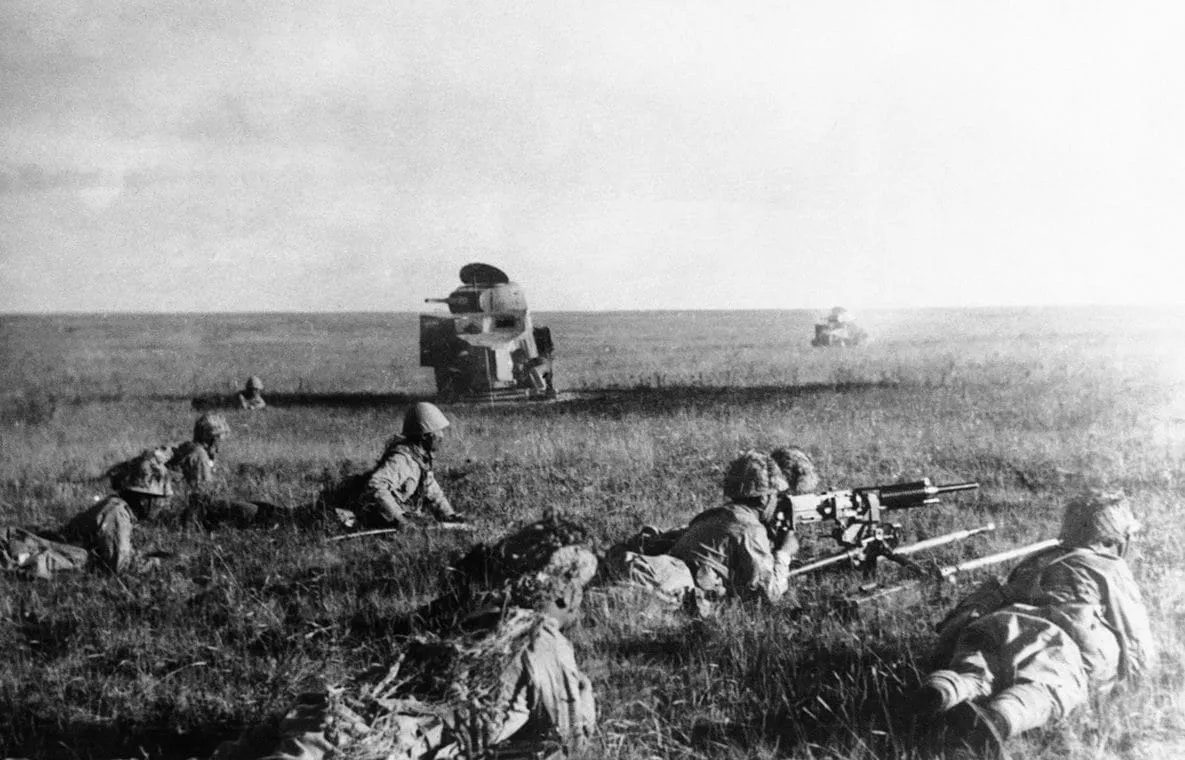
The Battle of Khalkhin Gol was an undeclared war fought on the steppe of eastern Mongolia from May to September 1939 between the Red Army and the army of the Mongolian People’s Republic on one side and the Japanese Kwantung Army and the forces of Manchukuo on the other. It began as a skirmish between a few dozen horsemen over a strip of pasture about twenty kilometres wide, between the Khalkhin Gol river and the Nomonhan-Burd-Obo mound. It ended in a battle in which tens of thousands of soldiers and hundreds of tanks and aircraft fought on both sides, and the Japanese 23rd Infantry Division ceased to exist as a fighting unit. For Komdiv Georgy Zhukov it was his first great victory. For Japan it was the heaviest defeat on land since the creation of its modern army, and a lesson that influenced its choice of direction for further expansion. The last shots were fired on 16 September 1939, the day before the Red Army entered Poland.
Name and dates
In Japan the fighting was called the “Nomonhan incident” (Nomonhan jiken), after the border mound that the Japanese regarded as a point on the Mongolian side and the Mongolians as a border marker. In the USSR and in Russia people speak of the “battles on the Khalkhin Gol”, and in Mongolia of the Khalkhin Gol war. Officially neither side declared war, and both treated the clash as a border conflict, although some Japanese historians openly call it the “second Russo-Japanese War”.
The starting date is taken to be 11 May 1939, the day of the clash between Mongolian border guards and Manchukuo cavalry, which Soviet and Japanese historiography regard as the beginning of the conflict. Earlier exchanges of fire in the area, from January to early May, were still border incidents. The end is taken to be 16 September, when the ceasefire agreed in Moscow the day before came into force. The main fighting on land ended on 31 August, but skirmishes on the border and air battles continued until mid-September.
Background
The border between Khalkha (present-day Mongolia) and Barga, a steppe region around Lake Hulun and Lake Buir, had been drawn by the authorities of the Qing Empire in the 18th century. It ran along a ridge some fifteen to twenty-odd kilometres east of the Khalkhin Gol. After the Mukden incident and the conquest of Manchuria, Barga became part of Manchukuo, and the Japanese, citing certain maps from the early 20th century, held that the border was the river itself. Mongolia, from 1924 a people’s republic wholly dependent on Moscow, kept to the old line. Talks on demarcation held in Manchuria in 1935–1937 produced no result, and every year dozens, and later hundreds, of incidents took place on the border.
On 12 March 1936 the USSR and Mongolia signed a protocol of mutual assistance. From 1937 the Soviet 57th Special Corps was stationed in Mongolia, and the country was going through a Mongolian version of the Great Purge, imposed by Moscow, in which power became concentrated in the hands of Marshal Khorloogiin Choibalsan. Japan had been a party to the Anti-Comintern Pact since 1936 and, since July 1937 and the Marco Polo Bridge incident, had been waging war in China. For the Japanese, Mongolia was a Soviet wedge driven between Manchukuo and Mengjiang, which they controlled. For Moscow it was a shield for Lake Baikal and the Trans-Siberian Railway.
In the summer of 1938 the Japanese Korea Army fought the Red Army at Lake Khasan. Tokyo ended the fighting with a truce, which the Kwantung Army staff saw as a sign of weakness. In April 1939 the commander of the Kwantung Army, General Kenkichi Ueda, issued the “Principles for the Settlement of Border Disputes between Manchukuo and the USSR”, written by Major Masanobu Tsuji of the operations staff. Where the border was not clearly demarcated, the local defence commander was to determine it “on his own initiative”, and in the event of a clash the troops were to win “regardless of the strength of the forces and the course of the border”, even if this required a temporary incursion into the enemy’s territory. The General Staff in Tokyo received the document but took no position on it. The Khalkhin Gol sector belonged to the 23rd Infantry Division from Hailar, a unit formed in 1938, made up largely of reservists and less well armed than the regular divisions. It was commanded by Lieutenant General Michitarō Komatsubara, a former military attaché in Moscow.
At the same time both states were reorienting their foreign policy. From April the USSR was conducting talks with Britain and France, initiated by the Soviet proposal of an alliance, while also cautiously sounding out Germany. In Tokyo the government of Kiichirō Hiranuma was divided over turning the Anti-Comintern Pact into a military alliance with Germany and Italy, and the War Minister, Seishirō Itagaki, was one of its chief advocates.
Forces and commanders
On the Japanese side the fighting was done above all by Komatsubara’s 23rd Division, reinforced from July by regiments of the 7th Division, by Lieutenant General Masaomi Yasuoka’s 1st Tank Group (two tank regiments), by heavy artillery brought in from all over Manchuria and by Manchukuo cavalry, made up mainly of Barga Mongols. The Kwantung Army’s air force, with its modern Nakajima Ki-27 fighters, was clearly superior to the Soviet air force in the first weeks. On 4 August the Sixth Army under Lieutenant General Rippei Ogisu was formed to direct the fighting, subordinated to General Ueda’s Kwantung Army. Officers of the Kwantung Army staff had a great influence on decisions, especially Tsuji and Lieutenant Colonel Takushirō Hattori, who travelled to the front and issued instructions in the name of the command.
On the Soviet–Mongolian side, the forces initially consisted of the 57th Special Corps under Komdiv Nikolai Feklenko (PL) and the Mongolian 6th and 8th Cavalry Divisions. In June Zhukov took over command of the corps, and on 19 July the corps was converted into the 1st Army Group. Zhukov’s deputy for Mongolian troops was Corps Commissar Jamyangiin Lkhagvasüren, while overall authority over the Mongolian army rested with Choibalsan. The group’s chief of staff was Kombrig Mikhail Bogdanov (PL), and the air force was commanded by Komkor Yakov Smushkevich. From July the whole operation was overseen by Komandarm 2nd Rank Grigory Shtern, commander of the Front Group in Chita, who was responsible above all for supplies and reserves. Relations between him and Zhukov were tense, and in his memoirs Zhukov played down Shtern’s role.
The greatest problem for both sides was supply. The battlefield lay several hundred kilometres from the nearest railway stations. The Japanese were closer to their railheads but were short of lorries. Soviet supplies came along the Trans-Siberian Railway and then, from a station in the USSR, by lorry across Mongolia – a distance of between about 600 and more than 700 km according to various calculations. According to Soviet figures, in August more than 4,000 lorries and several hundred tankers were running along this route.
Course of events: May
On 11 May Manchukuo cavalry clashed with Mongolian border guards on the eastern bank of the river. According to the Japanese version, they drove back across the river a detachment of about 70–90 Mongolians who had crossed it in search of pasture; according to the Mongolian and Soviet version, it was a Japanese–Manchurian detachment that attacked a Mongolian outpost and was repulsed. On 12 and 13 May the Mongolians returned in greater strength. Komatsubara sent Lieutenant Colonel Yaozō Azuma’s reconnaissance unit with two infantry companies to the river. When it arrived on 15 May there were no Mongolians on the eastern bank, and Azuma turned back. That same day Japanese bombers attacked a Mongolian encampment on the western bank.
Feklenko sent a motorised detachment with armoured cars and artillery to the Khalkhin Gol, and it was joined by the Mongolian 6th Cavalry Division. On 28 May a force under Colonel Takemitsu Yamagata, some 2,000 Japanese and several hundred Manchurian cavalrymen, attacked the Soviet–Mongolian forces on the eastern bank in order to encircle them and cut them off from the crossings. Azuma’s unit broke through to the enemy’s rear, but the rest of the force got bogged down. For two days the cut-off unit was shelled by artillery from the high western bank and attacked by armoured cars and flamethrower tanks. On 29 May Azuma was killed and his unit was almost completely destroyed. Both sides withdrew and both proclaimed victory; the Kwantung Army staff, concealing the annihilation of Azuma’s unit, reported a success to Tokyo. According to Soviet figures, the Red Army lost 138 killed and missing and 198 wounded in the May fighting, while the Japanese, by their own figures, lost about 160 killed.
From 22 May an air war was also being fought over the steppe. In the first engagements Japanese pilots shot down a dozen or more Soviet fighters while losing only the odd machine. On 29 May Moscow sent a group of several dozen experienced airmen to Mongolia, many of them veterans of Spain and China, headed by Smushkevich.
Course of events: June
The setbacks of May prompted the People’s Commissar for Defence, Kliment Voroshilov, to send Komdiv Zhukov, deputy commander of the Belorussian Special Military District, on an inspection. Zhukov arrived at corps headquarters on 5 June, judged Feklenko’s command harshly and soon took his place (the order is dated 12 June). He moved his headquarters closer to the front, held on to the bridgehead on the eastern bank and began bringing in tanks, artillery and armoured cars from the interior of the USSR. Some historians stress that the plan for an active defence of the bridgehead and a subsequent counter-stroke was prepared by his chief of staff, Bogdanov.
In the second half of June the air war resumed on a large scale. Smushkevich’s airmen, flying improved I-16 fighters and, from July, I-153s as well, gradually made up their losses, and in the battles of 22–26 June each side shot down several dozen aircraft; the figures of each side greatly exaggerate the enemy’s losses. On 27 June the Kwantung Army’s air force, on Tsuji’s plan and without Tokyo’s consent, bombed Soviet airfields deep inside Mongolia, including the base near Tamsag-Bulag, destroying 22 aircraft according to Soviet sources. The General Staff sharply rebuked the Kwantung Army and forbade any further raids on the enemy’s rear. On 26 June the TASS agency reported the fighting officially for the first time.
Course of events: July
At the beginning of July the Kwantung Army carried out an operation that was meant to end the conflict. The plan envisaged a two-pronged attack. A force under Major General Kōichi Kobayashi (two regiments of the 23rd Division and Colonel Shin’ichirō Sumi’s 26th Regiment of the 7th Division) was to cross the Khalkhin Gol at night, seize Bain-Tsagan hill on the western bank and strike south into the Soviet rear. Yasuoka’s Tank Group, with nearly 90 tanks and tankettes, was meanwhile to destroy the Soviet forces on the eastern bank.
On the evening of 2 July Yasuoka’s tanks attacked on the eastern bank. In a night attack they inflicted heavy losses on the Soviet infantry but failed to break through the defences, and over the following days they lost vehicles to the fire of Soviet 45 mm anti-tank guns. During the night of 2–3 July Kobayashi’s troops crossed the river by the only pontoon bridge and took Bain-Tsagan in the morning. Zhukov, without waiting for the infantry, threw into a counter-attack straight from the march Kombrig Mikhail Yakovlev’s 11th Tank Brigade, the 7th Motorised Armoured Brigade, a Mongolian armoured battalion and then Colonel Ivan Fedyuninsky’s 24th Motorised Regiment. He did so against regulations and against Shtern’s opinion, and a denunciation was sent to Moscow claiming that he had thrown tanks into battle without reconnaissance. Tank attacks without infantry cost the Soviets dearly: the Japanese infantry destroyed the tanks with 37 mm anti-tank guns, mines and bottles of petrol, and according to Japanese figures the Soviet side lost several dozen tanks and armoured cars on 3 July. The Japanese, however, had nothing with which to hold the ground they had taken. Without tanks, with a single bridge and under artillery fire from the entire western bank, Kobayashi was ordered to withdraw. During the night of 4–5 July and on the morning of 5 July his troops pulled back across the river, and the bridge was blown up. Soviet propaganda called the fighting for Bain-Tsagan the “Bain-Tsagan rout”, and the figures it gave of well over ten thousand Japanese killed are exaggerated many times over. From then on the Japanese made no further attempt to cross to the western bank.
Yasuoka’s Tank Group, which had lost about half of its tanks (some of which were later repaired), was withdrawn from the front around 9–10 July and its commander was recalled. The Japanese army did not want to risk losing its few tanks. From 7 to 12 July Komatsubara’s infantry made night attacks on the eastern bank, which pushed the Soviets back towards the river but did not eliminate the bridgehead. On 23 July the Japanese launched a new attack, supported by heavy artillery brought in from Manchuria and from Japan. After two days of an artillery duel, in which the Japanese used up a large part of their ammunition stocks and the Soviet guns on the higher western bank proved more numerous and better concealed, the attack was called off on 25 July. By the end of July the Japanese had lost more than 5,000 killed and wounded since the fighting began.
In July two visitors arrived at Zhukov’s headquarters from Moscow: the Deputy People’s Commissar for Defence, Grigory Kulik, who tried to interfere in the conduct of operations and was recalled, and later the head of the Red Army’s Political Directorate, Lev Mekhlis, who a year earlier at Lake Khasan had helped to bring down Marshal Blyukher. This time Zhukov kept his post.
Preparations for the August offensive
After the failure of the July attacks the Kwantung Army decided to hold out on the eastern bank until winter. The Japanese positions stretched for several dozen kilometres, with exposed flanks, and by 20 August only part of the fortifications had been completed. Ogisu’s Sixth Army planned a new attack for 24 August. Meanwhile the Soviets, free from the fear that Japan would extend the war to other sectors of the border, were bringing selected units from all over the country to the Khalkhin Gol, including the 82nd and 57th Rifle Divisions and the 6th Tank Brigade.
Zhukov prepared his blow in strict secrecy. Troops moved only at night. Loudspeakers imitated the sounds of tanks and engineering work until the Japanese stopped reacting to them. Radio stations broadcast false reports, in an easily broken cipher, about the building of fortifications and preparations for winter. According to Soviet figures, before the offensive the 1st Army Group numbered about 57,000 men, 498 tanks, 385 armoured cars, 542 guns and mortars and 515 aircraft. Soviet historiography credited the Sixth Army with more than 75,000 men, but that was the figure for the whole army, including units far in the rear. In the combat zone itself the Japanese had the 23rd Division with attached units – according to Alvin D. Coox, author of the standard monograph on the battle, a force not much larger than a single division. Soviet superiority in tanks, artillery and aircraft was manifold. Japanese forward posts reported on 17–19 August that troops and vehicles were moving on the other side, but the staffs of the Sixth Army and the 23rd Division drew no conclusions from this.
The plan was to pin the Japanese down in the centre and strike both flanks with strong armoured and motorised groups. The Southern Group under Colonel Mikhail Potapov was to deliver the main blow, the Northern Group under Colonel Ivan Alekseyenko a supporting attack, and the Central Group under Kombrig Dmitry Petrov was to pin the enemy down on the front. The two flanks were to meet in the Nomonhan area, on the border line recognised by Mongolia, trapping the Japanese in a pocket between the border and the river. Moscow forbade any crossing of that line.
Course of events: the offensive of 20–31 August
20 August 1939 was a Sunday. At dawn (Zhukov gave the time in his memoirs as 5.45 a.m., Japanese and some Russian sources as 6.15 a.m.) the Soviet air force – more than 150 bombers escorted by about a hundred fighters – and the artillery attacked the Japanese positions, and at around 9 a.m. the ground forces moved off. The attack took the Sixth Army command completely by surprise, and for the whole of the first day it was unable to establish the direction of the main thrust. On the flanks the Manchukuo cavalry scattered, and the Soviet armoured columns advanced rapidly into the Japanese rear. In the centre, where the Japanese fortifications were strongest, the advance on the first day amounted to a few hundred metres.
The Japanese defended themselves with tremendous ferocity. Lieutenant Colonel Eiichi Ioki’s reconnaissance unit, about 800 men, held the Fui heights on the northern edge of the front for four days, tying down much stronger forces. On 24 August, out of water and ammunition, Ioki on his own decision led the survivors out of the encirclement, which was almost unprecedented in the Japanese army. In the south, around Noro hill, units of the 71st Regiment and border guards fought until they were wiped out. Zhukov had to commit his reserves, including the 9th Motorised Armoured Brigade and the 212th Airborne Brigade.
The Japanese command understood too late what was happening. A dispute between Komatsubara and the Sixth Army staff over how to counter-attack took up the whole of 21 August. A relief attack made on 24 and 25 August from the Manchukuo side by units of the 7th and 23rd Divisions broke against the Soviet Southern Group. On 25–26 August the Soviet flanks met in the Nomonhan area, trapping the main forces of the 23rd Division on the eastern bank of the Khalkhin Gol, around the hills on both sides of the small Khailastyn Gol river (Japanese: Holsten). Over the following days artillery, aircraft, tanks and infantry destroyed the encircled units one after another. The Japanese infantry often fought to the last man; years later Zhukov wrote that bunkers were taken only when there was no one left alive in them. Several regimental commanders were killed or committed suicide on the battlefield, among them Colonel Yamagata. During the night of 30–31 August Komatsubara broke out to the Manchukuo side with the remnants of his staff and about four hundred soldiers. By the morning of 31 August the area that Mongolia regarded as its own was clear of Japanese troops.
September and the ceasefire
The Kwantung Army had no intention of admitting defeat. General Ueda began bringing further divisions up to the border and planned a new offensive for September with forces several times larger than before. The political context, however, had changed completely. On 23 August Germany and the USSR concluded the Molotov–Ribbentrop Pact, which was received in Tokyo as a betrayal: at the very moment when the Japanese army was fighting the Red Army, its partner in the Anti-Comintern Pact had come to terms with Moscow. Joachim von Ribbentrop did offer the Japanese ambassador in Berlin, Hiroshi Ōshima, German mediation in the Nomonhan dispute, but this did not alter the fact that the talks on a German–Japanese alliance had become pointless. The Hiranuma government resigned on 28 August, the prime minister declaring that a “complicated and baffling” situation had arisen in Europe. The new cabinet of General Nobuyuki Abe wanted to end the conflict with the USSR as quickly as possible and to stay out of the war in Europe.
At the turn of August and September Imperial General Headquarters, acting in the name of Emperor Hirohito, ordered the Kwantung Army to halt offensive operations, and when Ueda dragged his feet, it repeated the order in a form that could not be evaded. On 7 September Ueda and his chief of staff were recalled; General Yoshijirō Umezu became the new commander of the Kwantung Army. Tsuji and Hattori were transferred. Clashes continued on the border – according to Soviet figures, on 4 and 8 September the Japanese tried in vain to seize hills on the Mongolian side – and on 15 September one of the largest air battles of the whole conflict took place over the front.
The ceasefire talks were conducted in Moscow by Ambassador Shigenori Tōgō and Vyacheslav Molotov, who since May had been People’s Commissar for Foreign Affairs in place of Maxim Litvinov. Tōgō initially demanded a return to the situation before May, Molotov a withdrawal of the Japanese behind the line recognised by Mongolia. On 15 September it was agreed that the troops would stop where they stood and that the border would later be fixed by a mixed commission. The ceasefire came into force in the afternoon of 16 September (the time most often given is 1.10 p.m.). The next day, 17 September 1939, the Red Army crossed Poland’s eastern border. Joseph Stalin struck in the west only once he had peace in the Far East.
Losses
Figures for the losses vary considerably. According to the Russian compilation edited by Grigory Krivosheyev (2001 edition), the Red Army lost 9,703 killed, died of wounds and missing, 15,251 wounded and 701 sick, a total of more than 25,600 men; some researchers consider the number of sick to be understated. Mongolian losses are estimated at about 550–990 killed and wounded. According to the figures of the Japanese Sixth Army’s medical service, the Japanese lost 7,696 killed, 8,647 wounded, 1,021 missing and 2,350 sick, a total of about 19,700 men; other Kwantung Army figures speak of 8,629 killed and 9,087 wounded. Zhukov reported 52,000–55,000 Japanese killed and wounded, and official Soviet figures even spoke of more than 60,000; these numbers are greatly exaggerated. The 23rd Division lost more than 70 per cent of its strength. Several hundred Japanese and Manchukuo soldiers were taken prisoner.
The Soviet side suffered irrecoverable losses of about 250 tanks, mostly light BT tanks, and more than 130 armoured cars, most of them to anti-tank gunfire. Aircraft losses amounted to about 250 machines according to Soviet figures, including 207–208 in combat, and to about 160 according to Japanese figures. Each side claimed to have shot down several hundred enemy aircraft.
Significance
The USSR and Mongolia achieved their aim: Japanese troops were driven out of the area that Mongolia regarded as its own. The border commission met in Chita and Harbin from November 1939 to January 1940 without result, and the border was finally demarcated only in 1941–1942, for the most part along the Mongolian line, although on some sections to Manchukuo’s advantage. Zhukov received the title of Hero of the Soviet Union, in 1940 took command of the Kiev Special Military District, and in 1941 became Chief of the General Staff. He used the same method – pinning the enemy down in the centre, secretly concentrating armoured forces and striking at the flanks – at Stalingrad in 1942 in Operation Uranus. Shtern and Smushkevich, who had also been made Heroes of the Soviet Union, were arrested by the NKVD in June 1941 and shot without trial on 28 October 1941. The battle also exposed weaknesses in the Red Army that would become fully apparent two years later: Soviet losses exceeded Japanese ones despite a huge superiority in equipment.
In Japan the blame was laid on the front-line commanders. Komatsubara was placed on the reserve list in January 1940 and died of cancer that autumn. Several officers who had survived or withdrawn without orders, Ioki among them, were forced to commit suicide; soldiers returning from captivity were court-martialled or sent to remote garrisons. The staff officers who had unleashed the conflict suffered few consequences. In 1941 Tsuji was among the most zealous advocates of war with the United States, and Hattori headed the Operations Section of the General Staff. The Japanese commission that investigated the fighting pointed to the enemy’s superiority in firepower and equipment, but the army continued to believe that fighting spirit and the bayonet charge could make up for inferior weaponry.
It is often stressed that the defeat led Japan to abandon its conflict with the USSR and to turn towards the possessions of the Western powers in the Pacific. This is largely true, but it needs qualifying. The defeat at Khalkhin Gol, coinciding with the German–Soviet pact, undermined in Tokyo the “Strike North” concept (hokushin-ron), long favoured by the army. The turn to the south (nanshin-ron), advocated by the navy, was, however, also decided by other factors: the protracted war in China; the defeats of France and the Netherlands in 1940, which opened the way to French Indochina and the Dutch East Indies; and above all oil, which Japan did not have. In April 1941 the Foreign Minister, Yōsuke Matsuoka, signed a neutrality pact in Moscow. When Germany invaded the USSR in June 1941, the Japanese army concentrated large forces in Manchuria and was ready to strike if the Soviet Union began to collapse, but the experience of Nomonhan told it to wait for a clear defeat of the Red Army, which never came. Japan chose war in the south and in December 1941 attacked Pearl Harbor and the British and Dutch colonies. Moscow, warned among others by its agent in Tokyo, Richard Sorge, was able in the autumn of 1941 to transfer some of its Far Eastern troops to the defence of Moscow, although it kept a strong army on the Manchurian border until the end of the war. The two sides kept the peace until August 1945, when the USSR declared war on Japan and occupied Manchuria. Before the International Military Tribunal for the Far East, Itagaki and Hiranuma were found guilty also in connection with the war of aggression at Khalkhin Gol.